
5 Deadly UPSC Mains Answer Writing Mistakes That Cost You Marks — With Before & After Examples
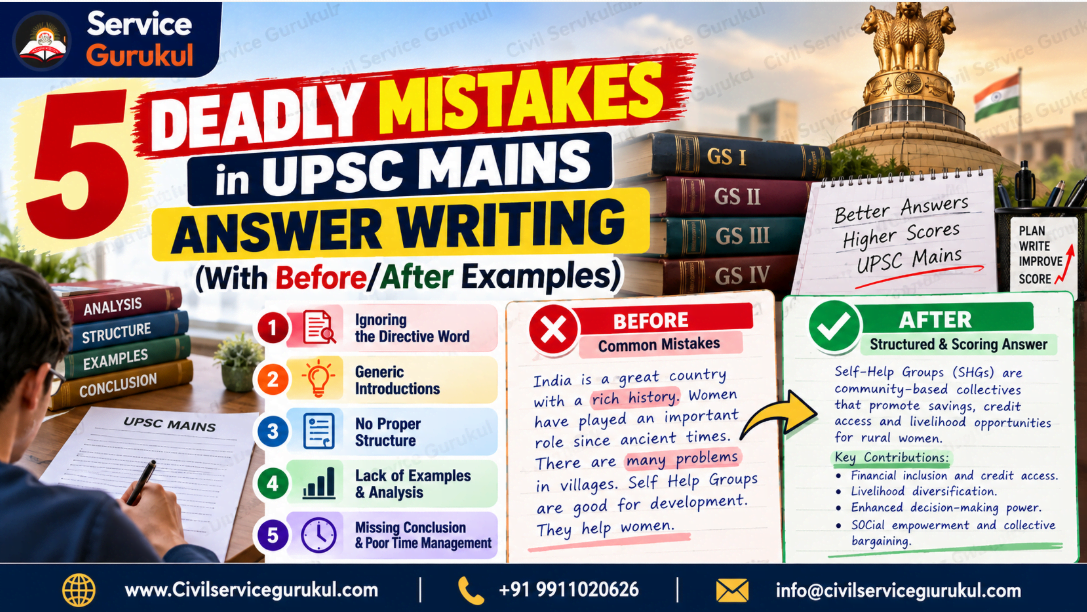
UPSC MAINS STRATEGY ANSWER WRITING GS PAPERS I–IV
5 Deadly UPSC Mains Answer Writing Mistakes That Cost You Marks
Before & After Examples | Examiner-Focused Corrections | Model Answer Frameworks | Practical Improvement Strategies
1. Why Good Knowledge Does Not Always Produce Good Mains Marks
Many UPSC aspirants study standard books, attend classes, prepare notes and revise current affairs regularly. Yet their Mains answers may fail to communicate their knowledge effectively.
The reason is that knowing the answer and writing an effective exam answer are different skills.
UPSC Mains demands relevance, conceptual clarity, analysis, balanced arguments, structured presentation and time management.
Below are five major answer-writing mistakes, each explained with realistic weak and improved sample answers.
Mistake 1: Ignoring the Directive Word
UPSC questions use directive words such as Discuss, Analyse, Examine, Critically Examine, Evaluate and Comment.
A candidate who ignores the directive may write a descriptive answer when analysis is required.
"Critically examine the role of Non-Governmental Organisations in improving public service delivery in India."
Word Limit: 150 words
✘ BEFORE: Weak Answer
NGOs are non-governmental organisations working for the development of society.
They work in education, health, sanitation, women empowerment and rural development.
NGOs are very important and always help society.
They do many good things for poor people.
The government should support NGOs because they are useful for development.
✔ AFTER: Improved Answer
NGOs complement public service delivery by reaching underserved communities and mobilising local participation.
Positive Contributions:
- Last-mile delivery: Support in health, education and sanitation.
- Community participation: Mobilisation of marginalised groups.
- Innovation: Context-specific, low-cost solutions.
Limitations:
- Uneven institutional capacity.
- Funding dependence.
- Accountability and transparency concerns.
Way Forward: Transparent partnerships, capacity building and outcome-based monitoring can strengthen NGO contributions.
- The weak answer described NGOs but did not critically examine their role.
- It contained unsupported absolute statements such as "always help society."
- It ignored limitations.
- It lacked a balanced judgment.
It presents benefits, limitations and a reasoned way forward, directly satisfying the directive "critically examine."
Mistake 2: Writing Generic Introductions and Irrelevant Background
A long introduction can consume valuable time and words without answering the actual question.
"Explain how Self-Help Groups contribute to women's economic empowerment in rural India."
Word Limit: 150 words
✘ BEFORE: Weak Answer
India is a great country with a very long history.
Women have played an important role since ancient times.
The country has many villages and many problems.
SHGs are important for development. They help women.
✔ AFTER: Improved Answer
Self-Help Groups are community-based collectives that promote savings, credit access and livelihood opportunities, especially among rural women.
Economic Contributions:
- Financial inclusion through savings and group-based credit.
- Promotion of microenterprises and livelihood activities.
- Improved financial decision-making.
- Collective bargaining and market participation.
Example: DAY-NRLM supports women's SHGs and livelihood development.
Conclusion: SHGs can strengthen women's economic agency when supported by skills, markets and affordable finance.
- Generic statements about India's history.
- Unnecessary background about women in ancient times.
- Failure to define SHGs at the beginning.
- Lack of specific economic mechanisms.
The revised introduction defines the concept and immediately connects it to the question.
Mistake 3: Writing Paragraphs Without Structure
Even accurate content becomes difficult to evaluate when presented as one long paragraph.
"Discuss the major causes of urban flooding in India and suggest suitable mitigation measures."
Word Limit: 150 words
✘ BEFORE: Weak Answer
Urban flooding happens because of heavy rainfall and there is a lot of construction and cities have many roads and sometimes drains do not work and rivers overflow and people throw garbage and many houses are damaged and the government should take action and make better plans and people should be aware and flooding should be prevented.
✔ AFTER: Improved Answer
Urban flooding occurs when intense rainfall overwhelms urban drainage and natural water-absorption systems.
Major Causes:
- Unplanned urbanisation and encroachment on floodplains.
- Loss of wetlands and permeable surfaces.
- Inadequate and poorly maintained drains.
- Intense rainfall and climate variability.
Mitigation Measures:
- Restore wetlands and urban lakes.
- Upgrade stormwater drainage.
- Protect natural drainage channels.
- Improve early-warning systems.
- Adopt risk-sensitive urban planning.
Conclusion: Integrated urban planning and ecosystem restoration are essential for reducing flood risk.
- No clear introduction.
- No distinction between causes and solutions.
- Repetitive and unorganised content.
- Important concepts are hidden in prose.
- Conclusion is vague.
It separates causes from solutions, uses meaningful headings and communicates the same subject more clearly.
Mistake 4: Making Claims Without Evidence, Examples or Analysis
Broad statements such as "technology is beneficial" or "education is important" do not demonstrate adequate analytical depth.
"Evaluate the role of digital governance in improving transparency and public service delivery."
Word Limit: 150 words
✘ BEFORE: Weak Answer
Digital governance is very good for India.
It solves all government problems.
Technology makes everything transparent.
All departments should become digital.
✔ AFTER: Improved Answer
Digital governance can improve service delivery by reducing information gaps, enabling tracking and standardising administrative processes.
Major Contributions:
- Direct Benefit Transfer: Can reduce intermediaries and improve traceability.
- Online grievance systems: Enable complaint registration and status tracking.
- Digital public services: Reduce repeated physical visits.
Challenges: Digital exclusion, privacy risks, cybersecurity threats and weak grievance redressal.
Conclusion: Digital governance works best with offline alternatives, data protection and accountable institutions.
- Unsupported generalisations.
- Absolute claims such as "solves all problems."
- No relevant examples.
- No evaluation of limitations.
- No practical recommendation.
The revised answer connects claims to recognisable mechanisms and examples while acknowledging limitations.
Mistake 5: Missing the Conclusion and Mismanaging Time
Some aspirants spend too long on initial answers and rush through the remaining questions.
Others end answers abruptly without a final judgment or way forward.
"Discuss the challenges of renewable energy adoption in India and suggest a way forward."
Word Limit: 150 words
✘ BEFORE: Weak Answer
Renewable energy is important for India. Solar and wind energy reduce pollution.
There are problems such as cost, land and technology.
The government should take steps.
Answer ends without specific solutions, a clear conclusion or adequate discussion.
✔ AFTER: Improved Answer
Renewable energy supports India's energy security and decarbonisation goals.
Major Challenges:
- Intermittency of solar and wind generation.
- Grid integration and storage costs.
- Land availability and transmission constraints.
- Financial stress in distribution companies.
Way Forward:
- Expand energy storage systems.
- Modernise transmission networks.
- Improve distribution-sector finances.
- Promote decentralised renewable energy.
Conclusion: A reliable renewable-energy transition requires investment in storage, modern grids and financially sustainable electricity distribution.
- Very limited coverage of challenges.
- Vague recommendation.
- No meaningful conclusion.
- No specific policy direction.
It responds to both parts of the question and closes with a clear, feasible policy direction.
6. Summary: Five Mistakes and Their Corrections
| Mistake | What to Avoid | What to Do Instead |
|---|---|---|
| Ignoring Directive | Writing only descriptive information | Respond directly to Discuss, Analyse, Evaluate, etc. |
| Generic Introduction | Unnecessary history and background | Start with a relevant definition or context |
| Poor Structure | Long, unorganised paragraphs | Use clear headings and logical points |
| Unsupported Claims | Vague statements and exaggeration | Use mechanisms, examples and balanced analysis |
| Weak Ending and Timing | Abrupt conclusions and excessive time per answer | Give a specific conclusion and practise timed writing |
7. The Civil Service Gurukul Answer-Writing Framework
↓
IDENTIFY THE DIRECTIVE
↓
BREAK INTO DEMANDS
↓
PLAN KEY POINTS
↓
WRITE A RELEVANT INTRODUCTION
↓
PRESENT STRUCTURED ANALYSIS
↓
ADD EXAMPLES
↓
CONCLUDE WITH JUDGMENT OR WAY FORWARD
For a 150-Word Answer
Introduction
Approximately 20–25 words
Body
Approximately 100–110 words
Conclusion
Approximately 15–25 words
These are flexible practice guidelines, not official UPSC word-allocation rules.
Directive Words: Quick Guide
| Directive | What the Examiner Expects |
|---|---|
| Discuss | Explain relevant dimensions with balanced coverage. |
| Analyse | Break the issue into parts and explain relationships. |
| Examine | Investigate the issue using evidence and reasoning. |
| Critically Examine | Assess strengths, weaknesses and reach a judgment. |
| Evaluate | Assess merit, impact and limitations against criteria. |
| Comment | Offer a reasoned and substantiated opinion. |
| Explain | Clarify causes, processes or mechanisms. |
8. Time Management for UPSC Mains
A conventional GS paper has 20 questions to be answered within 180 minutes.
That gives an average of nine minutes per question, although candidates may distribute time according to question length and difficulty.
10-Mark Question
Practice target: about 7 minutes.
15-Mark Question
Practice target: about 11 minutes.
Final Check
Reserve time for question numbering, legibility and completeness.
9. Self-Evaluation Checklist for Every Answer
- Did I identify the directive word correctly?
- Did I address every part of the question?
- Is my introduction directly relevant?
- Are my arguments logically structured?
- Did I use appropriate headings?
- Did I provide examples where useful?
- Did I avoid unsupported absolute claims?
- Did I include necessary counterarguments?
- Is the conclusion specific and relevant?
- Did I remain close to the word and time limits?
10. Practice Exercise for Enrolled Aspirants
Rewrite the following weak answers using the correction methods explained above.
Exercise 1: Governance
Question: "Examine the challenges of implementing e-governance in rural India."
Weak Answer:
"Technology is very important for India. E-governance is good. Villages have problems. Government should make everything digital."
Your Task: Write a structured 150-word answer covering infrastructure, literacy, language, accessibility, privacy and practical solutions.
Exercise 2: Social Justice
Question: "Discuss the role of education in women's empowerment."
Weak Answer:
"Women are very important. Education is good for everyone. India should educate all women."
Your Task: Explain the pathways through which education affects employment, health, agency and social participation.
Exercise 3: Environment
Question: "Critically analyse the potential of electric vehicles in reducing urban pollution."
Weak Answer:
"Electric vehicles are completely pollution-free. They will solve all pollution problems in India."
Your Task: Include tailpipe emissions, electricity generation, battery lifecycle, costs and charging infrastructure.
11. How to Improve Through Regular Practice
Improvement in Mains answer writing requires a repeatable process.
- Write answers under realistic time limits.
- Compare them with a question-demand checklist.
- Identify two or three specific weaknesses.
- Rewrite the same answer after receiving feedback.
- Review progress over multiple practice sessions.
12. Final Conclusion
UPSC Mains answer writing is not a competition to reproduce the maximum amount of information.
It is the ability to present relevant, accurate and balanced arguments within limited time and space.
By correcting five common mistakes— misreading directives, generic introductions, poor structure, unsupported claims and weak conclusions— aspirants can improve the quality and consistency of their answers.
Improve Your UPSC Mains Answer Writing
Civil Service Gurukul
UPSC & State PCS Preparation
Answer Writing |
Mentorship |
Current Affairs |
GS Foundation
Prepare with Mentors Who Cleared the Exam
Get personalized study plans, evaluated answer models, and test series access.