
US Strikes on Venezuela 2026: UPSC Notes & Analysis
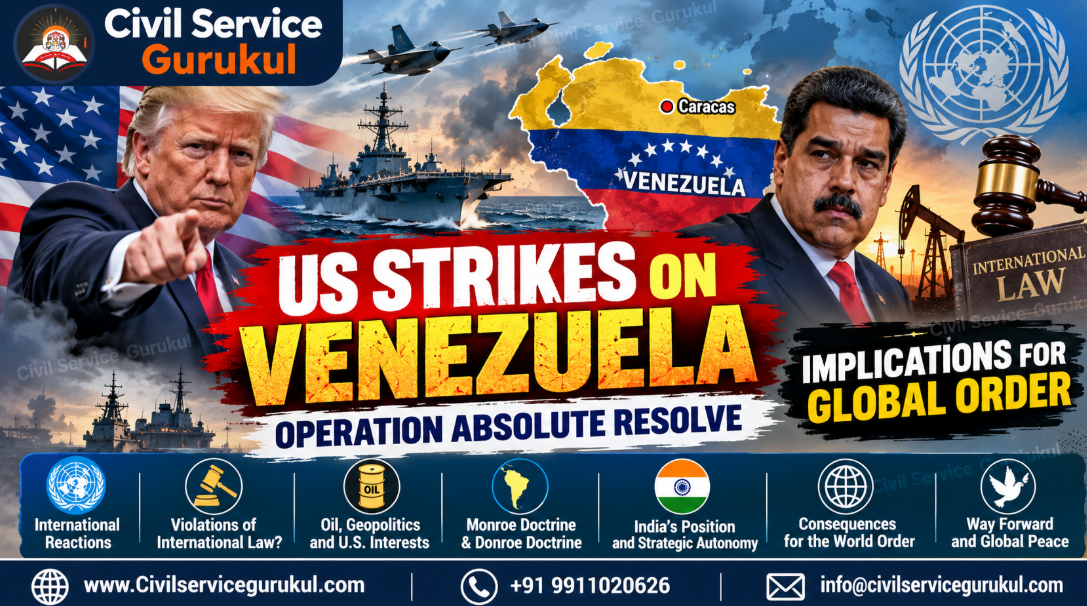
UPSC CURRENT AFFAIRS 2026 GS PAPER II INTERNATIONAL RELATIONS
US–Venezuela Crisis 2026: Operation Absolute Resolve and the Challenge to Global Order
International law, national sovereignty, the Monroe Doctrine, geopolitical rivalry, India's foreign policy and UPSC preparation.
1. Why Is Venezuela in the News?
On 3 January 2026, the United States conducted a military operation in Venezuela, known as Operation Absolute Resolve, during which Venezuelan President Nicolás Maduro was captured and transferred to the United States.
The operation involved US military activity in Caracas and surrounding areas. It triggered major international debate over sovereignty, the use of force, international law and the future of the global order.
2. Key International Reactions
A. United Nations
The UN Secretary-General expressed deep alarm about the military action, warning of its consequences for regional stability and international law.
The United Nations stressed the importance of respecting the UN Charter, human rights, the rule of law and inclusive dialogue.
B. UN Human Rights Concerns
The source material reports that UN human rights officials rejected the argument that allegations of human rights violations alone could justify unilateral military action.
The broader legal issue is whether human rights concerns can override the prohibition on the use of force without a recognised legal basis.
C. Countries Critical of the Operation
Russia and China criticised the operation. Several Latin American governments, including Brazil, Colombia, Mexico, Chile, Panama and Cuba, expressed concerns or objections, although their individual positions differed.
D. Countries Supporting the Operation
According to the supplied material, Argentina, Paraguay and Israel welcomed aspects of the US action, particularly in connection with narcotics trafficking and security.
E. European Response
European governments sought to balance concern about Venezuela's political situation with support for international law and diplomatic solutions.
F. India's Response
India expressed deep concern and emphasised peaceful dialogue, regional stability and respect for international norms.
3. Why Did the United States Strike Venezuela?
The following explanations should be separated into official US claims, political arguments and geopolitical interpretations.
A. Official US Justifications
The US administration linked its actions to allegations involving:
- Drug trafficking and narco-terrorism.
- Transnational organised crime.
- Threats to US and regional security.
- Criminal charges against Maduro.
These are US allegations and justifications, not an independent legal determination that the use of military force was lawful.
B. Political Legitimacy
The US questioned Maduro's legitimacy following Venezuela's disputed 2024 presidential election.
However, disputes over democratic legitimacy do not automatically authorise foreign military intervention.
C. Venezuela's Oil Reserves
Venezuela possesses some of the world's largest proven crude oil reserves, concentrated significantly in the Orinoco Belt.
Analysts have linked US interest in Venezuela to the country's energy resources and their strategic significance.
D. Regional Dominance
Critics interpret the operation as reflecting renewed US efforts to assert influence over the Western Hemisphere.
E. China, Russia and Iran
Venezuela has maintained important relationships with China, Russia and Iran.
Geopolitical interpretations suggest that limiting rival powers' influence in Latin America may be a US strategic objective.
F. Ideological Competition
Venezuela's ruling United Socialist Party has followed a political and economic orientation often at odds with US policy preferences.
4. Monroe Doctrine: Historical Background
The Monroe Doctrine was proclaimed in 1823 by US President James Monroe.
It was originally directed against further European colonisation and intervention in the Americas.
Three Main Principles
- Non-colonisation: European powers should not establish new colonies in the Americas.
- Non-intervention: European powers should not intervene in the affairs of independent American states.
- US non-interference: The United States would generally avoid involvement in European wars and existing colonies.
The doctrine later became associated with broader assertions of US influence in Latin America.
5. What Is the Donroe Doctrine?
The expression "Donroe Doctrine" combines Donald Trump's name with the Monroe Doctrine.
It is a political and media label used to describe an assertive approach to US influence in the Western Hemisphere.
Features Associated with the Term
- Resource interests: Greater attention to strategic energy and mineral resources.
- Regime management: Attempts to shape political outcomes without necessarily replacing all state institutions.
- Coercive diplomacy: Use of sanctions, tariffs, military threats or force.
- Regional influence: Opposition to strategic rivals' expanding presence in the Americas.
| Basis | Monroe Doctrine | Donroe Doctrine |
|---|---|---|
| Origin | 1823 | Contemporary political label |
| Historical Focus | European intervention in the Americas | Assertive US regional influence |
| Primary Concern | Colonisation and external interference | Security, resources and geopolitical rivalry |
| Nature | Historical US foreign-policy doctrine | Interpretive term, not a treaty |
6. International Law and the Use of Force
A. Article 2(4) of the UN Charter
Article 2(4) requires states to refrain from the threat or use of force against the territorial integrity or political independence of another state, or otherwise inconsistently with UN purposes.
B. Article 51: Self-Defence
Article 51 recognises the inherent right of individual or collective self-defence if an armed attack occurs, subject to the Charter framework.
C. Security Council Authorisation
The UN Security Council may authorise measures involving force under Chapter VII when the legal conditions are met.
D. Sovereignty and Non-Intervention
State sovereignty protects territorial independence and the right of states to conduct their affairs without unlawful external coercion.
E. The Legal Debate
The US described its operation through security and law-enforcement arguments, while critics argued that the military action violated Venezuelan sovereignty and international legal norms.
A sound UPSC answer should distinguish these competing claims from an authoritative judicial determination of legality.
7. Consequences for the Global Order
1. Pressure on International Law
Unilateral military interventions may weaken the norm against cross-border use of force.
2. Regional Destabilisation
Military intervention can intensify political uncertainty, displacement and regional insecurity.
The 2003 Iraq invasion is frequently discussed in debates about long-term instability following intervention.
3. Weakened Multilateralism
Actions undertaken outside collective UN mechanisms can raise questions about the effectiveness and authority of multilateral institutions.
4. Great-Power Rivalry
US, Chinese and Russian competition can make regional disputes part of wider geopolitical confrontation.
5. Economic Fragmentation
Sanctions, tariffs, export controls and trade restrictions can reshape supply chains and international investment.
6. Erosion of Sovereignty
Coercive actions by powerful countries may create insecurity among smaller and middle powers.
7. Pressure on Alliances
Disputes involving Greenland, trade policy and regional security can generate tensions between allies.
8. Friend-Shoring, De-Risking and Re-Globalisation
| Concept | Meaning |
|---|---|
| Friend-shoring | Moving supply chains towards politically trusted partners |
| De-risking | Reducing excessive dependence on vulnerable economic relationships |
| Economic fragmentation | Splitting trade and investment networks along geopolitical lines |
| Re-globalisation | Renewing international integration through more inclusive and resilient cooperation |
The WTO's World Trade Report 2023 discussed the importance of re-globalisation in addressing global economic and environmental challenges.
9. India's Strategic Interests
A. Strategic Autonomy
India seeks to retain independent decision-making while maintaining relationships with multiple major powers.
B. Multi-Alignment
India engages with the US, European Union, Russia, Global South and other international partners.
C. Energy Security
Developments in oil-producing regions can influence global energy markets and India's import costs.
D. Rules-Based International Order
India has an interest in predictable international norms, peaceful dispute settlement and respect for sovereignty.
E. Global South Leadership
India can advocate stronger representation of developing countries in global institutions.
10. Way Forward
1. United Nations Reform
Reform of the UN Security Council could improve representation and legitimacy.
The G4 countries are India, Japan, Germany and Brazil. Greater African representation is also an important reform demand.
2. Gujral Doctrine
The Gujral Doctrine provides a useful framework for regional diplomacy through:
- Respect for sovereignty.
- Non-interference in internal affairs.
- Respect for territorial integrity.
- Peaceful settlement of disputes.
- Mutual cooperation.
3. Multipolar and Inclusive World Order
Global governance should reflect the participation of major and emerging powers rather than excessive dependence on a single state.
4. Strategic Autonomy
India should diversify its economic, energy, defence and technology partnerships.
5. Resilient Supply Chains
Countries should promote trade diversification, regional cooperation and inclusive economic integration.
6. Peaceful Conflict Resolution
Negotiation, mediation, international legal processes and diplomatic engagement should remain central to dispute settlement.
11. UPSC Prelims Quick Revision
| Topic | Important Fact |
|---|---|
| Operation | Absolute Resolve |
| Date | 3 January 2026 |
| Venezuela's Capital | Caracas |
| President Captured | Nicolás Maduro |
| Monroe Doctrine | 1823 |
| President Associated | James Monroe |
| UN Charter Article 2(4) | Prohibition on threat or use of force |
| UN Charter Article 51 | Self-defence |
| Venezuela Oil Region | Orinoco Belt |
| G4 Countries | India, Japan, Germany, Brazil |
| Gujral Doctrine | Regional cooperation and non-interference |
12. UPSC Mains Answer-Writing Framework
Model Question: 250 Words
"The US intervention in Venezuela has reopened the debate over state sovereignty and the rules-based international order." Critically analyse.
Suggested Answer Points
- Explain the January 2026 military operation.
- Discuss Article 2(4) and Article 51.
- Distinguish legal claims from political justifications.
- Explain energy and geopolitical dimensions.
- Examine consequences for multilateralism.
- Discuss India's strategic autonomy.
- Recommend diplomacy and institutional reform.
Suggested Conclusion: A stable international order requires credible institutions, respect for sovereignty, accountability and peaceful dispute settlement.
13. Relevant UPSC Mains PYQs
PYQ 1: UNSC Counter-Terrorism Committee
Evaluate the effectiveness of the UN Security Council's Counter-Terrorism Committee and related bodies in addressing international terrorism.
Suggested Answer
The Committee strengthens coordination, implementation and technical assistance. However, enforcement depends on member states, while geopolitical disagreements can obstruct collective action.
Explanation: Link the question to UN institutional effectiveness, terrorism and multilateral security cooperation.
PYQ 2: NATO and India
Assess whether NATO's expansion and stronger US–Europe strategic cooperation benefit India.
Suggested Answer
Potential benefits include technology cooperation and stronger engagement with Western partners.
Challenges include bloc polarisation, Russia–West tensions and pressure on India's strategic autonomy.
Explanation: A balanced answer should consider both opportunities and geopolitical constraints.
PYQ 3: I2U2 and Global Politics
Explain how I2U2 could transform India's position in global politics.
Suggested Answer
I2U2 creates opportunities in investment, food security, technology and connectivity. It reflects India's flexible, issue-based partnerships.
Explanation: Relate this question to multi-alignment and strategic autonomy.
PYQ 4: US–China Strategic Competition
Explain why China presents a major strategic challenge to the United States compared with the former Soviet Union.
Suggested Answer
China combines economic integration, manufacturing strength, technological capacity and military power.
Unlike the Cold War rivalry, US–China competition also involves deep commercial interdependence.
Explanation: Connect this with great-power rivalry and economic fragmentation.
PYQ 5: India's Global Role
Examine India's changing position in international politics and the role of its diplomatic partnerships.
Suggested Answer
India seeks greater international influence through multilateralism, strategic partnerships, development cooperation and independent diplomacy.
Explanation: This is a broad theme-based revision prompt. Do not treat this wording as a verified verbatim UPSC question.
PYQ 6: China's Economic Influence
Analyse how China's economic relations and trade surplus may support its strategic and military influence in Asia, including implications for India.
Suggested Answer
Economic strength can support military modernisation, infrastructure investment and strategic leverage.
India must strengthen economic competitiveness, regional partnerships and strategic preparedness.
Explanation: The question highlights the relationship between economic power and geopolitical influence.
14. Original UPSC Prelims Practice MCQs
Question 1: Monroe Doctrine
The Monroe Doctrine was proclaimed in:
A. 1776
B. 1823
C. 1919
D. 1945
Correct Answer: B
Explanation: President James Monroe announced the doctrine in 1823.
Question 2: UN Charter
Which provision primarily prohibits the threat or use of force in international relations?
A. Article 2(4)
B. Article 21
C. Article 75
D. Article 101
Correct Answer: A
Explanation: Article 2(4) contains the Charter's central prohibition on the threat or use of force.
Question 3: Self-Defence
Which UN Charter article recognises the inherent right of self-defence?
A. Article 5
B. Article 19
C. Article 51
D. Article 99
Correct Answer: C
Explanation: Article 51 addresses individual and collective self-defence.
Question 4: Venezuela Geography
The Orinoco Belt is particularly associated with:
A. Coal reserves
B. Crude oil reserves
C. Uranium reserves
D. Diamond reserves
Correct Answer: B
Explanation: The Orinoco Belt contains major heavy crude oil deposits.
Question 5: G4 Countries
Which of the following is not a G4 country?
A. India
B. Brazil
C. Germany
D. Canada
Correct Answer: D
Explanation: The G4 comprises India, Brazil, Germany and Japan.
15. UPSC Revision: Most Important Themes
| Theme | Relevant Paper |
|---|---|
| State Sovereignty | GS II |
| UN Charter and International Law | GS II |
| Monroe Doctrine | Prelims and GS II |
| Great-Power Rivalry | GS II |
| Energy Geopolitics | GS III |
| India's Strategic Autonomy | GS II and Essay |
| UN Security Council Reform | GS II |
| Economic Fragmentation | GS III |
16. Conclusion
The January 2026 US military operation in Venezuela has reignited questions about the limits of military power, the meaning of sovereignty and the credibility of international institutions.
It also illustrates how energy resources, ideological differences and strategic competition can intersect with international legal disputes.
For India, the central challenge is to preserve strategic autonomy, support peaceful diplomacy and advocate a more inclusive multilateral system.
Prepare for UPSC with Civil Service Gurukul
UPSC | State PCS | International Relations | Prelims MCQs | Mains Answer Writing
Visit Our Website Contact on WhatsAppPrepare with Mentors Who Cleared the Exam
Get personalized study plans, evaluated answer models, and test series access.