
India Free Trade Agreements 2026: RCEP & UPSC Notes
UPSC CURRENT AFFAIRS 2026 GS PAPER III INTERNATIONAL RELATIONS
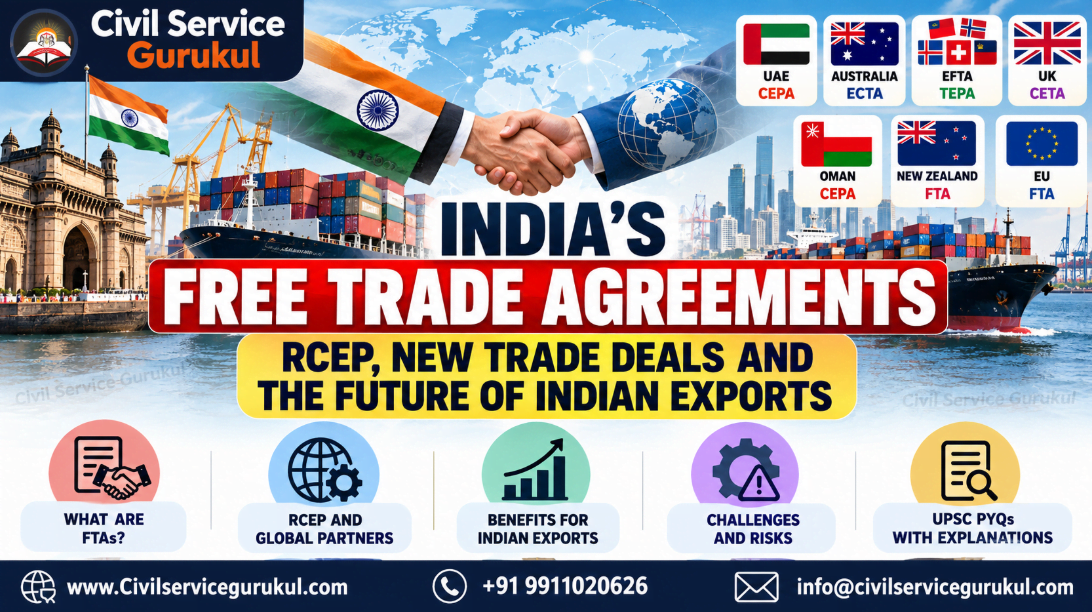
India's FTA Strategy 2026: RCEP, New Trade Deals and the Future of Indian Exports
A complete UPSC guide to free trade agreements, economic integration, India's global partnerships, trade opportunities, challenges and PYQs.
1. Why Are Free Trade Agreements in the News?
India has expanded its trade diplomacy through a series of bilateral and regional economic agreements.
The conclusion of India-New Zealand FTA negotiations in December 2025, alongside developments involving the European Union, United Kingdom, Oman and other partners, has renewed attention to India's global trade strategy.
These agreements aim to improve market access, diversify supply chains, encourage investment and strengthen India's export competitiveness.
2. What Is a Free Trade Agreement?
A Free Trade Agreement is an arrangement between two or more countries or trading blocs to reduce or eliminate selected barriers to trade.
Such barriers may include customs tariffs, quotas and certain regulatory restrictions.
Modern FTAs may extend beyond goods to include services, investment, intellectual property, digital trade, competition, government procurement and regulatory cooperation.
Important Terms
- Tariff: A customs duty imposed on imports or exports.
- Non-Tariff Barrier: A regulatory or administrative measure that can restrict trade.
- Rules of Origin: Criteria used to establish the economic nationality of a product.
- Preferential Market Access: Favourable trade treatment provided under an agreement.
- Trade Diversion: A shift of imports towards a preferential partner, which may not always be the lowest-cost supplier.
3. Types of Economic Integration
| Type | Main Feature | Example / Explanation |
|---|---|---|
| Preferential Trade Agreement | Selected tariff preferences | Limited trade concessions |
| Free Trade Area | Reduced tariffs among members | Members retain independent external tariffs |
| Customs Union | FTA plus common external tariff | Common treatment of third-country imports |
| Common Market | Customs union plus factor mobility | Greater movement of labour and capital |
| Economic Union | Deeper economic policy coordination | Higher level of integration |
↓
Common Market → Economic Union
4. What Is RCEP?
The Regional Comprehensive Economic Partnership is a major Asia-Pacific free trade arrangement.
It brings together the ten original ASEAN RCEP participants and five partner economies: Australia, China, Japan, South Korea and New Zealand.
India participated in the negotiations but decided not to join RCEP in 2019.
Why Did India Stay Outside RCEP?
- Concerns over rising imports.
- Potential pressure on domestic manufacturing.
- Protection of sensitive agricultural sectors.
- Concerns about trade deficits.
- Rules-of-origin enforcement.
- Safeguards against import surges.
5. Major Free Trade Agreements Involving India
| Partner | Agreement | Key Date / Status | Importance |
|---|---|---|---|
| UAE | CEPA | Effective May 2022 | Goods, services and wider economic cooperation |
| Australia | ECTA | Effective December 2022 | Market access and supply-chain cooperation |
| EFTA | TEPA | Signed March 2024; effective October 2025 | Trade and investment cooperation |
| United Kingdom | CETA | Signed July 2025; effective July 2026 | Goods, services and professional mobility |
| Oman | CEPA | Signed December 2025; effective June 2026 | Market access and Gulf trade connectivity |
| New Zealand | FTA | Negotiations concluded December 2025; signed April 2026 | Trade, investment and Indo-Pacific engagement |
| European Union | FTA | Negotiations concluded January 2026 | Potential expansion of access to EU markets |
A. India-UAE CEPA
The Comprehensive Economic Partnership Agreement entered into force in May 2022.
It supports trade in goods and services and wider economic cooperation.
B. India-Australia ECTA
The Economic Cooperation and Trade Agreement entered into force in December 2022.
It supports preferential trade access and stronger economic cooperation.
C. India-EFTA TEPA
The Trade and Economic Partnership Agreement was signed in March 2024.
EFTA consists of Iceland, Liechtenstein, Norway and Switzerland.
The agreement entered into force in October 2025.
D. India-UK CETA
The Comprehensive Economic and Trade Agreement was signed in July 2025 and entered into force in July 2026.
It offers significant preferential access for Indian exports, including labour-intensive products, alongside services provisions.
E. India-Oman CEPA
Signed in December 2025, the agreement entered into force in June 2026.
It supports trade, services and professional cooperation with an important Gulf economic partner.
F. India-New Zealand FTA
Negotiations concluded in December 2025. The agreement was signed in April 2026.
As of 13 October 2026, its scheduled entry into force is 20 October 2026.
The agreement includes market-access arrangements, investment cooperation and provisions for professional mobility.
G. India-EU FTA
India and the European Union announced the conclusion of FTA negotiations in January 2026.
The negotiated framework seeks to expand market access while retaining safeguards for sensitive sectors.
Conclusion of negotiations should not be confused with entry into force.
6. Benefits of Free Trade Agreements for India
A. Improved Market Access
Lower import duties in partner markets can improve the competitiveness of Indian exports.
B. Labour-Intensive Industries
Textiles, leather, footwear, gems and jewellery, marine products and other labour-intensive sectors may benefit from preferential access.
C. MSME Opportunities
FTAs can create new export opportunities for small businesses, although firms must satisfy quality, documentation and rules-of-origin requirements.
D. Global Value Chains
Trade agreements can support access to inputs, production networks and diversified supply chains.
E. Services Exports
Modern agreements may improve opportunities in IT, consulting, education, engineering and other services.
F. Strategic Partnerships
Economic agreements can strengthen bilateral relationships and Indo-Pacific engagement.
7. Challenges Associated with FTAs
- Import Competition: Domestic producers may face competition from lower-cost imports.
- Trade Deficits: Import growth may exceed export growth in some sectors.
- Rules of Origin: Weak enforcement may undermine intended preferences.
- Non-Tariff Barriers: Technical, sanitary and other standards can limit exports.
- MSME Readiness: Small firms may lack certification and export capacity.
- Sensitive Sectors: Agriculture and vulnerable industries may require safeguards.
8. Way Forward for India's Trade Strategy
- Strengthen domestic manufacturing competitiveness.
- Improve logistics and trade infrastructure.
- Help MSMEs meet export standards.
- Enforce rules of origin effectively.
- Protect sensitive sectors through negotiated safeguards.
- Promote export diversification.
- Review the actual impact of trade agreements.
- Expand skills and services competitiveness.
9. UPSC Prelims Quick Revision
| Topic | Important Fact |
|---|---|
| FTA | Free Trade Agreement |
| RCEP | Regional Comprehensive Economic Partnership |
| India in RCEP | Not a member |
| UAE CEPA | Effective 2022 |
| Australia ECTA | Effective 2022 |
| EFTA TEPA | Signed 2024; effective 2025 |
| UK CETA | Signed 2025; effective 2026 |
| Oman CEPA | Effective June 2026 |
| New Zealand FTA | Signed April 2026 |
| EU FTA | Negotiations concluded January 2026 |
| Rules of Origin | Determine product origin |
| Customs Union | Common external tariff |
10. UPSC Mains Answer-Writing Strategy
GS Paper II
Connect FTAs with India's bilateral relations, regional diplomacy and international institutions.
GS Paper III
Discuss trade liberalisation, industrial competitiveness, employment, MSMEs, exports and economic growth.
Essay Paper
Use FTAs to analyse globalisation, self-reliance, economic interdependence and inclusive development.
11. UPSC Previous Year Questions
PYQ 1: WTO Trade Facilitation Agreement
Consider the following statements:
- India has ratified the Trade Facilitation Agreement (TFA) of the WTO.
- TFA is part of the WTO's Bali Ministerial Package of 2013.
- TFA entered into force in January 2016.
Which statements are correct?
A. 1 and 2 only
B. 1 and 3 only
C. 2 and 3 only
D. 1, 2 and 3
Correct Answer and Explanation
Answer: A. 1 and 2 only
India ratified the WTO Trade Facilitation Agreement in April 2016.
The agreement emerged from the Bali Ministerial Conference of 2013.
However, it entered into force on 22 February 2017, not January 2016.
Therefore, statements 1 and 2 are correct and statement 3 is incorrect.
12. Original UPSC-Style Practice MCQs
RCEP Membership
Which statement is correct?
A. India is an RCEP member.
B. RCEP includes China.
C. RCEP is a customs union.
D. RCEP excludes Japan.
Answer and Explanation
Answer: B
China is an RCEP member. India is not a member, and RCEP is a free trade arrangement rather than a customs union.
Levels of Economic Integration
Which arrangement includes a common external tariff?
A. Preferential Trade Agreement
B. Free Trade Area
C. Customs Union
D. Bilateral Investment Treaty
Answer and Explanation
Answer: C
A customs union combines internal trade liberalisation with a common external tariff towards non-members.
India-EFTA Agreement
Which of the following is an EFTA member?
A. France
B. Switzerland
C. Spain
D. Poland
Answer and Explanation
Answer: B
EFTA comprises Iceland, Liechtenstein, Norway and Switzerland.
Rules of Origin
The primary purpose of rules of origin is to:
A. Determine the origin of traded goods
B. Fix exchange rates
C. Determine fiscal deficits
D. Regulate central bank reserves
Answer and Explanation
Answer: A
Rules of origin establish whether goods qualify for preferential treatment under a trade agreement.
India-New Zealand FTA
India-New Zealand FTA negotiations concluded in:
A. December 2022
B. March 2024
C. December 2025
D. January 2020
Answer and Explanation
Answer: C
Negotiations concluded in December 2025. The agreement was signed in April 2026.
India-EU FTA Status
Which statement accurately describes the January 2026 India-EU development?
A. India joined the European Union.
B. Negotiations for an FTA concluded.
C. India adopted the euro.
D. A common customs union was established.
Answer and Explanation
Answer: B
India and the EU announced the conclusion of FTA negotiations in January 2026. This does not mean that India joined the EU or a customs union.
13. Important UPSC Question Trends
| Theme | UPSC Relevance |
|---|---|
| Trade Agreements and WTO | Prelims and GS III |
| RCEP and Regional Integration | Prelims, GS II and GS III |
| Trade Liberalisation | GS III and Essay |
| MSMEs and Export Competitiveness | GS III |
| Trade Deficits and Tariffs | Prelims and GS III |
| Economic Diplomacy | GS II |
Final Preparation Strategy
For Prelims: Memorise agreement names, partner countries, RCEP membership, rules of origin, tariffs and the differences between FTAs and customs unions.
For Mains: Analyse the opportunities and risks of FTAs for manufacturing, employment, farmers, MSMEs and India's position in global value chains.
14. Conclusion
India's expanding network of Free Trade Agreements reflects an increasingly active economic diplomacy.
These agreements can support market diversification, export growth, investment and strategic cooperation.
However, their success depends on domestic competitiveness, effective implementation, rules-of-origin enforcement and safeguards for vulnerable sectors.
Prepare Indian Economy and International Relations with Civil Service Gurukul
UPSC | State PCS | Current Affairs | Conceptual Notes | Answer Writing Practice
Visit Civil Service Gurukul Enquire on WhatsAppPrepare with Mentors Who Cleared the Exam
Get personalized study plans, evaluated answer models, and test series access.