All India Students’ Association (AISA): Origins, Role in Student Politics and UPSC Relevance
All India Students’ Association (AISA): Origins, Role in Student Politics and UPSC Relevance
Student organisations occupy a distinctive place in Indian democracy. They function as platforms for youth leadership, political socialisation, campus representation and wider debates on education, equality and civil liberties. AISA is one such organisation with roots in India’s Left political tradition.
Excerpt / Brief Summary
What Is AISA?
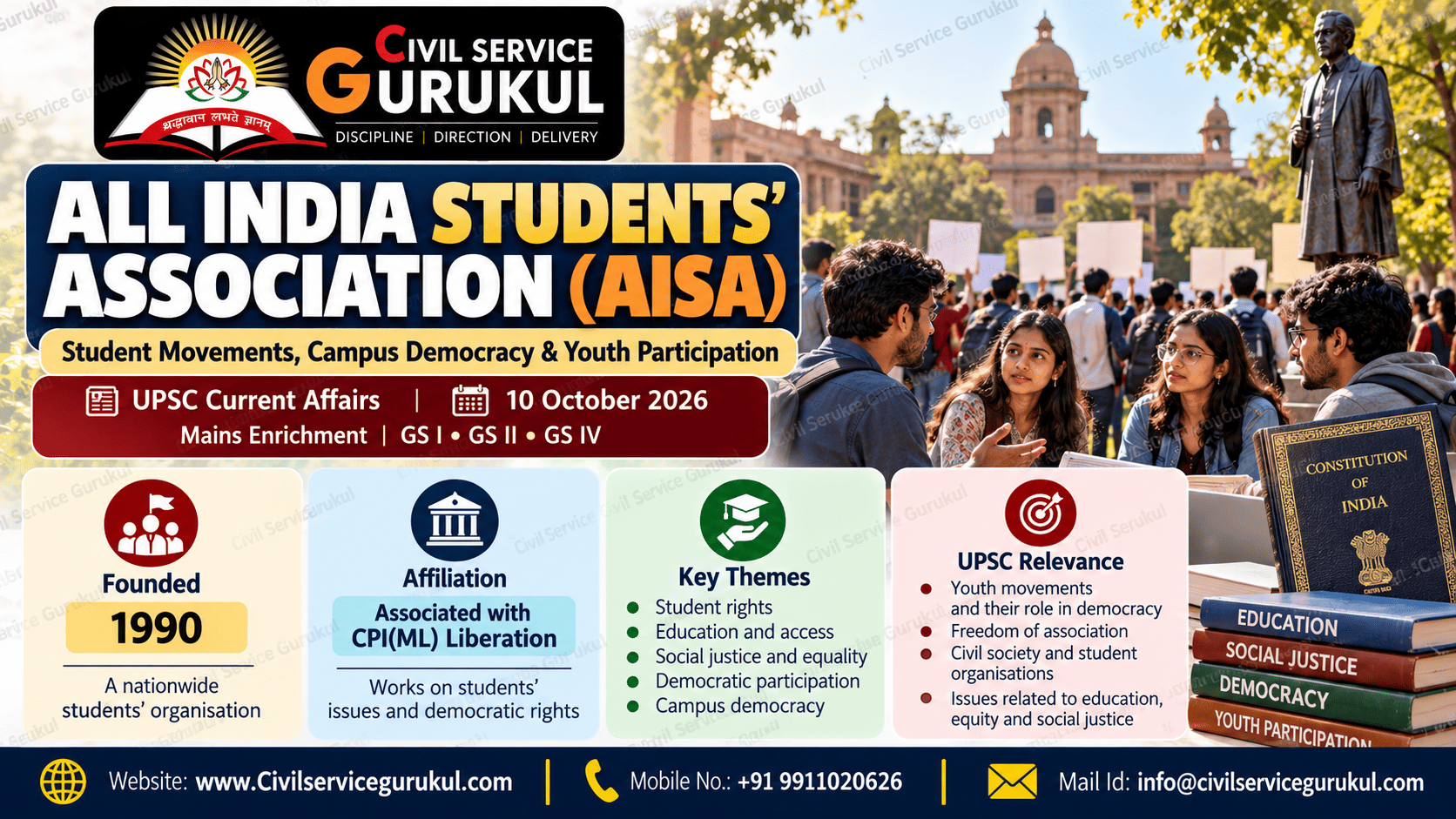
AISA stands for All India Students’ Association.
It is a national student organisation that emerged from India’s broader Left political tradition. The organisation participates in student movements, campus elections and issue-based campaigns.
| Particular | Details |
|---|---|
| Full Name | All India Students’ Association |
| Abbreviation | AISA |
| Established | 1990 |
| Political Orientation | Left-oriented student organisation |
| Associated Political Organisation | CPI(ML) Liberation |
| Major Areas of Activity | Education, student rights, campus democracy, social justice and civil liberties |
Historical Background
To understand AISA, it is useful to place it within the broader trajectory of the Indian communist movement.
1. Naxalbari and the Communist Movement
The Naxalbari uprising of 1967 became an important turning point in the history of radical Left politics in India.
Political disagreements within the communist movement eventually contributed to the formation of the Communist Party of India (Marxist-Leninist) in 1969.
Over time, different political groups emerged from this ideological stream, following different approaches to political participation.
2. Transition Toward Mass Politics
CPI(ML) Liberation gradually moved toward mass mobilisation, public political activity and participation in electoral politics.
This represented a shift away from earlier strategies centred on armed struggle.
Radical revolutionary politics
↓
Mass organisations
↓
Student and worker mobilisation
↓
Electoral participation
3. Formation of AISA in 1990
AISA was established in 1990 through the coming together of several regional Left-oriented student groups.
Its organisational base expanded particularly across parts of:
- Uttar Pradesh;
- Bihar;
- West Bengal;
- Delhi and university campuses in northern India.
Mandal–Mandir Era and Student Mobilisation
The early 1990s were a major period of political and social transformation in India.
Student politics was influenced by debates over:
- Reservation;
- Caste and social justice;
- Communal politics;
- Secularism;
- Educational access;
- Youth representation.
AISA expanded during this politically charged period, when universities became important spaces for national debates.
What Does AISA Advocate?
Its principal areas of mobilisation include:
- Affordable education;
- Student representation;
- Campus democracy;
- Examination transparency;
- Institutional accountability;
- Social equality;
- Gender justice;
- Secularism;
- Civil liberties.
Student Rights Advocacy
Student organisations often act as collective representatives of students in disputes relating to educational institutions.
Common issues include:
- Fee increases;
- Scholarships;
- Hostel facilities;
- Examination delays;
- Recruitment and admission policies;
- Campus facilities;
- Grievance redressal.
Campus Democracy
AISA participates in student-union elections and issue-based campus politics in several institutions.
Student unions can function as training grounds for:
- Leadership;
- Debate;
- Public speaking;
- Negotiation;
- Representative politics;
- Collective decision-making.
Social Justice and Equality
AISA has associated its student politics with wider questions of:
- Caste inequality;
- Gender justice;
- Educational inclusion;
- Representation of disadvantaged groups;
- Access to public education.
This demonstrates how student politics often extends beyond campus administration into broader social questions.
Secularism and Constitutional Freedoms
The organisation also campaigns around issues involving secularism, constitutional freedoms and civil liberties.
From a UPSC perspective, these debates can be connected to:
- Freedom of speech;
- Freedom of association;
- Peaceful assembly;
- Equality;
- Democratic dissent.
Constitutional Framework for Student Associations
Student organisations operate within the wider framework of constitutional freedoms.
| Constitutional Provision | Relevance |
|---|---|
| Article 19(1)(a) | Freedom of speech and expression |
| Article 19(1)(b) | Right to assemble peacefully and without arms |
| Article 19(1)(c) | Right to form associations or unions |
| Article 14 | Equality before law |
| Article 21 | Protection of life and personal liberty |
Fundamental freedoms are not absolute. Reasonable restrictions prescribed by the Constitution may apply in the interests of public order, security and other constitutionally recognised grounds.
Student Movements and Civil Society
Civil society refers broadly to organisations and associations operating between individuals, markets and the State.
Student organisations can function as civil-society actors by:
- Aggregating student demands;
- Mobilising public opinion;
- Questioning institutional decisions;
- Promoting political participation;
- Developing future leadership.
Why Student Movements Matter in Democracy
- Political awareness among youth;
- Leadership development;
- Representation of student concerns;
- Debate on public policy;
- Accountability within educational institutions;
- Participation in broader social movements.
Student Movements in Indian History
Student political participation has a long history in India.
Young people and students participated in:
- Swadeshi Movement;
- Non-Cooperation Movement;
- Quit India Movement;
- Anti-Emergency mobilisation;
- JP Movement;
- Assam Movement;
- Anti-corruption and social-justice movements.
Thus, student politics is not a new phenomenon in Indian democracy.
Youth as a Political Socialisation Group
University politics often introduces young citizens to:
- Political ideologies;
- Constitutional rights;
- Election campaigning;
- Public debate;
- Policy questions;
- Collective action.
This process is known as political socialisation.
Potential Benefits of Campus Politics
- Leadership training;
- Public-speaking skills;
- Democratic awareness;
- Exposure to diverse viewpoints;
- Student representation;
- Issue-based mobilisation.
Challenges Associated with Student Politics
Student politics can also generate governance challenges.
These may include:
- Excessive partisan polarisation;
- Disruption of academic activities;
- Violence or intimidation;
- External political interference;
- Personality-based politics;
- Weak issue-based debate.
Student politics should neither be romanticised nor dismissed. Its democratic value depends on whether participation remains peaceful, constitutional, inclusive and issue-based.
The Lyngdoh Committee and Student Elections
Debates over campus elections led to efforts to create transparent and accountable student-union elections.
The Lyngdoh Committee recommendations focused on issues such as:
- Candidate eligibility;
- Election expenditure;
- Campaign rules;
- Academic requirements;
- Prevention of violence;
- Limits on external influence.
These recommendations are useful for understanding the balance between campus democracy and institutional discipline.
Freedom of Dissent and Public Order
Democracies must protect legitimate dissent, but protest activity must also operate within constitutional limits.
Right to dissent
+
Peaceful assembly
+
Institutional autonomy
+
Public order
=
Responsible democratic participation
AISA as a Case Study of Ideology-Based Student Politics
AISA is useful for UPSC preparation not because candidates need to endorse or oppose its ideology, but because it illustrates how political ideologies are transmitted into youth and student mobilisation.
Similar analytical treatment can be applied to other ideological student organisations.
When writing about politically affiliated organisations, focus on: origin, ideology, organisational role, constitutional framework, social significance and democratic impact. Avoid partisan language.
Role in Leadership Development
Student organisations often produce future participants in:
- Politics;
- Academia;
- Journalism;
- Activism;
- Trade unions;
- Civil society.
Campus politics can therefore serve as a recruitment and leadership-development arena for wider public life.
Education Governance and Student Representation
Students are key stakeholders in universities, but governance structures often involve:
- University administrations;
- Faculty;
- Government regulators;
- Students;
- Parents;
- Accreditation institutions.
Student organisations can provide collective representation within this multi-stakeholder system.
GS Paper I Relevance
- Youth mobilisation;
- Student movements;
- Social justice;
- Political socialisation;
- Post-independence political developments.
GS Paper II Relevance
- Freedom of association;
- Freedom of speech;
- Peaceful assembly;
- Civil society organisations;
- Democratic participation;
- Education governance.
GS Paper IV Relevance
Student movements can also be linked with ethical concepts such as:
- Tolerance;
- Respect for dissent;
- Equality;
- Responsible citizenship;
- Non-violence;
- Democratic ethics.
Essay Relevance
The topic can enrich essays on:
- Youth and democracy;
- Role of universities in nation building;
- Dissent in democracy;
- Civil society;
- Education and citizenship;
- Political participation.
UPSC Prelims Quick Revision
- AISA stands for All India Students’ Association.
- It was established in 1990.
- It is associated with CPI(ML) Liberation.
- Its politics includes student rights and social-justice issues.
- Article 19 protects speech, peaceful assembly and association subject to constitutional restrictions.
- Student organisations can be analysed as part of civil society and democratic participation.
UPSC Practice MCQ
1. It was established in 1990.
2. It is associated with CPI(ML) Liberation.
3. It participates in student-rights and campus-democracy issues.
4. It is a constitutional body established by Parliament.
Which of the statements given above are correct?
A. 1 and 2 only
B. 1, 2 and 3 only
C. 2, 3 and 4 only
D. 1, 2, 3 and 4
Answer: B
Statement 4 is incorrect. AISA is a student organisation, not a constitutional or statutory body.
UPSC Mains Practice Question
“Student movements can simultaneously function as schools of democracy and arenas of political polarisation.” Discuss the role of student organisations in strengthening democratic participation in India.
Suggested Marks: 15
Suggested Word Limit: 250 words
Mains Answer Framework
Introduction:
Explain the historical role of students in Indian political and social movements.
Body:
- Political socialisation;
- Leadership development;
- Student representation;
- Campus democracy;
- Civil-society participation;
- Social-justice mobilisation;
- Risks of violence and excessive partisan polarisation;
- Need for constitutional and peaceful participation.
Conclusion:
Universities should remain spaces where disagreement is expressed through
debate, elections and peaceful democratic engagement.
Key Terms for Answer Enrichment
Conclusion
The All India Students’ Association provides a useful case study for understanding how ideology, education, youth mobilisation and democratic politics interact in India.
Its emergence from the wider Left political tradition and participation in campus politics illustrate the continuing significance of student organisations in public life.
For a democracy, the larger challenge is to ensure that student politics remains peaceful, inclusive, constitutionally grounded and centred on meaningful public debate.
SEO Tags
Prepare with Mentors Who Cleared the Exam
Get personalized study plans, evaluated answer models, and test series access.