Indore Water Contamination Crisis: Why India's Urban Water Governance Needs a Public Health Reset
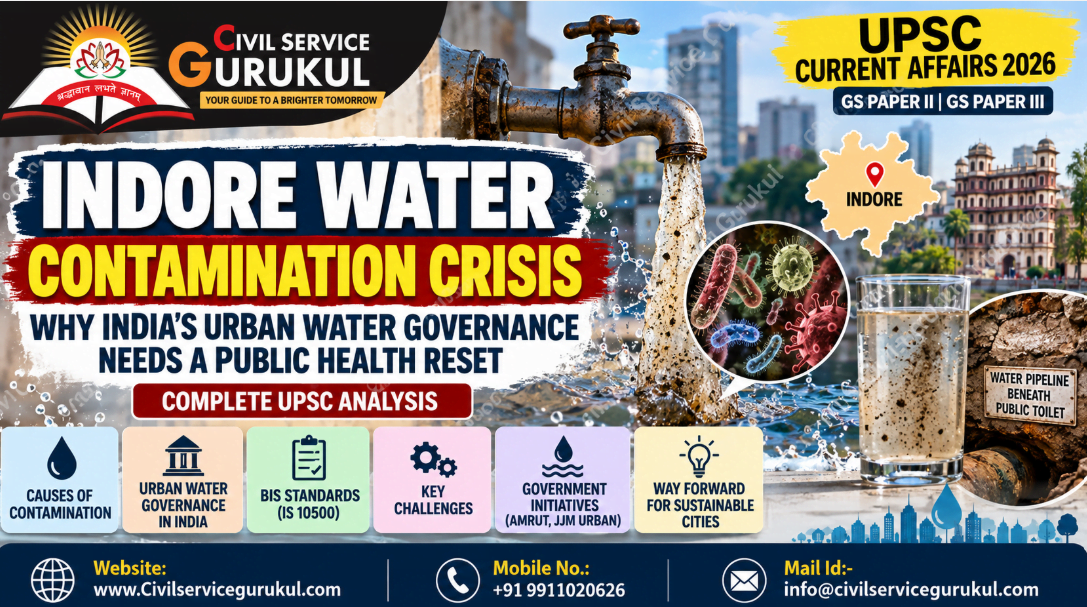
Indore Water Contamination Crisis: Why India's Urban Water Governance Needs a Public Health Reset
Municipal Accountability, Drinking Water Safety, AMRUT 2.0, Water Security and Sustainable Urban Development
1. Why in the News?
The reported public health crisis linked to contaminated municipal tap water in Indore, Madhya Pradesh, has exposed serious vulnerabilities in India's urban drinking water infrastructure and governance systems.
The incident demonstrates how failures in municipal infrastructure, sanitation planning, pipeline maintenance and water quality monitoring can create severe public health risks.
NHRC Intervention
The National Human Rights Commission (NHRC) took suo motu cognizance of the reported incident.
The material concerning the incident indicates that a drinking water supply pipeline passed beneath a public toilet, raising serious concerns about contamination risks and infrastructure safety.
Pathogens Reported in Contaminated Water
- Escherichia coli (E. coli): Certain strains cause gastrointestinal illness; its presence can indicate faecal contamination.
- Salmonella: Bacteria associated with gastrointestinal and systemic infections.
- Vibrio cholerae: Bacteria responsible for cholera.
- Viruses: Certain waterborne viruses can cause gastrointestinal illness.
- Protozoa: Organisms that may cause parasitic infections.
- Fungi: Some fungi may pose health risks under particular circumstances.
The reported crisis involved concerns about polymicrobial infections, sepsis and multi-organ complications.
2. Understanding Urban Water Governance
Urban water governance refers to the institutions, policies, infrastructure, financial arrangements and accountability mechanisms responsible for ensuring safe, affordable and sustainable water services in cities.
It covers water sourcing, treatment, distribution, quality monitoring, wastewater management and conservation.
Constitutional Framework
- State responsibility: Water supply and related water matters fall substantially within the State List under the Seventh Schedule.
- State Governments: Establish policies, allocate resources and oversee implementation.
- Urban Local Bodies: Undertake water-related functions assigned to them under state law.
- 74th Constitutional Amendment: Established a constitutional framework for municipalities.
- Article 243W: Enables state legislatures to devolve powers and responsibilities to municipalities.
- Twelfth Schedule: Includes water supply for domestic, industrial and commercial purposes.
Role of the Union Government
The Ministry of Housing and Urban Affairs supports urban water infrastructure through programmes such as AMRUT and AMRUT 2.0.
3. BIS Drinking Water Quality Standards: IS 10500
The Bureau of Indian Standards (BIS) has established drinking water specifications under IS 10500.
These specifications address physical, chemical and microbiological characteristics of drinking water.
Important Water Quality Parameters
| Parameter | Acceptable Limit | Permissible Limit in Absence of Alternate Source |
|---|---|---|
| Fluoride | 1.0 mg/L | 1.5 mg/L |
| Total Dissolved Solids | 500 mg/L | 2,000 mg/L |
| Iron | 0.3 mg/L | No relaxation under the cited IS 10500:2012 specification |
| Manganese | 0.1 mg/L | 0.3 mg/L |
| Arsenic | 0.01 mg/L | 0.05 mg/L |
| Nitrate | 45 mg/L | No relaxation |
Note: The values above follow the cited IS 10500:2012 framework. Applicable amendments and current specifications should be checked for regulatory use.
When Is Drinking Water Unsafe?
Water may be considered unsafe when:
- Microbiological contamination is detected beyond prescribed criteria.
- Chemical concentrations exceed applicable limits.
- Water quality fails to meet other mandatory safety requirements.
4. Major Challenges in Urban Water Governance
4.1 Demand–Supply Gap
Rapid urbanisation, population growth and industrial expansion increase demand for freshwater.
In many cities, available water resources and infrastructure development have not kept pace with growing demand.
The NITI Aayog Composite Water Management Index (2018) highlighted major groundwater stress risks in Indian cities.
4.2 Fragmented Institutional Framework
Urban water management often involves multiple agencies responsible for supply, sewerage, drainage, planning and maintenance.
Overlapping jurisdictions can weaken coordination and accountability.
Example: Gurugram has different agencies involved in urban infrastructure and service provisioning across jurisdictions.
4.3 Inadequate and Ageing Infrastructure
Old pipelines, leakages, poor maintenance and inadequate monitoring can reduce service reliability and increase contamination risks.
Leakages can also contribute to substantial non-revenue water.
4.4 Non-Revenue Water
Non-revenue water (NRW) refers to water entering a distribution system that does not generate billed revenue.
It includes:
- Physical losses from leakage.
- Apparent losses from theft or metering inaccuracies.
- Authorised but unbilled consumption.
High NRW increases operational costs and reduces the financial sustainability of municipal utilities.
4.5 Climate Change and Water Insecurity
Irregular rainfall, droughts, extreme weather and flooding increase pressure on urban water systems.
Examples: Chennai's 2019 water crisis and Bengaluru's 2024 water stress illustrate vulnerabilities in urban water security.
4.6 Inadequate Wastewater Treatment
Untreated or inadequately treated sewage contributes to river pollution and reduces the availability of safe water resources.
The pollution burden in the Yamuna in Delhi illustrates this challenge.
4.7 Excessive Groundwater Dependence
Intermittent piped water supply encourages reliance on borewells, private tankers and groundwater extraction.
Over-extraction can cause aquifer depletion and deepen inequality in access to water.
5. Major Government Initiatives for Urban Water Management
| Initiative | Objectives and Significance |
|---|---|
| AMRUT | Improvement of basic urban infrastructure, including water supply and sewerage. |
| AMRUT 2.0 | Focus on water-secure cities, water supply coverage, conservation, reuse and sustainable urban water management. |
| Pey Jal Survekshan | Assessment of urban water services, including quality, quantity, coverage and related performance. |
| Jal Shakti Abhiyan: Catch the Rain | Water conservation and rainwater harvesting through institutional and community participation. |
| National Water Policy, 2012 | Promotes water conservation, efficient utilisation and sustainable resource management. |
| Namami Gange Programme | Pollution abatement, conservation and rejuvenation of the River Ganga. |
AMRUT 2.0 and Urban Water Security
AMRUT 2.0 promotes improved urban water services, conservation, rainwater harvesting and the reuse of treated wastewater.
Its approach also includes aquifer management and efforts to strengthen the long-term sustainability of water resources.
6. Way Forward: Rebuilding India's Urban Water Systems
6.1 Integrated Urban Water Management
Cities should adopt integrated approaches combining demand management, conservation and diversified water resources.
Important measures include:
- Water metering and demand monitoring.
- Rational and equitable pricing.
- Rainwater harvesting.
- Rejuvenation of lakes and ponds.
- Reuse of treated wastewater.
6.2 Institutional Coordination
Clearly defined responsibilities for water supply, sewage and stormwater management can improve accountability.
A coordinated city-level institutional framework may reduce administrative fragmentation.
6.3 Modernisation of Infrastructure
Priority measures include:
- Replacing ageing pipelines.
- Regular inspection and preventive maintenance.
- Pressure testing and acoustic leak detection.
- Digital monitoring of distribution networks.
- Routine water quality testing and public reporting.
- Water audits to reduce non-revenue water.
6.4 Climate-Resilient Water Planning
Urban planning must account for droughts, extreme rainfall, flooding and climate variability.
Nature-based solutions such as lake restoration, floodplain protection and decentralised water storage can improve resilience.
6.5 Wastewater Treatment and Reuse
Cities should improve sewage treatment capacity and encourage reuse of treated water for suitable non-potable applications.
6.6 Sustainable Groundwater Management
Groundwater extraction should be regulated alongside recharge, conservation and improved reliability of piped water supply.
6.7 Strengthening the 3Ps Framework
- Policy: Integrated regulations, institutional coordination and effective planning.
- People: Citizen participation, awareness and community accountability.
- Place: Cooperation across cities, surrounding regions and water catchments.
7. UPSC Prelims Practice Questions
A. Panchayati Raj Institutions
B. Urban Local Bodies
C. Inter-State Water Disputes
D. National Disaster Management
Correct Answer: B
The 74th Constitutional Amendment provided constitutional recognition to municipalities.
A. Air Quality Standards
B. Drinking Water Quality
C. Industrial Waste Management
D. Groundwater Extraction Licensing
Correct Answer: B
IS 10500 specifies drinking water quality requirements.
1. Pipeline leakage
2. Unauthorised consumption
3. Inaccurate metering
A. 1 only
B. 1 and 2 only
C. 2 and 3 only
D. 1, 2 and 3
Correct Answer: D
All three can contribute to non-revenue water.
1. Water supply for domestic purposes appears in the Twelfth Schedule.
2. Article 243W relates to the powers and responsibilities of municipalities.
3. AMRUT 2.0 focuses exclusively on rural drinking water.
Which statements are correct?
A. 1 and 2 only
B. 2 and 3 only
C. 1 and 3 only
D. 1, 2 and 3
Correct Answer: A
AMRUT 2.0 is an urban development programme.
8. UPSC Mains Practice Questions
"The Indore drinking water contamination crisis highlights the gap between constitutional decentralisation and effective municipal accountability." Discuss.
Examine the major challenges facing urban water governance in India. Suggest an integrated strategy for achieving safe, sustainable and climate-resilient urban water systems.
9. Quick Revision for UPSC
- Current issue: Indore municipal drinking water contamination.
- Human rights institution: NHRC.
- Constitutional amendment: 74th Amendment.
- Article: 243W.
- Schedule: Twelfth Schedule.
- Drinking water standard: BIS IS 10500.
- Major urban mission: AMRUT 2.0.
- Water management issue: Non-revenue water.
- Key strategy: Integrated Urban Water Management.
- Governance framework: Policy, People and Place.
- SDG: SDG 6 – Clean Water and Sanitation.
10. Frequently Asked Questions
Why is the Indore water crisis important for UPSC?
It connects public health, municipal accountability, water infrastructure, decentralisation, environmental governance and sustainable urban development.
What is IS 10500?
IS 10500 is the Bureau of Indian Standards specification for drinking water quality.
What is non-revenue water?
It is water entering a distribution system that does not generate billed revenue due to physical losses, apparent losses or authorised unbilled use.
Which constitutional amendment strengthened municipalities?
The 74th Constitutional Amendment Act, 1992.
What is the role of AMRUT 2.0?
AMRUT 2.0 supports urban water security through improved services, conservation and sustainable water management.
Conclusion
The Indore drinking water contamination crisis demonstrates that urban water governance is not merely an infrastructure issue. It is equally a matter of public health, constitutional accountability, institutional coordination and environmental sustainability.
India needs reliable water distribution networks, strong municipal institutions, transparent water quality monitoring and sustainable management of water resources.
A water-secure city must provide not only adequate water but also safe, affordable and equitable access to every resident.
Prepare with Mentors Who Cleared the Exam
Get personalized study plans, evaluated answer models, and test series access.