India's Sports Governance Revolution: Abhinav Bindra Task Force, Professional Sports Administration and Olympic Vision 2036
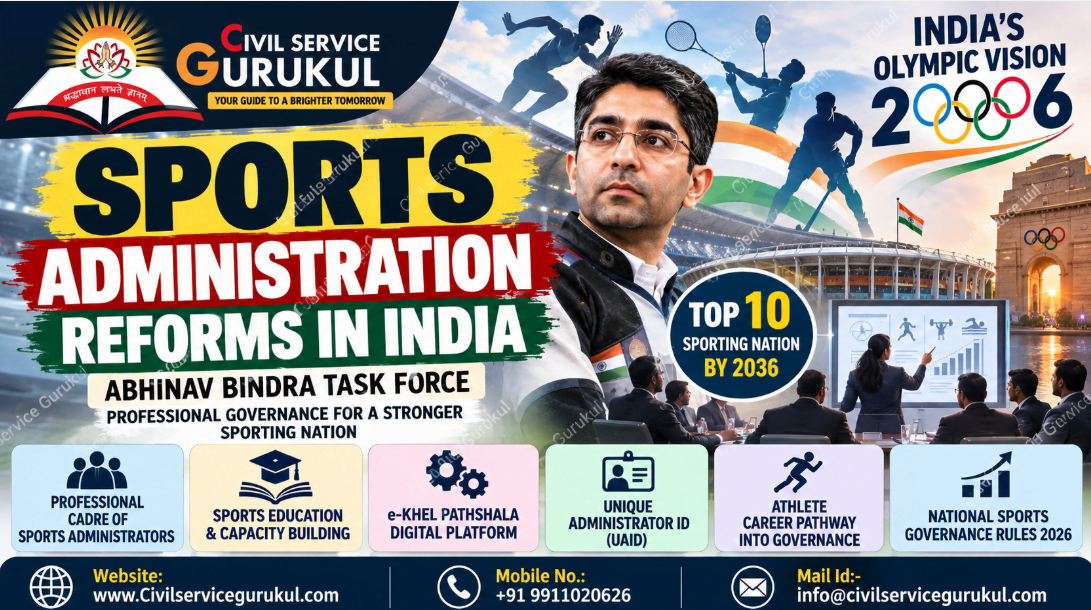
India's Sports Governance Revolution: Abhinav Bindra Task Force and Olympic Vision 2036
Professionalising Sports Administration, Building Institutional Capacity and Transforming India's Sporting Ecosystem
1. Why in the News?
The Government constituted a Task Force on Capacity Building of Sports Administrators under Khelo Bharat NITI 2025, which submitted its report to the Department of Sports.
The Task Force was chaired by Abhinav Bindra, India's Olympic gold medallist in shooting.
Its central objective is to strengthen sports administration, develop professional governance capacity and support India's long-term sporting ambitions.
- Become a top-ten sporting nation by 2036.
- Strengthen the sports governance ecosystem.
- Build professional sports administration capacity.
- Support India's ambition to host the 2036 Olympic Games.
The initiative highlights the importance of institutional governance, athlete representation, administrative professionalism and technology-driven sports management.
2. What Is Sports Administration?
Sports administration refers to the management, regulation, planning and governance of sporting institutions, competitions, athletes, infrastructure and development programmes.
Effective sports administration involves:
- Strategic planning and policy implementation.
- Sports federation management.
- Financial administration and accountability.
- Athlete welfare and career development.
- Competition and event management.
- Talent identification and grassroots development.
- Ethical governance and regulatory compliance.
- Data analytics and technology integration.
3. Key Findings of the Abhinav Bindra Task Force
3.1 Absence of a Professional Administrative Cadre
The Task Force identified the lack of a dedicated professional cadre of sports administrators.
This contributes to weak institutional continuity and inconsistent administrative standards.
3.2 Fragmented Training Opportunities
Existing training opportunities are fragmented and outdated, with insufficient focus on professional competencies and continuous learning.
3.3 Gaps in Sports Education
Sports education programmes do not adequately prepare graduates for administrative responsibilities.
Many graduates lack practical exposure to the interactions between national, state and institutional sports structures.
3.4 Limited Athlete Pathways into Governance
Former athletes often possess valuable sporting experience but may lack the formal management, leadership and governance skills needed to transition into administrative positions.
3.5 Inadequate Use of Digital Technology
The Task Force identified limited use of digital tools, analytics and technology in sports governance.
Digital systems can strengthen transparency, administrative efficiency and evidence-based decision-making.
4. Major Recommendations of the Task Force
4.1 National Council for Sports Education and Capacity Building
The Task Force recommended establishing an autonomous statutory body under the Ministry responsible for sports.
The proposed Council would:
- Regulate sports administration education.
- Accredit training institutions and programmes.
- Certify sports administration training.
- Promote professional standards.
- Strengthen national institutional capacity.
4.2 National Training and Development Cell
The proposed Cell would act as the operational arm of the capacity-building framework.
Its functions would include:
- Developing India-specific training curricula.
- Maintaining a national administrators' registry.
- Overseeing digital training delivery.
- Monitoring learning outcomes.
- Coordinating with international institutions.
4.3 e-Khel Pathshala Digital Platform
The e-Khel Pathshala platform associated with the Sports Authority of India supports online sports education and training.
Its intended beneficiaries include teachers, community coaches and grassroots learners.
Digital training can improve access to learning opportunities and reduce geographical barriers.
4.4 National Competency Framework
The Task Force recommended a national competency framework to define professional skills and performance expectations for sports administrators.
A Five-Level Capability Maturity Model was proposed to support progression across district, state, national, institutional and global levels.
4.5 Unique Administrator ID (UAID)
The proposed Unique Administrator ID would support a national registry of sports administrators.
It would help track:
- Training and certifications.
- Professional development.
- Administrative competencies.
- Career progression.
- Performance-related records.
The objective is to link promotions and professional growth with measurable skill acquisition.
4.6 Dual Athlete Career Pathway
The Task Force recommended a pathway enabling athletes to pursue leadership and management education alongside their sporting careers.
The proposal also refers to certification recognising a Sportsperson of Merit.
This approach would create opportunities for athletes to transition into governance and leadership roles after their competitive careers.
International Example: Kirsty Coventry
Former Zimbabwean swimmer Kirsty Coventry became the first woman President of the International Olympic Committee.
Her career illustrates the potential for athletes to transition into international sports leadership.
5. Performance Management and Accountability
The Task Force proposed evaluating sports administrators through structured performance management systems.
Important features include:
- Measurable administrative performance indicators.
- Regular professional assessments.
- Linking incentives with performance.
- Competency-based career advancement.
- Transparent monitoring of outcomes.
Such systems would encourage administrators to meet professional standards and improve institutional performance.
6. International Partnerships and Technology
International Cooperation
The Task Force recommended collaboration with international sports institutions such as:
- International Olympic Committee (IOC).
- Fédération Internationale de Football Association (FIFA).
- Other international sports education and governance institutions.
These partnerships could support curriculum development, professional exposure and leadership training.
Technology Integration
Digital technology can transform sports administration through:
- Online administrator training.
- Digital registries and certification.
- Data-driven performance evaluation.
- Transparent institutional reporting.
- Sports science and analytics.
7. National Sports Governance Rules, 2026
According to the supplied current-affairs material, the Government notified the National Sports Governance (National Sports Bodies) Rules, 2026 under the National Sports Governance Act, 2025.
The rules concern the institutional structure, representation, elections and governance of national sports bodies.
Key Provisions
| Aspect | Provision Described in the Material |
|---|---|
| Institutional structure | National sports bodies to have a General Body and an Executive Committee. |
| Sportsperson representation | At least four Sportspersons of Outstanding Merit in the General Body. |
| Minimum age | Specified sportsperson representatives must be at least 25 years old. |
| Women's representation in General Body | At least 50% of the specified sportsperson representatives to be women. |
| Women's representation in Executive Committee | Provisions aimed at ensuring at least four women members. |
| National Sports Election Panel | At least 20 members, as described in the supplied notes. |
| Disqualification | Conviction followed by imprisonment is identified as a disqualification criterion. |
8. National Sports Board: Selection Framework
The supplied material also discusses the National Sports Board (Search-cum-Selection Committee) Rules, 2026, framed under the National Sports Governance Act, 2025.
Search-cum-Selection Committee
The Committee is described as being chaired by the Cabinet Secretary.
Its composition includes:
- Cabinet Secretary – Chairperson.
- Secretary responsible for Sports.
- One person with experience in sports administration.
- Two recipients of national sports awards.
The framework seeks to bring administrative experience and sporting expertise into institutional appointments.
9. Why Are Sports Governance Reforms Important?
Institutional Professionalism
Qualified administrators can improve planning, implementation and long-term institutional stability.
Athlete-Centred Governance
Greater athlete representation can help institutions respond to the practical needs of sportspersons.
Transparency and Accountability
Clear performance standards, elections and digital monitoring can strengthen institutional trust.
Gender Inclusion
Women's representation in decision-making can support more inclusive sports governance.
Olympic Preparedness
Professional administration is important for international competitiveness, event management and India's 2036 Olympic aspirations.
10. Way Forward for Indian Sports Governance
- Professional training: Develop standardised courses and continuous learning systems for administrators.
- Institutional coordination: Improve cooperation among national federations, state associations and grassroots institutions.
- Athlete participation: Strengthen pathways for current and former athletes to enter governance.
- Digital transformation: Use registries, analytics and online education platforms.
- Gender inclusion: Promote meaningful participation of women in decision-making positions.
- Performance accountability: Introduce measurable administrative indicators and transparent evaluations.
- International collaboration: Learn from global sports management practices.
- Grassroots development: Strengthen district-level administration, community coaching and talent development.
11. UPSC Prelims Practice MCQs
A. Neeraj Chopra
B. Abhinav Bindra
C. P. V. Sindhu
D. Leander Paes
Correct Answer: B
The Task Force was chaired by Olympic gold medallist Abhinav Bindra.
A. Register Olympic spectators
B. Track professional development of sports administrators
C. Replace athlete identification systems
D. Allocate international medals
Correct Answer: B
A. Online sports education and training
B. Agricultural insurance
C. Judicial training
D. Urban infrastructure financing
Correct Answer: A
1. National Competency Framework
2. Dual Athlete Career Pathway
3. Unique Administrator ID
A. 1 only
B. 1 and 2 only
C. 2 and 3 only
D. 1, 2 and 3
Correct Answer: D
12. UPSC Mains Practice Questions
"Professional sports administration is essential for transforming India into a global sporting power." Discuss with reference to the recommendations of the Abhinav Bindra-led Task Force.
Examine the challenges in India's sports governance ecosystem. How can institutional reforms, athlete participation, technology and performance accountability improve sports administration?
13. Quick Revision for UPSC
| Topic | Important Fact |
|---|---|
| Task Force | Capacity Building of Sports Administrators |
| Chairperson | Abhinav Bindra |
| Policy framework | Khelo Bharat NITI 2025 |
| Sports ambition | Top-ten sporting nation by 2036 |
| Olympic aspiration | Hosting the 2036 Olympics |
| Proposed statutory institution | National Council for Sports Education and Capacity Building |
| Digital platform | e-Khel Pathshala |
| Professional registry | Unique Administrator ID |
| Competency model | Five-Level Capability Maturity Model |
| Governance legislation | National Sports Governance Act, 2025 |
| Related rules | National Sports Governance Rules, 2026 |
| NSB Selection Committee Chair | Cabinet Secretary |
14. Frequently Asked Questions
Who chaired the Sports Administrators Task Force?
Olympic gold medallist Abhinav Bindra chaired the Task Force.
What is the Unique Administrator ID?
It is a proposed mechanism for tracking the training, certification and professional development of sports administrators.
What is e-Khel Pathshala?
It is a digital sports education platform supporting online training for teachers, community coaches and grassroots learners.
What is India's sporting ambition for 2036?
The reform agenda aims to support India's ambition to become a top-ten sporting nation and its aspiration to host the 2036 Olympic Games.
Why is sports governance important for UPSC?
It connects public administration, institutional reforms, transparency, accountability, inclusion and policy implementation.
Conclusion
The Abhinav Bindra-led Task Force highlights the need to move from fragmented sports administration towards a professional, competency-based and technology-enabled governance ecosystem.
Institutional reforms, athlete participation, transparent appointments, continuous training and international cooperation can strengthen India's sporting institutions.
India's ambition to become a global sporting power by 2036 will depend not only on athlete performance but also on the quality of its sports governance.
Prepare with Mentors Who Cleared the Exam
Get personalized study plans, evaluated answer models, and test series access.