
AI in Mathematics: Human Reasoning & Ethics – UPSC 2027
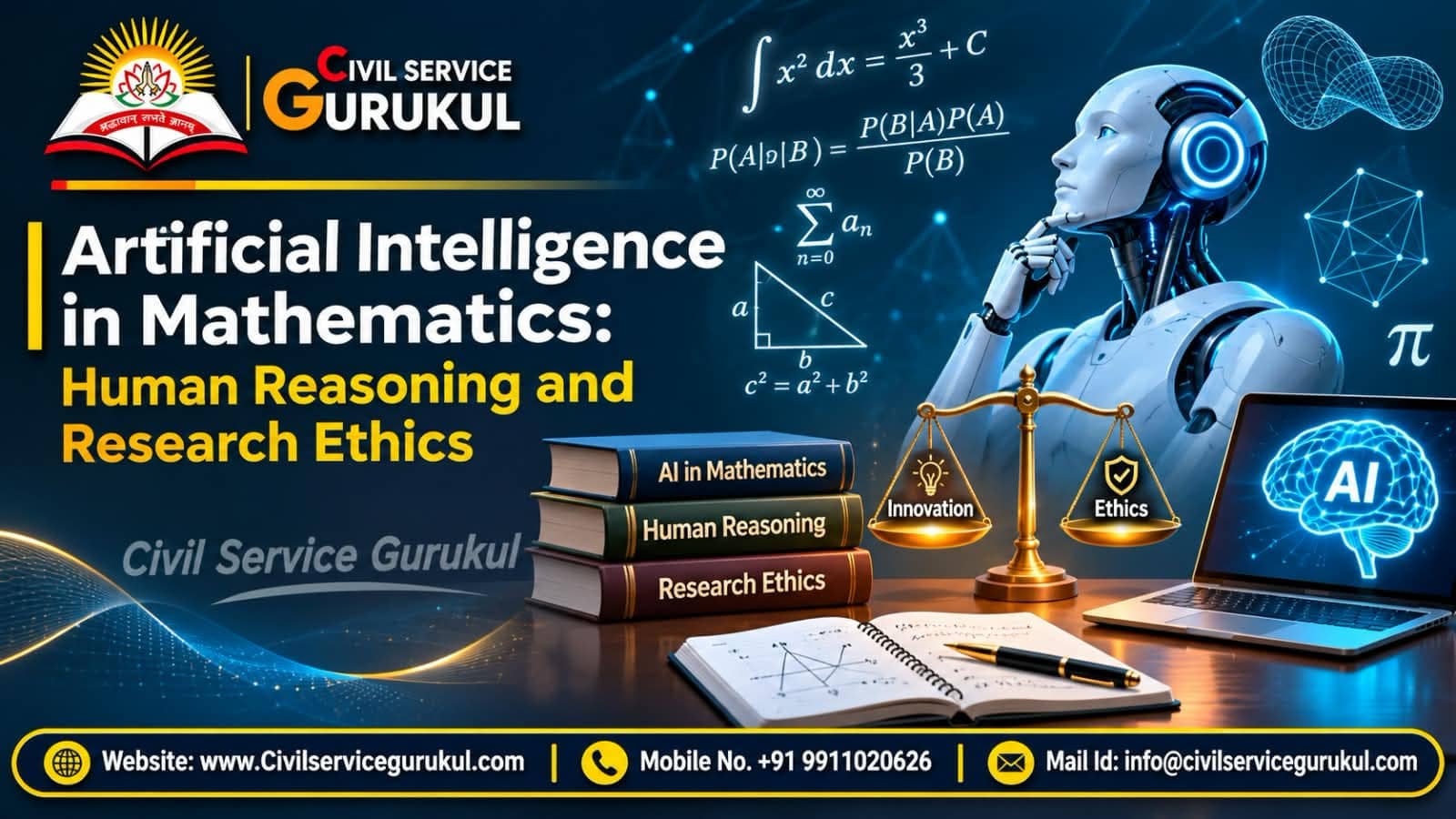
Artificial Intelligence in Mathematics: Can Machines Discover Mathematical Truth? Human Reasoning, the Leiden Declaration and Research Ethics
Artificial intelligence is entering one of the most intellectually demanding areas of human knowledge: mathematical discovery. While advanced AI systems can generate solutions, identify patterns and assist in verifying mathematical proofs, their growing capabilities raise fundamental questions about human understanding, scientific integrity, intellectual credit and the future of research.
Why in the News?
Recent developments in artificial intelligence have demonstrated that machines can solve increasingly difficult mathematical problems, including questions previously associated with advanced human reasoning.
AI systems such as AlphaProof, AlphaGeometry and Gemini Deep Think have demonstrated impressive mathematical problem-solving capabilities in International Mathematical Olympiad evaluations.
During 2026, the growing use of AI in advanced mathematical research intensified discussions concerning the reliability of machine-generated proofs, the role of mathematicians and the attribution of scientific discoveries.
The Leiden Declaration on Artificial Intelligence and Mathematics emerged as an important community-led initiative addressing these concerns. It has received endorsement from the International Mathematical Union.
In September 2026, the International Council for Industrial and Applied Mathematics also emphasized the importance of combining human mathematical expertise with the capabilities of artificial intelligence.
These developments highlight a fundamental policy question: how can societies benefit from AI-assisted scientific discovery without weakening human intellectual autonomy and research accountability?
UPSC CSE Syllabus Relevance
| UPSC Paper | Relevant Syllabus Topics |
|---|---|
| Prelims GS Paper I | General science, artificial intelligence and technological developments |
| Mains GS Paper II | Education, government policies, institutional governance and human resource development |
| Mains GS Paper III | Artificial intelligence, scientific innovation, information technology, intellectual property and research development |
| Mains GS Paper IV | Ethics in science, integrity, accountability, intellectual honesty and professional responsibility |
| Essay Paper | Human intelligence, technology, creativity, scientific progress and ethical responsibility |
What Is Artificial Intelligence in Mathematics?
Artificial intelligence in mathematics refers to the application of computational intelligence to mathematical problem-solving, logical reasoning, pattern recognition, theorem proving and scientific discovery.
Unlike conventional calculators that primarily perform predefined arithmetic operations, advanced mathematical AI systems may explore multiple solution approaches, identify relationships and assist researchers in constructing complex arguments.
Mathematical AI combines techniques from computer science, formal logic, machine learning, statistics and symbolic computation.
Major Capabilities of Mathematical AI
- Identifying mathematical patterns and relationships.
- Generating potential mathematical conjectures.
- Exploring alternative problem-solving approaches.
- Assisting in theorem proving.
- Translating mathematical arguments into formal representations.
- Supporting computer-assisted verification.
- Improving mathematical optimization and computational modelling.
Artificial intelligence in mathematics is not merely about obtaining correct numerical answers. Its broader research potential lies in discovering relationships, constructing arguments and helping researchers investigate complex mathematical structures.
What Is Mathematical Reasoning?
Mathematical reasoning involves using logical principles to establish relationships, draw conclusions and determine whether mathematical statements are valid.
| Type of Reasoning | Explanation |
|---|---|
| Deductive Reasoning | Deriving logically necessary conclusions from accepted premises |
| Inductive Reasoning | Identifying patterns from observations to suggest general conclusions |
| Abductive Reasoning | Identifying a plausible explanation for observed information |
| Analogical Reasoning | Applying insights from similar mathematical structures or problems |
| Symbolic Reasoning | Manipulating symbols and logical expressions according to formal rules |
| Probabilistic Reasoning | Evaluating relationships and uncertainty through probability-based methods |
Simple Example: Pattern Recognition vs Proof
Consider the following mathematical pattern:
1 = 1²
1 + 3 = 2²
1 + 3 + 5 = 3²
1 + 3 + 5 + 7 = 4²
General Conjecture:
The sum of the first n positive odd integers is n².
An AI system may recognize this pattern and propose the general relationship. However, observing several examples does not establish that the relationship holds for every positive integer.
A deductive proof, such as a proof using mathematical induction, is required to establish the general result.
Assume the sum of the first k positive odd integers equals k². Adding the next odd integer, 2k + 1, produces k² + 2k + 1, which equals (k + 1)². Together with the base case, this establishes the identity by mathematical induction.
Pattern recognition may generate a conjecture, but repeated observations alone do not establish a universally valid mathematical theorem.
Important Mathematical Research Terminology
| Term | Meaning |
|---|---|
| Axiom | A foundational statement accepted within a mathematical system |
| Conjecture | A mathematical statement proposed as true but not yet established by proof |
| Theorem | A mathematical statement established through valid logical reasoning |
| Lemma | A proven result that often supports a larger theorem |
| Corollary | A result that follows from an established theorem or proposition |
| Proof | A logical argument establishing a mathematical conclusion |
| Counterexample | An example demonstrating that a proposed general statement is false |
| Formal Verification | Checking a specified mathematical or computational property using formal methods |
How Does AI Solve Mathematical Problems?
A mathematical problem is represented in a form that an AI system can process. Depending on the technology, this may involve natural language, mathematical symbols or a formal logical language.
The AI system identifies potentially relevant relationships, methods and similarities to mathematical structures encountered during training or supplied through external tools.
The system considers alternative calculations, logical arguments or proof strategies.
The system produces a possible solution or mathematical argument based on the available information.
The proposed solution is evaluated using appropriate logical checks, symbolic computation, proof assistants or independent mathematical analysis.
Researchers assess whether the result answers the intended question, relies on appropriate assumptions, contributes original knowledge and can be meaningfully understood or independently examined.
Important AI Technologies Used in Mathematics
| Technology | Mathematical Application |
|---|---|
| Machine Learning | Identifying patterns and statistical relationships |
| Deep Learning | Modelling complex relationships through multilayer neural networks |
| Large Language Models | Generating mathematical explanations and candidate solutions |
| Reinforcement Learning | Learning strategies through feedback and reward mechanisms |
| Symbolic AI | Applying explicit logical rules and symbolic representations |
| Neuro-Symbolic AI | Combining neural learning with symbolic reasoning methods |
| Automated Theorem Proving | Searching for formal mathematical proofs using computational methods |
| Computer Algebra Systems | Performing symbolic mathematical operations |
| Proof Assistants | Supporting the construction and logical verification of formal proofs |
Major Artificial Intelligence Tools in Mathematics
1. AlphaGeometry
AlphaGeometry is an AI system developed by Google DeepMind to solve challenging mathematical geometry problems.
It combines a neural language model with a symbolic deduction engine.
Research published in 2024 reported that AlphaGeometry solved 25 out of 30 selected Olympiad geometry problems.
This demonstrated the potential of combining learned mathematical intuition with explicit logical rules.
2. AlphaProof
AlphaProof is a reinforcement-learning-based system designed for formal mathematical reasoning.
It uses mathematical problems represented in the Lean formal language and searches for valid proofs.
At the 2024 International Mathematical Olympiad evaluation, AlphaProof and AlphaGeometry 2 together solved four of the six problems, earning a score of 28 out of 42 points, equivalent to the silver-medal range.
3. Gemini Deep Think
An advanced version of Gemini with Deep Think achieved a score of 35 out of 42 points in the 2025 International Mathematical Olympiad evaluation.
The model produced solutions to five of the six problems and reached gold-medal-level performance.
The evaluation was an important milestone in AI mathematical reasoning. Nevertheless, Olympiad performance is not equivalent to comprehensive mastery of advanced mathematical research.
4. Lean Proof Assistant
Lean is a formal proof assistant and programming language used to express mathematical statements and verify formal arguments.
It enables researchers to represent mathematical definitions, propositions and proofs in a machine-checkable format.
Mathlib is a collaborative mathematical library developed for Lean that provides formalized mathematical knowledge.
5. Computer Algebra Systems
Computer algebra systems perform symbolic operations such as algebraic simplification, differentiation, integration and equation solving.
These systems remain important tools in mathematical research, although their functions are distinct from those of generative AI models.
| System | Primary Function |
|---|---|
| AlphaGeometry | Geometry problem-solving |
| AlphaProof | Formal mathematical reasoning and proof search |
| Gemini Deep Think | Advanced natural-language mathematical problem-solving |
| Lean | Machine-checkable formal mathematical proofs |
| Mathlib | Collaborative formal mathematical library |
| Computer Algebra Systems | Symbolic mathematical computation |
What Is Automated Theorem Proving?
Automated Theorem Proving refers to the use of computer-based techniques to search for logical proofs of formally represented mathematical statements.
Such systems work within mathematical frameworks containing definitions, axioms, previously established results and logical inference rules.
Difference Between Proof Generation and Proof Verification
| Particulars | Proof Generation | Proof Verification |
|---|---|---|
| Objective | Discover a valid argument | Check whether an argument satisfies formal logical requirements |
| Primary Activity | Exploring possible proof strategies | Checking the validity of specified proof steps |
| AI Hallucination Risk | A proposed argument may contain unsupported steps | Formal checking can detect invalid steps within the encoded argument |
| Human Role | Problem selection, strategy and interpretation | Checking the intended statement, assumptions and significance |
A machine-checked proof establishes a formally expressed statement relative to its assumptions and logical framework. It does not independently guarantee that the formal statement perfectly represents the original research question.
Human Reasoning vs Artificial Intelligence in Mathematics
| Parameter | Human Mathematicians | Artificial Intelligence Systems |
|---|---|---|
| Problem Selection | Can identify questions based on scientific significance and intellectual curiosity | Generally operates within supplied objectives or computationally defined tasks |
| Pattern Recognition | Uses experience, concepts and intuition | Can analyse extensive datasets and mathematical representations |
| Creativity | Develops new concepts, questions and interpretations | Can generate novel candidate solutions and combinations |
| Computational Capacity | Limited without supporting tools | Can explore large computational search spaces |
| Understanding | Can explain the conceptual significance of mathematical results | May generate explanations, but human-like understanding is not established by performance alone |
| Accountability | Can assume professional and ethical responsibility | Cannot independently assume human professional responsibility |
| Ethical Judgment | Can evaluate competing values and societal consequences | Depends on design, supervision and governance frameworks |
The comparison does not imply that every human reasoning process is superior to every computational approach. Different mathematical tasks may benefit from different combinations of human expertise and automated techniques.
Can Artificial Intelligence Replace Mathematicians?
Artificial intelligence can increasingly assist with mathematical calculations, problem-solving, literature exploration and proof development.
However, mathematical research involves much more than producing correct answers.
Researchers must decide which questions are meaningful, determine appropriate assumptions, develop useful abstractions, interpret results and communicate their significance.
Even when AI produces a valid mathematical proof, the research community may still need to understand why the result is important and how it connects with existing mathematical knowledge.
AI may automate some research activities while increasing the importance of other human skills. The future relationship between mathematicians and artificial intelligence is therefore likely to evolve through changing forms of collaboration and specialization.
Leiden Declaration on Artificial Intelligence and Mathematics 2026
The Leiden Declaration is a community-led initiative addressing the implications of artificial intelligence for mathematical research.
It has been endorsed by the International Mathematical Union and offers recommendations for researchers, academic institutions, publishers, funding agencies, policymakers and technology companies.
The declaration seeks to protect the intellectual and scientific foundations of mathematics while allowing researchers to make informed choices about the use of automated tools.
Major Principles of the Leiden Declaration
- Transparency: Researchers should disclose material uses of AI and other automated research tools.
- Human Accountability: Authors remain responsible for the validity of their published mathematical arguments.
- Proper Attribution: Researchers should identify and acknowledge earlier work and relevant human contributions.
- Independent Verification: Mathematical results should be open to meaningful examination and reproducibility.
- Research Autonomy: Scientists should retain the freedom to select research questions and decide whether to use AI tools.
- Peer Review: AI-assisted discoveries should remain subject to appropriate academic scrutiny.
- Equitable Research Conditions: Institutions should consider access to research infrastructure, environmental consequences and fair collaboration.
The Leiden Declaration represents an example of professional self-governance in an emerging technological field. It seeks to balance scientific innovation with established research values instead of demanding a complete prohibition on artificial intelligence.
Is the Leiden Declaration Legally Binding?
No. It is a professional and ethical declaration rather than an international treaty or binding national legislation.
Its recommendations may influence institutional policies, academic publishing standards and future regulatory discussions.
International Mathematical Union
The International Mathematical Union, commonly known as IMU, is an international scientific organization supporting cooperation and advancement in mathematics.
Its endorsement of the Leiden Declaration highlights the growing importance of responsible AI governance within the global mathematical research community.
International Council for Industrial and Applied Mathematics
The International Council for Industrial and Applied Mathematics, or ICIAM, promotes international cooperation in applied mathematics.
Its September 2026 statement emphasizes the complementary relationship between mathematical knowledge and artificial intelligence, including the importance of education and reliable scientific applications.
Major Applications of Artificial Intelligence in Mathematics
1. Mathematical Research
AI can assist researchers in exploring conjectures, identifying potential relationships and investigating alternative mathematical arguments.
2. Scientific Modelling
AI-assisted mathematical modelling may support research in physics, engineering, environmental science and other scientific fields.
3. Climate Change Research
Mathematical and computational models support the study of atmospheric processes, climate variability and environmental risks.
AI can complement these methods by identifying patterns and improving selected forecasting or computational tasks.
4. Healthcare and Medical Research
Mathematics supports medical imaging, epidemiological modelling, biostatistics and clinical research.
AI-assisted analysis may help researchers process complex datasets, subject to appropriate scientific and clinical validation.
5. Economic Planning and Financial Modelling
Mathematical optimization and AI can support forecasting, resource allocation, financial risk assessment and economic policy research.
6. Infrastructure and Engineering
AI-assisted computational methods may help improve structural modelling, energy systems, transportation networks and industrial processes.
7. Space Research
Mathematical techniques are essential in orbital calculations, satellite operations, navigation and astronomical research.
8. Education and Personalized Learning
Artificial intelligence may provide adaptive mathematical exercises, alternative explanations and individualized feedback.
However, educational use must encourage independent thinking rather than dependence on automatically generated answers.
Major Ethical Concerns in AI-Assisted Mathematical Research
1. Research Integrity
Researchers must ensure that published mathematical results satisfy accepted scientific standards. The use of AI does not eliminate the obligation to identify errors or verify conclusions.
2. Authorship and Intellectual Credit
AI-generated outputs may combine information derived from earlier mathematical work.
Human authors must investigate relevant prior discoveries and acknowledge the contributions of other researchers rather than claiming unsupported originality.
3. Intellectual Property Rights
AI training and research activities may involve copyrighted publications, proprietary software and mathematical datasets.
Although abstract mathematical principles and copyright-protected expressions are different concepts, applicable licensing and intellectual property requirements must be respected.
4. AI Hallucinations
Artificial intelligence systems can generate mathematically plausible arguments that contain invalid assumptions, incorrect calculations or fabricated references.
Confident presentation does not establish logical correctness.
5. Lack of Explainability
Some machine-generated mathematical arguments may be difficult for researchers to interpret, particularly when the underlying system relies on complex computational processes.
6. Academic Misconduct
Undisclosed AI-generated assignments, fabricated research findings and misrepresentation of authorship may undermine academic integrity.
7. Decline in Independent Reasoning Skills
Excessive dependence on AI may discourage students from developing foundational problem-solving skills, conceptual understanding and intellectual perseverance.
8. Unequal Access to Computing Resources
Well-funded institutions and technology companies may possess substantially greater computational resources than individual researchers or smaller universities.
Such disparities may influence research opportunities and academic competition.
9. Commercial Influence on Research
Private investment can accelerate mathematical innovation. However, commercial priorities may encourage attention to highly publicized results rather than long-term scientific understanding.
10. Environmental Costs
Large-scale AI systems may require significant computing infrastructure, electricity and cooling resources.
Researchers should evaluate whether the scientific objective justifies the resources consumed and consider less resource-intensive alternatives where appropriate.
11. Pressure on Academic Peer Review
The rapid generation of mathematical manuscripts may increase the workload of academic reviewers.
Research institutions should prioritize the quality, originality and verifiability of submissions rather than merely their quantity.
12. Accountability for Incorrect Results
When AI-assisted mathematical outputs are used in public policy, infrastructure or scientific applications, incorrect assumptions may have practical consequences.
Clear responsibilities must therefore be established for validation, approval and implementation.
GS Paper IV: Ethical Principles Relevant to Mathematical AI
| Ethical Value | Application to AI-Assisted Research |
|---|---|
| Integrity | Accurate and honest reporting of research results |
| Transparency | Disclosure of relevant AI tools and methods |
| Accountability | Human responsibility for published conclusions |
| Objectivity | Independent evaluation based on scientific evidence |
| Fairness | Equitable research opportunities and appropriate attribution |
| Intellectual Honesty | Acknowledgment of errors, uncertainties and prior contributions |
| Autonomy | Freedom to pursue independently selected research questions |
| Beneficence | Using scientific knowledge for human welfare |
| Non-maleficence | Preventing foreseeable harm arising from unreliable applications |
| Sustainability | Responsible utilization of energy and computational resources |
UNESCO Recommendation on the Ethics of Artificial Intelligence
In November 2021, UNESCO adopted its Recommendation on the Ethics of Artificial Intelligence, providing an international normative framework for responsible AI development and use.
Its emphasis on fairness, transparency, human rights and meaningful oversight is relevant to scientific research and mathematical applications.
The UNESCO recommendation is not itself an international treaty. Countries and institutions may implement its principles through appropriate policy, regulatory and governance measures.
India and the Future of AI-Assisted Mathematical Research
India has a strong mathematical heritage, an expanding technology ecosystem and significant scientific research capabilities.
Artificial intelligence offers opportunities to strengthen mathematical education, scientific research, engineering innovation and interdisciplinary collaboration.
1. IndiaAI Mission
The Union Cabinet approved the IndiaAI Mission on 7 March 2024 with an outlay of ₹10,371.92 crore over five years.
The mission is implemented under the Ministry of Electronics and Information Technology and seeks to strengthen India's artificial intelligence ecosystem.
| IndiaAI Mission Pillar | Relevance to Research |
|---|---|
| IndiaAI Compute Capacity | Improving access to computing infrastructure |
| IndiaAI Innovation Centre | Supporting indigenous AI model development |
| IndiaAI Datasets Platform | Facilitating access to suitable research datasets |
| IndiaAI Application Development Initiative | Encouraging socially useful AI applications |
| IndiaAI FutureSkills | Strengthening AI education and skills |
| IndiaAI Startup Financing | Supporting AI entrepreneurship and innovation |
| Safe and Trusted AI | Promoting responsible and reliable AI development |
2. Anusandhan National Research Foundation
The Anusandhan National Research Foundation provides a national framework for strengthening research and innovation across scientific institutions.
Interdisciplinary mathematical and AI research may contribute to its broader objectives of expanding India's scientific capabilities.
3. National Supercomputing Mission
High-performance computing infrastructure can support complex numerical simulations, computational mathematics and scientific modelling.
The National Supercomputing Mission represents an important component of India's wider scientific computing ecosystem.
4. National Education Policy 2020
The National Education Policy emphasizes conceptual understanding, critical thinking, multidisciplinary education and technological integration.
AI-based educational tools should reinforce these objectives rather than encourage mechanical dependence on generated solutions.
5. Indian Scientific and Mathematical Institutions
Institutions such as the Indian Statistical Institute, Indian Institute of Science, Indian Institutes of Technology, Tata Institute of Fundamental Research, Chennai Mathematical Institute and the Institute of Mathematical Sciences provide important foundations for advanced mathematical and scientific research.
Greater collaboration between mathematics, computer science and engineering departments can strengthen India's capacity for responsible computational discovery.
Constitutional Dimensions of AI and Scientific Research
Article 51A(h): Scientific Temper
Article 51A(h) identifies the development of scientific temper, humanism and the spirit of inquiry and reform as a fundamental duty of Indian citizens.
Responsible use of mathematical AI should encourage questioning, evidence-based analysis and independent intellectual inquiry.
Article 14: Equality
The constitutional principle of equality is relevant when evaluating equitable access to publicly supported scientific infrastructure and educational opportunities.
Article 19(1)(a): Freedom of Speech and Expression
Freedom of expression provides an important constitutional context for academic discussion, criticism and the communication of scientific findings, subject to applicable legal restrictions.
Challenges Associated with AI Mathematical Research
| Challenge | Potential Consequence |
|---|---|
| Incorrect Mathematical Arguments | Publication or application of invalid research results |
| Formalization Errors | A verified formal statement may differ from the intended theorem |
| Limited Explainability | Difficulty in interpreting machine-generated discoveries |
| Training Data Dependence | Potential weaknesses on unfamiliar problems |
| Benchmark Contamination | Previously encountered questions may distort performance evaluation |
| Research Attribution | Failure to acknowledge earlier discoveries or human contributions |
| Computational Inequality | Unequal opportunities among research institutions |
| Academic Dependency | Reduced opportunities to develop independent reasoning skills |
| Commercial Pressure | Premature claims of scientific breakthroughs |
| Environmental Impact | Resource consumption associated with intensive computation |
Way Forward: Responsible Human-AI Collaboration
1. Maintain Human Responsibility
Researchers should remain accountable for the correctness, originality and interpretation of published results.
2. Establish AI Disclosure Standards
Academic institutions should develop clear requirements for reporting the use of artificial intelligence in research publications and educational assessments.
3. Strengthen Formal Verification
Proof assistants should be encouraged where appropriate, alongside careful examination of the mathematical statement being formalized.
4. Promote Open Science
Accessible mathematical libraries, reproducible research methods and appropriate sharing of computational resources can support independent verification.
5. Strengthen Mathematical Education
Students should learn mathematical concepts, logical reasoning and problem-solving skills before relying heavily on automated assistance.
6. Improve Independent Peer Review
Scientific publishers should develop review mechanisms suited to the complexity of AI-assisted mathematical research.
7. Ensure Equitable Access
Public computing infrastructure and collaborative research platforms can help reduce technological disparities between institutions.
8. Protect Intellectual Property and Attribution
Researchers and developers should respect applicable licensing requirements and establish transparent practices for acknowledging prior contributions.
9. Encourage Sustainable Computing
Research institutions should consider energy efficiency, computational proportionality and environmental impacts when selecting AI tools.
10. Promote International Cooperation
Scientific organizations, universities and governments should collaborate to develop interoperable research standards and responsible AI governance practices.
The objective of mathematical AI should not be limited to producing an increasing number of answers. It should contribute to deeper understanding, reliable knowledge, human intellectual development and socially beneficial scientific innovation.
UPSC Prelims 2027: Important Facts for Revision
- Artificial intelligence can assist in mathematical pattern recognition, conjecture generation and theorem proving.
- A conjecture is a mathematical statement that has not yet been established by proof.
- A theorem is a mathematical statement established through valid logical reasoning.
- A counterexample can disprove a universal mathematical claim.
- Mathematical induction is a deductive proof technique.
- Automated theorem proving involves computational search for logical proofs.
- Lean is a formal proof assistant and programming language.
- Mathlib is a collaborative mathematical library for Lean.
- AlphaGeometry was developed by Google DeepMind.
- AlphaGeometry solved 25 of 30 selected Olympiad geometry problems in its 2024 benchmark.
- AlphaProof uses reinforcement learning for formal mathematical reasoning.
- AlphaProof and AlphaGeometry 2 achieved a combined score of 28 out of 42 in the 2024 IMO evaluation.
- Gemini Deep Think achieved 35 out of 42 in the 2025 IMO evaluation.
- Neuro-symbolic AI combines neural learning and symbolic reasoning.
- The Leiden Declaration addresses responsible AI adoption in mathematics.
- The International Mathematical Union endorsed the Leiden Declaration.
- The Leiden Declaration is not a legally binding international treaty.
- UNESCO adopted its Recommendation on the Ethics of Artificial Intelligence in November 2021.
- The IndiaAI Mission was approved on 7 March 2024.
- IndiaAI Mission has an approved outlay of ₹10,371.92 crore over five years.
- Safe and Trusted AI is one of the seven pillars of the IndiaAI Mission.
- Article 51A(h) concerns scientific temper, humanism and the spirit of inquiry and reform.
- AI-generated mathematical arguments require appropriate verification.
- Formal verification does not automatically establish the scientific significance of a result.
UPSC Prelims Practice Questions
Question 1
With reference to artificial intelligence in mathematics, consider the following statements:
1. AI can assist in generating mathematical conjectures.
2. AI can support automated theorem proving.
3. Every AI-generated mathematical argument is necessarily correct.
Which of the statements given above are correct?
(a) 1 only
(b) 1 and 2 only
(c) 2 and 3 only
(d) 1, 2 and 3
View Answer and Explanation
Correct Answer: (b) 1 and 2 only
AI can assist in conjecture generation and proof development. However, generated arguments may contain errors and require verification.
Question 2
The Leiden Declaration, recently discussed in the context of scientific research, primarily concerns:
(a) International regulation of nuclear energy
(b) Ethical use of artificial intelligence in mathematics
(c) International intellectual property taxation
(d) Conservation of marine biodiversity
View Answer and Explanation
Correct Answer: (b)
The Leiden Declaration addresses responsible AI adoption, research transparency, human accountability and intellectual credit in mathematics.
Question 3
Consider the following pairs:
| Technology | Primary Application |
|---|---|
| 1. AlphaGeometry | Mathematical geometry problem-solving |
| 2. AlphaProof | Formal mathematical reasoning |
| 3. Lean | Formal proof verification |
How many of the above pairs are correctly matched?
(a) Only one
(b) Only two
(c) All three
(d) None
View Answer and Explanation
Correct Answer: (c) All three
AlphaGeometry focuses on geometry, AlphaProof supports formal mathematical reasoning, and Lean enables machine-checkable mathematical proofs.
Question 4
Which one of the following constitutional provisions refers to the duty to develop scientific temper, humanism and the spirit of inquiry and reform?
(a) Article 21A
(b) Article 40
(c) Article 51A(h)
(d) Article 368
View Answer and Explanation
Correct Answer: (c) Article 51A(h)
Article 51A(h) establishes this fundamental duty of Indian citizens.
Question 5
With reference to mathematical reasoning, consider the following statements:
1. A conjecture is necessarily an established mathematical theorem.
2. A counterexample can disprove a universally quantified mathematical statement.
3. Mathematical induction is a method of deductive proof.
Which of the statements given above are correct?
(a) 1 and 2 only
(b) 2 and 3 only
(c) 1 and 3 only
(d) 1, 2 and 3
View Answer and Explanation
Correct Answer: (b) 2 and 3 only
A conjecture is not necessarily proven. A valid counterexample disproves a universal statement, while mathematical induction establishes results deductively.
Question 6
The IndiaAI Mission is implemented under which of the following ministries?
(a) Ministry of Home Affairs
(b) Ministry of Education
(c) Ministry of Finance
(d) Ministry of Electronics and Information Technology
View Answer and Explanation
Correct Answer: (d)
The IndiaAI Mission is implemented under the Ministry of Electronics and Information Technology.
Question 7
The term neuro-symbolic artificial intelligence refers to:
(a) Combining neural learning techniques with symbolic reasoning
(b) Replacing all mathematical symbols with digital images
(c) Studying biological neurons without computational methods
(d) Eliminating logical rules from artificial intelligence systems
View Answer and Explanation
Correct Answer: (a)
Neuro-symbolic approaches combine neural learning capabilities with symbolic representations or logical reasoning techniques.
Question 8
Which of the following are ethical concerns associated with AI-assisted mathematical research?
1. Improper intellectual attribution.
2. Unequal access to computing resources.
3. Undisclosed AI-generated research content.
4. Publication of inadequately verified mathematical results.
Select the correct answer using the code given below:
(a) 1 and 2 only
(b) 2 and 3 only
(c) 1, 3 and 4 only
(d) 1, 2, 3 and 4
View Answer and Explanation
Correct Answer: (d) 1, 2, 3 and 4
All four represent important issues involving scientific integrity, fairness, transparency or professional responsibility.
Question 9
With reference to the Leiden Declaration, consider the following statements:
1. It has received endorsement from the International Mathematical Union.
2. It promotes human accountability and transparency in AI-assisted research.
3. It is a legally binding international treaty.
Which of the statements given above are correct?
(a) 1 and 2 only
(b) 2 and 3 only
(c) 1 and 3 only
(d) 1, 2 and 3
View Answer and Explanation
Correct Answer: (a) 1 and 2 only
The declaration is a professional ethical initiative endorsed by the IMU. It is not a legally binding treaty.
Question 10
Consider the following statements regarding formal verification:
1. Formal verification can check whether a mathematical argument satisfies specified logical requirements.
2. A formally verified proof necessarily establishes that the encoded statement accurately represents every aspect of the original research problem.
3. Human interpretation may remain important after formal verification.
Which of the statements given above are correct?
(a) 1 only
(b) 1 and 3 only
(c) 2 and 3 only
(d) 1, 2 and 3
View Answer and Explanation
Correct Answer: (b) 1 and 3 only
Formal verification checks the encoded argument. Human examination may still be required to establish that the formal representation corresponds to the intended mathematical problem.
UPSC Mains Practice Questions
Question 1 – GS Paper III
Artificial intelligence is transforming mathematical research, but computational capability cannot substitute entirely for human scientific understanding. Discuss.
Marks: 15 | Word Limit: 250 words
Question 2 – GS Paper IV
Examine the ethical challenges of AI-assisted scientific research with reference to intellectual honesty, authorship, transparency and accountability.
Marks: 15 | Word Limit: 250 words
Question 3 – GS Paper III
What is automated theorem proving? Discuss its applications and limitations in the development of scientific knowledge.
Marks: 10 | Word Limit: 150 words
Question 4 – GS Paper II
How can India's education and research institutions adopt artificial intelligence while preserving independent reasoning, academic integrity and equitable access?
Marks: 15 | Word Limit: 250 words
Question 5 – GS Paper IV
Discuss the significance of the Leiden Declaration in balancing scientific innovation with professional ethics in mathematical research.
Marks: 10 | Word Limit: 150 words
UPSC Mains Model Answer
Question
Artificial intelligence is transforming mathematical research, but computational capability cannot substitute entirely for human scientific understanding. Discuss.
GS Paper III | 15 Marks | 250 Words
Introduction
Artificial intelligence has demonstrated growing mathematical capabilities through automated theorem proving, pattern recognition and advanced problem-solving. Systems such as AlphaProof and AlphaGeometry illustrate the potential of human-AI collaboration in scientific research.
Opportunities
- Accelerating mathematical exploration and conjecture generation.
- Assisting construction and formal verification of complex proofs.
- Supporting computational modelling in engineering, healthcare and climate research.
- Improving access to personalized mathematical education.
- Reducing the time required for selected computational tasks.
Limitations and Ethical Concerns
- AI-generated arguments may contain logical errors and fabricated references.
- Formal verification may not establish that the encoded statement matches the intended research question.
- Scientific significance and conceptual understanding require interpretation.
- Undisclosed AI use may undermine authorship and academic integrity.
- Unequal computational access may increase research disparities.
Way Forward
The Leiden Declaration emphasizes transparency, independent scrutiny and human responsibility. India should strengthen interdisciplinary research, public computing infrastructure and responsible AI education through initiatives such as the IndiaAI Mission.
Article 51A(h) provides a constitutional foundation for encouraging scientific temper and independent inquiry.
Conclusion
Artificial intelligence should complement mathematical expertise rather than displace human accountability. A balanced approach combining computational efficiency, logical verification, ethical governance and intellectual understanding can advance scientific knowledge responsibly.
UPSC GS Paper IV: Ethics Case Study
Case Study: AI-Generated Mathematical Research and Academic Integrity
You are the director of a publicly funded scientific research institution. A research team has used an advanced AI system to develop a possible solution to an important mathematical problem.
The proposed solution has attracted considerable interest from institutional management and potential private investors.
However, the research team has not completed independent verification. Some researchers are also concerned that the AI-generated argument may incorporate earlier mathematical contributions that have not been properly acknowledged.
The sponsoring organization pressures you to announce the discovery immediately to improve the institution's reputation and attract additional funding.
Questions
- Identify the stakeholders involved.
- What are the ethical dilemmas in this situation?
- What alternatives are available to you?
- What course of action would you adopt and why?
View Model Case Study Solution
Stakeholders
- Research institution and its management.
- Mathematicians and research scholars.
- Public funding agencies.
- Private investors and sponsoring organizations.
- Previous contributors to mathematical knowledge.
- Scientific journals and peer reviewers.
- The wider scientific community and society.
Ethical Dilemmas
- Institutional reputation versus scientific integrity.
- Commercial pressure versus academic independence.
- Rapid publication versus rigorous verification.
- Individual recognition versus fair intellectual attribution.
- Short-term financial benefits versus long-term public trust.
Possible Alternatives
Option 1: Announce the discovery immediately as a confirmed mathematical breakthrough.
This may attract publicity but creates serious risks of misrepresentation, reputational damage and unreliable scientific communication.
Option 2: Reject the research solely because artificial intelligence was involved.
This would avoid immediate uncertainty but unnecessarily disregard potentially valuable scientific work.
Option 3: Conduct independent verification, review the originality of the research and disclose AI involvement before making a definitive announcement.
This protects scientific integrity while allowing the research to proceed.
Recommended Course of Action
I would adopt the third option and constitute an independent mathematical review panel, ensure appropriate formal verification, examine prior literature and establish proper attribution.
The institution should communicate the current research status truthfully. If a preliminary announcement is necessary, it should clearly state that the proposed result remains under verification.
I would also introduce an institutional AI research policy covering disclosure, accountability, authorship, peer review and conflict-of-interest management.
Ethical Justification
This approach upholds integrity, objectivity, transparency, accountability and responsible utilization of public resources while encouraging genuine scientific innovation.
Important Keywords for UPSC Mains Answer Writing
Human-AI Collaboration | Scientific Integrity | Intellectual Autonomy | Mathematical Reasoning | Automated Theorem Proving | Formal Verification | Research Accountability | Neuro-Symbolic AI | Scientific Temper | Academic Integrity | Intellectual Attribution | Responsible Innovation | Human-Centric AI | Open Science | Algorithmic Transparency | Computational Equity | Evidence-Based Research | Professional Ethics | Scientific Reproducibility | Technological Governance
Essay Paper: Important Themes
- Technology should expand human intelligence rather than diminish independent thought.
- Scientific progress without ethical responsibility can undermine public trust.
- Knowledge is more than the accumulation of correct answers.
- Artificial intelligence and the future of human creativity.
- The relationship between scientific freedom and professional accountability.
Frequently Asked Questions
1. What is artificial intelligence in mathematics?
It is the application of AI techniques to mathematical problem-solving, pattern recognition, conjecture generation, proof construction and scientific computation.
2. What is the Leiden Declaration on Artificial Intelligence and Mathematics?
It is a community-led ethical initiative promoting responsible AI adoption, transparency, human accountability and research integrity in mathematics.
3. Is the Leiden Declaration legally binding?
No. It is a professional ethical declaration rather than an international treaty or national law.
4. What is AlphaProof?
AlphaProof is a reinforcement-learning-based artificial intelligence system developed for formal mathematical reasoning and proof search.
5. What is AlphaGeometry?
AlphaGeometry is an AI system that combines neural and symbolic reasoning methods to solve mathematical geometry problems.
6. What is the Lean proof assistant?
Lean is a formal proof assistant and programming language used to represent mathematical statements and verify formal proofs.
7. What is automated theorem proving?
Automated theorem proving is the use of computational methods to search for logical proofs of mathematical statements.
8. Can artificial intelligence make mathematical discoveries?
AI can generate novel mathematical results and candidate proofs. Their correctness, originality and significance must be established through appropriate verification and research evaluation.
9. Can AI replace human mathematicians?
AI may automate selected mathematical activities, but problem selection, conceptual interpretation, ethical judgment and research accountability remain important human responsibilities.
10. What is an AI hallucination in mathematics?
It is a generated mathematical claim, calculation, explanation or reference that appears plausible but is incorrect or unsupported.
11. What are the major ethical concerns of mathematical AI?
Major concerns include research integrity, inaccurate proofs, improper attribution, academic misconduct, unequal computational access and insufficient accountability.
12. When was the IndiaAI Mission approved?
The Union Cabinet approved the IndiaAI Mission on 7 March 2024.
13. What is the approved budget of the IndiaAI Mission?
The approved outlay is ₹10,371.92 crore over five years.
14. Which constitutional article refers to scientific temper?
Article 51A(h) of the Constitution of India refers to the fundamental duty to develop scientific temper, humanism and the spirit of inquiry and reform.
15. Why is artificial intelligence in mathematics important for UPSC 2027?
The topic connects science and technology, artificial intelligence, education, public policy, research ethics, intellectual property and responsible technological governance.
Conclusion
Artificial intelligence is expanding the possibilities of mathematical research by supporting computational exploration, pattern recognition and formal reasoning.
However, mathematics is not simply a collection of answers. It is also a discipline concerned with understanding, logical explanation, intellectual creativity and reliable knowledge.
The Leiden Declaration highlights the need to preserve research integrity, human responsibility and transparent scientific practices in an era of rapid technological change.
India should promote AI-assisted research through accessible scientific infrastructure, interdisciplinary education, independent verification and responsible governance.
The most constructive future for mathematical research lies in combining the computational strengths of artificial intelligence with human curiosity, judgment, creativity and ethical responsibility.
Prepare for UPSC CSE 2027 with Civil Service Gurukul
Strengthen your UPSC preparation through syllabus-oriented current affairs, conceptual clarity, comprehensive revision, Prelims MCQs and analytical Mains answer writing.
Our Academic Focus:
UPSC Prelims | UPSC Mains | Current Affairs | Science and Technology | Artificial Intelligence | Indian Economy | Indian Polity | Geography | Environment and Ecology | Ethics | Essay Writing | Test Series | Mains Answer Writing | Mentorship
Explore Our Courses Contact Our Academic Team WhatsApp for Guidance Email UsThis article has been prepared for educational purposes and UPSC Civil Services Examination preparation. It reflects scientific and policy information reviewed as of 24 November 2026.
AI benchmark achievements should not be interpreted as evidence of universal mathematical competence or established human-like understanding. AI-generated scientific results require appropriate independent verification.
The practice questions, model answers and hypothetical ethics case study are independently prepared educational materials and are not represented as official UPSC previous-year questions.
Prepare with Mentors Who Cleared the Exam
Get personalized study plans, evaluated answer models, and test series access.