
Arunachal Border Villages Reverse Migration – UPSC 2027
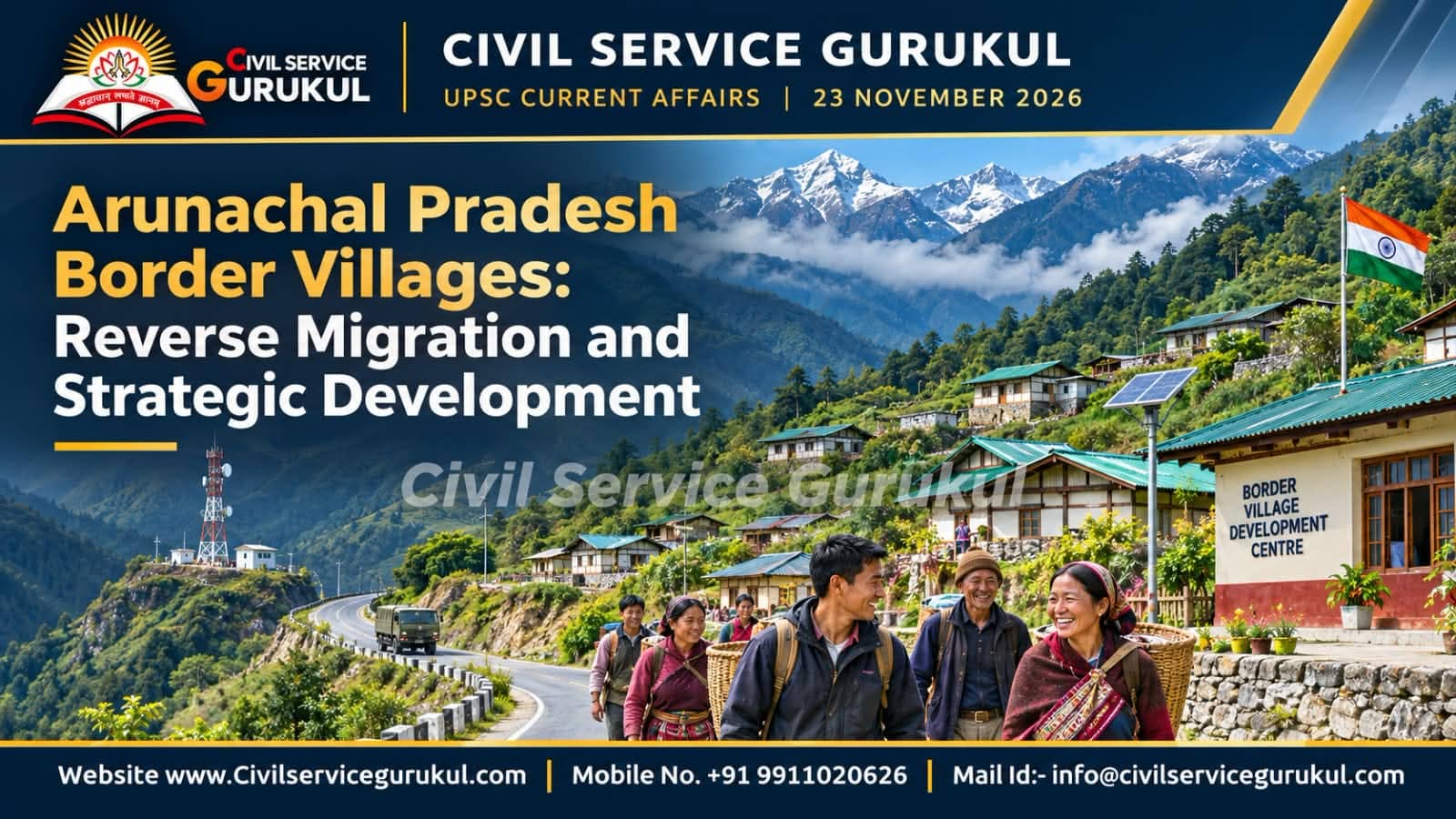
Arunachal Pradesh Border Villages Witness Reverse Migration: How the Vibrant Villages Programme Is Transforming India's Strategic Frontiers
India's border management strategy is increasingly integrating infrastructure development, rural livelihoods, community empowerment and national security. The reported return of residents to border villages in Arunachal Pradesh highlights the potential of development-oriented governance in strengthening India's Himalayan frontiers.
Why in the News?
On 22 November 2026, Union Home Minister Amit Shah stated that residents had begun returning to around 40 border villages in Arunachal Pradesh following improvements associated with the Vibrant Villages Programme.
The announcement was made during a cooperative festival in Itanagar, where the Union Minister unveiled the Arunachal Pradesh Cooperative Vision 2047 and launched development initiatives valued at approximately ₹5,610.95 crore.
The reported reverse migration reflects the potential relationship between improved infrastructure, local employment opportunities, public services and the willingness of residents to remain in or return to remote border settlements.
However, the reported number of villages should be understood as a government statement rather than an independently verified demographic impact assessment.
UPSC CSE Syllabus Relevance
| UPSC Paper | Relevant Syllabus Topics |
|---|---|
| Prelims GS Paper I | Indian geography, government schemes, economic development and current affairs |
| Mains GS Paper I | Population, migration, regional development and physical geography |
| Mains GS Paper II | Government policies, welfare schemes, governance, India and its neighbourhood |
| Mains GS Paper III | Border management, internal security, infrastructure, inclusive growth and disaster management |
| Mains GS Paper IV | Participatory governance, empathy, public service and ethical development |
| Essay Paper | National security, sustainable development, regional inequality and human dignity |
Geographical and Strategic Significance of Arunachal Pradesh
Arunachal Pradesh occupies a strategically significant position in the eastern Himalayan region of northeastern India.
The state is characterized by mountainous terrain, deep river valleys, extensive forests, rich biodiversity and diverse indigenous communities.
Its international boundaries and geographical location make it particularly important for India's border management, regional connectivity and national security.
| Geographical Particular | Details |
|---|---|
| Capital | Itanagar |
| Geographical Region | Eastern Himalayas and Northeast India |
| Total Area | 83,743 square kilometres |
| International Boundaries | China, Bhutan and Myanmar |
| Domestic Boundaries | Assam and Nagaland |
| Major River Systems | Siang, Subansiri, Kameng, Lohit and Dibang |
| Important Passes | Sela Pass, Bum La and Pangsau Pass |
| Constitutional Provision | Article 371H |
| Statehood Day | 20 February 1987 |
Why Arunachal Pradesh Is Strategically Important
- Its northern frontier forms part of the eastern sector of the India-China boundary dispute.
- Its international borders connect the state geographically with China, Bhutan and Myanmar.
- Mountainous terrain influences accessibility, infrastructure development and border management.
- The state contains major river systems with ecological, agricultural and hydropower significance.
- Its location makes it relevant to India's broader engagement with Southeast Asia.
- Resident communities contribute to regional economic activity, cultural continuity and public administration.
The Brahmaputra enters Arunachal Pradesh from Tibet, where it is known as the Yarlung Tsangpo. In Arunachal Pradesh, it is known as the Siang or Dihang before entering Assam and becoming the Brahmaputra after meeting major tributaries.
What Is Reverse Migration?
Reverse migration refers to the movement of individuals or households back to their original place of residence after having migrated elsewhere.
In the context of Arunachal Pradesh's border villages, reverse migration involves residents returning to native settlements after previously moving away because of limited employment opportunities, inadequate infrastructure, educational needs or other socio-economic factors.
It is important to distinguish temporary visits, seasonal movement and permanent household resettlement when measuring the scale and sustainability of reverse migration.
Types of Migration Relevant to UPSC
| Migration Type | Meaning |
|---|---|
| Rural-to-Urban Migration | Movement from villages to urban settlements |
| Urban-to-Rural Migration | Movement from urban areas to rural settlements |
| Reverse Migration | Return of migrants to their original place of residence |
| Seasonal Migration | Temporary movement associated with seasonal employment or other requirements |
| Distress Migration | Movement caused by economic hardship, insecurity or adverse living conditions |
| Voluntary Migration | Movement undertaken primarily through individual or household choice |
Why Do People Migrate Away from Border Villages?
1. Limited Employment Opportunities
Remote villages may offer limited livelihood options beyond subsistence agriculture, traditional occupations and small-scale economic activities.
2. Inadequate Transport Connectivity
Difficult terrain, unreliable road networks and seasonal disruptions can restrict access to markets, educational institutions and healthcare facilities.
3. Limited Healthcare Infrastructure
The absence of accessible medical facilities and specialized healthcare services may encourage households to relocate to larger settlements.
4. Educational Requirements
Families may migrate to provide children with better educational opportunities, particularly at secondary and higher levels.
5. Digital Connectivity Gaps
Limited mobile and internet access can reduce access to information, financial services, education and modern employment opportunities.
6. Climatic and Environmental Challenges
Landslides, floods, extreme weather conditions and challenging terrain can affect housing, livelihoods and infrastructure reliability.
7. Market Access Constraints
High transportation costs and limited local markets can make agricultural production, handicrafts and other rural enterprises economically less attractive.
Push and Pull Factors of Border Village Migration
| Push Factors from Villages | Pull Factors Encouraging Return |
|---|---|
| Unemployment | Local livelihood opportunities |
| Poor road connectivity | Reliable all-weather transportation |
| Limited healthcare | Accessible health facilities |
| Educational limitations | Improved schools and digital education |
| Weak market access | Cooperatives and organized procurement |
| Inadequate electricity | Reliable energy infrastructure |
| Limited telecommunications | Mobile and internet connectivity |
| Economic uncertainty | Sustainable and diversified income sources |
Reverse migration becomes sustainable when the economic and social advantages of returning to a native village are sufficient to support long-term household aspirations. Infrastructure development alone may not ensure permanent resettlement unless accompanied by viable livelihoods and quality public services.
What Is the Vibrant Villages Programme?
The Vibrant Villages Programme is an integrated border area development initiative of the Government of India aimed at improving living conditions and livelihood opportunities in selected settlements along the country's international land borders.
The programme seeks to reduce development disparities between remote border regions and other areas by combining infrastructure creation, welfare delivery, local economic development and community participation.
VVP-I was approved on 15 February 2023 and formally launched on 10 April 2023 at Kibithoo in Anjaw district of Arunachal Pradesh.
The initiative reflects a policy shift towards viewing frontier settlements as India's first villages rather than geographically isolated last villages.
Major Objectives of the Vibrant Villages Programme
- Reduce distress-driven outward migration.
- Improve the quality of life of border residents.
- Strengthen physical and digital connectivity.
- Expand access to essential public services.
- Create sustainable local livelihood opportunities.
- Promote entrepreneurship and rural economic development.
- Support local culture and traditional knowledge.
- Improve coordination between border communities and public institutions.
- Strengthen development-oriented border management.
Vibrant Villages Programme-I vs Vibrant Villages Programme-II
| Particulars | VVP-I | VVP-II |
|---|---|---|
| Approval Date | 15 February 2023 | 2 April 2025 |
| Scheme Type | Centrally Sponsored Scheme | Central Sector Scheme |
| Financial Outlay | ₹4,800 crore | ₹6,839 crore |
| Nodal Ministry | Ministry of Home Affairs | Ministry of Home Affairs |
| Geographical Coverage | Selected villages along the northern border | Selected villages along other international land borders not covered under VVP-I |
| Villages Identified on Priority | 662 initially prioritized villages | 1,954 identified villages |
| Funding Structure | Centrally Sponsored Scheme framework | 100% Central Government funding |
| Major Focus | Connectivity, public services and livelihoods | Village development, convergence, livelihood generation and border-specific interventions |
States and Union Territory Covered Under VVP-I
- Arunachal Pradesh.
- Himachal Pradesh.
- Sikkim.
- Uttarakhand.
- Union Territory of Ladakh.
States and Union Territories Covered Under VVP-II
VVP-II extends the border development approach to eligible areas in 15 states and two Union Territories:
Arunachal Pradesh, Assam, Bihar, Gujarat, Manipur, Meghalaya, Mizoram, Nagaland, Punjab, Rajasthan, Sikkim, Tripura, Uttarakhand, Uttar Pradesh, West Bengal, Jammu and Kashmir, and Ladakh.
Its approved financial period extends from FY 2024-25 to FY 2028-29.
VVP-I is a Centrally Sponsored Scheme, whereas VVP-II is a Central Sector Scheme with complete Central Government funding. The two programmes should not be confused.
Major Components of the Vibrant Villages Programme
1. Physical Infrastructure Development
Roads, bridges and village-level infrastructure can improve accessibility, reduce transport costs and facilitate access to essential services.
2. Digital Connectivity
Mobile networks and internet access support digital education, financial inclusion, telemedicine, communication and electronic governance.
3. Electricity and Renewable Energy
Reliable electricity supply and decentralized renewable energy systems can support households, schools, healthcare facilities and local enterprises.
4. Healthcare and Education
Improving access to schools, medical services and community infrastructure can reduce the pressure on families to relocate for essential needs.
5. Agriculture and Allied Activities
Agriculture, horticulture, animal husbandry, dairy production and other suitable activities can diversify local incomes.
6. Sustainable Tourism
Nature-based tourism, cultural tourism and community-managed homestays may generate additional livelihood opportunities when developed within ecological limits.
7. Local Entrepreneurship
Skill development, self-help groups, cooperative institutions and local product value chains can improve economic opportunities.
8. Scheme Convergence
The integration of existing government programmes can help address multiple development needs through coordinated implementation rather than isolated interventions.
Under VVP-II, all-weather road connectivity is to be supported through the approved PMGSY-IV framework, while village-level priorities are identified through collaborative action plans.
How Border Development Can Encourage Reverse Migration
Improved transportation, electricity, water supply and telecommunications reduce geographical isolation.
Accessible schools, healthcare and public administration improve household living conditions.
Agriculture, tourism, cooperatives and rural entrepreneurship create alternative income opportunities.
Residents may become less dependent on migration for basic services and livelihood security.
Some former residents may choose to return when improved local conditions meet household aspirations.
Long-term development can strengthen local institutions, economic resilience and community participation in governance.
Strategic Significance of Reverse Migration
1. Human-Centric Border Management
Border management requires more than military infrastructure and surveillance. Residents possess knowledge of local geography, environmental conditions and community networks that can support civil administration and emergency response.
Community participation must remain voluntary, rights-based and consistent with the safety of civilians.
2. Stronger Administrative Presence
Functioning settlements support the delivery of public services and regular engagement between residents and government institutions.
3. Improved Infrastructure Resilience
Reliable connectivity can support civilian mobility, disaster response and the lawful logistical requirements of border administration.
4. Reduction in Regional Development Disparities
Targeted public investment in remote frontier regions can reduce disadvantages arising from difficult geography and historically limited infrastructure.
5. Strengthening National Integration
Equitable access to welfare, education, economic opportunities and public institutions can reinforce citizens' confidence in governance.
6. Economic Resilience of Frontier Communities
Local enterprises and diversified livelihoods can reduce excessive dependence on distant markets and seasonal employment.
7. Cultural Preservation
Sustainable village economies can help indigenous communities preserve their languages, traditions, traditional ecological knowledge and cultural practices.
Populated and prosperous border villages can contribute to national resilience, but the rights, safety and aspirations of their residents must remain central. Border communities should be treated as beneficiaries and partners in development rather than merely as instruments of security policy.
India-China Border and the Importance of Arunachal Pradesh
The India-China boundary dispute is generally discussed in terms of western, middle and eastern sectors.
| Sector | Broad Geographical Region |
|---|---|
| Western Sector | Ladakh region |
| Middle Sector | Himachal Pradesh and Uttarakhand |
| Eastern Sector | Arunachal Pradesh, with Sikkim also relevant to India's eastern frontier |
The Line of Actual Control represents the line separating areas under Indian and Chinese control along much of their disputed boundary. Its alignment has not been mutually agreed in all areas.
India considers Arunachal Pradesh an integral part of its sovereign territory. China disputes India's position over substantial parts of the state.
A durable approach to frontier security requires appropriate defence preparedness, diplomatic engagement, crisis management and development that improves civilian welfare.
McMahon Line: Important Historical Background
The McMahon Line is associated with the boundary arrangements negotiated between British India and Tibet during the Simla Convention process of 1913-1914.
India regards it as the basis of the boundary in the eastern sector, while China does not recognize the agreement as a valid settlement of the boundary.
The McMahon Line and the Line of Actual Control are conceptually different and should not be treated as interchangeable terms.
The McMahon Line concerns the historical boundary alignment in the eastern sector, whereas the Line of Actual Control concerns actual territorial control along the disputed frontier.
Role of Cooperatives in Border Village Development
Cooperative institutions can help overcome the disadvantages faced by small producers operating in geographically isolated rural settlements.
During the November 2026 event in Itanagar, local procurement by the armed forces and border guarding personnel was highlighted as a potential source of demand for agricultural and dairy produce.
Arunachal Pradesh Cooperative Vision 2047 also places emphasis on local economic opportunities, producer organizations and market access.
How Cooperatives Can Support Reverse Migration
- Aggregate agricultural and horticultural produce from small farmers.
- Improve bargaining power and market access.
- Support dairy and livestock-based livelihoods.
- Facilitate processing, storage and transportation.
- Promote women-led self-help groups and entrepreneurship.
- Encourage locally suitable fisheries and allied activities.
- Connect rural producers with institutional buyers.
- Support value addition to traditional and indigenous products.
Relevant Government Schemes and Institutional Linkages
| Scheme or Institution | Potential Contribution |
|---|---|
| Vibrant Villages Programme | Integrated border village development |
| Border Area Development Programme | Addressing development needs in border regions |
| Pradhan Mantri Gram Sadak Yojana | Rural road connectivity |
| Jal Jeevan Mission | Household drinking water infrastructure |
| DAY-NRLM | Rural livelihoods and women-led self-help groups |
| PM-KUSUM | Eligible decentralized renewable energy and agricultural applications |
| National Rural Livelihoods Institutions | Skill development and economic empowerment |
| Border Roads Organisation | Development and maintenance of strategic transport infrastructure |
| Indo-Tibetan Border Police | Border guarding and appropriate community engagement |
These programmes and institutions represent relevant areas of possible coordination. Their listing does not imply that every scheme is operational in every identified border village.
Constitutional and Governance Dimensions
Article 14
Equality before the law and equal protection of the laws provide a constitutional foundation for non-discriminatory governance.
Article 21
The protection of life and personal liberty, as interpreted through constitutional jurisprudence, reinforces the importance of dignified living conditions.
Article 19(1)(d) and Article 19(1)(e)
Citizens have constitutional freedoms of movement and residence, subject to permissible reasonable restrictions. Reverse migration should therefore remain a voluntary development outcome.
Article 46
The Directive Principles emphasize the promotion of educational and economic interests of weaker sections, particularly Scheduled Castes and Scheduled Tribes.
Article 371H
Article 371H contains special provisions concerning Arunachal Pradesh, including the Governor's special responsibility regarding law and order as specified in the Constitution.
Cooperative Federalism
Effective border village development requires coordination among Central ministries, state governments, district administrations, local institutions and community organizations.
Environmental Significance of Border Village Development
Arunachal Pradesh forms part of the ecologically sensitive Eastern Himalayan region.
The region supports extensive forests, diverse wildlife, freshwater ecosystems and traditional livelihood systems.
Rapid infrastructure development without adequate environmental safeguards can create risks involving habitat fragmentation, slope instability, water pollution and biodiversity loss.
Environmental Priorities
- Climate-resilient road and bridge construction.
- Scientific slope stability assessments.
- Protection of forests and wildlife corridors.
- Sustainable watershed management.
- Disaster-resilient housing and infrastructure.
- Responsible tourism and waste management.
- Community participation in biodiversity conservation.
- Decentralized renewable energy solutions.
Border infrastructure development must balance national security requirements with ecological sustainability, indigenous rights and disaster risk reduction in the fragile Himalayan ecosystem.
Major Challenges in Border Village Development
1. Difficult Himalayan Terrain
Mountainous landscapes, steep slopes and remote settlements increase infrastructure construction and maintenance costs.
2. Natural Disaster Vulnerability
Landslides, earthquakes, flooding and extreme rainfall can disrupt connectivity and damage public infrastructure.
3. Limited Market Size
Small populations and geographically dispersed settlements may make private investment and service delivery financially challenging.
4. Human Resource Shortages
Recruiting and retaining teachers, doctors, engineers and skilled workers in remote locations can be difficult.
5. Infrastructure Maintenance
Creating new infrastructure without providing adequate maintenance resources may limit long-term effectiveness.
6. Environmental Degradation
Unplanned construction and tourism can place pressure on forests, water resources and fragile mountain ecosystems.
7. Indigenous Community Concerns
Development initiatives must respect customary practices, community land arrangements, cultural identity and local decision-making.
8. Inter-Departmental Coordination
Multiple implementing agencies can create challenges involving duplication, accountability and project monitoring.
9. Sustainability of Return Migration
Residents may return temporarily after infrastructure improvements but migrate again if employment, education and healthcare needs remain unmet.
10. Limited Impact Assessment
A Lok Sabha reply dated 3 February 2026 reported return migration in villages of Kurung Kumey, Dibang Valley and Shi-Yomi districts. It also stated that a formal programme impact assessment had not been carried out at that time.
A robust evaluation is therefore necessary to distinguish anecdotal improvements from durable demographic and economic outcomes.
How Should the Success of the Vibrant Villages Programme Be Measured?
| Indicator | Purpose of Measurement |
|---|---|
| Permanent Returnee Households | Assess long-term reverse migration |
| Net Migration Rate | Measure overall demographic change |
| Local Employment Rate | Evaluate livelihood generation |
| Household Income | Measure improvement in economic well-being |
| Road Accessibility Throughout the Year | Evaluate reliability of transportation |
| Healthcare Access | Assess availability and quality of medical services |
| School Enrollment and Attendance | Evaluate educational outcomes |
| Digital Connectivity | Measure quality and availability of communication services |
| Women's Economic Participation | Evaluate inclusive livelihood development |
| Environmental Indicators | Monitor ecological sustainability |
| Community Satisfaction | Evaluate citizen-centric governance |
Way Forward
1. Adopt Village-Specific Development Plans
Development strategies should reflect the geographical conditions, population profile, economic opportunities and cultural characteristics of individual villages.
2. Build Climate-Resilient Infrastructure
Roads, bridges, housing and public facilities should be designed to withstand Himalayan environmental conditions and disaster risks.
3. Strengthen Local Livelihoods
Agriculture, horticulture, animal husbandry, handicrafts, digital services and responsible tourism should be developed according to local potential.
4. Promote Cooperative Institutions
Producer cooperatives and self-help groups can improve market access, value addition and local economic participation.
5. Improve Human Resource Availability
Appropriate incentives, infrastructure and professional support can help retain teachers, healthcare workers and other essential service providers in remote settlements.
6. Ensure Digital Inclusion
Reliable telecommunications can support online learning, telemedicine, digital payments and access to government services.
7. Strengthen Community Participation
Local residents should participate in identifying priorities, planning projects, monitoring implementation and evaluating outcomes.
8. Protect Indigenous Rights and Cultural Identity
Development planning must respect customary institutions, traditional livelihoods and applicable legal protections.
9. Introduce Independent Impact Assessments
Periodic demographic, economic, environmental and social evaluations should assess whether development projects are producing sustainable improvements.
10. Improve Institutional Coordination
Central and state agencies should coordinate project implementation, funding, monitoring and infrastructure maintenance.
11. Continue Diplomatic Engagement
Border development should complement peaceful diplomatic engagement, confidence-building measures and appropriate security preparedness.
UPSC Prelims 2027: Important Facts for Revision
- Vibrant Villages Programme-I was approved on 15 February 2023.
- VVP-I was formally launched on 10 April 2023.
- The launch location was Kibithoo in Anjaw district of Arunachal Pradesh.
- The nodal ministry is the Ministry of Home Affairs.
- VVP-I is a Centrally Sponsored Scheme.
- VVP-I has an approved financial outlay of ₹4,800 crore.
- Initially, 662 villages were prioritized under VVP-I.
- VVP-II was approved on 2 April 2025.
- VVP-II is a Central Sector Scheme.
- VVP-II receives 100% Central Government funding.
- The approved financial outlay of VVP-II is ₹6,839 crore.
- VVP-II covers 1,954 identified villages.
- The combined approved outlay of VVP-I and VVP-II is ₹11,639 crore.
- Arunachal Pradesh shares international boundaries with China, Bhutan and Myanmar.
- Article 371H contains special constitutional provisions relating to Arunachal Pradesh.
- Reverse migration refers to the return of migrants to their original places of residence.
- The McMahon Line is associated with the eastern sector of the India-China boundary dispute.
- The Vibrant Villages Programme combines development interventions with border management objectives.
UPSC Prelims Practice Questions
Question 1
With reference to the Vibrant Villages Programme, consider the following statements:
1. Vibrant Villages Programme-I is a Centrally Sponsored Scheme.
2. Vibrant Villages Programme-II is a Central Sector Scheme.
3. Both programmes are administered by the Ministry of Rural Development.
Which of the statements given above are correct?
(a) 1 only
(b) 1 and 2 only
(c) 2 and 3 only
(d) 1, 2 and 3
View Answer and Explanation
Correct Answer: (b) 1 and 2 only
Statement 1 is correct because VVP-I operates as a Centrally Sponsored Scheme.
Statement 2 is correct because VVP-II is a Central Sector Scheme.
Statement 3 is incorrect because the nodal ministry is the Ministry of Home Affairs.
Question 2
Which of the following countries share an international land boundary with Arunachal Pradesh?
1. China
2. Bhutan
3. Myanmar
4. Nepal
Select the correct answer using the code given below:
(a) 1 and 2 only
(b) 2 and 3 only
(c) 1, 2 and 3 only
(d) 1, 2, 3 and 4
View Answer and Explanation
Correct Answer: (c) 1, 2 and 3 only
Arunachal Pradesh shares international boundaries with China, Bhutan and Myanmar. It does not share a boundary with Nepal.
Question 3
The Vibrant Villages Programme-I was formally launched at Kibithoo, which is located in:
(a) Tawang district
(b) Anjaw district
(c) West Kameng district
(d) Upper Subansiri district
View Answer and Explanation
Correct Answer: (b) Anjaw district
Kibithoo is located in Anjaw district of Arunachal Pradesh. VVP-I was formally launched there on 10 April 2023.
Question 4
Consider the following statements regarding reverse migration:
1. It refers to the return of migrants to their original places of residence.
2. Improvement in local employment opportunities may encourage reverse migration.
3. Reverse migration necessarily implies that all outward migration has permanently stopped.
Which of the statements given above are correct?
(a) 1 only
(b) 1 and 2 only
(c) 2 and 3 only
(d) 1, 2 and 3
View Answer and Explanation
Correct Answer: (b) 1 and 2 only
Reverse migration involves return movement to the place of origin. Local employment and infrastructure improvements may encourage such movement. However, return migration does not establish that outward migration has permanently ceased.
Question 5
Consider the following pairs:
| Programme | Financial Outlay |
|---|---|
| 1. Vibrant Villages Programme-I | ₹4,800 crore |
| 2. Vibrant Villages Programme-II | ₹6,839 crore |
| 3. Combined Outlay of VVP-I and VVP-II | ₹11,639 crore |
How many of the pairs given above are correctly matched?
(a) Only one
(b) Only two
(c) All three
(d) None
View Answer and Explanation
Correct Answer: (c) All three
The approved outlay of VVP-I is ₹4,800 crore, while VVP-II has an outlay of ₹6,839 crore. Their combined outlay is ₹11,639 crore.
Question 6
Which of the following measures can contribute to sustainable development of Himalayan border villages?
1. All-weather road connectivity.
2. Community-led livelihood development.
3. Climate-resilient infrastructure.
4. Unrestricted tourism without environmental safeguards.
Select the correct answer using the code given below:
(a) 1 and 2 only
(b) 2 and 4 only
(c) 1, 2 and 3 only
(d) 1, 2, 3 and 4
View Answer and Explanation
Correct Answer: (c) 1, 2 and 3 only
Road connectivity, local livelihoods and climate-resilient infrastructure can support sustainable development. Unregulated tourism may damage fragile Himalayan ecosystems.
Question 7
Article 371H of the Constitution of India contains special provisions relating to which of the following states?
(a) Sikkim
(b) Nagaland
(c) Mizoram
(d) Arunachal Pradesh
View Answer and Explanation
Correct Answer: (d) Arunachal Pradesh
Article 371H provides special constitutional arrangements for Arunachal Pradesh, including provisions relating to the Governor's responsibility concerning law and order.
Question 8
With reference to the Vibrant Villages Programme-II, consider the following statements:
1. It is fully funded by the Central Government.
2. It is intended exclusively for villages along the northern border already covered under VVP-I.
3. It emphasizes collaborative village action plans and convergence of government schemes.
Which of the statements given above are correct?
(a) 1 and 2 only
(b) 1 and 3 only
(c) 2 and 3 only
(d) 1, 2 and 3
View Answer and Explanation
Correct Answer: (b) 1 and 3 only
VVP-II is a fully centrally funded scheme and emphasizes collaborative planning and convergence. It extends the development approach to selected villages along other international land borders not covered under VVP-I.
UPSC Mains Practice Questions
Question 1 – GS Paper III
"Border management is not merely a military exercise but also a developmental challenge." Discuss with reference to the Vibrant Villages Programme and reverse migration in Arunachal Pradesh.
Marks: 15 | Word Limit: 250 words
Question 2 – GS Paper I
Examine the major causes of outward migration from India's Himalayan border villages. How can integrated rural development encourage sustainable reverse migration?
Marks: 15 | Word Limit: 250 words
Question 3 – GS Paper II
Evaluate the role of cooperative federalism and community participation in ensuring effective implementation of border area development programmes in India.
Marks: 10 | Word Limit: 150 words
Question 4 – GS Paper III
Discuss the challenges of balancing strategic infrastructure development with environmental sustainability in the Eastern Himalayan region.
Marks: 15 | Word Limit: 250 words
Question 5 – GS Paper III
Distinguish between Vibrant Villages Programme-I and Vibrant Villages Programme-II. Examine their significance for India's integrated border management strategy.
Marks: 10 | Word Limit: 150 words
UPSC Mains Model Answer
Question
"Border management is not merely a military exercise but also a developmental challenge." Discuss with reference to the Vibrant Villages Programme and reverse migration in Arunachal Pradesh.
GS Paper III | 15 Marks | 250 Words
Introduction
Border security depends not only on defence preparedness but also on the socio-economic resilience of frontier communities. The reported return of residents to around 40 border villages in Arunachal Pradesh highlights the potential of the Vibrant Villages Programme to integrate rural development with border management.
Development-Security Linkage
- Improved roads, electricity and telecommunications reduce geographical isolation and strengthen administrative accessibility.
- Healthcare and educational facilities improve living standards and reduce distress migration.
- Agriculture, tourism, cooperatives and local procurement generate sustainable livelihood opportunities.
- Thriving communities contribute to local governance, disaster resilience and national integration.
- Community engagement can improve coordination between residents and border management institutions.
Major Challenges
- Difficult terrain and high infrastructure costs.
- Environmental fragility and disaster vulnerability.
- Limited market access and shortage of skilled professionals.
- Coordination gaps among implementing agencies.
- Insufficient evidence regarding long-term migration outcomes.
Way Forward
India should prioritize climate-resilient infrastructure, participatory village planning, diversified livelihoods, digital inclusion and regular independent impact assessments. Development must respect indigenous rights and ensure that return migration remains voluntary. Strategic preparedness should complement diplomatic engagement and peaceful border management.
Conclusion
Prosperous border villages can strengthen India's national resilience while advancing inclusive development. The transformation of frontier settlements into economically viable communities should therefore be understood as a citizen-centric governance objective as well as a strategic development priority.
Important Keywords for UPSC Mains Answer Writing
Human-Centric Border Management | Development-Security Nexus | Reverse Migration | Cooperative Federalism | Inclusive Growth | Regional Development | Strategic Connectivity | Community Resilience | Last-Mile Governance | Indigenous Rights | Climate-Resilient Infrastructure | Scheme Convergence | Participatory Development | National Integration | Evidence-Based Policymaking | Sustainable Livelihoods | Demographic Resilience | Ecological Security
Frequently Asked Questions
1. Why are Arunachal Pradesh's border villages in the news?
On 22 November 2026, the Union Home Minister reported that residents had begun returning to around 40 border villages following development interventions associated with the Vibrant Villages Programme.
2. What is reverse migration?
Reverse migration refers to the return of migrants to their original places of residence after having moved elsewhere.
3. What is the Vibrant Villages Programme?
It is a Government of India initiative aimed at comprehensive development of selected border villages through improved infrastructure, livelihoods and public services.
4. When was the Vibrant Villages Programme launched?
VVP-I was formally launched on 10 April 2023 at Kibithoo in Arunachal Pradesh.
5. Which ministry implements the Vibrant Villages Programme?
The Ministry of Home Affairs is the nodal ministry.
6. What is the financial outlay of VVP-I?
The approved financial outlay of VVP-I is ₹4,800 crore.
7. What is the financial outlay of VVP-II?
The approved financial outlay of VVP-II is ₹6,839 crore.
8. Is VVP-II a Centrally Sponsored Scheme?
No. VVP-II is a Central Sector Scheme funded entirely by the Central Government, whereas VVP-I is a Centrally Sponsored Scheme.
9. Which countries share a border with Arunachal Pradesh?
Arunachal Pradesh shares international land boundaries with China, Bhutan and Myanmar.
10. Which constitutional article contains special provisions for Arunachal Pradesh?
Article 371H contains special constitutional provisions relating to Arunachal Pradesh.
11. What is the strategic significance of reverse migration?
Sustainable return migration may strengthen local economies, community institutions, administrative presence and development-oriented border management.
12. Has the impact of VVP on migration been independently established?
A parliamentary reply in February 2026 stated that no formal impact assessment had been carried out at that time. Subsequent government statements indicate positive developments, but independently evaluated long-term demographic outcomes remain important.
13. Why is the topic important for UPSC 2027?
The topic connects Indian geography, migration, government schemes, cooperative federalism, environmental sustainability, international relations and internal security.
Conclusion
The reported reverse migration in Arunachal Pradesh's border villages highlights the potential of integrated development policies to address longstanding challenges associated with geographical isolation and limited economic opportunities.
The Vibrant Villages Programme represents an approach that combines infrastructure, livelihood development, public service delivery and strategic border management.
Its long-term success will depend on sustainable employment, reliable public services, environmental safeguards, community participation and measurable improvements in household well-being.
India's border villages should not be viewed solely as remote geographical settlements. They are living communities whose prosperity, rights, cultural identity and resilience are integral to inclusive national development.
Prepare for UPSC CSE 2027 with Civil Service Gurukul
Strengthen your preparation through syllabus-oriented current affairs, conceptual clarity, systematic revision, Prelims MCQs and analytical Mains answer writing.
Our Academic Focus:
UPSC Prelims | UPSC Mains | Current Affairs | General Studies | Indian Economy | Indian Polity | Geography | Environment and Ecology | Internal Security | Essay Writing | Test Series | Answer Writing Practice
Explore Our Courses Contact Our Academic Team WhatsApp for Guidance Email UsThis article has been prepared for educational purposes and UPSC Civil Services Examination preparation. It reflects information available as of 24 November 2026.
The reported reverse migration figure is based on a statement by the Union Home Minister and should not be interpreted as an independently verified population census. Analytical observations, policy recommendations and model answers are original educational interpretations.
The practice questions are independently prepared UPSC-style questions and are not represented as official UPSC previous-year questions.
Prepare with Mentors Who Cleared the Exam
Get personalized study plans, evaluated answer models, and test series access.