
Baltic Sea 2026: Complete UPSC Geography Notes
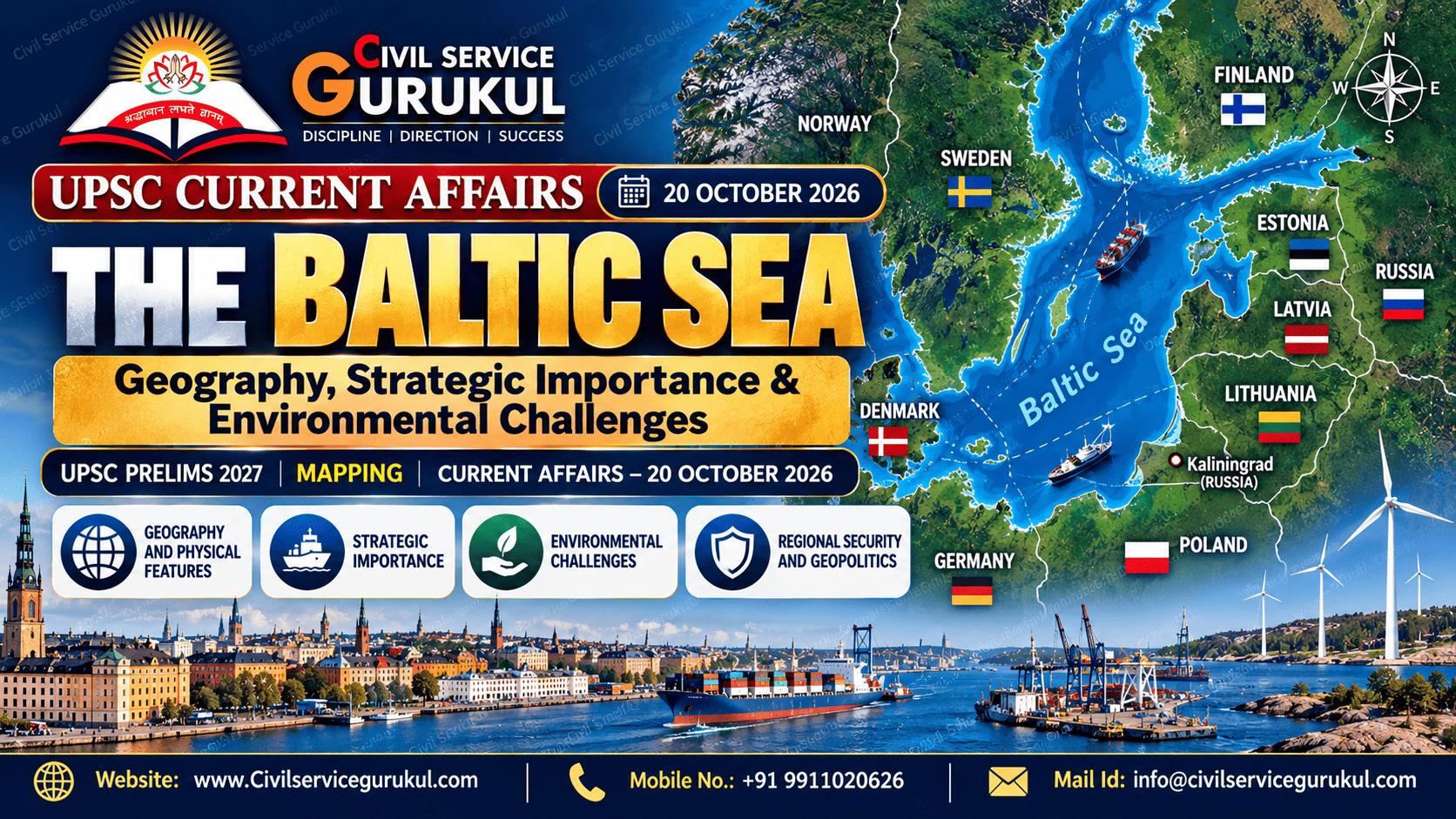
Baltic Sea in News 2026: Nine Bordering Countries, Geography, Eutrophication and Marine Dead Zones
Complete UPSC geography and environment notes covering the Baltic Sea, Danish Straits, major gulfs, its brackish-water ecosystem, Nordic cooperation and HELCOM.
Why in News? On 19 October 2026, the Nordic Council highlighted the persistent environmental deterioration of the Baltic Sea. The key concerns include nutrient pollution, eutrophication, oxygen-depleted seabeds and stressed fish stocks. The development makes the Baltic Sea important for UPSC map-based geography, marine ecology and international environmental governance.
UPSC GS Section / Paper
GS Paper I: World Geography, physical features, seas, straits and location-based questions.
GS Paper III: Environmental pollution, marine biodiversity, eutrophication and ecological conservation.
GS Paper II: Regional institutions and international environmental cooperation.
UPSC Prelims: Countries, rivers, gulfs, straits and environmental terminology.
1. Where Is the Baltic Sea Located?
The Baltic Sea is a semi-enclosed sea situated in Northern Europe. It lies between the Scandinavian Peninsula and continental Europe.
It forms part of the broader Atlantic Ocean system through its connection with the North Sea.
The sea is relatively shallow and receives freshwater from numerous rivers.
Its restricted exchange with the North Sea creates distinctive salinity and ecological conditions.
2. Nine Countries Bordering the Baltic Sea
| Country | Geographical Relevance |
|---|---|
| Denmark | Western entrance and Danish Straits |
| Sweden | Western and northern Baltic coast |
| Finland | Northern Baltic coast and Gulf of Finland |
| Russia | Gulf of Finland and Kaliningrad coast |
| Estonia | Eastern Baltic coast |
| Latvia | Eastern coast and Gulf of Riga |
| Lithuania | Southeastern Baltic coast |
| Poland | Southern Baltic coastline |
| Germany | Southwestern Baltic coastline |
Which Are the Three Baltic States?
The term Baltic States refers specifically to Estonia, Latvia and Lithuania.
Although Sweden, Finland and Denmark also border the Baltic Sea, they are not included in the three Baltic States.
Norway is a Nordic country, but it does not have a Baltic Sea coastline.
3. Important Straits, Gulfs and Rivers
Danish Straits
The principal Danish passages include the Øresund, the Great Belt and the Little Belt.
These passages form part of the route between the Baltic Sea and the North Sea.
Major Gulfs
| Gulf | Location |
|---|---|
| Gulf of Bothnia | Between Sweden and Finland |
| Gulf of Finland | Between Finland and Estonia, extending toward Russia |
| Gulf of Riga | Between Estonia and Latvia |
Important Rivers
Major rivers entering the Baltic Sea system include the Vistula, Oder, Neva, Daugava and Neman.
These rivers contribute freshwater and transport land-based nutrients into the marine environment.
4. Why Is the Baltic Sea Geographically Unique?
Brackish Water
The water contains less salt than ordinary ocean water due to substantial freshwater inputs.
Restricted Exchange
Narrow sea connections restrict the exchange of water with the North Sea.
Stratification
Surface and deeper water layers can have different salinities and densities.
Post-Glacial Formation
The sea's development was shaped by the retreat of major Pleistocene ice sheets.
These physical characteristics influence the distribution of dissolved oxygen, marine species and pollution.
Stable water layering can make it harder for oxygen-rich surface water to reach deeper basins.
5. Baltic Sea Environmental Crisis 2026
The Nordic Council's October 2026 discussion highlighted continuing pressure on the Baltic Sea ecosystem.
Important concerns include nutrient enrichment, algal blooms, poor seabed oxygen conditions and declining fish-stock health.
Major Environmental Threats
- Excess nitrogen and phosphorus.
- Agricultural nutrient runoff.
- Municipal wastewater pollution.
- Marine eutrophication.
- Oxygen-depleted seabed habitats.
- Pressure on cod, herring and other fish stocks.
- Climate-related ecological stress.
Important 2026 Current Affairs Fact
The Nordic Council reported that, among 15 assessed commercial fish stocks, only about four on average were in good condition during 2016–2021.
The figure describes the historical assessment period, not the precise condition of every stock in October 2026.
6. Eutrophication: The Main Pollution Problem
Eutrophication is the enrichment of a waterbody with nutrients, primarily nitrogen and phosphorus.
Excess nutrients can stimulate rapid growth of algae. When the resulting organic matter decomposes, oxygen in the water may be consumed.
How Eutrophication Develops
Why Recovery Takes Time
Nutrients stored in seabed sediments can continue to influence the ecosystem, even after external inputs fall.
This internal nutrient recycling, combined with restricted water exchange, can delay recovery.
7. Marine Dead Zones, Hypoxia and Anoxia
| Term | Meaning |
|---|---|
| Hypoxia | Low dissolved oxygen concentration. |
| Anoxia | Absence of dissolved oxygen. |
| Dead Zone | Severely oxygen-depleted water where many organisms cannot thrive. |
| Stratification | Separation into water layers with differing density. |
Dead zones can damage bottom-dwelling organisms, reduce habitat quality and disrupt marine food webs.
In some areas, low-oxygen sediments can release previously stored phosphorus, further reinforcing the eutrophication cycle.
8. Economic, Historical and Strategic Importance
Maritime Trade
The Baltic Sea is an important European shipping corridor.
Major ports in its region include Stockholm, Helsinki, Riga, Gdańsk and Saint Petersburg.
Historical Trade
The Hanseatic League connected trading towns around the Baltic and North Sea regions during medieval Europe.
Fisheries
Fishing supports regional coastal economies. Environmental degradation can affect catches, employment and food supply.
Security and Geopolitics
The Baltic Sea is strategically significant because it borders several European states and Russia and contains important shipping and infrastructure routes.
9. HELCOM and the Baltic Sea Action Plan
HELCOM stands for the Baltic Marine Environment Protection Commission.
It coordinates regional marine environmental cooperation under the Helsinki Convention.
Baltic Sea Action Plan
The Baltic Sea Action Plan was adopted in 2007 and updated in 2021.
It provides a framework for improving the environmental condition of the Baltic Sea through measures intended for implementation by 2030.
| Priority | Policy Objective |
|---|---|
| Biodiversity | Healthy and resilient marine ecosystems. |
| Eutrophication | Reduction of excess nutrient loading. |
| Hazardous Substances and Litter | Lower marine pollution. |
| Sea-Based Activities | Environmentally sustainable maritime activities. |
10. Challenges and the Way Forward
- Reduce agricultural runoff: Promote efficient fertiliser application and nutrient management.
- Improve wastewater treatment: Remove more nitrogen and phosphorus before discharge.
- Protect coastal wetlands: Maintain natural systems that help filter pollutants.
- Restore marine habitats: Protect biodiversity and ecological functioning.
- Strengthen fisheries management: Apply sustainable catch and stock-recovery practices.
- Improve international coordination: Use shared monitoring, environmental targets and scientific cooperation.
The Baltic Sea demonstrates that transboundary environmental problems cannot be addressed effectively through isolated national policies alone.
11. UPSC Prelims 2027: Quick Revision
| Topic | Key Fact |
|---|---|
| Sea | Baltic Sea |
| Location | Northern Europe |
| Coastal Countries | 9 |
| Baltic States | Estonia, Latvia, Lithuania |
| Connection | North Sea via Danish Straits |
| Water Type | Brackish |
| Gulfs | Bothnia, Finland, Riga |
| Rivers | Vistula, Oder, Neva, Daugava, Neman |
| Main Ecological Issue | Eutrophication |
| Main Nutrients | Nitrogen, phosphorus |
| Oxygen-Deficient Water | Hypoxia |
| Marine Protection Body | HELCOM |
| Action Plan Adopted | 2007 |
| Action Plan Updated | 2021 |
| Action Plan Horizon | 2030 |
12. UPSC Prelims Practice MCQs
Question 1
Which of the following countries border the Baltic Sea?
1. Sweden
2. Poland
3. Norway
4. Estonia
(a) 1 and 2 only
(b) 1, 2 and 4 only
(c) 2, 3 and 4 only
(d) All four
Show Answer
Correct Answer: (b). Norway does not border the Baltic Sea.
Question 2
The Baltic Sea is connected to the North Sea through:
(a) Bab-el-Mandeb
(b) Danish Straits
(c) Strait of Hormuz
(d) Bering Strait
Show Answer
Correct Answer: (b).
Question 3
The Baltic Sea is brackish because:
(a) It contains no freshwater
(b) Freshwater mixes with restricted inflows of saline seawater
(c) It is located in the Indian Ocean
(d) It has no connection with other seas
Show Answer
Correct Answer: (b).
Question 4
Which nutrients are primarily responsible for eutrophication?
(a) Nitrogen and phosphorus
(b) Iron and gold
(c) Helium and neon
(d) Sodium and chlorine alone
Show Answer
Correct Answer: (a).
Question 5
Consider the following statements:
1. HELCOM deals with Baltic marine environmental protection.
2. The Baltic Sea Action Plan was updated in 2021.
3. The Nordic Council and HELCOM are the same institution.
(a) 1 only
(b) 1 and 2 only
(c) 2 and 3 only
(d) All three
Show Answer
Correct Answer: (b). The two organisations are distinct.
13. UPSC Mains GS-III: Model Answer
Practice Question — 15 Marks
"The ecological degradation of the Baltic Sea demonstrates the importance of transboundary cooperation in marine conservation." Discuss with special reference to eutrophication and oxygen-depleted marine environments.
Suggested length: 250 words
Model Answer
Introduction: The Baltic Sea is a semi-enclosed brackish waterbody in Northern Europe. Its restricted seawater exchange and dense network of river catchments make it environmentally sensitive. In October 2026, the Nordic Council highlighted persistent ecological stress.
Causes: Agricultural runoff, untreated or inadequately treated wastewater and other sources contribute nitrogen and phosphorus. Excess nutrients promote algal blooms, while decomposition reduces dissolved oxygen. Salinity-driven stratification limits the renewal of deep waters.
Consequences: Oxygen depletion affects marine biodiversity, fish populations and seabed habitats. Degraded water quality can also undermine fisheries, tourism and coastal livelihoods.
International Response: HELCOM and the Baltic Sea Action Plan support regional cooperation, nutrient reduction, biodiversity protection and monitoring. Stronger wastewater treatment, sustainable agricultural practices and ecosystem restoration are essential.
Conclusion: The Baltic Sea highlights the importance of integrated land-to-sea governance, scientific monitoring and long-term cooperation for restoring marine ecosystems.
14. Frequently Asked Questions
Q1. Where is the Baltic Sea?
In Northern Europe, between Scandinavia and continental Europe.
Q2. How many countries border it?
Nine countries.
Q3. Which are the Baltic States?
Estonia, Latvia and Lithuania.
Q4. Why does the Baltic Sea face eutrophication?
Excessive nitrogen and phosphorus enter through agriculture, wastewater and other sources.
Q5. What is HELCOM?
The Baltic Marine Environment Protection Commission.
Q6. Which GS papers cover the topic?
Primarily GS-I World Geography and GS-III Environment and Ecology.
15. Conclusion: A Global Lesson in Marine Conservation
The Baltic Sea is important for its distinctive physical geography, nine coastal countries and connection with the North Sea through the Danish Straits.
Its environmental problems demonstrate how nutrient pollution, restricted water exchange and oxygen depletion can threaten marine life.
The October 2026 Nordic Council initiative reinforces the importance of regional cooperation and evidence-based policy.
For UPSC aspirants, the most important approach is to combine map-based facts with environmental processes and international governance.
Prepare for UPSC 2027 With Civil Service Gurukul
Join our Integrated Guidance Program for World Geography, Environment, Indian Polity, International Relations and Current Affairs, including Prelims practice and Mains answer writing.
Enquire About Courses Visit Our WebsitePrepare with Mentors Who Cleared the Exam
Get personalized study plans, evaluated answer models, and test series access.