
India's Surplus Labour Trap: UPSC Notes 2027
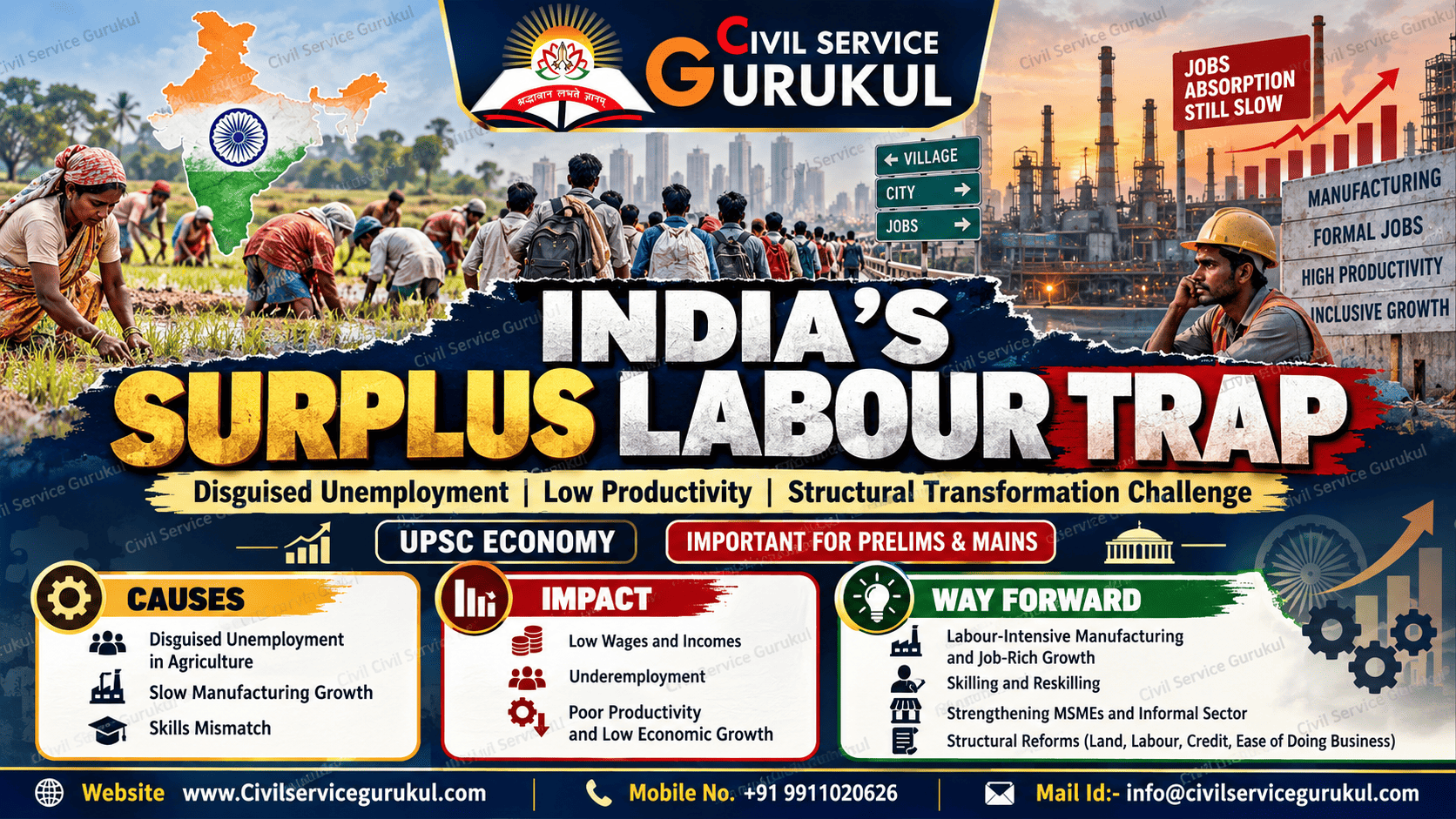
India's Surplus Labour Trap: Why Economic Growth Is Not Creating Enough Quality Jobs
Disguised unemployment, low-productivity agriculture, structural transformation, the Lewis dual-sector model, labour-market evidence and India's demographic dividend explained.
Central Issue: India's surplus labour trap refers to a structural economic challenge in which large numbers of workers remain employed in low-productivity agriculture, informal activities and marginal self-employment because adequate remunerative jobs are not available in higher-productivity sectors. A person may therefore be technically employed but economically underutilised. This is why employment quantity and employment quality must be examined separately.
UPSC GS Section / Paper
GS-III: Indian economy, employment, growth, development, inclusive growth and government budgeting.
GS-II: Welfare policies, human-resource development and governance.
GS-I: Population, migration, urbanisation and demographic dividend.
Prelims: Labour-market indicators, unemployment types, economic models and employment policies.
1. What Is India's Surplus Labour Trap?
Surplus labour exists when the number of workers available for an activity exceeds the amount required for efficient production.
For example, a small family farm may involve six members, even though four could maintain roughly the same output with existing land, capital and technology.
The two additional workers may be disguisedly unemployed. Their labour is being used, but their marginal contribution to production may be very low or effectively zero.
The trap arises when such workers cannot easily shift to higher-productivity activities because adequate opportunities, skills, finance or mobility are missing.
Illustrative Example
A farm produces 100 units with six workers. If four workers can still produce 100 units under the same conditions, the additional two workers may represent disguised unemployment.
This is a textbook illustration, not an estimate of India's actual agricultural workforce.
2. Types of Unemployment: Important UPSC Concepts
| Type | Meaning | Example |
|---|---|---|
| Open Unemployment | Available and seeking work but not employed. | A jobseeker unable to find work. |
| Disguised Unemployment | Workers contribute very little additional output. | Excess family workers on a farm. |
| Seasonal Unemployment | Work unavailable in certain parts of the year. | Season-dependent agricultural labour. |
| Structural Unemployment | Mismatch between available jobs and skills or location. | Workers lacking skills for expanding industries. |
| Underemployment | Insufficient working hours or inadequate utilisation of abilities. | Qualified worker in irregular, low-hour work. |
| Frictional Unemployment | Temporary unemployment during job transitions. | Worker changing employers. |
3. Lewis Dual-Sector Model Explained
Economist W. Arthur Lewis developed a dual-sector model to explain how development can occur through the movement of labour from traditional, low-productivity activities to a modern, higher-productivity economic sector.
Two Sectors
Traditional Sector
Typically represented by subsistence agriculture, low capital intensity, surplus workers and low labour productivity.
Modern Sector
Typically represented by industrial or other productive enterprises with capital accumulation and higher potential earnings.
Expected Transformation
What Is the Lewis Turning Point?
The Lewis turning point occurs when the surplus labour pool has been sufficiently absorbed that additional workers cannot be attracted without upward pressure on wages.
India's continuing productivity and employment disparities suggest that this transformation remains incomplete.
4. What Does Recent Evidence Show?
The Economic Survey 2025–26 reported that agriculture accounted for 42.4% of employed persons aged 15 and above in Q2 FY26 under the Current Weekly Status measure.
The Annual PLFS 2025 found that 23.6% of workers were in regular wage or salaried employment under usual status.
Unemployment among people with at least secondary education was estimated at 6.5% in 2025 under the same usual-status framework.
| Indicator | Figure | Meaning |
|---|---|---|
| Agricultural workforce share | 42.4% | Q2 FY26, age 15+, CWS |
| Regular salaried/wage employment | 23.6% | 2025, usual status |
| Educated unemployment | 6.5% | 2025, secondary education or above, age 15+, usual status |
| Monthly unemployment | 5.0% | September 2026, age 15+, CWS |
The ILO–IHD India Employment Report 2024 also identified the shortage of productive and remunerative non-farm jobs as an important obstacle for educated young workers.
These indicators highlight different dimensions of India's employment challenge, rather than establishing a single measure of surplus labour.
5. Why Does India's Surplus Labour Trap Persist?
Small Agricultural Holdings
Fragmented landholdings and limited productive assets constrain output per agricultural worker.
Insufficient Labour-Intensive Jobs
Manufacturing has not absorbed available workers as extensively as in some earlier industrialising economies.
Skills Mismatch
Qualifications, employable skills and employer requirements may not align.
Informal Employment
Many workers rely on small enterprises, irregular work and low-productivity self-employment.
Regional Development Gaps
Industrial investment, infrastructure and job opportunities remain uneven across states and districts.
Barriers to Mobility
Housing, transport, information gaps and family responsibilities may limit worker movement.
6. Can GDP Grow Without Enough Quality Jobs?
Yes. Output can expand through capital investment, technology, automation and better efficiency without a proportionate increase in employment.
Employment Elasticity of Growth
Employment elasticity =
Percentage change in employment divided by percentage change in real output.
For illustration, if employment grows by 2% while real output grows by 8%, employment elasticity is 0.25.
Low employment elasticity does not automatically indicate an unhealthy economy, because productivity improvements are valuable.
The policy concern arises when expanding output fails to provide sufficient jobs for those seeking better livelihoods and when workers cannot transition to more productive work.
7. Why Are Women and Young People Especially Important?
Women Workers
Unpaid household enterprise work, care responsibilities, limited safe transport and unequal access to formal opportunities can reduce women's access to remunerative employment.
Educated Youth
Young workers may struggle to obtain jobs that match their qualifications and career expectations.
The problem includes both open unemployment and employment below a worker's skill potential.
Regional Migration
Migration can improve access to jobs but may also expose workers to housing shortages, informal contracts and limited social protection.
8. Economic and Social Consequences
Low Household Incomes
Low productivity limits earnings and constrains household purchasing power.
Unequal Growth
Higher economic output may not translate into equally broad improvements in living standards.
Weak Domestic Demand
Inadequate labour income may limit consumption and demand for new business investment.
Demographic Risk
A large working-age population may become an economic challenge when productive job opportunities are scarce.
9. Government Initiatives Relevant to Employment
| Initiative | Relevant Objective |
|---|---|
| Make in India | Strengthen domestic manufacturing and investment. |
| Production Linked Incentive Schemes | Support production scale and investment in selected sectors. |
| PMKVY / Skill India | Promote vocational training and employability. |
| PMEGP | Support microenterprise establishment and self-employment. |
| MUDRA | Expand access to microenterprise credit. |
| PM Vishwakarma | Support traditional artisans and craft-based livelihoods. |
| MGNREGA | Provide a statutory rural wage-employment guarantee. |
| e-Shram | Facilitate registration and policy support for unorganised workers. |
The effectiveness of these interventions should be assessed through sustainable job creation, real earnings, enterprise productivity and long-term outcomes, not merely programme enrolment.
10. Way Forward: Escaping the Surplus Labour Trap
1. Expand labour-intensive manufacturing: Strengthen textiles, apparel, food processing, leather, furniture and other employment-generating value chains.
2. Increase MSME productivity: Improve technology access, formal credit, market linkages and cluster infrastructure.
3. Develop rural non-farm employment: Promote agro-processing, logistics, repair services and rural enterprises.
4. Reform skilling: Connect vocational education with apprenticeships and local employer demand.
5. Improve women's employment: Expand childcare, safe transport, suitable workplaces and equitable opportunities.
6. Enable worker mobility: Strengthen rental housing, portable benefits and reliable labour-market information.
7. Improve agricultural productivity: Support diversification, water efficiency, farmer producer organisations and supply chains.
8. Measure job quality: Track earnings, working hours, employment security, underemployment and labour productivity.
UPSC Mains Analytical Takeaway
India's policy objective should not be to move workers out of agriculture regardless of opportunities elsewhere. It should be to create productive, voluntary and remunerative transitions across the economy.
11. UPSC Prelims 2027: Quick Revision
| Concept | Remember |
|---|---|
| Surplus Labour | Workers available beyond the labour efficiently required. |
| Disguised Unemployment | Low or zero marginal contribution by additional workers. |
| Lewis Model | Movement from traditional to modern productive sector. |
| Lewis Turning Point | Exhaustion of surplus labour begins exerting upward wage pressure. |
| Structural Transformation | Reallocation of labour and output to higher-productivity sectors. |
| PLFS | Periodic Labour Force Survey, conducted by NSO under MoSPI. |
| LFPR | Labour Force Participation Rate. |
| WPR | Worker Population Ratio. |
| Employment Elasticity | Employment growth divided by output growth. |
| Demographic Dividend | Growth potential from favourable working-age population structure. |
12. UPSC Prelims Practice MCQs
Question 1
Disguised unemployment is most accurately described as:
(a) A worker changing jobs
(b) Additional workers contributing negligible marginal output
(c) Workers temporarily absent because of illness
(d) An economy with no unemployment
View answer
Answer: (b). This captures the standard economic meaning of disguised unemployment.
Question 2
The Lewis dual-sector model emphasises the transfer of labour from:
(a) Modern industry to subsistence agriculture
(b) Traditional low-productivity activities to the modern sector
(c) Public services to foreign trade only
(d) Urban employment to unpaid household work only
View answer
Answer: (b).
Question 3
The Periodic Labour Force Survey is conducted under:
(a) Reserve Bank of India
(b) Ministry of Statistics and Programme Implementation
(c) Election Commission
(d) NITI Aayog alone
View answer
Answer: (b).
Question 4
If employment grows by 3% and real output grows by 6%, employment elasticity equals:
(a) 0.5
(b) 2.0
(c) 3.0
(d) 9.0
View answer
Answer: (a). 3 ÷ 6 = 0.5.
Question 5
Consider the following statements:
- A lower unemployment rate necessarily means there is no underemployment.
- Structural transformation can increase aggregate productivity.
- Informal self-employment may coexist with low earnings.
Which statements are correct?
(a) 1 only
(b) 1 and 2 only
(c) 2 and 3 only
(d) All three
View answer
Answer: (c). Statement 1 is incorrect because unemployment and underemployment measure different conditions.
13. UPSC Mains GS-III: Model Answer
Practice Question — 15 Marks
"India's employment challenge is increasingly a problem of productivity and job quality rather than merely open unemployment." Examine the surplus labour trap and suggest measures for sustainable structural transformation.
Suggested word limit: 250 words
Model Answer
Introduction: India's surplus labour trap refers to the concentration of workers in low-productivity agriculture and informal activities due to inadequate remunerative employment elsewhere. The Economic Survey 2025–26 reported agriculture's share at 42.4% of employment in Q2 FY26 under PLFS Current Weekly Status.
Causes: Limited labour-intensive manufacturing, fragmented agricultural holdings, skills mismatch, informality and regional disparities constrain the transfer of workers to higher-productivity sectors.
Consequences: Low marginal productivity depresses earnings and household demand. Disguised unemployment, precarious self-employment and inadequate formal jobs weaken inclusive growth. Educated youth and women face additional barriers.
Way forward: India must expand labour-intensive manufacturing, MSME competitiveness and rural non-farm industries. Demand-linked skilling, apprenticeships, agricultural diversification and stronger worker mobility are essential. Female employment requires safe transport, childcare and flexible opportunities. Policy monitoring should prioritise real wages, productivity and job quality.
Conclusion: India can harness its demographic dividend by transforming surplus labour into a productive workforce through employment-rich and inclusive structural change.
14. Frequently Asked Questions
Q1. What is surplus labour?
Labour available in excess of what is efficiently needed for production.
Q2. What is disguised unemployment?
A situation in which some workers contribute little or no additional output despite being employed.
Q3. Who developed the dual-sector model?
Economist W. Arthur Lewis.
Q4. Why is economic growth alone insufficient?
Growth may arise from capital and productivity improvements without creating enough remunerative jobs.
Q5. Which GS paper covers the topic?
Primarily GS Paper III: Indian Economy, Employment and Inclusive Growth.
15. Conclusion
India's surplus labour trap highlights the gap between having work and having productive, remunerative work.
The central policy priority is to improve productivity, create sustainable non-farm jobs, strengthen skills and ensure that growth translates into better livelihoods.
For UPSC preparation, connect disguised unemployment with the Lewis model, structural transformation, employment elasticity and demographic dividend.
Master Indian Economy for UPSC 2027
Study with Civil Service Gurukul through our Integrated Guidance Program on Indian Economy, Current Affairs, Prelims concepts and GS-III Mains answer writing.
Explore Indian Economy study material authored by CA Dhananjay Ojha and contact us for book and course enquiries.
Contact for Books and Courses Visit Our WebsitePrepare with Mentors Who Cleared the Exam
Get personalized study plans, evaluated answer models, and test series access.