
India Battery Recycling 2026: Black Mass Export Ban, Critical Minerals & Circular Economy | UPSC
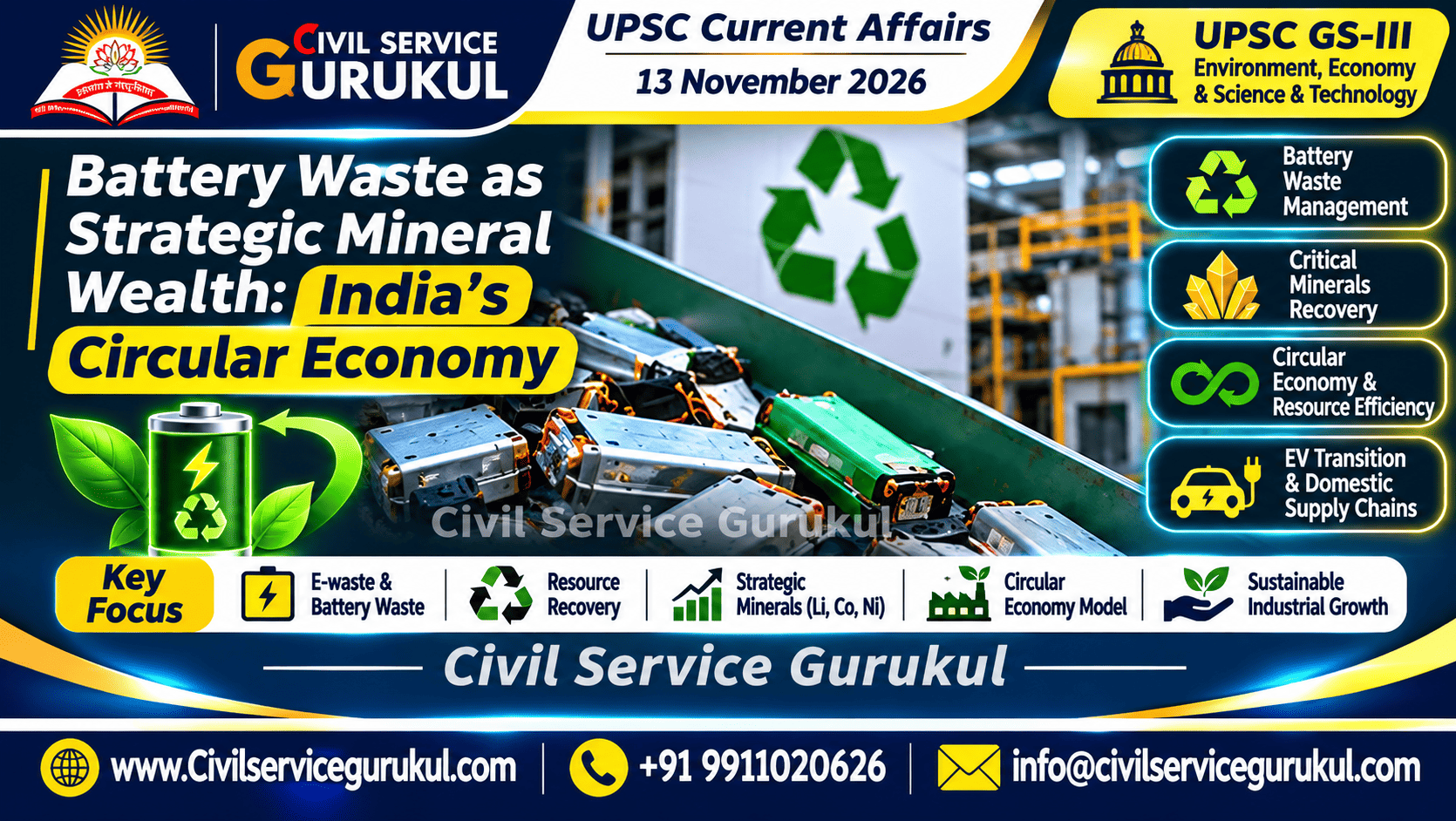
India's Battery Waste Revolution 2026: Black Mass Export Ban, Critical Minerals and Circular Economy
From discarded lithium-ion batteries to strategic mineral wealth: understand India's new black mass export restriction, mineral recycling incentives, Extended Producer Responsibility, battery chemistry and the economic opportunities of urban mining.
Executive Summary / Brief Overview
India is increasingly recognising discarded lithium-ion batteries as a potential domestic source of strategically important minerals.
Battery waste may contain recoverable quantities of lithium, nickel, cobalt, manganese, copper and aluminium, depending on battery chemistry.
On 10 November 2026, the Directorate General of Foreign Trade issued Notification No. 49/2026-27, prohibiting exports of specified lithium-ion battery black mass under ITC(HS) Code 85491400.
The prohibition took effect immediately, subject to the applicable transitional provisions of India's Foreign Trade Policy.
Black mass is an intermediate material generated when spent lithium-ion batteries or manufacturing scrap undergo mechanical processing.
Retaining this material domestically is intended to support Indian recycling and refining facilities.
The decision complements the ₹1,500 crore Critical Mineral Recycling Incentive Scheme under the National Critical Mineral Mission.
In April 2026, the Ministry of Mines reported 58 companies eligible for the scheme, with approximately 850 KTPA of pledged processing capacity and ₹5,000 crore of pledged investment.
The Battery Waste Management Rules, 2022, as amended, provide the Extended Producer Responsibility framework for battery waste management.
Together, these measures illustrate the link between circular economy, industrial policy, critical mineral security and environmental protection.
Spent Batteries → Black Mass → Critical Mineral Recovery → EPR → National Critical Mineral Mission → Domestic Supply Chains → Circular Economy.
Key distinction: Black mass is not the same as refined battery-grade lithium, nickel or cobalt. Additional processing and purification are required.
1. Why in the News?
On 11 November 2026, the Ministry of Commerce and Industry announced that the Directorate General of Foreign Trade had prohibited exports of specified lithium-ion battery black mass.
The decision followed Notification No. 49/2026-27 dated 10 November 2026.
Key Facts
| Particular | Details |
|---|---|
| Agency | Directorate General of Foreign Trade (DGFT) |
| Notification | 49/2026-27, dated 10 November 2026 |
| Product | Specified lithium-ion battery black mass |
| ITC(HS) Code | 85491400 |
| Earlier Export Policy | Free |
| Revised Export Policy | Prohibited |
| Application | Immediate, subject to notified transitional provisions |
Why This Matters
The government identified inadequate domestic feedstock availability as a constraint on the utilisation of existing battery recycling capacity.
The restriction is intended to retain mineral-bearing material for domestic recovery and refining.
Its eventual economic effects will depend on actual feedstock flows, processing capacity, recovery efficiency and compliance.
2. What Is Lithium-Ion Battery Black Mass?
Black mass is a powdery intermediate material produced by mechanically processing spent lithium-ion batteries or battery manufacturing scrap.
Its mineral composition depends on the battery's original chemistry and the recycling process used.
Typical Recoverable Materials
- Lithium.
- Nickel, where present.
- Cobalt, where present.
- Manganese, where present.
- Graphite and other battery materials.
Why Is It Valuable?
Black mass may contain concentrated battery materials that can be processed to recover industrially useful inputs.
Important Distinction
Black mass is an intermediate recycling feedstock.
It is not automatically a finished, high-purity battery-grade mineral product.
3. Why Has India Restricted Black Mass Exports?
A. Domestic Feedstock Availability
Retaining recoverable battery materials can improve supply to domestic recyclers.
B. Better Capacity Utilisation
Recycling facilities require sufficient input material to operate efficiently.
C. Local Value Addition
Domestic refining can generate economic value beyond basic waste collection and mechanical processing.
D. Mineral Security
Recovering strategic inputs locally can complement primary mining and diversified imports.
E. Industrial Development
Reliable secondary raw materials can support battery manufacturing, electric mobility and energy storage systems.
Trade-Offs
Export restrictions must be evaluated for their effects on waste collection incentives, market prices, domestic competition, processing quality and international trade relationships.
The policy does not by itself guarantee higher mineral recovery or lower environmental impacts.
4. Critical Minerals and Battery Chemistry
Critical minerals are materials considered strategically important because of their economic, technological or security relevance and potential supply-chain vulnerabilities.
Why Batteries Matter
Batteries are essential to electric vehicles, portable electronics, renewable energy storage and several industrial applications.
LFP vs NMC Batteries
| Feature | LFP | NMC |
|---|---|---|
| Full Form | Lithium Iron Phosphate | Lithium Nickel Manganese Cobalt Oxide |
| Main Cathode Elements | Lithium, iron, phosphorus and oxygen | Lithium, nickel, manganese, cobalt and oxygen |
| Cobalt in Cathode | No | Yes |
| Nickel in Cathode | No | Yes |
| Recycling Implication | Recovery economics differ because high-value nickel and cobalt are absent from the cathode. | Nickel and cobalt recovery can contribute significantly to value. |
Common UPSC Trap
Not every lithium-ion battery contains cobalt or nickel in its cathode.
Recycling strategies must account for different battery chemistries.
5. Circular Economy and Urban Mining
A circular economy aims to retain the value of materials and products through better design, maintenance, reuse, repurposing, refurbishment and recycling.
What Is Urban Mining?
Urban mining refers to recovering valuable materials from discarded products, industrial scrap and waste streams rather than extracting them exclusively from natural mineral deposits.
Battery Circularity
Reuse vs Repurposing vs Recycling
| Process | Meaning |
|---|---|
| Reuse | Using a suitable battery again for its intended purpose. |
| Repurposing | Using a suitable battery for a different application after technical assessment. |
| Recycling | Processing waste batteries to recover materials. |
Second-life applications require appropriate safety, state-of-health and performance assessment.
Repurposing is not automatically suitable for every discarded battery.
6. How Are Battery Materials Recovered?
A. Mechanical Processing
Batteries undergo appropriate de-energising, safe dismantling and controlled size reduction or separation.
This may generate black mass and separate streams of metals, plastics and other materials.
B. Pyrometallurgy
Pyrometallurgy uses high-temperature processes to recover selected metals.
Its advantages and limitations depend on the technology, feed composition, energy demand and treatment of emissions and residues.
C. Hydrometallurgy
Hydrometallurgy uses chemical processes in liquid media to extract and separate target metals.
It can provide selective recovery but requires careful management of reagents, wastewater and residual materials.
D. Direct Recycling
Direct recycling aims to recover or regenerate battery materials while preserving more of their useful structure.
The suitability of this approach depends on feedstock purity, technology and commercial maturity.
Technology Comparison
| Technology | Main Approach | Key Concern |
|---|---|---|
| Mechanical | Physical separation | Fire, dust and mixed-material handling |
| Pyrometallurgical | High-temperature processing | Energy use and emissions control |
| Hydrometallurgical | Chemical extraction | Chemical handling and effluent treatment |
| Direct Recycling | Recovery or regeneration of battery materials | Feedstock consistency and process maturity |
7. Battery Waste Management Rules, 2022
The Battery Waste Management Rules, 2022, notified under the Environment (Protection) Act, 1986, establish a regulatory framework for battery waste in India.
They have been amended subsequently and must be read in their current applicable form.
Battery Categories
- Portable batteries.
- Automotive batteries.
- Industrial batteries.
- Electric vehicle batteries.
Major Principles
- Extended Producer Responsibility.
- Registration of specified obligated entities.
- Collection and recycling or refurbishment obligations.
- Online reporting and traceability.
- Environmentally sound processing.
- Regulatory monitoring and applicable enforcement measures.
Important Institutions
The Ministry of Environment, Forest and Climate Change frames the rules, while the CPCB and State Pollution Control Boards perform specified implementation and regulatory functions.
8. Extended Producer Responsibility (EPR)
Extended Producer Responsibility assigns producers defined responsibility for the management of battery waste associated with products they introduce into the market.
How the EPR System Works
- Obligated producers comply with registration requirements.
- Applicable waste-management targets are assigned.
- Registered recyclers or refurbishers process eligible battery waste.
- EPR certificates are generated through the regulatory framework.
- Producers meet obligations through the prescribed certificate and reporting mechanisms.
Why EPR Matters
- Supports formal waste collection.
- Links producer obligations to waste processing.
- Creates a market for verified recycling services.
- Encourages traceability.
- Can reduce unsafe disposal when effectively enforced.
Exam Distinction
An EPR certificate is a compliance instrument. It does not automatically prove that every recoverable metal has been extracted at battery-grade purity.
9. National Critical Mineral Mission
The National Critical Mineral Mission (NCMM) is a major Indian policy initiative aimed at strengthening critical mineral supply-chain resilience.
Important Areas
- Mineral exploration.
- Domestic mineral resource development.
- Processing and value addition.
- Overseas resource partnerships.
- Recycling and recovery from secondary sources.
- Research and technological capability.
Why Recycling Is Important
Primary exploration, mining and refining can take substantial time.
Recycling can complement these efforts by recovering materials from existing products and industrial waste streams.
However, recycling cannot fully eliminate the need for responsibly sourced primary minerals, especially while battery demand continues to grow.
10. ₹1,500 Crore Critical Mineral Recycling Incentive Scheme
The Union Cabinet approved a ₹1,500 crore incentive scheme on 3 September 2025 to promote domestic critical mineral recycling.
The Ministry of Mines issued detailed guidelines on 2 October 2025.
Eligible Secondary Sources
- Spent lithium-ion batteries.
- Eligible electronic waste.
- Specified industrial scrap and other qualifying secondary sources.
Progress Reported in April 2026
| Indicator | Reported Position |
|---|---|
| Eligible Entities | 58 |
| Pledged Capacity | Approximately 850 KTPA |
| Pledged Investment | Approximately ₹5,000 crore |
| Next Stage | Project execution, capacity development and commencement of production |
Interpretation
The reported capacity and investment were pledges from eligible entities, not verified operational output or expenditure already incurred.
The scheme creates a policy pathway for investment in India's recycling ecosystem.
11. Environmental and Worker-Safety Risks
Battery recycling is not automatically environmentally safe simply because it recovers valuable materials.
Major Risks
- Battery fires and thermal runaway.
- Exposure to hazardous dust and chemicals.
- Unsafe informal dismantling.
- Improper acid or chemical handling.
- Contaminated wastewater.
- Air emissions and hazardous residues.
- Inadequate worker training and protective equipment.
Necessary Safeguards
- Safe collection and transport.
- Electrical isolation and controlled handling.
- Fire prevention and emergency response.
- Worker training and protective equipment.
- Emission and effluent treatment.
- Safe residual-waste disposal.
- Independent environmental compliance monitoring.
Environmental Justice
Poorly regulated processing may shift health and pollution costs onto workers and nearby communities.
Circular-economy policies must therefore include environmental and occupational safety safeguards.
12. Strategic and Economic Benefits
A. Reduced Import Vulnerability
Domestic recovery can supplement the supply of minerals for which India has significant external dependence.
B. EV Ecosystem
Recovered materials can support the development of domestic battery value chains after appropriate refining and quality assurance.
C. Energy Security
Battery storage is important for renewable energy integration, grid flexibility and certain off-grid systems.
D. Industrial Value Addition
Domestic recycling and refining can generate industrial activity, technical skills and employment.
E. Resource Efficiency
Recovering materials from waste can reduce demand for additional primary extraction relative to a purely linear system.
Important Qualification
Actual gains depend on collection rates, recovery yields, energy use, product quality and environmental performance.
13. Challenges and Way Forward
| Challenge | Recommended Reform |
|---|---|
| Inadequate waste collection | Expand accessible formal take-back systems. |
| Informal and unsafe processing | Support formalisation, training and safe handling. |
| Mixed battery chemistry | Improve identification, sorting and design information. |
| Feedstock uncertainty | Strengthen verified domestic supply arrangements. |
| Recovery losses | Audit actual material-specific recycling yields. |
| Environmental hazards | Enforce pollution-control and worker-safety standards. |
| Weak traceability | Improve digital records and chain-of-custody checks. |
| Research limitations | Invest in efficient and chemistry-appropriate recovery technologies. |
| Investment risk | Provide predictable regulation and transparent incentives. |
Material Passports
A battery material passport can provide information on battery chemistry, composition and other relevant lifecycle characteristics.
Such tools may help improve sorting, traceability and safer recycling.
Measuring Success
Useful performance indicators include:
- Quantity of waste batteries formally collected.
- Verified mineral-specific recovery yields.
- Volume of battery-grade material produced domestically.
- Worker safety and environmental compliance.
- Operating capacity actually commissioned.
- Changes in import dependence for target materials.
14. UPSC Prelims 2027: Quick Revision Card
- Battery Waste Management Rules were notified in 2022.
- EPR means Extended Producer Responsibility.
- Black mass is a battery-recycling intermediate.
- DGFT prohibited specified black mass exports in November 2026.
- Relevant notification: 49/2026-27.
- Relevant ITC(HS) Code: 85491400.
- The ₹1,500 crore recycling scheme is part of the NCMM.
- 58 companies were found eligible by April 2026.
- 850 KTPA represented pledged capacity, not verified operational output.
- LFP cathodes contain lithium, iron and phosphate.
- NMC cathodes contain lithium, nickel, manganese and cobalt.
- Hydrometallurgy uses chemical extraction in liquid media.
- Pyrometallurgy relies on high-temperature processing.
- Urban mining recovers resources from secondary material streams.
- Reuse, repurposing and recycling are distinct processes.
Common UPSC Traps
- Assuming all lithium-ion cathodes contain cobalt.
- Confusing black mass with refined battery-grade minerals.
- Assuming recycling is automatically pollution-free.
- Confusing EPR certificates with proof of 100% mineral recovery.
- Assuming pledged recycling capacity is already operational.
- Confusing reuse with repurposing.
- Assuming circularity eliminates all primary mining.
15. Original UPSC Prelims Practice MCQs
Question 1
Consider the following statements about lithium-ion battery black mass:
- It is an intermediate material from battery processing.
- It can contain recoverable critical minerals.
- It is always a finished battery-grade mineral product.
Which statements are correct?
(A) 1 and 2 only
(B) 2 and 3 only
(C) 1 and 3 only
(D) All three
Show Answer and Explanation
Black mass is a recycling intermediate. Further processing is generally needed to produce refined materials.
Question 2
Which authority issued the November 2026 black mass export policy change?
(A) Election Commission
(B) Directorate General of Foreign Trade
(C) Reserve Bank of India
(D) National Green Tribunal
Show Answer and Explanation
DGFT issued Notification No. 49/2026-27 on 10 November 2026.
Question 3
Consider the following:
- LFP cathodes contain lithium iron phosphate.
- NMC cathodes contain nickel, manganese and cobalt.
- All LFP cathodes contain cobalt.
Which statements are correct?
(A) 1 only
(B) 1 and 2 only
(C) 2 and 3 only
(D) All three
Show Answer and Explanation
Cobalt is not a constituent of the LFP cathode chemistry.
Question 4
Extended Producer Responsibility is best described as:
(A) A producer's specified responsibility for managing waste associated with products placed on the market
(B) Permission to discharge untreated waste
(C) A universal exemption from environmental compliance
(D) A ban on all recycled materials
Show Answer and Explanation
EPR creates specified producer obligations for waste management.
Question 5
With reference to India's critical mineral recycling scheme, consider:
- Its approved outlay is ₹1,500 crore.
- It forms part of the National Critical Mineral Mission.
- The 850 KTPA figure reported in April 2026 was confirmed actual recycling output.
Which statements are correct?
(A) 1 only
(B) 1 and 2 only
(C) 2 and 3 only
(D) All three
Show Answer and Explanation
The reported 850 KTPA represented pledged capacity, not completed processing output.
Question 6
Which process commonly uses chemical solutions to extract and separate metals?
(A) Hydrometallurgy
(B) Photovoltaic conversion
(C) Desalination by evaporation only
(D) Wind-energy conversion
Show Answer and Explanation
Hydrometallurgy involves chemical processing in liquid media.
Question 7
Consider the following statements concerning battery recycling:
- It may reduce dependence on primary mineral extraction.
- Unsafe recycling can create environmental and health risks.
- Recycling eliminates all future need for primary mining.
Which statements are correct?
(A) 1 and 2 only
(B) 1 and 3 only
(C) 2 and 3 only
(D) All three
Show Answer and Explanation
Recycling complements responsible primary mineral supply but does not automatically replace it entirely.
16. UPSC Mains GS-III: Model Answer
"Battery waste is emerging as strategic mineral wealth for India, but recycling must be both economically viable and environmentally sound." Critically examine with reference to India's recent policy initiatives.
Model Answer
Introduction: Spent lithium-ion batteries contain potentially recoverable materials important for electric mobility, energy storage and advanced manufacturing. Their recycling can strengthen India's circular economy and mineral security.
Opportunities:
- Mineral security: Domestic recovery can supplement imports of strategically important materials.
- Industrial development: Recycling and refining support value addition and specialised employment.
- Clean energy: Recovered materials can support battery and energy-storage supply chains.
- Resource efficiency: Urban mining extracts value from existing waste streams.
- Policy support: EPR rules and the ₹1,500 crore incentive scheme encourage formal capacity development.
Challenges: Collection gaps, informal processing, chemical hazards, battery-chemistry differences, high capital costs and inadequate refining capacity can undermine the benefits.
Recent Initiative: The November 2026 black mass export prohibition seeks to retain valuable secondary materials for domestic recycling and refining. Its success depends on effective implementation.
Way Forward: India should strengthen formal collection, recycling traceability, worker safety, material-specific recovery auditing and domestic R&D.
Conclusion: Battery recycling can become a pillar of strategic resource security if mineral recovery is matched with environmentally responsible processing and verifiable industrial outcomes.
Mains Answer Framework
Introduction → Critical Mineral Dependence → Circular Economy → EPR → Black Mass Ban → Benefits → Environmental Risks → Policy Reforms → Conclusion.
17. Final UPSC 2027 Takeaways
- Battery waste is a potentially valuable secondary source of critical minerals.
- DGFT prohibited exports of specified lithium-ion battery black mass in November 2026.
- The ₹1,500 crore recycling scheme forms part of the National Critical Mineral Mission.
- India's Battery Waste Management Rules establish an EPR framework.
- Battery chemistry determines which minerals can be recovered.
- Recycling technologies have different economic and environmental trade-offs.
- Actual mineral recovery, not merely announced capacity, is the meaningful performance measure.
18. Frequently Asked Questions
What is black mass?
A powdery intermediate material produced during processing of spent lithium-ion batteries or manufacturing scrap.
Why did India prohibit specified black mass exports?
The stated objective is to improve domestic feedstock availability and support critical mineral recovery.
What is the National Critical Mineral Mission?
An Indian policy initiative aimed at strengthening critical mineral security across the value chain.
What is Extended Producer Responsibility?
A framework under which producers have specified responsibility for waste management associated with their products.
Do LFP batteries contain cobalt?
LFP cathodes do not contain cobalt or nickel as constituent cathode metals.
What is urban mining?
Recovery of valuable resources from discarded products and secondary material streams.
Is battery recycling always pollution-free?
No. Unsafe processing can create fire, chemical, air-pollution and occupational health risks.
Why is battery recycling relevant for UPSC?
It connects GS-III environment, technology, economy, industrial policy, energy security and resource management.
19. Prepare for UPSC 2027 With Civil Service Gurukul
Civil Service Gurukul helps UPSC aspirants through structured preparation, current-affairs analysis, original MCQs, Mains answer writing and mentorship.
Our Academic Focus
- UPSC GS Prelims Test Series.
- UPSC GS Mains Answer Writing.
- Environment and Ecology.
- Indian Economy.
- Science and Technology.
- Indian Polity and Governance.
- Geography and Modern History.
- Daily Current Affairs and Revision.
Prepare Smarter for UPSC Prelims & Mains 2027
Concept Clarity • Current Affairs • Original MCQs • Mains Analysis • Mentorship
Explore Civil Service GurukulWebsite: www.civilservicegurukul.com
Mobile: +91 9911020626
Email: info@civilservicegurukul.com
Editorial Disclaimer: This original educational article was prepared by Civil Service Gurukul on 13 November 2026. The November 2026 export restriction and 2025–26 recycling programme details are based on government announcements. Eligibility, pledged capacity and investment figures should not be interpreted as completed production or actual mineral recovery. The technology and policy analysis is provided for UPSC education. Practice questions are original, not official UPSC questions.
Prepare with Mentors Who Cleared the Exam
Get personalized study plans, evaluated answer models, and test series access.