
India–France Relations 2026: Economic Security, Critical Technology & Strategic Autonomy | UPSC
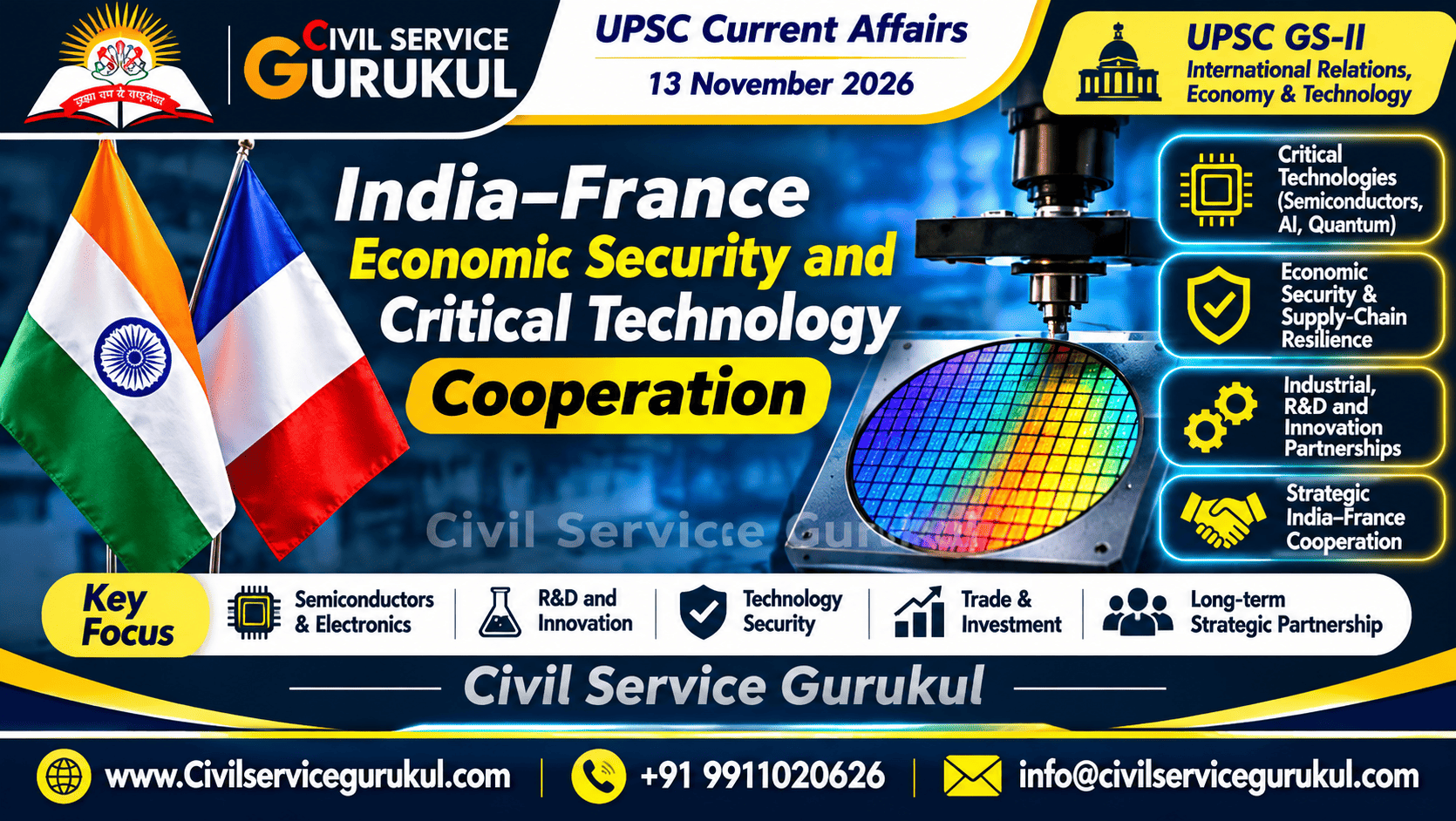
India–France Economic Security and Critical Technology Cooperation 2026: Strategic Autonomy, Innovation and Supply-Chain Resilience
India and France are expanding their strategic partnership through economic security dialogues, critical technologies, defence cooperation, space collaboration, artificial intelligence and trusted industrial supply chains.
Executive Summary / Brief Overview
India and France held the inaugural Economic Security and Critical Technologies Dialogue in Paris on 10 November 2026.
The meeting was co-chaired by India's Foreign Secretary Vikram Misri and French Foreign Ministry Secretary-General Martin Briens.
The discussions covered supply-chain vulnerabilities, critical technologies, cybersecurity and the security of strategic supplies.
The two officials also co-chaired the third India–France Strategic Space Dialogue and reviewed wider bilateral relations.
The Economic Security Dialogue was among the institutional outcomes announced during Prime Minister Narendra Modi's visit to France in June 2026.
The partnership rests on the Horizon 2047 Roadmap, adopted in July 2023, and the India–France Innovation Roadmap 2030, adopted in June 2026.
India and France elevated their relationship to a Special Global Strategic Partnership in February 2026.
Their cooperation now spans defence manufacturing, space exploration, civil nuclear energy, artificial intelligence, cybersecurity, advanced materials, industrial innovation and resilient supply chains.
For UPSC 2027, the issue connects bilateral relations, strategic autonomy, technology governance, economic security and national security.
India–France → Strategic Partnership 1998 → Horizon 2047 → Special Global Strategic Partnership 2026 → Innovation Roadmap 2030 → Economic Security Dialogue → Strategic Autonomy.
Remember: Strategic autonomy does not mean complete isolation or the rejection of international partnerships.
1. Why in the News?
On 10 November 2026, India and France held their first Economic Security and Critical Technologies Dialogue in Paris.
The discussions focused on the vulnerabilities of global supply chains and the need to secure strategic technological capabilities.
Key Participants
| India | France |
|---|---|
| Foreign Secretary Vikram Misri | Secretary-General Martin Briens |
Major Discussion Areas
- Supply-chain vulnerabilities.
- Critical and emerging technologies.
- Cybersecurity.
- Safeguarding strategic supplies.
- Broader bilateral economic security.
The meeting established an important channel for discussing economic resilience as a matter of national and strategic security.
It should not be confused with a confirmed announcement of new procurement contracts or technology-transfer agreements.
2. Evolution of India–France Relations
| Year | Milestone |
|---|---|
| 1947 | Establishment of diplomatic relations. |
| 1998 | Launch of the India–France Strategic Partnership. |
| 2023 | Adoption of Horizon 2047 Roadmap. |
| 2024 | Defence Industrial Roadmap adopted. |
| February 2026 | Relationship elevated to Special Global Strategic Partnership. |
| June 2026 | India–France Innovation Roadmap 2030 adopted. |
| November 2026 | Inaugural Economic Security and Critical Technologies Dialogue. |
Why France Matters to India
France is a major European power, a permanent member of the UN Security Council and an important partner in defence, space and civil nuclear technology.
France also has a significant strategic presence in the Indo-Pacific.
Both countries emphasise a rules-based international order and independent strategic decision-making.
3. Horizon 2047 Roadmap
The Horizon 2047 Roadmap was adopted in July 2023 to guide long-term India–France relations.
The year 2047 marks the centenary of India's independence and diplomatic relations with France.
Major Pillars
- Defence and security cooperation.
- Space and advanced technology.
- Civil nuclear energy.
- Indo-Pacific cooperation.
- Research and innovation.
- Education and people-to-people relations.
- Climate and sustainable development.
Strategic Significance
The roadmap provides continuity beyond individual diplomatic visits and supports long-term industrial and technological planning.
4. India–France Innovation Roadmap 2030
India and France adopted the Innovation Roadmap 2030 in June 2026.
It builds on Horizon 2047 and places innovation at the centre of economic resilience and strategic autonomy.
Key Areas
- Trusted artificial intelligence.
- Critical and emerging technologies.
- Joint research and development.
- Research and academic mobility.
- Startup ecosystem collaboration.
- Technology-based industrial innovation.
- Digital and scientific cooperation.
Trusted AI
Trusted AI refers to the development and deployment of artificial intelligence systems with appropriate safety, security, transparency and accountability safeguards.
It also raises questions concerning privacy, bias, misinformation and human rights.
UPSC Perspective
The Innovation Roadmap connects GS-II international relations with GS-III science and technology.
5. What Is Economic Security?
Economic security is the capacity of a country to protect essential economic functions and maintain resilience against external disruptions.
Important Dimensions
- Supply-chain resilience.
- Access to critical minerals.
- Energy security.
- Cybersecurity of essential systems.
- Industrial capacity.
- Technological capability.
- Trade and investment resilience.
Economic Security vs Economic Protectionism
Economic security does not necessarily require closing markets.
A country may improve resilience through diversification, trusted partnerships, domestic capacity and strategic stockpiles.
Why India and France Cooperate
Both countries have an interest in reducing excessive dependence on single suppliers for strategically important inputs.
6. Cooperation in Critical and Emerging Technologies
A. Semiconductors
Semiconductors are foundational components of digital infrastructure, telecommunications, industrial systems and defence electronics.
Bilateral cooperation can support research, design capability, specialised materials and industrial ecosystems.
Such opportunities should not be confused with confirmation of a specific new fabrication plant or investment.
B. Artificial Intelligence
AI cooperation can include joint research, responsible governance, computing resources and industrial applications.
C. Quantum Technologies
Quantum technologies may have applications in secure communication, advanced sensing and computing.
D. Cybersecurity
Cybersecurity cooperation supports the protection of critical information infrastructure, digital services and trusted industrial networks.
E. Advanced Materials
Advanced materials are important for aerospace, electronics, energy storage and high-performance industrial applications.
Key Policy Lesson
Technology cooperation should build domestic research capability rather than create permanent dependence on external suppliers.
7. India–France Defence Cooperation
Defence cooperation has long been a major pillar of bilateral relations.
Important Examples
- Rafale fighter aircraft cooperation.
- Scorpene-class submarine programme.
- Defence industrial collaboration.
- Aerospace manufacturing.
- Military exercises and exchanges.
- Co-development and co-production initiatives.
Defence Industrial Roadmap
The 2024 Defence Industrial Roadmap emphasises industrial cooperation and opportunities for co-design, co-development and co-production.
Technology Transfer: Important Distinction
| Term | Meaning |
|---|---|
| Licensing | Permission to use specified intellectual property or technology under agreed conditions. |
| Co-production | Joint manufacturing or production arrangements. |
| Co-development | Joint participation in designing or developing a technology or system. |
| Technology Transfer | Transfer of specified technical knowledge, know-how or capabilities under agreed terms. |
Co-production does not automatically guarantee unrestricted access to all intellectual property or sensitive technology.
8. India–France Space Cooperation
India and France have a long-standing space partnership involving ISRO and France's space agency CNES.
Major Areas
- Earth observation.
- Climate monitoring.
- Satellite development.
- Space science.
- Human spaceflight cooperation.
- Commercial launch services.
TRISHNA Mission
TRISHNA stands for Thermal infraRed Imaging Satellite for High-resolution Natural resource Assessment.
It is an India–France Earth-observation collaboration focused on thermal imaging and environmental applications.
Strategic Space Dialogue
The third India–France Strategic Space Dialogue was held in Paris in November 2026.
Such dialogue supports coordination between government institutions and space industries.
9. Civil Nuclear Energy Cooperation
Civil nuclear energy is another important dimension of India–France relations.
Jaitapur Nuclear Project
The proposed Jaitapur nuclear power project in Maharashtra is associated with long-standing India–France civil nuclear cooperation.
Project proposals and negotiations must not be described as completed operational generating capacity.
Small Modular Reactors
Both countries have also discussed potential cooperation in emerging nuclear technologies, including Small Modular Reactors and Advanced Modular Reactors.
UPSC Linkage
Nuclear cooperation connects energy security, climate mitigation, technology policy and international partnerships.
10. India–France Cooperation in the Indo-Pacific
India and France share an interest in a stable, secure and rules-based Indo-Pacific.
France has overseas territories and a maritime presence in the Indian and Pacific Oceans.
Cooperation Areas
- Maritime security.
- Freedom of navigation under international law.
- Ocean governance.
- Humanitarian assistance and disaster relief.
- Maritime domain awareness.
- Protection of sea lanes of communication.
Strategic Significance
The partnership allows India to engage with a major European maritime power while preserving its independent foreign-policy choices.
11. Strategic Autonomy and Technological Sovereignty
Strategic autonomy means retaining the capacity to make independent policy choices without excessive external dependence.
It does not mean complete economic self-sufficiency or diplomatic isolation.
Technological Sovereignty
Technological sovereignty concerns a country's ability to develop, access, maintain and govern technologies essential to its strategic interests.
How Partnerships Support Autonomy
- Diversification of suppliers.
- Joint research and development.
- Domestic industrial capacity.
- Skill development.
- Access to advanced scientific knowledge.
- Resilient technological ecosystems.
Important Limitation
Replacing dependence on one external supplier with dependence on another does not necessarily create strategic autonomy.
12. Challenges and Limitations
Export Controls
Sensitive technologies may be subject to national export control regimes.
Intellectual Property
Access to advanced technology depends on negotiated licensing, ownership and commercial terms.
High Costs
Advanced industrial and research projects may require significant capital investment.
Research Capacity
Technology absorption requires trained personnel, research institutions and industrial capability.
Supply-Chain Concentration
Diversification efforts can fail if critical components continue to depend on a narrow group of suppliers.
Implementation Gaps
An agreement or roadmap does not automatically translate into delivered technology, manufacturing capacity or commercial output.
13. Way Forward: Policy Recommendations
| Priority | Recommended Action |
|---|---|
| Joint R&D | Expand collaborative research in critical technologies. |
| Industrial Capacity | Promote meaningful co-development and domestic production. |
| Skills | Support technical training and research mobility. |
| Supply Chains | Map vulnerabilities and diversify critical inputs. |
| Standards | Improve interoperability and safety assurance. |
| Intellectual Property | Negotiate clear and balanced access arrangements. |
| Accountability | Evaluate completed projects and measurable outcomes. |
Measuring Real Progress
Success should be assessed through measurable results such as joint patents, research outputs, industrial production, trained personnel, diversified suppliers and operational capabilities.
The value of announced agreements alone is not a sufficient measure of strategic autonomy.
14. UPSC Prelims 2027: Quick Revision
- India–France diplomatic relations: 1947.
- Strategic Partnership established: 1998.
- Horizon 2047 Roadmap adopted: 2023.
- Defence Industrial Roadmap: 2024.
- Special Global Strategic Partnership: February 2026.
- India–France Year of Innovation: 2026.
- Innovation Roadmap 2030 adopted: June 2026.
- Inaugural Economic Security Dialogue: 10 November 2026.
- Location of inaugural dialogue: Paris.
- Indian co-chair: Vikram Misri.
- French co-chair: Martin Briens.
- Space agencies: ISRO and CNES.
- TRISHNA: Earth observation and thermal imaging.
- Key concept: strategic autonomy is not isolation.
Common UPSC Traps
- Confusing Horizon 2047 with Innovation Roadmap 2030.
- Assuming the partnership was first established in 2026.
- Confusing the Economic Security Dialogue with the Strategic Space Dialogue.
- Assuming co-production always means full technology transfer.
- Assuming the Jaitapur project is already fully operational.
- Equating strategic autonomy with diplomatic isolation.
15. Original UPSC Prelims Practice MCQs
Question 1
Consider the following statements:
- India and France established a Strategic Partnership in 1998.
- Horizon 2047 was adopted in 2023.
- The Innovation Roadmap 2030 was adopted in 2026.
Which statements are correct?
(A) 1 and 2 only
(B) 2 and 3 only
(C) 1 and 3 only
(D) 1, 2 and 3
Show Answer and Explanation
All three statements are correctly matched with their respective milestones.
Question 2
The inaugural India–France Economic Security and Critical Technologies Dialogue was held in:
(A) New Delhi
(B) Paris
(C) Mumbai
(D) Brussels
Show Answer and Explanation
The inaugural dialogue was held in Paris on 10 November 2026.
Question 3
Which statement best describes strategic autonomy?
(A) Complete rejection of foreign partnerships
(B) Independent policy choices supported by resilient capabilities
(C) Exclusive dependence on one foreign supplier
(D) Permanent withdrawal from international institutions
Show Answer and Explanation
Strategic autonomy is compatible with diversified international cooperation.
Question 4
Consider the following:
- ISRO is India's space agency.
- CNES is France's space agency.
- TRISHNA is associated with Earth observation.
How many statements are correct?
(A) Only one
(B) Only two
(C) All three
(D) None
Show Answer and Explanation
All three statements are correct.
Question 5
Which of the following best distinguishes co-production from co-development?
(A) Co-production involves joint manufacturing; co-development involves joint design or development.
(B) Co-production always guarantees unrestricted intellectual property rights.
(C) Co-development excludes research activities.
(D) Both terms are legally identical in every agreement.
Show Answer and Explanation
The distinction concerns the nature of collaboration. Specific rights depend on contractual terms.
Question 6
With reference to economic security, consider:
- Supply-chain diversification can improve resilience.
- Cybersecurity may be relevant to economic security.
- Economic security always requires eliminating international trade.
Which statements are correct?
(A) 1 and 2 only
(B) 1 and 3 only
(C) 2 and 3 only
(D) All three
Show Answer and Explanation
Economic security can be strengthened through trade diversification and trusted international partnerships.
Question 7
The India–France Innovation Roadmap 2030 places particular emphasis on:
(A) Trusted AI and collaborative innovation
(B) Ending all academic exchanges
(C) Eliminating domestic research
(D) Replacing all civilian technology with military systems
Show Answer and Explanation
The roadmap emphasises trusted AI, research, innovation and critical technologies.
16. UPSC Mains GS-II and GS-III Model Answer
"India–France cooperation in critical technologies and economic security can strengthen India's strategic autonomy, but outcomes depend on domestic technological capacity." Critically examine.
Model Answer
Introduction: India and France have expanded their strategic partnership from traditional defence cooperation into economic security, space, AI and critical technologies. The inaugural Economic Security and Critical Technologies Dialogue in November 2026 reflects this evolution.
Opportunities:
- Supply-chain resilience: Diversified partnerships reduce excessive dependence on concentrated suppliers.
- Technology development: Joint research can strengthen domestic capabilities.
- Defence manufacturing: Co-development and co-production may support industrial capacity.
- Space cooperation: Joint missions and research expand scientific capability.
- Energy security: Civil nuclear collaboration offers potential long-term benefits.
Challenges: Export controls, intellectual-property restrictions, high costs, industrial asymmetries and weak domestic absorption capacity can limit technology gains.
Way Forward: India should prioritise joint R&D, technical skilling, domestic manufacturing, transparent technology-transfer arrangements and measurable project outcomes.
Conclusion: India–France cooperation can advance strategic autonomy when international collaboration produces sustainable domestic capabilities rather than replacing one dependency with another.
17. Final UPSC 2027 Takeaways
- The inaugural Economic Security and Critical Technologies Dialogue took place in Paris on 10 November 2026.
- India and France have been strategic partners since 1998.
- Horizon 2047 is the long-term framework adopted in 2023.
- The relationship was elevated to a Special Global Strategic Partnership in February 2026.
- The Innovation Roadmap 2030 was adopted in June 2026.
- Critical technology cooperation includes AI, space, advanced materials and other emerging technologies.
- Strategic autonomy requires diversified partnerships and stronger domestic capability.
18. Frequently Asked Questions
When was the first India–France Economic Security and Critical Technologies Dialogue held?
10 November 2026 in Paris, France.
Who co-chaired the dialogue?
Vikram Misri and Martin Briens.
What is Horizon 2047?
A long-term bilateral roadmap adopted in July 2023.
What is the India–France Innovation Roadmap 2030?
A framework for expanded cooperation in innovation, trusted AI, research and critical technologies.
What is strategic autonomy?
The capacity to make independent strategic choices without excessive external dependence.
What is the difference between co-production and technology transfer?
Co-production concerns joint manufacturing, while technology transfer involves the agreed transfer of specified technical knowledge or capabilities.
Why is this topic important for UPSC?
It connects GS-II bilateral relations with GS-III science, technology, economic security and defence.
19. Prepare for UPSC 2027 With Civil Service Gurukul
Civil Service Gurukul supports UPSC aspirants through structured learning, current-affairs analysis, original MCQs, Mains answer writing and mentorship.
Academic Focus
- UPSC GS Prelims Test Series.
- UPSC GS Mains Answer Writing.
- International Relations.
- Indian Polity and Governance.
- Science and Technology.
- Indian Economy.
- Environment and Geography.
- Daily Current Affairs and Revision.
Prepare Smarter for UPSC Prelims & Mains 2027
Concept Clarity • Current Affairs • Original MCQs • Mains Analysis • Mentorship
Explore Civil Service GurukulWebsite: www.civilservicegurukul.com
Mobile: +91 9911020626
Email: info@civilservicegurukul.com
Editorial Disclaimer: This original UPSC educational article was prepared by Civil Service Gurukul on 13 November 2026. The November dialogue details are based on contemporaneous reporting of the bilateral meetings, while the historical roadmaps and partnership milestones are supported by government announcements. Analytical recommendations are educational interpretations, not claims of newly signed agreements. MCQs and Mains questions are original practice material and not official UPSC questions.
Prepare with Mentors Who Cleared the Exam
Get personalized study plans, evaluated answer models, and test series access.