
Tamil Nadu Industrial Water Crisis 2026: Wastewater Reuse, Water Pricing & River Health | UPSC
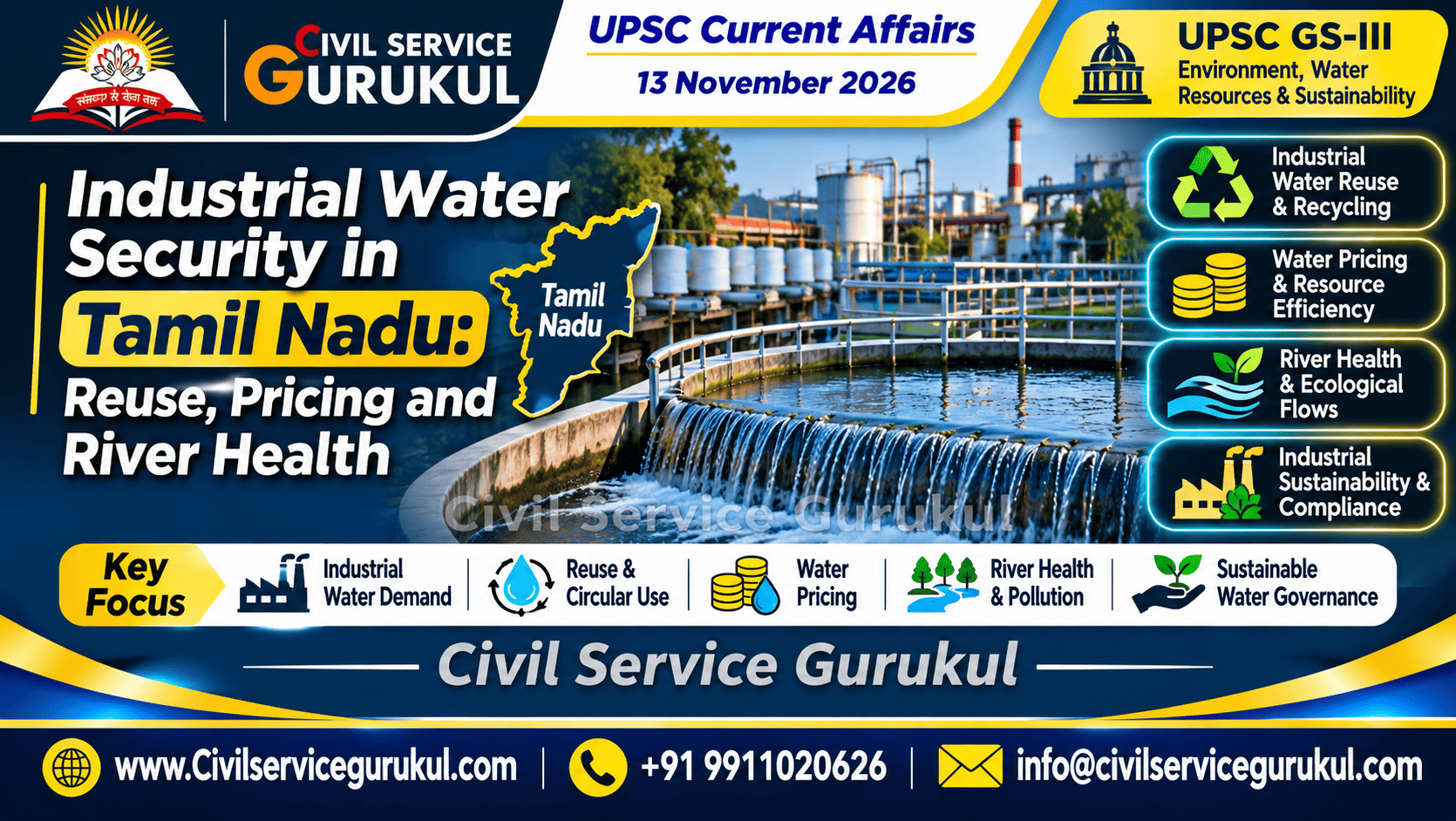
Tamil Nadu's Industrial Water Challenge: Wastewater Reuse, Smart Pricing and River Health
How can Tamil Nadu sustain industrial growth without exhausting freshwater resources? Explore treated wastewater reuse, industrial water efficiency, groundwater governance, pollution control and sustainable river-basin management.
Executive Summary / Brief Overview
Industrial water security is emerging as an important challenge for water-stressed manufacturing regions in India.
Tamil Nadu's diversified industrial economy depends on reliable water supplies for manufacturing, processing, cooling and sanitation.
At the same time, industries compete with households, agriculture and ecosystems for limited freshwater resources.
Seasonal rainfall, groundwater stress, pollution and uneven distribution make water security a major economic and environmental concern.
A sustainable strategy requires greater use of treated wastewater, closed-loop industrial recycling, water-efficient technologies and better monitoring.
Water pricing can encourage conservation, but poorly designed tariffs may impose disproportionate costs on smaller firms.
Industrial pollution control must also protect river ecosystems, groundwater quality and the interests of downstream communities.
The policy challenge is to integrate industrial development with water-resource management and environmental sustainability.
Industrial Growth → Freshwater Demand → Water Stress → Wastewater Reuse → Efficient Pricing → Pollution Control → River-Basin Governance → Sustainable Development.
Important distinction: Water withdrawal and water consumption are not identical. A large withdrawal does not necessarily mean the entire quantity is consumed.
1. Why in the News?
The 12 November 2026 current-affairs editorial index highlighted Tamil Nadu's growing industrial water challenge.
The issue draws attention to the increasing importance of sustainable water management in industrial planning.
Manufacturing requires water for several processes, including cooling, cleaning, production and waste management.
Where water availability is seasonal or groundwater is stressed, industrial demand can intensify competition with other users.
Key Policy Questions
- How can industries reduce freshwater withdrawals?
- Can treated municipal wastewater substitute for freshwater?
- How should industrial water tariffs be designed?
- Who bears the cost of industrial pollution?
- How can river ecosystems and downstream communities be protected?
The discussion is a broader policy analysis. It should not be interpreted as confirmation of a new Tamil Nadu government notification or a specific investment announcement.
2. Why Is Water Security Important for Tamil Nadu?
Tamil Nadu has a diversified manufacturing base that includes textiles, automobiles, leather, chemicals, electronics and other industrial activities.
Water availability is influenced by rainfall, reservoir storage, river flows, groundwater recharge and local demand.
A. Seasonal Rainfall
Tamil Nadu receives a substantial share of its annual rainfall from the northeast monsoon.
The timing and distribution of rainfall affect surface storage and groundwater recharge.
B. Competing Demands
- Domestic drinking water.
- Agricultural irrigation.
- Industrial manufacturing.
- Urban infrastructure.
- Ecological requirements of rivers and wetlands.
C. Industrial Concentration
Clusters of manufacturing units can create high local demand even when the State's overall water availability appears adequate.
D. Water Quality
Pollution can make water unusable for certain purposes, reducing the effective availability of freshwater.
3. What Is Industrial Water Security?
Industrial water security means reliable access to water of suitable quantity and quality for industrial activities, without undermining the needs of communities, agriculture and ecosystems.
Four Dimensions
| Dimension | Explanation |
|---|---|
| Availability | Reliable supply across seasons. |
| Quality | Water suitable for specific industrial processes. |
| Affordability | Predictable costs that support efficient operations. |
| Sustainability | Protection of groundwater, rivers and communities. |
Water security is therefore both an economic competitiveness issue and an environmental governance challenge.
4. Water Withdrawal vs Water Consumption
UPSC aspirants must distinguish between two important concepts.
Water Withdrawal
The volume of water taken from a river, reservoir, aquifer or other source.
Water Consumption
The portion of withdrawn water not returned to the relevant water system within the defined accounting boundary and period.
This simplified relationship assumes a consistent accounting boundary and treatment of storage changes and other water flows.
Illustrative Example
An industrial facility withdraws 100 units of water.
If 70 units are returned to the relevant system within the accounting period, the simplified consumptive use is 30 units.
However, returning water does not automatically mean the discharge is environmentally safe.
Water quality must also be assessed.
5. Treated Wastewater Reuse: A Circular Water Economy
Treated wastewater reuse involves processing wastewater to a quality suitable for specified applications.
Industrial users can substitute treated wastewater for freshwater where technical, health and environmental standards permit.
Potential Applications
- Industrial cooling systems.
- Selected cleaning operations.
- Utility and service water.
- Process water after suitable advanced treatment.
- Landscaping and other permitted non-potable uses.
Benefits
- Reduces pressure on freshwater sources.
- Creates productive demand for treated municipal wastewater.
- Improves resilience during seasonal shortages.
- Encourages circular resource management.
- May reduce untreated discharge when supported by effective collection and treatment.
Limitations
Not all industrial processes can use the same quality of recycled water.
Treatment requirements, pipeline infrastructure, energy costs and continuous quality monitoring are important.
6. Zero Liquid Discharge and Common Effluent Treatment Plants
A. Zero Liquid Discharge (ZLD)
Zero Liquid Discharge is a treatment approach designed to recover water and minimise or eliminate liquid effluent discharge.
It may combine filtration, membrane technologies, evaporation and other treatment processes.
Advantages
- Greater recovery of process water.
- Reduced liquid effluent discharge.
- Potential reduction in freshwater demand.
- Improved control over certain wastewater streams.
Limitations
- High capital and operating costs.
- Significant energy requirements in some systems.
- Management of concentrated salts and residual solids.
- Need for continuous operation and monitoring.
B. Common Effluent Treatment Plant (CETP)
A CETP treats wastewater collected from multiple industrial units.
It is particularly relevant where individual smaller industries cannot economically operate their own full-scale treatment systems.
| ZLD | CETP |
|---|---|
| A treatment and recovery approach aimed at avoiding liquid discharge. | A shared facility for treating wastewater from multiple units. |
| Can be implemented at a plant or cluster level. | Can use different treatment technologies, potentially including ZLD. |
| Requires management of residual solids and concentrates. | Requires coordinated collection, operation and compliance. |
Exam trap: ZLD and CETP are not interchangeable terms. A CETP does not automatically achieve ZLD.
7. Industrial Water Pricing and Demand Management
Water pricing influences industrial decisions about extraction, recycling, efficiency and investment.
Problems With Very Low Prices
- Weak incentives for conservation.
- Possible overuse of freshwater.
- Underinvestment in efficient equipment.
- Difficulty recovering infrastructure costs.
Problems With Excessively High Prices
- Disproportionate burden on smaller firms.
- Potential incentives for unregulated extraction.
- Reduced competitiveness in water-intensive industries.
- Possible shifting of costs to workers or consumers.
Better Pricing Design
A balanced tariff framework can consider metered use, local scarcity, treatment costs, environmental externalities and the capacity of different industrial users.
Freshwater vs Recycled Water
Where safe and technically appropriate, pricing and supply arrangements can make treated wastewater an attractive alternative to freshwater.
However, the price difference alone is insufficient without reliable water quality and delivery infrastructure.
8. Groundwater Sustainability
Groundwater supports domestic, agricultural and industrial demand in many regions.
Excessive extraction can reduce water levels and increase pumping costs.
Potential Consequences
- Declining groundwater tables.
- Reduced well yields.
- Higher energy requirements for pumping.
- Saline intrusion in vulnerable coastal aquifers.
- Reduced water availability for nearby communities.
Key Management Measures
- Meter industrial groundwater withdrawals.
- Conduct periodic aquifer assessments.
- Promote treated wastewater substitution.
- Protect natural recharge areas.
- Use scientifically appropriate recharge interventions.
- Coordinate extraction controls across industrial clusters.
Artificial recharge must not be treated as a substitute for controlling unsustainable withdrawals.
9. Industrial Water Use and River Health
River health depends on adequate flows, water quality, habitat connectivity and the functioning of aquatic ecosystems.
Potential Industrial Impacts
- Reduction in available river flows.
- Discharge of inadequately treated effluents.
- Changes in water temperature.
- Increased salinity or chemical contamination.
- Effects on aquatic organisms and downstream users.
Relevant Tamil Nadu River Systems
River systems such as the Cauvery, Noyyal and Palar are important geographical reference points for examining water availability, land use, urbanisation and industrial pressures.
Actual pollution levels and trends must be assessed using current monitoring data, rather than assuming that every river stretch has the same condition.
Environmental Flows
Environmental flows refer to the quantity, timing and quality of water flows needed to sustain freshwater ecosystems and the benefits they provide.
River Restoration Measures
- Enforce effluent standards.
- Improve sewage treatment.
- Protect environmental flows.
- Monitor water quality across seasons.
- Restore wetlands and riparian habitats.
- Include downstream communities in decision-making.
10. Constitutional, Legal and Institutional Framework
Constitutional Position
Water is primarily a State List subject under Entry 17 of List II, subject to the constitutional qualification concerning inter-State rivers and river valleys under Entry 56 of List I.
Major Legal and Institutional References
| Law / Institution | Relevance |
|---|---|
| Water (Prevention and Control of Pollution) Act, 1974 | Legal framework for prevention and control of water pollution, subject to applicable amendments. |
| Environment (Protection) Act, 1986 | Framework for environmental protection and regulatory standards. |
| Central Pollution Control Board (CPCB) | National-level pollution control functions under applicable laws. |
| Tamil Nadu Pollution Control Board (TNPCB) | State-level pollution regulation and monitoring. |
| Central Ground Water Authority (CGWA) | Groundwater regulatory functions within its applicable jurisdiction. |
| National Green Tribunal (NGT) | Adjudication of specified environmental disputes and matters. |
Polluter-Pays Principle
The polluter-pays principle places responsibility for pollution prevention and remediation costs on the polluter, consistent with applicable law.
Precautionary Principle
Where there is a risk of serious environmental harm, scientific uncertainty should not automatically justify postponing appropriate preventive measures.
11. Why Is River-Basin Governance Important?
Water resources are interconnected across administrative and industrial boundaries.
Decisions made upstream can affect downstream water users and ecosystems.
Limitations of Fragmented Governance
- Industrial extraction may be considered separately from irrigation.
- Groundwater and surface water may be managed independently.
- Pollution monitoring may not fully capture cumulative impacts.
- Different agencies may use inconsistent datasets.
Integrated Basin-Level Approach
- Assess total water availability and seasonal variation.
- Measure domestic, agricultural and industrial demand.
- Protect ecological flow requirements.
- Track groundwater extraction and recharge.
- Monitor cumulative pollution loads.
- Coordinate across departments and affected communities.
Integrated management reduces the risk of solving one sector's water problem by transferring the burden to another.
12. Challenges and Policy Trade-offs
Economic Competitiveness
Industries need reliable water at predictable costs.
Environmental Protection
Extraction and pollution must remain within ecologically sustainable limits.
Equity
Industrial requirements should not displace essential household needs or undermine vulnerable communities.
Small Industry Capacity
Micro, small and medium enterprises may struggle to finance advanced treatment systems.
Monitoring Gaps
Poor metering, weak enforcement and incomplete public data can undermine water governance.
Technology Costs
Advanced wastewater treatment may involve substantial energy and maintenance requirements.
13. Way Forward: A Sustainable Industrial Water Strategy
| Policy Priority | Recommended Action |
|---|---|
| Water Accounting | Mandate reliable metering and periodic water audits. |
| Wastewater Reuse | Develop treated wastewater supply networks for suitable industrial applications. |
| Industrial Efficiency | Encourage closed-loop systems and process improvements. |
| Water Pricing | Use transparent, scarcity-sensitive pricing with appropriate safeguards. |
| Groundwater | Monitor extraction and protect recharge zones. |
| Pollution Control | Strengthen effluent monitoring and compliance. |
| MSME Support | Facilitate shared treatment facilities and technical assistance. |
| River Health | Protect environmental flows and restore affected habitats. |
| Transparency | Publish accessible water-use and compliance information. |
Measurable Outcomes
Policy performance should be evaluated through:
- Freshwater withdrawal per unit of industrial output.
- Percentage of suitable wastewater reused.
- Groundwater-level trends.
- Effluent compliance rates.
- River water-quality indicators.
- Costs imposed on households and small industries.
A policy announcement alone is not evidence of successful implementation.
14. UPSC Prelims 2027: Quick Revision Card
- Industrial water security combines availability, quality, affordability and sustainability.
- Tamil Nadu receives substantial rainfall from the northeast monsoon.
- Water withdrawal is not the same as water consumption.
- Treated wastewater can substitute for freshwater in suitable applications.
- ZLD aims to minimise or eliminate liquid effluent discharge.
- CETPs treat wastewater from multiple industrial units.
- ZLD does not eliminate the need to manage residual solids.
- Water pricing can influence industrial demand.
- Excessive groundwater withdrawal can worsen coastal saline intrusion.
- Environmental flows support freshwater ecosystems.
- CPCB and State Pollution Control Boards perform pollution-control functions.
- Water is primarily a State List subject, subject to constitutional qualifications.
- Polluter-pays is an important environmental law principle.
- Basin-level governance addresses cumulative impacts.
Common UPSC Traps
- Equating water withdrawal with consumption.
- Assuming recycled water is suitable for every industrial process.
- Assuming ZLD produces no solid waste.
- Confusing CETP with an individual industrial treatment plant.
- Assuming all river-water pollution comes from industry.
- Assuming higher water tariffs always produce socially desirable outcomes.
- Ignoring the constitutional qualifications to State control over water.
15. Original UPSC Prelims Practice MCQs
Question 1
Consider the following statements:
- Water withdrawal and water consumption are identical concepts.
- Treated wastewater may replace freshwater in suitable industrial applications.
- Industrial water security includes water quality as well as quantity.
Which statements are correct?
(A) 1 and 2 only
(B) 2 and 3 only
(C) 1 and 3 only
(D) All three
Show Answer and Explanation
Statements 2 and 3 are correct. Withdrawal refers to water taken from a source, whereas consumption concerns water not returned within the relevant accounting boundary.
Question 2
With reference to Zero Liquid Discharge, consider:
- It aims to minimise or eliminate liquid effluent discharge.
- It can require energy-intensive treatment.
- It necessarily eliminates all residual solid waste.
Which statements are correct?
(A) 1 only
(B) 1 and 2 only
(C) 2 and 3 only
(D) All three
Show Answer and Explanation
ZLD may generate concentrated salts and other residual materials that require safe management.
Question 3
A Common Effluent Treatment Plant is primarily intended to:
(A) Replace all groundwater recharge
(B) Treat wastewater from multiple industrial units
(C) Eliminate every form of industrial solid waste
(D) Regulate inter-State river disputes
Show Answer and Explanation
A CETP provides shared wastewater treatment, often for industrial clusters.
Question 4
Consider the following statements:
- Water is primarily a State List subject.
- Parliament has a constitutionally specified role concerning regulation and development of inter-State rivers and river valleys.
- The Central Pollution Control Board has no role in water-pollution control.
Which statements are correct?
(A) 1 and 2 only
(B) 2 and 3 only
(C) 1 and 3 only
(D) All three
Show Answer and Explanation
Statements 1 and 2 reflect the constitutional framework. The CPCB performs pollution-control functions under applicable law.
Question 5
Which of the following best describes environmental flows?
(A) Only the maximum annual flood discharge
(B) Water-flow conditions needed to sustain freshwater ecosystems
(C) Water exclusively reserved for industrial cooling
(D) All groundwater pumped from an aquifer
Show Answer and Explanation
Environmental flows include relevant quantity, timing and quality conditions supporting freshwater ecosystems.
Question 6
Which measure would most directly reduce freshwater demand from an industrial facility?
(A) Unmetered groundwater pumping
(B) Untreated effluent discharge
(C) Closed-loop water recycling
(D) Increasing process-water losses
Show Answer and Explanation
Closed-loop recycling allows water to be reused within suitable industrial processes.
Question 7
Consider the following statements about industrial water pricing:
- Very low prices can weaken conservation incentives.
- Very high prices may impose disproportionate burdens on small firms.
- Water pricing alone guarantees the elimination of industrial pollution.
Which statements are correct?
(A) 1 only
(B) 1 and 2 only
(C) 2 and 3 only
(D) All three
Show Answer and Explanation
Water pricing can influence demand but cannot replace pollution monitoring, treatment requirements and enforcement.
16. UPSC Mains GS-III: Model Answer
"Industrial water security cannot be achieved through supply augmentation alone." Discuss with reference to wastewater reuse, water pricing and river-basin governance in water-stressed States such as Tamil Nadu.
Model Answer
Introduction: Industrial water security requires reliable water supplies without compromising domestic needs, agriculture or ecological sustainability. Tamil Nadu's diversified manufacturing base illustrates the importance of integrating industrial development with water governance.
Key Challenges:
- Competing demand: Industries, households and agriculture depend on limited water resources.
- Seasonality: Rainfall variability affects surface storage and recharge.
- Groundwater stress: Excessive withdrawals can reduce aquifer resilience.
- Pollution: Inadequately treated effluents may reduce usable water availability.
Policy Measures:
- Wastewater reuse: Supply appropriately treated municipal wastewater to suitable industrial users.
- Demand management: Promote water audits, metering and efficient processes.
- Pricing: Introduce transparent tariffs that encourage conservation while protecting smaller firms from disproportionate burdens.
- Pollution control: Strengthen effluent monitoring and enforce applicable standards.
- Basin governance: Coordinate surface water, groundwater and environmental-flow management.
Way Forward: An integrated strategy should combine technological innovation, institutional coordination, community participation and public disclosure of water-use information.
Conclusion: Sustainable industrialisation depends not merely on finding new water sources but on using existing resources efficiently, recycling safely and protecting river ecosystems.
Answer-Writing Framework
Definition → Tamil Nadu context → Water stress → Reuse → Pricing → Groundwater → River health → Governance → Conclusion.
17. Final UPSC 2027 Takeaways
- Industrial water security is an economic and ecological issue.
- Freshwater withdrawal and water consumption are different concepts.
- Treated wastewater reuse can reduce industrial dependence on freshwater.
- ZLD and CETP serve related but distinct purposes.
- Water pricing must balance efficiency with equity.
- Groundwater extraction requires monitoring and sustainable management.
- Industrial water policy must consider river health and environmental flows.
- Integrated basin-level governance is essential for long-term resilience.
18. Frequently Asked Questions
What is industrial water security?
It means reliable access to suitable water for industrial activities without undermining other users or ecosystems.
Why is Tamil Nadu's industrial water challenge important?
Industrial demand, seasonal rainfall, groundwater pressure and environmental protection create complex water-management trade-offs.
What is treated wastewater reuse?
It involves treating wastewater to meet quality requirements for suitable subsequent uses.
What is Zero Liquid Discharge?
ZLD is a treatment approach aimed at minimising or eliminating liquid effluent discharge.
What is a Common Effluent Treatment Plant?
A shared facility that treats wastewater from multiple industrial units.
Why does water pricing matter?
Appropriate pricing can encourage efficient use, but must account for equity and economic impacts.
What are environmental flows?
Flow conditions required to sustain freshwater ecosystems and their benefits.
Why is this topic relevant for UPSC?
It connects GS-I geography with GS-III environment, industrial development, resource management and sustainable growth.
19. Prepare for UPSC 2027 With Civil Service Gurukul
Civil Service Gurukul supports UPSC aspirants through structured learning, current-affairs analysis, original MCQs, Mains answer writing and mentorship.
Academic Focus
- UPSC GS Prelims Test Series.
- UPSC GS Mains Answer Writing.
- Environment and Ecology.
- Indian Geography.
- Indian Economy.
- Science and Technology.
- Indian Polity and Governance.
- Daily Current Affairs and Revision.
Prepare Smarter for UPSC Prelims & Mains 2027
Concept Clarity • Current Affairs • Original MCQs • Mains Analysis • Mentorship
Explore Civil Service GurukulWebsite: www.civilservicegurukul.com
Mobile: +91 9911020626
Email: info@civilservicegurukul.com
Editorial Disclaimer: This original UPSC educational article was prepared by Civil Service Gurukul on 13 November 2026. It expands the editorial topic concerning Tamil Nadu's industrial water challenge into a conceptual and policy analysis. Recommendations are educational interpretations, not claims of newly announced government schemes or projects. Practice questions are original and are not official UPSC questions.
Prepare with Mentors Who Cleared the Exam
Get personalized study plans, evaluated answer models, and test series access.