
India Visa Reform 2026: 9 Categories, 70% Shorter Forms, e-Visa & UPSC GS-II Analysis
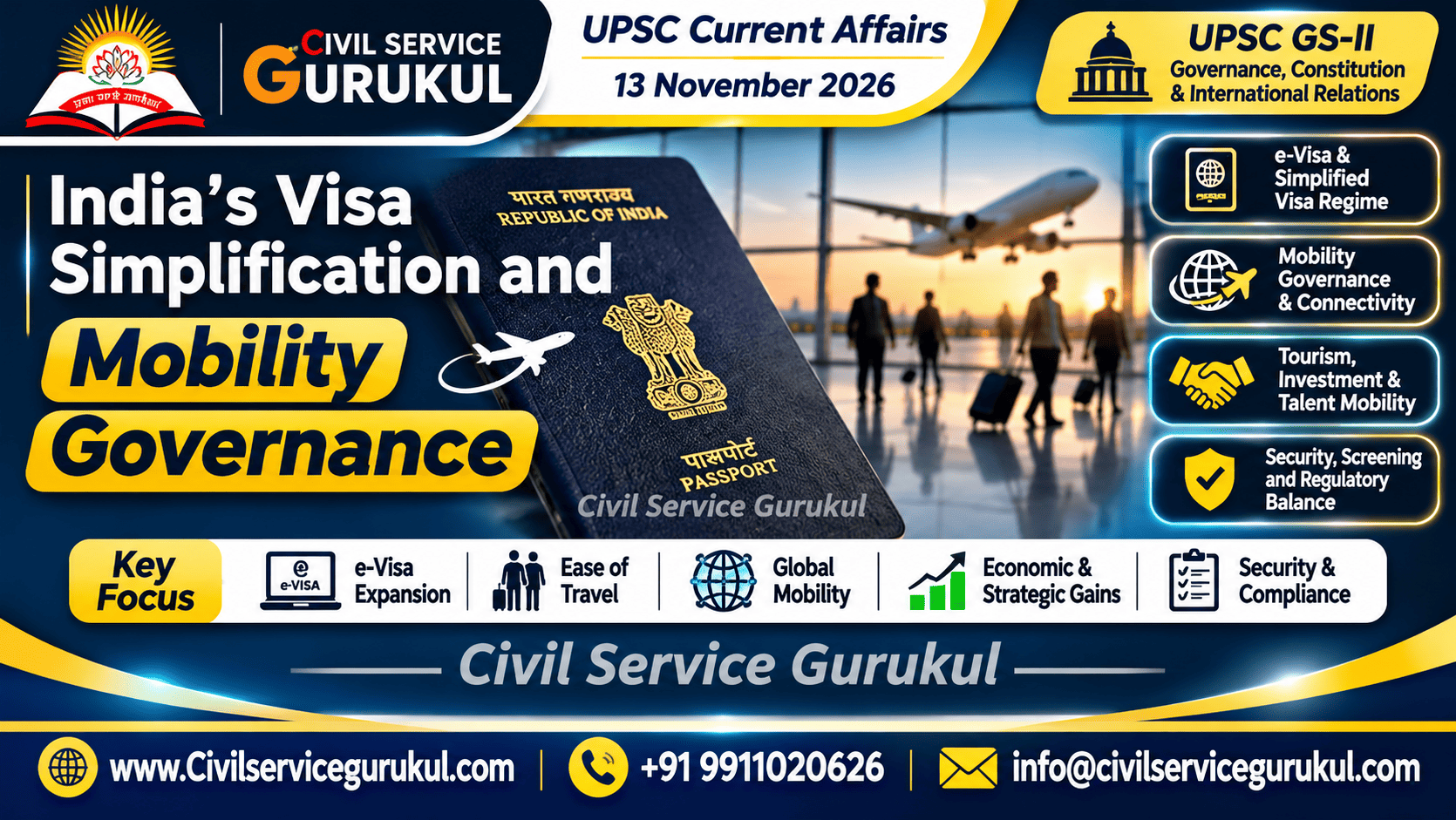
India's Visa Reform 2026: Nine Categories, 70% Shorter Forms and the Future of Mobility Governance
India is restructuring its visa system to facilitate legitimate international travel, education, business and healthcare. Understand the revised categories, digital immigration reforms, security implications and UPSC examination relevance.
Executive Summary / Brief Overview
On 11 November 2026, the Ministry of Home Affairs announced details of India's revised visa regime.
The rationalisation reduces the number of main visa categories from 13 to nine and sub-categories from 49 to 23.
Application forms across the revised sub-categories have been simplified through a 65–70% reduction in the number of required fields.
The latest category rationalisation was undertaken on 27 August 2026, following an earlier exercise in October 2025 that reduced 22 main categories to 13.
The erstwhile Tourist Visa has been renamed the Visitor Visa, with V-1 and V-2 sub-categories.
The revised framework also differentiates business, employment, medical, student, journalist and other purposes of travel.
The government reported that e-Visa facilities were available to nationals of 172 countries under 13 electronic visa sub-categories at the time of announcement.
The Ministry was updating its IT systems and expected visa issuance under the revised framework by the end of 2026.
The reform aims to improve administrative efficiency and support tourism, medical value travel, international education and business engagement.
For UPSC 2027, the policy raises important questions about digital governance, national security, migration management, data protection and international mobility.
Visa Reform 2026 → MHA → 13 to 9 categories → 49 to 23 sub-categories → 65–70% shorter forms → Visitor Visa V-1/V-2 → 172 e-Visa countries → Digital Governance.
Important: A visa is subject to applicable entry conditions and does not guarantee unconditional admission into India.
1. Why in the News?
The Ministry of Home Affairs issued a detailed announcement on 11 November 2026 regarding India's simplified visa framework.
The government aims to make the visa system more coherent and easier for foreign nationals to navigate.
Key Changes
| Parameter | Earlier | Revised |
|---|---|---|
| Main Visa Categories | 13 | 9 |
| Sub-Categories | 49 | 23 |
| Application Form Fields | Earlier requirements | 65–70% fewer fields |
| Tourist Visa | Tourist designation | Visitor Visa, V-1/V-2 |
| IT System | Existing framework | Transition targeted by end-2026 |
The reform consolidates overlapping purposes of travel and aims to retain essential information needed for immigration scrutiny.
2. Timeline of India's Visa Rationalisation
| Date | Development |
|---|---|
| October 2025 | Main categories reduced from 22 to 13 and sub-categories from 63 to 49. |
| 27 August 2026 | Further rationalisation to nine main categories and 23 sub-categories. |
| 11 November 2026 | MHA detailed the revised regime and simplified application forms. |
| End of 2026 | Target for issuing visas under updated IT systems. |
Why This Timeline Matters
The changes were not all introduced for the first time on 11 November.
The November announcement explained earlier rationalisation and the ongoing operational transition.
3. The Nine Main Visa Categories
| Category | Principal Purpose |
|---|---|
| Business Visa | Specified business, investment and commercial activities. |
| Diplomatic Visa | Eligible diplomatic assignments and official diplomatic purposes. |
| Work Visa | Eligible employment and professional assignments. |
| Journalist Visa | Specified journalism and media-related activities. |
| Medical Visa | Medical treatment, including differentiated AYUSH provisions. |
| Official Visa | Eligible official assignments and government-related visits. |
| Student Visa | Education, research and other qualifying academic activities. |
| Visitor Visa | Tourism and other eligible short- or long-term visitor purposes. |
| Miscellaneous Visa | Specified special cases not covered by the other main categories. |
Policy Logic
The new structure seeks to reduce confusion between overlapping visa purposes.
It also allows clearer differentiation between temporary visits, academic activities, employment and long-term business arrangements.
4. Visitor Visa: V-1 and V-2 Explained
One of the most visible changes is the renaming of the Tourist Visa as the Visitor Visa.
V-1 Visa
V-1 is intended for eligible short-duration visitor activities.
- Tourism and permitted visitor activities.
- Business meetings.
- Medical consultations.
- Wellness retreats.
- Short-duration medical treatment.
- Short courses in Indian languages, music, art and craft.
The announced V-1 provision is for 30 days with multiple entries, subject to applicable conditions.
V-2 Visa
V-2 is designed for longer-duration visits.
Its specified validity options include one, five or ten years.
It covers activities permissible under V-1 and certain additional purposes, including mountaineering.
For mountaineering, the announced provision is a six-month multiple-entry visa.
Important Distinction
Visa validity and the permitted duration of each stay are not necessarily the same thing.
Travellers must follow the conditions attached to the particular visa issued.
5. Business, Investment and Work Visas
B-1 Business Visa
The B-1 sub-category covers specified long-term business activities, including establishing industrial or business ventures.
B-2 Business Visa
The B-2 sub-category covers specified short-term, contract-based commercial activities.
These may include qualifying assignments connected with conferences, production, performing arts, films and investment-related activities.
Production Investment Business Visa
The government also described a route for eligible foreign specialists, engineers and technical personnel engaged in specified industrial assignments.
Examples include:
- Installation and commissioning.
- Equipment maintenance.
- Technical training.
- Technology transfer.
- Support for industrial production.
The Production Investment Business Visa is associated with the revised B-2 framework and replaces the earlier e-B4 nomenclature for specified eligible activities.
Work Visa
Employment-based activities remain subject to the appropriate Work Visa provisions and eligibility conditions.
A Business Visa should not automatically be treated as permission for every type of paid employment.
6. Medical Visa and AYUSH Treatment
The revised framework distinguishes medical treatment under conventional and AYUSH systems.
| Sub-Category | Purpose |
|---|---|
| M-1 | Medical treatment other than AYUSH. |
| M-2 | Eligible attendant accompanying an M-1 patient. |
| M-3 | AYUSH medical treatment. |
| M-4 | Eligible attendant accompanying an M-3 patient. |
The government announced that eligible M-1 and M-3 visas, including their electronic variants, would ordinarily have one-year multiple-entry validity under the revised provisions.
Why Is This Important?
Medical-value travel is an important component of India's services economy.
Clear visa categories can support foreign patients, hospitals, wellness providers and accompanying family members.
7. Student Visas, Research and Academic Mobility
S-1 Student Visa
S-1 covers eligible school, undergraduate and postgraduate education.
S-2 Student Visa
S-2 covers specified research and academic activities, including PhD programmes, visiting faculty assignments, internships and student exchanges.
Study in India Portal
Eligible foreign students enrolled through the Study in India portal may receive an e-S1 visa for up to five years or the duration of their course, whichever is shorter.
This is subject to applicable conditions and multiple-entry provisions.
Policy Significance
Simplified student visas may improve India's attractiveness as a destination for international education and academic collaboration.
8. e-Visa vs Regular Visa vs Passport
| Document / System | Meaning |
|---|---|
| Passport | Travel and identity document generally issued by the traveller's country of nationality. |
| Regular Visa | Visa authorisation issued through the applicable diplomatic, consular or immigration process. |
| e-Visa | Electronic visa authorisation issued through an eligible online process. |
| Residence Permission | Permission relating to residence or stay under applicable immigration conditions. |
| Citizenship | Legal membership of a country, distinct from temporary entry authorisation. |
172-Country e-Visa Coverage
According to the November 2026 announcement, India's e-Visa facility was available to nationals of 172 countries under 13 electronic visa sub-categories.
Eligibility can depend on nationality, purpose, travel documents and other applicable conditions.
Prelims Trap
An e-Visa is not an electronic passport.
Nor does a valid visa create an unconditional right to enter or remain in India.
9. Legal and Institutional Framework
Ministry of Home Affairs
The Ministry of Home Affairs plays a central role in India's visa and immigration policy framework.
Indian Missions Abroad
Embassies and consulates perform relevant visa and consular functions under applicable procedures.
Immigration Authorities
Immigration officials apply entry, stay and departure requirements at authorised immigration checkpoints.
Immigration and Foreigners Act, 2025
The Immigration and Foreigners Act, 2025, forms part of India's updated legal framework concerning foreigners and immigration administration.
Its provisions should be read alongside applicable rules, orders and visa instructions.
Policy vs Implementation
A policy announcement may precede complete technical implementation.
As of 13 November 2026, the MHA had announced ongoing IT-system updates, with issuance under the revised framework targeted by year-end.
10. Economic and Diplomatic Significance
Tourism
Clearer visitor categories can reduce confusion for foreign tourists and short-term travellers.
Medical Tourism
Dedicated medical and AYUSH provisions may improve predictability for patients and attendants.
Foreign Investment
More precise business categories may facilitate legitimate commercial visits and industrial collaboration.
International Education
Simplified student procedures may support enrolment, research partnerships and academic exchanges.
People-to-People Relations
Predictable mobility can strengthen cultural, educational and economic relationships between countries.
Soft Power
Accessible travel arrangements may support India's international cultural and institutional appeal.
11. National Security, Data Protection and Digital Rights
Security Screening
Simplification should preserve appropriate identity verification, document checks and risk-based security assessment.
Cybersecurity
Digital visa systems must protect applicant information from unauthorised access, fraud and system disruption.
Privacy
Immigration administration should collect information necessary for lawful processing while avoiding unnecessary data collection.
Digital Inclusion
Applicants may face language, connectivity or accessibility barriers.
Support channels and clear instructions are important for equitable service delivery.
Fraud Prevention
Applicants should be able to identify authentic government portals and avoid fraudulent intermediaries.
Grievance Redressal
Transparent procedures and accessible complaint mechanisms can improve trust and accountability.
12. Challenges and Way Forward
| Challenge | Recommended Response |
|---|---|
| Complex implementation | Phased IT rollout and clear public guidance. |
| Security risks | Risk-based checks and effective identity verification. |
| Cyber threats | Security testing, audits and incident response. |
| Data privacy | Purpose limitation, appropriate retention and access controls. |
| Digital exclusion | Multilingual and assisted application services. |
| Applicant uncertainty | Transparent eligibility rules and service standards. |
| Weak accountability | Complaint mechanisms and performance reporting. |
Measuring Success
Policy performance should be assessed using actual outcomes such as:
- Average application completion time.
- Processing time by category.
- Rate of incomplete applications.
- Applicant satisfaction.
- System uptime and cybersecurity incidents.
- Grievance resolution time.
- Compliance with immigration conditions.
A reduction in form fields alone does not prove that processing times have already improved.
13. UPSC Prelims 2027: Quick Revision Card
- Administrative Ministry: Ministry of Home Affairs.
- Main visa categories: reduced from 13 to nine.
- Sub-categories: reduced from 49 to 23.
- Application fields: reduced by 65–70%.
- Earlier rationalisation: October 2025.
- Latest category rationalisation: 27 August 2026.
- Detailed announcement: 11 November 2026.
- Tourist Visa renamed Visitor Visa.
- V-1: 30-day multiple-entry provision for eligible activities.
- V-2: specified longer validity options.
- e-Visa availability: nationals of 172 countries at announcement.
- Revised IT implementation target: end of 2026.
Common Prelims Traps
- Confusing nine main categories with 23 sub-categories.
- Assuming the 65–70% reduction refers to visa fees.
- Assuming an e-Visa is the same as a passport.
- Assuming visa validity guarantees an identical permitted stay duration.
- Confusing Business Visas with unrestricted employment permission.
- Assuming every revised visa process was fully operational on 11 November.
14. Original UPSC Prelims Practice MCQs
Question 1
Consider the following statements regarding India's 2026 visa reform:
- Main visa categories were reduced from 13 to nine.
- Visa sub-categories were reduced from 49 to 23.
- Application-form fields were reduced by 65–70%.
Which statements are correct?
(A) 1 and 2 only
(B) 2 and 3 only
(C) 1 and 3 only
(D) 1, 2 and 3
View Answer and Explanation
All three statements match the MHA's November 2026 announcement.
Question 2
The Tourist Visa was renamed:
(A) Work Visa
(B) Visitor Visa
(C) Diplomatic Visa
(D) Residence Visa
View Answer and Explanation
The revised Visitor Visa includes V-1 and V-2 sub-categories.
Question 3
Which statement about an Indian visa is most accurate?
(A) It guarantees admission without border checks.
(B) It is equivalent to Indian citizenship.
(C) It authorises travel or entry subject to applicable conditions.
(D) It permanently grants domicile.
View Answer and Explanation
Visa holders remain subject to applicable immigration and entry requirements.
Question 4
With reference to the revised Visitor Visa, consider:
- V-1 covers specified short-duration visitor activities.
- V-2 provides specified longer-validity options.
- Every V-2 holder automatically receives Indian citizenship.
Which statements are correct?
(A) 1 only
(B) 1 and 2 only
(C) 2 and 3 only
(D) All three
View Answer and Explanation
Visa validity does not confer citizenship.
Question 5
Match the following:
- M-1 — Medical treatment other than AYUSH.
- M-3 — AYUSH medical treatment.
- S-2 — Specified research and academic activities.
How many pairs are correct?
(A) Only one
(B) Only two
(C) All three
(D) None
View Answer and Explanation
All three pairs are correct under the announced revised framework.
Question 6
Consider the following statements:
- An e-Visa is a type of electronic travel authorisation.
- An e-Visa is identical to a passport.
- Visa eligibility may depend on nationality and purpose of travel.
Which statements are correct?
(A) 1 and 3 only
(B) 1 and 2 only
(C) 2 and 3 only
(D) All three
View Answer and Explanation
A passport is a travel document, whereas an e-Visa is an electronic visa authorisation.
Question 7
Which of the following is the best measure of successful digital visa reform?
(A) Number of announcements alone
(B) Reduced form fields alone
(C) Faster processing with security, accessibility and accountability
(D) Elimination of all identity checks
View Answer and Explanation
Good governance requires service quality, appropriate security safeguards and measurable outcomes.
15. UPSC Mains GS-II: Model Answer
"Visa simplification can strengthen India's global mobility and economic engagement, but must be balanced with national security and digital rights." Discuss in light of India's 2026 visa reforms.
Model Answer
Introduction: India's 2026 visa rationalisation reduces main categories from 13 to nine, sub-categories from 49 to 23, and application fields by 65–70%. It seeks to make legitimate international mobility more efficient.
Opportunities:
- Tourism: Clearer visitor categories can improve travel convenience.
- Healthcare: Dedicated medical and AYUSH provisions can support medical-value travel.
- Education: Simplified student visas can attract foreign learners and researchers.
- Investment: Business categories may improve predictability for commercial visits and technology collaboration.
- Administrative efficiency: Shorter forms can reduce duplication and applicant effort.
Challenges:
- Security: Identity verification and immigration compliance remain essential.
- Privacy: Digital systems must protect sensitive applicant information.
- Digital divide: Online procedures may disadvantage applicants lacking connectivity or language support.
- Implementation: New IT systems require testing, staff training and transition management.
Way Forward: India should adopt risk-based screening, privacy-conscious data handling, accessible multilingual guidance, cybersecurity audits and transparent service standards.
Conclusion: The success of visa reform will depend not merely on fewer categories but on combining mobility facilitation with security, inclusion and institutional accountability.
Answer-Writing Framework
Introduction → Reform details → Economic and diplomatic benefits → Security and privacy challenges → Practical reforms → Balanced conclusion.
16. Final UPSC 2027 Takeaways
- India has rationalised its visa framework to nine main categories and 23 sub-categories.
- Application fields have been reduced by 65–70%.
- The Visitor Visa replaces the earlier Tourist Visa designation.
- Business, medical and student visa provisions are more clearly differentiated.
- e-Visa availability covered nationals of 172 countries at the time of the announcement.
- Full IT implementation was targeted for the end of 2026.
- Successful mobility governance must balance ease of travel with security, privacy and accountability.
17. Frequently Asked Questions
How many visa categories are in India's revised 2026 framework?
Nine main categories and 23 sub-categories.
How much shorter are the visa application forms?
The government reported a 65–70% reduction in required form fields.
What is a V-1 Visitor Visa?
A revised short-duration visitor category with a 30-day multiple-entry provision for eligible purposes.
What is a V-2 Visitor Visa?
A longer-validity visitor category with specified one-, five- or ten-year options.
Is an e-Visa the same as a passport?
No. A passport is a travel document; an e-Visa is electronic visa authorisation.
Does a visa guarantee entry into India?
No. Admission remains subject to applicable entry and immigration conditions.
When was full IT implementation expected?
The Ministry of Home Affairs targeted issuance under the revised framework by the end of 2026.
Why is the reform relevant for UPSC?
It connects governance, international relations, digital public administration, national security and economic policy under GS Paper II.
18. Prepare for UPSC 2027 With Civil Service Gurukul
Civil Service Gurukul supports UPSC aspirants through structured learning, current-affairs analysis, original MCQs, Mains answer writing and mentorship.
Our Academic Focus
- UPSC GS Prelims Test Series.
- UPSC GS Mains Answer Writing.
- Indian Polity and Governance.
- International Relations.
- Indian Economy.
- Environment and Geography.
- Modern History.
- Daily Current Affairs and Integrated Revision.
Prepare Smarter for UPSC Prelims & Mains 2027
Concept Clarity • Current Affairs • Original MCQs • Mains Analysis • Mentorship
Explore Civil Service GurukulWebsite: www.civilservicegurukul.com
Mobile: +91 9911020626
Email: info@civilservicegurukul.com
Editorial and Educational Disclaimer: This is original UPSC educational content prepared by Civil Service Gurukul on 13 November 2026. The reform figures and category descriptions are based on the Ministry of Home Affairs' 11 November 2026 announcement. The Ministry reported ongoing IT-system updates with an end-2026 implementation target. Actual visa eligibility, fees, validity, stay duration and application procedures must be checked against the latest official immigration instructions. Practice MCQs and Mains questions are original educational material and are not official UPSC examination questions.
Prepare with Mentors Who Cleared the Exam
Get personalized study plans, evaluated answer models, and test series access.