Why Child Marriage Persists in India: Poverty, Patriarchy and the Missing Social Protection
Why Child Marriage Persists in India: Poverty, Patriarchy and the Missing Social Protection
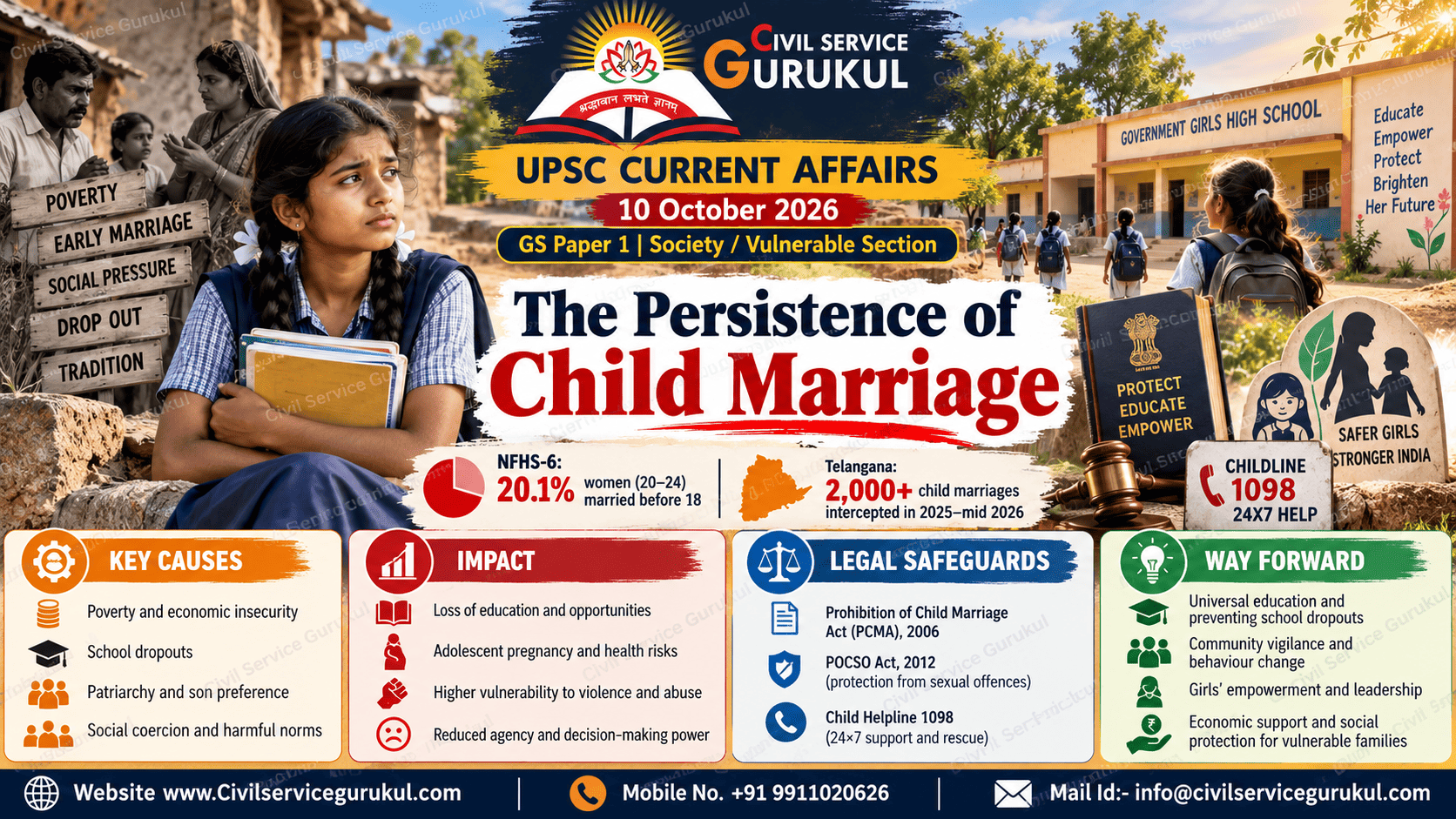
India has made significant progress in reducing child marriage, but the practice persists because it is rooted not only in custom, but also in poverty, school exclusion, family distress, patriarchal control and weak social protection.
Excerpt / Brief Summary
What Is Child Marriage?
Child marriage refers to a formal marriage or informal union where at least one party is below the legally prescribed age of marriage.
In India:
- Minimum age for males: 21 years
- Minimum age for females: 18 years
Child marriage restricts adolescent agency, disrupts education, increases health risks, and reinforces gender inequality.
Key Data on Child Marriage in India
| Indicator | Finding |
|---|---|
| Women aged 20–24 married before 18 | 20.1% |
| Earlier benchmark | 23.3% |
| Older benchmark | 47.4% |
| Telangana prevalence | Declined from 23.5% to 17.9% |
| Rural Telangana | 19.6% |
| Urban Telangana | 12.9% |
Telangana: A Revealing Case Study
Telangana has recorded substantial administrative intervention against planned child marriages.
| Period | Child Marriages Prevented |
|---|---|
| 2025–26 | 1,245 |
| April–August 2026 | 825 |
| Since 2014–15 | 10,710 |
The large number of prevented marriages demonstrates both stronger enforcement and the continued persistence of the practice.
District-Level Disparities
The incidence of intervention varies considerably across districts.
For example:
- Vikarabad recorded 878 interventions;
- Mahabubnagar recorded 759;
- Sangareddy recorded 715;
- Rajanna Sircilla recorded only 54.
Child marriage is not uniformly distributed. It is strongly associated with local poverty, education levels, social norms and administrative capacity.
School Dropout Is a Major Warning Signal
Among children identified during intervention efforts, hundreds had already dropped out of school.
This shows a direct relationship between:
↓
Loss of educational protection
↓
Economic dependency
↓
Greater exposure to social pressure
↓
Higher risk of child marriage
Keeping adolescent girls in school is therefore one of the strongest preventive tools.
Why Child Marriage Persists
1. Extreme Economic Distress
Poor households may view daughters as an additional economic burden.
Marriage is sometimes seen as a way to:
- Reduce household expenses;
- Shift responsibility to another family;
- Lower perceived future marriage costs;
- Manage severe financial distress.
2. Household Shocks and Parental Illness
Serious illness or loss of a breadwinner can destabilise vulnerable households.
Adolescent girls may then be forced to:
- Leave school;
- Work for wages;
- Take up care responsibilities;
- Enter premature marriage arrangements.
This shows why child marriage must also be understood as a social-protection problem.
3. Entrenched Patriarchy
Deep-rooted patriarchal beliefs continue to restrict adolescent girls’ autonomy.
Families may worry about:
- Female mobility;
- Sexuality;
- Family reputation;
- Community pressure;
- Marriageability.
In some communities, menarche is wrongly treated as a signal of readiness for marriage.
4. Family Honour and Social Control
Marriage is sometimes used as a mechanism to regulate adolescent girls’ choices.
Fear of:
- Inter-caste relationships;
- Pre-marital relationships;
- Elopement;
- Community criticism
can lead families to arrange early marriage.
5. Influence of Local Intermediaries
Landlords, moneylenders, brokers and local power-holders can sometimes influence marriage decisions in vulnerable families.
Economic dependency may therefore become social coercion.
This demonstrates the intersection of: poverty + caste/class hierarchy + gender inequality + local power structures.
6. Social Media, Romantic Relationships and Elopements
Digital communication has created new patterns of adolescent interaction.
In some cases, families respond to teenage relationships by quickly formalising marriage rather than providing counselling and adolescent support.
Thus, digital exposure without adequate social and emotional guidance can create new forms of vulnerability.
Why Child Marriage Is a Human Rights Issue
Child marriage affects multiple rights simultaneously.
| Right | Impact |
|---|---|
| Right to Education | Girls are often forced to leave school |
| Right to Health | Early pregnancy increases maternal and child health risks |
| Right to Dignity | Children lose agency over major life decisions |
| Right to Equality | Girls are disproportionately affected |
| Right to Personal Liberty | Marriage may be imposed without meaningful consent |
Health Consequences of Child Marriage
Adolescent girls may not be physically mature enough for pregnancy and childbirth.
Early pregnancy can lead to:
- Severe anaemia;
- Maternal complications;
- Bone-mass depletion;
- Obstetric risks;
- Premature birth;
- Foetal growth restriction.
Intergenerational Health Impact
The consequences extend beyond the young mother.
↓
Maternal undernutrition
↓
Low birth weight / premature birth
↓
Child stunting and poor development
↓
Long-term health disadvantage
Thus, child marriage can reproduce inequality across generations.
Educational Consequences
Marriage often permanently disrupts formal education.
Girls who drop out may find it difficult to re-enter school because of:
- Domestic responsibilities;
- Pregnancy;
- Childcare;
- Learning gaps;
- Social stigma.
Economic Consequences
Lower education results in fewer skills and weaker labour-market participation.
This produces a cycle:
Domestic Violence and Power Imbalance
Large age differences between child brides and adult husbands can produce severe power imbalances.
Young brides may have limited ability to:
- Negotiate contraception;
- Refuse sexual relations;
- Leave abusive relationships;
- Control household finances;
- Participate in decision-making.
Prohibition of Child Marriage Act, 2006
The Prohibition of Child Marriage Act provides the principal statutory framework.
It:
- Prohibits child marriage;
- Treats specified offences as cognizable and non-bailable;
- Provides for Child Marriage Prohibition Officers;
- Enables injunctions to stop planned marriages;
- Penalises adults and facilitators in appropriate cases.
Role of the POCSO Act
The Protection of Children from Sexual Offences Act, 2012 provides an important child-protection framework.
Sexual activity involving a person below 18 years can attract statutory criminal consequences, irrespective of informal family approval.
Role of Helpline 1098 and One Stop Centres
Emergency response systems play a critical role where a planned marriage must be stopped quickly.
Important mechanisms include:
- Child Helpline 1098;
- Sakhi One Stop Centres;
- District Child Protection Units;
- Police;
- Child Welfare Committees.
Grassroots Early-Warning Networks
Child marriage is often easiest to prevent when identified before invitations are printed or ceremonies begin.
Frontline workers such as:
- Anganwadi workers;
- ASHAs;
- Teachers;
- Panchayat representatives;
- Self-help groups
can help detect warning signs.
Stopping the Wedding Is Not Enough
- Poverty;
- No school access;
- Domestic pressure;
- Family debt;
- Continued marriage coercion.
Therefore, one-time intervention without rehabilitation may only postpone the marriage.
Need to Shift from Rescue to Prevention
Policy must move from last-minute intervention toward early prevention.
School attendance monitoring → Identify vulnerable girls → Family support → Cash and social protection → Counselling → Community intervention → Marriage prevention
Way Forward
1. Stronger Legal Deterrence
Authorities should act not only against families, but also against deliberate facilitators such as:
- Adult grooms;
- Brokers;
- Priests;
- Community intermediaries;
- Other enablers where legally liable.
2. Conditional Cash Transfers
Targeted financial support can help economically vulnerable families keep daughters in school.
Cash support can be linked to:
- School attendance;
- Completion of secondary education;
- Remaining unmarried until adulthood;
- Skill training.
3. Re-Enrolment and Bridge Education
Girls rescued from child marriage may already have been out of school for years.
They need:
- Bridge courses;
- Remedial education;
- Residential schooling where necessary;
- Vocational training;
- Digital learning support.
Institutions such as Kasturba Gandhi Balika Vidyalayas can play an important role.
4. Strengthen Frontline Early-Warning Systems
Frontline workers should be trained to track:
- Irregular school attendance;
- Sudden withdrawal from school;
- Adolescent pregnancy;
- Engagement ceremonies;
- Household distress.
5. Community-Led Behaviour Change
Legal prohibition alone cannot eliminate deeply embedded social practices.
Behavioural transformation requires participation of:
- Panchayats;
- Women’s SHGs;
- Religious and community leaders;
- Teachers;
- Youth groups;
- Local media.
6. Social Protection for Vulnerable Families
Families facing medical emergencies, widowhood, disability or debt may require targeted support.
Relevant measures include:
- Health insurance;
- Food security;
- Pensions;
- Livelihood assistance;
- Scholarships;
- Emergency cash support.
Child Marriage and Women’s Empowerment
Child marriage weakens women’s empowerment by reducing:
- Education;
- Employment;
- Mobility;
- Financial independence;
- Political voice;
- Reproductive choice.
Child marriage is both a consequence of gender inequality and a mechanism that reproduces gender inequality.
Child Marriage and SDGs
| SDG | Connection |
|---|---|
| SDG 1 | No Poverty |
| SDG 3 | Good Health and Well-being |
| SDG 4 | Quality Education |
| SDG 5 | Gender Equality |
| SDG 8 | Decent Work and Economic Growth |
UPSC GS Paper I Relevance
- Role of women;
- Social empowerment;
- Poverty and developmental issues;
- Effects of social practices on vulnerable groups;
- Population and social change.
UPSC GS Paper II Linkages
The issue can also be linked to:
- Social justice;
- Government interventions;
- Child rights;
- Women’s welfare;
- Education;
- Public health.
Essay Relevance
Child marriage can be used in essays on:
- Women empowerment;
- Education as social transformation;
- Gender justice;
- Poverty;
- Human dignity;
- Development and freedom.
UPSC Practice MCQ
1. The minimum legal age of marriage is 21 years for males and 18 years for females.
2. Child marriage is associated with school dropout and higher maternal health risks.
3. The Prohibition of Child Marriage Act, 2006 provides for Child Marriage Prohibition Officers.
4. Poverty has no significant relationship with child marriage.
Which of the statements given above are correct?
A. 1 and 2 only
B. 1, 2 and 3 only
C. 2, 3 and 4 only
D. 1, 2, 3 and 4
Answer: B
Statement 4 is incorrect because poverty and household economic distress are important structural drivers of child marriage.
UPSC Mains Practice Question
“Child marriage in India is not merely a traditional practice, but a manifestation of poverty, gender inequality and weak social protection.” Discuss the multi-dimensional causes and suggest an effective strategy to eliminate it.
Suggested Marks: 15
Suggested Word Limit: 250 words
Mains Answer Framework
Introduction:
Define child marriage and mention declining prevalence but continued persistence.
Body:
- Poverty and household distress;
- School dropout;
- Patriarchy and family honour;
- Local intermediaries and social coercion;
- Health and educational consequences;
- Existing legal framework;
- Need for social protection and community reform.
Conclusion:
Emphasise education, economic security,
gender equality and bodily autonomy.
Key Terms for Answer Enrichment
Conclusion
India’s decline in child marriage prevalence demonstrates that social change is possible, but enforcement alone cannot eliminate the practice.
Child marriage survives where poverty, school exclusion, patriarchal control, health shocks and social coercion converge.
The policy response therefore must go beyond stopping a wedding ceremony. It must ensure that the girl who is rescued has access to education, social protection, health services, economic opportunity and freedom from renewed coercion.
SEO Tags
Prepare with Mentors Who Cleared the Exam
Get personalized study plans, evaluated answer models, and test series access.