Constitution Day 2026: History, Significance & UPSC Notes
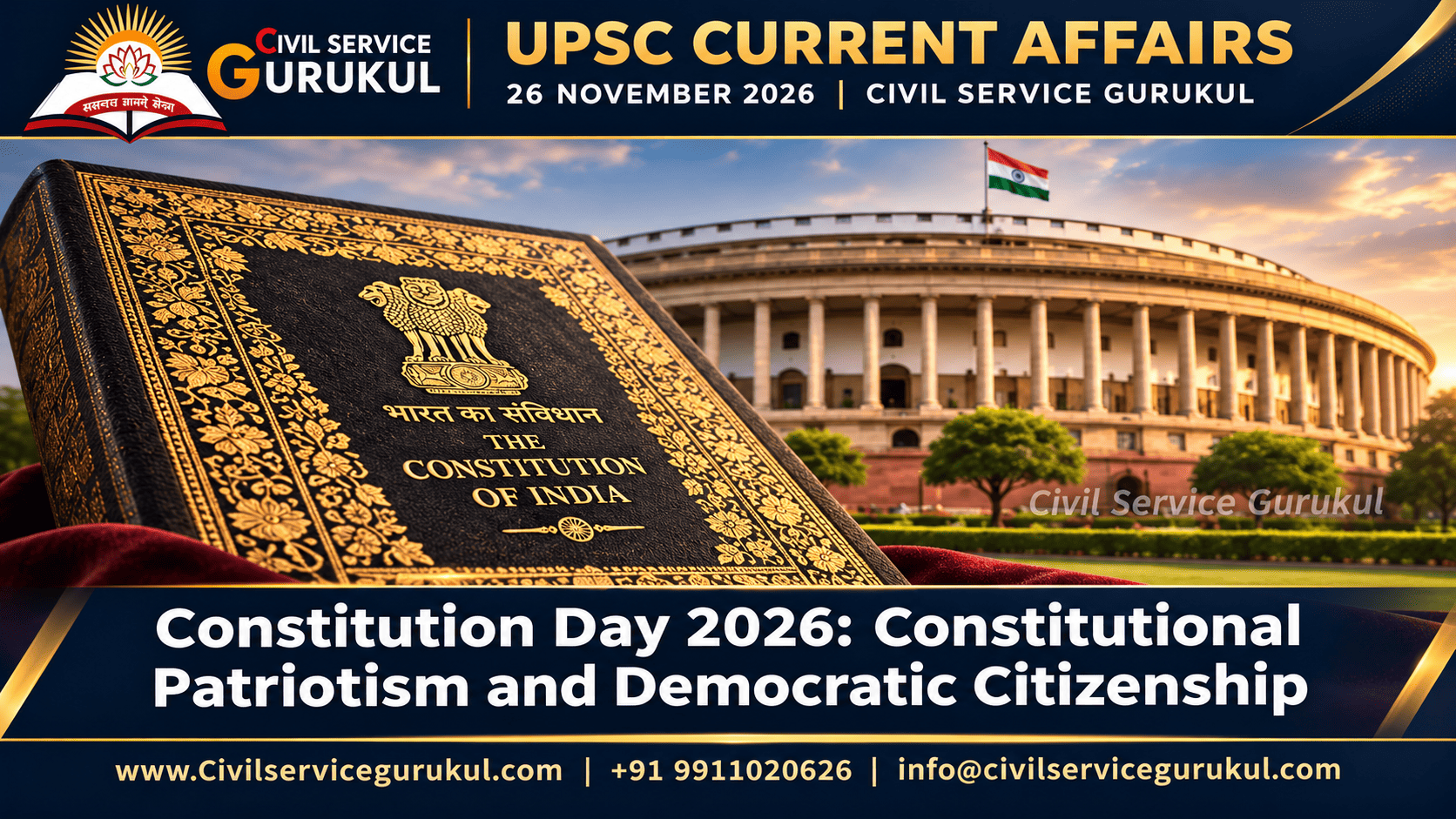
Constitution Day 2026: Constitutional Patriotism, Democratic Citizenship and the Living Spirit of India's Constitution – UPSC Special
India celebrates Constitution Day, also known as Samvidhan Diwas, on 26 November 2026, marking 77 years since the adoption of the Constitution by the Constituent Assembly.
The nationwide observance includes online Preamble readings in 23 languages and the release of updated editions of the Constitution in all 22 Scheduled Languages.
The occasion provides an opportunity to examine constitutional patriotism, constitutional morality, democratic citizenship, Fundamental Rights, Fundamental Duties and the responsibility of public institutions to uphold constitutional values.
UPSC Syllabus Relevance
| Examination Stage | Relevant Topics |
|---|---|
| Prelims | Indian Constitution, Preamble, Fundamental Rights, Fundamental Duties and Constitutional Amendments. |
| GS Paper I | Indian society, diversity, social empowerment and national integration. |
| GS Paper II | Indian Constitution, constitutional features, governance, democracy and accountability. |
| GS Paper IV | Ethics, constitutional morality, integrity, impartiality and public service values. |
| Essay | Democracy, constitutional values, freedom, equality, citizenship and social justice. |
| Interview | Constitutional commitment, administrative neutrality and democratic responsibility. |
1. Why in the News?
Constitution Day is being observed across India on 26 November 2026 to commemorate the adoption of the Constitution by the Constituent Assembly in 1949.
The Ministry of Parliamentary Affairs has facilitated an online Preamble-reading initiative through MyGov in 23 languages, comprising English and the 22 languages recognised under the Eighth Schedule.
Updated editions of the Constitution in all 22 Scheduled Languages were also released on the occasion, supporting wider public access to constitutional knowledge.
Major Highlights of Constitution Day 2026
- Completion of 77 years since the adoption of the Constitution.
- Online Preamble reading in 23 languages.
- Release of updated constitutional editions in all 22 Scheduled Languages.
- Constitutional awareness programmes in educational and public institutions.
- Promotion of responsible citizenship and democratic participation.
2. History and Significance of Constitution Day
Constitution Day commemorates the historic decision of the Constituent Assembly to adopt the Constitution of India on 26 November 1949.
Most constitutional provisions came into force on 26 January 1950, when India became a Republic.
In 2015, the Government of India formally designated 26 November as Constitution Day to promote awareness of constitutional principles among citizens.
Constitution Day vs Republic Day
| Parameter | Constitution Day | Republic Day |
|---|---|---|
| Date | 26 November | 26 January |
| Historical Event | Adoption of the Constitution in 1949 | General commencement of the Constitution in 1950 |
| Primary Significance | Constitutional awareness | Establishment of the Republic |
| Focus | Constitutional values and citizenship | Republican governance and national celebration |
3. Historical Timeline: Making of the Indian Constitution
| Date | Historical Event |
|---|---|
| 9 December 1946 | First meeting of the Constituent Assembly. |
| 11 December 1946 | Dr Rajendra Prasad elected permanent President of the Constituent Assembly. |
| 13 December 1946 | Jawaharlal Nehru introduced the Objectives Resolution. |
| 22 January 1947 | Objectives Resolution adopted. |
| 29 August 1947 | Drafting Committee constituted. |
| 26 November 1949 | Constitution adopted by the Constituent Assembly. |
| 24 January 1950 | Members signed the Constitution. |
| 26 January 1950 | General commencement of the Constitution. |
| 19 November 2015 | Government notified the annual observance of Constitution Day. |
| 26 November 2026 | 77th anniversary of constitutional adoption. |
4. Important Facts About the Indian Constitution
| Particulars | Important Facts |
|---|---|
| Chairman of Drafting Committee | Dr B. R. Ambedkar |
| President of Constituent Assembly | Dr Rajendra Prasad |
| Temporary Chairman | Dr Sachchidananda Sinha |
| Constitutional Adviser | B. N. Rau |
| Time Taken to Frame Constitution | 2 years, 11 months and 18 days |
| Original Articles | 395 |
| Original Parts | 22 |
| Original Schedules | 8 |
| Present Number of Schedules | 12 |
| Languages in Eighth Schedule | 22 |
| Constitutional Amendment Procedure | Article 368 |
5. Preamble: The Philosophy of the Indian Constitution
The Preamble expresses the fundamental philosophy and objectives of the Constitution. It establishes the people of India as the source of constitutional authority.
Nature of the Indian State
| Constitutional Term | Meaning |
|---|---|
| Sovereign | India possesses independent authority over its internal and external affairs. |
| Socialist | Commitment to social and economic justice and reducing inequalities. |
| Secular | Equal constitutional respect and protection for religious freedom. |
| Democratic | Government derives legitimacy from the people. |
| Republic | The head of the State holds an elected rather than hereditary office. |
Four Fundamental Constitutional Objectives
| Objective | Significance |
|---|---|
| Justice | Social, economic and political justice. |
| Liberty | Freedom of thought, expression, belief, faith and worship. |
| Equality | Equality of status and opportunity. |
| Fraternity | Dignity of the individual and unity and integrity of the nation. |
The 42nd Constitutional Amendment Act, 1976, inserted the words Socialist, Secular and Integrity into the Preamble.
The Preamble is part of the Constitution but is not independently enforceable in a court of law. It guides constitutional interpretation.
6. What Is Constitutional Patriotism?
Constitutional patriotism refers to commitment to the values, principles and democratic framework of the Constitution rather than unquestioning loyalty to a particular government, political party or leader.
It emphasises equal citizenship, respect for diversity, constitutional procedures and peaceful democratic participation.
The modern theoretical development of constitutional patriotism is particularly associated with German philosopher Jürgen Habermas.
Major Elements of Constitutional Patriotism
- Commitment to the supremacy of the Constitution.
- Respect for the rule of law.
- Protection of Fundamental Rights.
- Acceptance of democratic diversity.
- Respect for peaceful and lawful dissent.
- Accountability of public institutions.
- Commitment to justice, equality and fraternity.
Constitutional Patriotism and Democratic Governance
7. Constitutional Morality: Meaning and Importance
Constitutional morality refers to adherence to the principles, procedures, rights and institutional limitations established by the Constitution.
It requires citizens and public authorities to act consistently with constitutional values, even when prevailing social attitudes or political pressures favour a different approach.
Dr B. R. Ambedkar emphasised the need to cultivate constitutional morality for the successful functioning of democratic institutions.
Constitutional Morality vs Social Morality
| Parameter | Constitutional Morality | Social Morality |
|---|---|---|
| Foundation | Constitutional principles | Social traditions and accepted practices |
| Primary Focus | Justice, liberty, equality and dignity | Community values and social expectations |
| Protection | Individual rights and equal citizenship | Established social norms |
| Authority | Constitutional framework | Customs and collective beliefs |
Social traditions may reinforce constitutional values. However, where a social practice violates constitutionally protected rights, its legitimacy must be assessed within the constitutional framework.
8. Democratic Citizenship
Democratic citizenship involves active and responsible participation in public life while respecting the rights of others and the constitutional framework.
Citizenship in a democracy extends beyond voting. It includes civic awareness, informed participation, accountability and respect for institutional processes.
Characteristics of Responsible Democratic Citizens
- Participation in democratic processes.
- Respect for constitutional rights and duties.
- Responsible exercise of freedom of expression.
- Respect for religious and cultural diversity.
- Protection of public property.
- Scientific temper and critical thinking.
- Peaceful engagement with public institutions.
- Commitment to social justice and fraternity.
9. Fundamental Rights, Directive Principles and Fundamental Duties
| Parameter | Fundamental Rights | DPSP | Fundamental Duties |
|---|---|---|---|
| Constitutional Part | Part III | Part IV | Part IVA |
| Articles | 12–35 | 36–51 | 51A |
| Nature | Constitutionally enforceable rights | Principles guiding State policy | Civic responsibilities |
| Justiciability | Generally justiciable | Non-justiciable | Not directly enforceable as constitutional duties |
| Objective | Political freedom and individual dignity | Social and economic welfare | Responsible citizenship |
Important Constitutional Articles for UPSC
| Article | Subject |
|---|---|
| Article 14 | Equality before law and equal protection of laws. |
| Article 15 | Prohibition of discrimination on specified grounds. |
| Article 19 | Protection of specified freedoms of citizens. |
| Article 21 | Protection of life and personal liberty. |
| Article 21A | Right to education for children aged six to fourteen years. |
| Article 32 | Constitutional remedies for enforcement of Fundamental Rights. |
| Article 37 | Application and non-justiciability of Directive Principles. |
| Article 39A | Equal justice and free legal aid. |
| Article 50 | Separation of judiciary from executive in public services of the State. |
| Article 51A | Fundamental Duties. |
| Article 226 | Writ jurisdiction of High Courts. |
| Article 368 | Power and procedure to amend the Constitution. |
| Article 394 | Commencement of the Constitution. |
- The 42nd Constitutional Amendment Act, 1976, introduced ten Fundamental Duties.
- The recommendations of the Swaran Singh Committee influenced their introduction.
- The 86th Constitutional Amendment Act, 2002, added the eleventh Fundamental Duty under Article 51A(k).
- Fundamental Duties are prescribed for citizens of India.
10. Landmark Supreme Court Judgments
| Judgment | Year | Constitutional Significance |
|---|---|---|
| In Re Berubari Union | 1960 | Considered the Preamble an interpretative aid but not part of the Constitution at that time. |
| Kesavananda Bharati v. State of Kerala | 1973 | Established the Basic Structure Doctrine and recognised the Preamble as part of the Constitution. |
| Maneka Gandhi v. Union of India | 1978 | Strengthened the protection of personal liberty and fairness of legal procedure. |
| Minerva Mills v. Union of India | 1980 | Recognised the importance of harmony between Fundamental Rights and Directive Principles. |
| S. R. Bommai v. Union of India | 1994 | Reaffirmed secularism as a basic feature and strengthened constitutional limits on Article 356. |
| K. S. Puttaswamy v. Union of India | 2017 | Recognised privacy as a constitutionally protected Fundamental Right. |
| Navtej Singh Johar v. Union of India | 2018 | Emphasised dignity, equality, individual autonomy and constitutional morality. |
Basic Structure Doctrine
Parliament possesses the power to amend the Constitution under Article 368. However, it cannot exercise this power to destroy or damage the Constitution's basic structure.
Judicial decisions have recognised several basic features, including:
- Supremacy of the Constitution.
- Republican and democratic governance.
- Secularism.
- Judicial review.
- Federalism.
- Rule of law.
- Independence of the judiciary.
- Limited constitutional amendment power.
The basic structure is not an exhaustive, fixed list expressly enumerated in the Constitution.
11. Significance of Constitution Day 2026
Promoting Constitutional Literacy
Constitution Day creates an opportunity for citizens to understand their rights, responsibilities and democratic institutions.
Strengthening Linguistic Inclusion
Access to the Constitution in Scheduled Languages can reduce linguistic barriers and improve public understanding of constitutional principles.
Protecting Democratic Institutions
Constitutional awareness can encourage public accountability, institutional independence and informed participation.
Promoting National Integration
Shared commitment to constitutional values can help unite citizens across linguistic, cultural, religious and regional differences.
Encouraging Ethical Governance
Constitutional principles provide an ethical foundation for impartial administration, transparency and public service.
Strengthening Social Justice
Awareness of constitutional safeguards can help marginalised communities understand and exercise their rights.
12. Challenges to Constitutional Democracy
Although ceremonial observances can strengthen public awareness, constitutional democracy requires continuous institutional and civic commitment.
| Challenge | Constitutional Concern |
|---|---|
| Limited Constitutional Literacy | Citizens may remain unaware of their rights and remedies. |
| Social Discrimination | Undermines equality, dignity and substantive justice. |
| Economic Inequality | Can restrict meaningful access to opportunities and institutions. |
| Political Polarisation | May weaken fraternity, dialogue and democratic tolerance. |
| Misinformation | Can undermine informed citizenship and public trust. |
| Institutional Weakness | May affect accountability and constitutional checks and balances. |
| Barriers to Justice | Financial, procedural and geographical obstacles may restrict access to remedies. |
| Administrative Bias | Undermines impartial governance and equal treatment. |
13. Way Forward
Constitutional Education
Schools, colleges and training institutions should teach constitutional principles through practical case studies, debates and civic exercises.
Strengthening Access to Justice
Legal aid, accessible grievance redress systems and public awareness initiatives can help citizens exercise constitutional remedies.
Institutional Accountability
Public institutions should maintain transparency, professional independence and respect for constitutional limitations.
Ethical Civil Services
Civil servants should uphold impartiality, political neutrality, integrity and constitutional commitment.
Multilingual Constitutional Awareness
Constitutional education should be accessible across languages and literacy levels, including through suitable digital and accessible formats.
Responsible Digital Citizenship
Citizens should verify information, avoid misinformation and engage responsibly in democratic discussions.
Outcome-Based Evaluation
Civic awareness programmes should be assessed through improvements in constitutional understanding and meaningful participation rather than attendance figures alone.
14. UPSC Prelims 2027 – Quick Revision
- Constitution Day is celebrated on 26 November.
- The Constitution was adopted on 26 November 1949.
- Most provisions commenced on 26 January 1950.
- Official Constitution Day observance began in 2015.
- Dr B. R. Ambedkar chaired the Drafting Committee.
- Dr Rajendra Prasad was President of the Constituent Assembly.
- B. N. Rau was its Constitutional Adviser.
- Article 51A deals with Fundamental Duties.
- Article 368 deals with constitutional amendments.
- The Eighth Schedule contains 22 languages.
- English is not included in the Eighth Schedule.
- The 2026 Preamble initiative includes 22 Scheduled Languages and English.
- The 42nd Amendment modified the Preamble and introduced Fundamental Duties.
- The 86th Amendment added the eleventh Fundamental Duty.
- Kesavananda Bharati established the Basic Structure Doctrine in 1973.
15. UPSC Prelims Practice MCQs
Question 1
With reference to the Indian Constitution, consider the following statements:
- The Constitution was adopted on 26 November 1949.
- All provisions of the Constitution came into force on 26 January 1950.
- Constitution Day has been officially observed since 2015.
Which of the statements given above are correct?
- 1 and 2 only
- 1 and 3 only
- 2 and 3 only
- 1, 2 and 3
Reveal Correct Answer and Explanation
Statement 1 is correct. The Constitution was adopted on 26 November 1949.
Statement 2 is incorrect. Certain provisions commenced immediately upon adoption under Article 394.
Statement 3 is correct. Official annual observance began in 2015.
Question 2
Which of the following words were inserted into the Preamble by the 42nd Constitutional Amendment Act?
- Socialist
- Secular
- Republic
- Integrity
Select the correct answer using the code given below:
- 1 and 2 only
- 2 and 3 only
- 1, 2 and 4 only
- 1, 2, 3 and 4
Reveal Correct Answer and Explanation
The words Socialist, Secular and Integrity were inserted by the 42nd Amendment in 1976. Republic was already present in the original Preamble.
Question 3
Consider the following statements regarding Fundamental Duties:
- They are contained in Part IVA of the Constitution.
- They were originally included in the Constitution of 1950.
- The 86th Constitutional Amendment added a Fundamental Duty.
Which of the statements given above are correct?
- 1 and 2 only
- 1 and 3 only
- 2 and 3 only
- 1, 2 and 3
Reveal Correct Answer and Explanation
Fundamental Duties are contained in Part IVA under Article 51A. They were introduced by the 42nd Amendment in 1976. The 86th Amendment added the eleventh duty.
Question 4
With reference to the Eighth Schedule of the Indian Constitution, consider the following statements:
- It presently contains 22 languages.
- English is included in the Eighth Schedule.
- The Constitution Day 2026 online Preamble-reading initiative covers English and all 22 Scheduled Languages.
Which of the statements given above are correct?
- 1 only
- 1 and 2 only
- 1 and 3 only
- 1, 2 and 3
Reveal Correct Answer and Explanation
The Eighth Schedule contains 22 languages. English is not one of them. The 2026 initiative covers 23 languages by including English alongside the Scheduled Languages.
Question 5
Which of the following best describes constitutional patriotism?
- Unquestioning loyalty to the government in power.
- Acceptance of every practice supported by a social majority.
- Commitment to constitutional values, equal citizenship and democratic institutions.
- Rejection of peaceful criticism of public institutions.
Reveal Correct Answer and Explanation
Constitutional patriotism emphasises commitment to constitutional principles rather than unconditional loyalty to political authorities. It accommodates lawful dissent, pluralism and accountable governance.
16. UPSC Mains Answer Writing Practice
Question: Constitutional patriotism depends on the strength of democratic institutions as much as ceremonial observance. Discuss in the context of Constitution Day 2026.
Marks: 15 | Word Limit: 250 Words
Reveal Model Answer
Introduction
Constitutional patriotism signifies loyalty to constitutional values rather than unconditional allegiance to a particular government or political authority. Constitution Day 2026, commemorating the adoption of the Constitution in 1949, provides an opportunity to strengthen this democratic commitment.
Body
Ceremonial observances such as collective Preamble readings promote constitutional literacy and a shared understanding of justice, liberty, equality and fraternity. Multilingual initiatives further support inclusive citizenship by reducing linguistic barriers.
However, constitutional patriotism requires more than symbolic participation. Its practical realisation depends on:
- Rule of law: Equal application of laws to citizens and public authorities.
- Independent judiciary: Protection of Fundamental Rights and constitutional limitations.
- Accountable governance: Transparency, legislative scrutiny and effective grievance redress.
- Democratic pluralism: Respect for diversity, peaceful dissent and minority rights.
- Ethical administration: Impartial delivery of public services without discrimination.
Persistent inequalities, social discrimination, limited civic literacy and institutional weaknesses may undermine the translation of constitutional ideals into everyday governance.
Strengthening legal aid, civic education, administrative accountability and accessible constitutional resources can bridge this gap. Constitutional awareness programmes should also be evaluated through measurable improvements in public understanding and democratic participation.
Conclusion
Constitution Day must become an occasion for renewing practical constitutional commitment rather than merely repeating ceremonial pledges. A living constitutional culture requires citizens and institutions to uphold dignity, equality, liberty and fraternity through everyday conduct.
Discuss the role of multilingual constitutional education in strengthening inclusive citizenship and participatory democracy in India.
Marks: 10 | Word Limit: 150 Words
Explain the significance of constitutional morality in resolving conflicts between personal beliefs, social customs and the official responsibilities of civil servants.
Marks: 10 | Word Limit: 150 Words
17. GS Paper IV – Ethics Case Study
You are a District Magistrate responsible for organising a Constitution Day awareness programme. Certain influential local representatives demand that members of a marginalised community be excluded from the event, citing prevailing social customs.
The proposed exclusion contradicts the constitutional principles of equality, dignity and fraternity.
Questions
- Identify the ethical issues involved.
- Identify the stakeholders.
- What course of action should you adopt?
Reveal Suggested Case Study Solution
Ethical Issues
- Equality versus discriminatory social customs.
- Constitutional morality versus social pressure.
- Administrative impartiality and integrity.
- Human dignity and inclusive citizenship.
- Professional courage and accountability.
Stakeholders
- Members of the marginalised community.
- Local representatives.
- District administration.
- Educational and public institutions.
- Citizens participating in the event.
Appropriate Course of Action
- Reject the discriminatory demand through a reasoned and lawful administrative decision.
- Ensure equal access and participation for all eligible citizens.
- Engage local representatives in constructive dialogue regarding constitutional obligations.
- Make appropriate arrangements to maintain public order and participant safety.
- Document the decision and establish accessible grievance mechanisms.
- Promote long-term constitutional literacy through inclusive civic programmes.
Ethical Justification: The proposed action upholds constitutional morality, equality, dignity, impartiality, integrity and commitment to public service.
18. Important Essay Topics for UPSC
- The Constitution is a living document, not merely a legal text.
- Constitutional morality is the foundation of ethical governance.
- Democracy flourishes when citizens understand their rights and responsibilities.
- Fraternity is essential for the meaningful realisation of liberty and equality.
- National unity is strengthened through respect for diversity.
19. Frequently Asked Questions
Why is Constitution Day celebrated on 26 November?
It commemorates the adoption of the Indian Constitution by the Constituent Assembly on 26 November 1949.
When did India begin officially celebrating Constitution Day?
India began the official annual observance in 2015.
Who chaired the Drafting Committee of the Constitution?
Dr B. R. Ambedkar.
What is special about Constitution Day 2026?
It marks 77 years since constitutional adoption. The celebrations include an online Preamble-reading initiative in 23 languages and the release of updated constitutional editions in all 22 Scheduled Languages.
How many languages are included in the Eighth Schedule?
There are 22 languages in the Eighth Schedule.
Is English included in the Eighth Schedule?
No. English is not included in the Eighth Schedule.
Which Article contains Fundamental Duties?
Article 51A under Part IVA of the Constitution.
How many Fundamental Duties are there?
There are eleven Fundamental Duties.
What is constitutional morality?
Constitutional morality means commitment to constitutional values, democratic procedures, individual rights and institutional limitations.
What is constitutional patriotism?
Constitutional patriotism refers to loyalty to constitutional principles, equal citizenship and democratic institutions rather than unconditional loyalty to political authorities.
Which judgment established the Basic Structure Doctrine?
Kesavananda Bharati v. State of Kerala, 1973.
Is the Preamble part of the Indian Constitution?
Yes. The Supreme Court recognised the Preamble as part of the Constitution in the Kesavananda Bharati judgment.
Why is Constitution Day important for UPSC 2027?
It connects current affairs with Indian Polity, constitutional amendments, landmark judgments, governance, ethics and democratic citizenship.
20. Conclusion
Constitution Day 2026 is an opportunity to celebrate India's democratic heritage while examining the practical implementation of constitutional values.
The initiatives promoting multilingual access to constitutional knowledge can support inclusive citizenship and strengthen civic awareness.
Nevertheless, constitutional democracy requires continuous commitment to the rule of law, judicial independence, transparent governance, individual dignity and equal citizenship.
The true significance of Samvidhan Diwas lies in translating justice, liberty, equality and fraternity into the everyday functioning of society and public institutions.
A Constitution becomes a living instrument of democracy when citizens understand it, institutions respect it and public servants practise its values.
Prepare for UPSC CSE 2027 with Civil Service Gurukul
Develop conceptual clarity, analytical thinking and examination-oriented preparation through structured learning.
Daily Current Affairs | Prelims Test Series | Mains Answer Writing | NCERT Foundation | Indian Polity | Ethics and Governance | UPSC Mentorship
Visit Our Website Connect on WhatsAppWebsite: www.Civilservicegurukul.com
Mobile No.: +91 9911020626
Email: info@civilservicegurukul.com
Prepare with Mentors Who Cleared the Exam
Get personalized study plans, evaluated answer models, and test series access.