
Electoral Roll Revision in India: SSR, Voter Rights & UPSC 2027
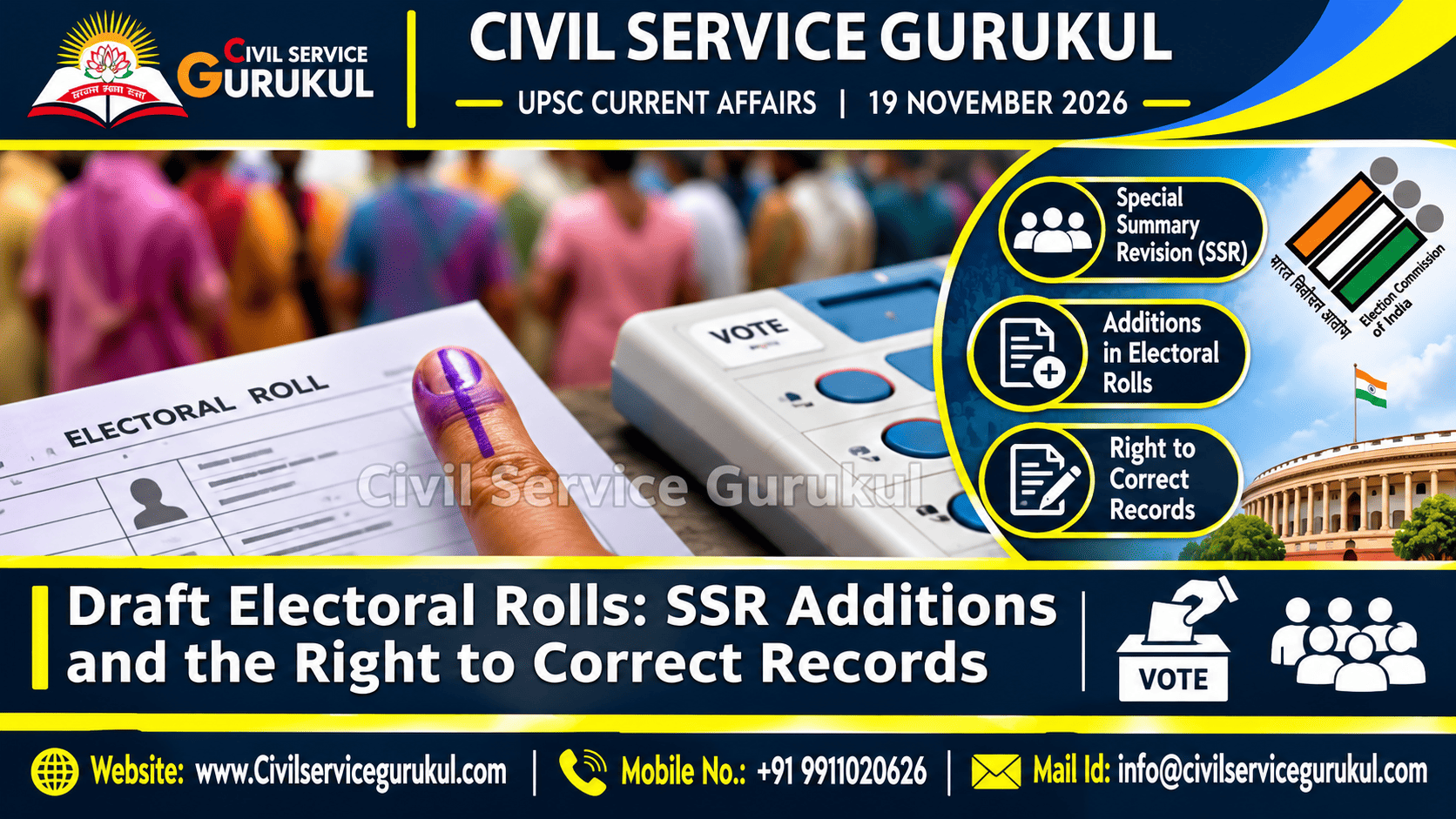
Electoral Roll Revision in India: Why Voter Inclusion, Draft Rolls and Correction Rights Matter for Democracy
A comprehensive UPSC analysis of Special Summary Revision, voter registration, Article 326, electoral-roll accuracy, claims and objections, and democratic accountability.
1. Why Are Draft Electoral Rolls in the News?
A November 2026 current-affairs topic has highlighted reported additions to draft electoral rolls during a revision exercise.
The issue draws attention to the importance of accurate voter registration, transparent procedures and accessible correction mechanisms.
Draft publication is an important administrative stage because eligible citizens can inspect records and use prescribed procedures to raise claims or objections.
2. What Are Electoral Rolls?
An electoral roll is an official record of registered electors for a particular electoral constituency.
Electoral rolls support the administration of elections by identifying persons registered to vote in the relevant constituency.
Why Are Electoral Rolls Important?
Electoral registration enables eligible citizens to participate through voting.
Updated records help election authorities manage electoral processes.
Published records support scrutiny and correction.
Fair and accessible procedures strengthen trust in elections.
3. Draft Electoral Roll vs Final Electoral Roll
| Parameter | Draft Roll | Final Roll |
|---|---|---|
| Stage | Published for scrutiny during revision. | Published after the prescribed revision process. |
| Corrections | Claims and objections may be invited. | Further changes may still occur through applicable continuous-updation procedures. |
| Purpose | Public verification and correction. | Official updated electoral record. |
4. Constitutional Framework of Electoral Rolls
Article 324
Article 324 vests the superintendence, direction and control of electoral-roll preparation and specified elections in the Election Commission of India.
Article 325
Article 325 provides for one general electoral roll for every territorial constituency for elections to Parliament and state legislatures, and prohibits exclusion or special-roll claims on specified grounds.
Article 326
Article 326 provides for elections to the Lok Sabha and state legislative assemblies on the basis of adult suffrage, subject to constitutional and legal conditions.
The voting age is 18 years, subject to applicable eligibility requirements.
5. Representation of the People Act, 1950
The Representation of the People Act, 1950 provides the statutory framework for electoral-roll preparation and related matters.
It addresses registration, eligibility and revision-related processes under the applicable legal framework.
6. What Is Special Summary Revision?
Special Summary Revision, or SSR, is a process used to update electoral rolls through prescribed stages of verification, draft publication, claims, objections and final publication.
The detailed schedule and procedures are determined by the relevant Election Commission instructions and applicable rules.
Illustrative Stages of SSR
- Preparatory and verification activities.
- Publication of draft electoral rolls.
- Receipt of claims and objections.
- Verification and disposal of applications.
- Publication of final electoral rolls.
7. Why Is Draft Publication Important?
Draft publication provides an opportunity for citizens and other eligible participants to scrutinise electoral records.
It helps identify possible omissions, incorrect particulars and other issues requiring administrative attention.
The process supports both inclusion and accuracy when supported by accessible procedures and fair decision-making.
8. Claims, Objections and Correction Procedures
Eligible persons may use prescribed procedures to request inclusion, correction or other relevant changes to electoral records.
Applications are subject to applicable rules, verification and decision-making by the competent authorities.
Common Electoral Forms
| Form | Broad Purpose |
|---|---|
| Form 6 | Application for inclusion of name in the electoral roll. |
| Form 7 | Objection to proposed inclusion or request for deletion of a name, subject to prescribed grounds. |
| Form 8 | Specified corrections, shifting of residence and other permitted changes. |
Applicants should consult current ECI instructions for exact eligibility, documentation and procedural requirements.
9. Role of Electoral Registration Officers
Electoral Registration Officers perform statutory functions relating to the preparation and revision of electoral rolls within their jurisdiction.
The process may involve support from other designated electoral officials and field-level personnel.
10. Role of Booth Level Officers
Booth Level Officers support electoral-roll activities at the local level under the relevant administrative framework.
Their work can assist verification, citizen outreach and record maintenance.
11. Voter Inclusion and the Right to Correct Records
Accurate electoral records require both the inclusion of eligible citizens and the lawful removal or correction of entries that do not meet applicable requirements.
Procedural fairness is particularly important when decisions may affect a person's ability to participate in elections.
Important Safeguards
- Clear public notice of revision schedules.
- Accessible procedures for claims and objections.
- Reasoned decisions by competent authorities.
- Appropriate verification before adverse changes.
- Availability of statutory remedies where applicable.
- Support for citizens facing access barriers.
12. Digital and Offline Access
Digital systems can make electoral services more accessible and efficient.
However, digital-only approaches may create difficulties for people with limited connectivity, digital literacy or access to devices.
An inclusive electoral system should provide appropriate offline assistance alongside digital facilities.
13. Electoral Inclusion and Vulnerable Groups
Certain groups may experience greater difficulty in accessing registration and correction services.
Administrative design should therefore consider accessibility, language, mobility and other practical barriers.
14. Challenges in Electoral-Roll Revision
Eligible electors may face problems if records are incorrectly removed or omitted.
Outdated or inaccurate particulars can affect administrative quality.
Unequal access to online services may create barriers.
Large-scale verification requires adequate staffing and oversight.
Inadequate information may reduce awareness of available remedies.
Unclear procedures can weaken public confidence.
15. Accuracy vs Inclusion: The Governance Balance
Electoral-roll revision must balance two important objectives.
First, records should accurately reflect eligible electors.
Second, eligible citizens should not face unjustified barriers to registration or correction.
16. Ethical Dimensions for GS Paper IV
- Impartiality: Electoral administration should avoid unfair discrimination.
- Accountability: Decisions should be subject to appropriate review.
- Transparency: Procedures and relevant information should be accessible.
- Fairness: Citizens should have meaningful opportunities to correct records.
- Public Trust: Consistent procedures support confidence in democratic institutions.
17. Way Forward for Electoral-Roll Governance
- Improve public notice: Communicate draft publication and claim periods clearly.
- Strengthen verification: Use fair and reliable administrative procedures.
- Provide offline support: Ensure access for digitally excluded citizens.
- Improve grievance redress: Enable timely review of relevant complaints.
- Maintain transparency: Publish appropriate revision information and procedures.
- Protect eligible voters: Reduce risks of wrongful exclusion.
- Build institutional capacity: Support trained personnel and effective supervision.
- Verify reported figures: Use official ECI tables for exact statewise statistics.
18. UPSC Prelims 2027: Quick Revision
- Article 324 concerns the Election Commission's constitutional responsibilities.
- Article 325 concerns general electoral rolls and prohibits specified forms of exclusion.
- Article 326 establishes adult suffrage for Lok Sabha and state assembly elections.
- The voting age is 18 years, subject to legal eligibility.
- The Representation of the People Act, 1950 deals with electoral-roll matters.
- The Representation of the People Act, 1951 deals principally with the conduct of elections and related matters.
- Draft electoral rolls may change after claims, objections and verification.
- Form 6 concerns inclusion of a name.
- Form 7 concerns specified objections and deletion requests.
- Form 8 concerns specified corrections and other permitted changes.
19. Original UPSC Prelims MCQs
Question 1
Consider the following statements:
- Article 326 provides for adult suffrage in elections to the Lok Sabha and state legislative assemblies.
- The voting age is 21 years.
- Electoral-roll preparation is governed by a statutory framework.
Which statements are correct?
(A) 1 only
(B) 1 and 3 only
(C) 2 and 3 only
(D) 1, 2 and 3
Statements 1 and 3 are correct. Statement 2 is incorrect because the voting age is 18 years.
Question 2
Which legislation principally governs electoral-roll preparation in India?
(A) Representation of the People Act, 1950
(B) Representation of the People Act, 1951 only
(C) Companies Act, 2013
(D) Indian Contract Act, 1872
The Representation of the People Act, 1950 provides the principal statutory framework for electoral-roll preparation.
Question 3
Consider the following statements about draft electoral rolls:
- Draft publication provides an opportunity for public scrutiny.
- Claims and objections may result in changes before final publication.
- A draft roll must always be identical to the final roll.
Which statements are correct?
(A) 1 and 2 only
(B) 2 and 3 only
(C) 1 and 3 only
(D) 1, 2 and 3
Draft rolls may change after prescribed claims, objections and verification.
Question 4
Which of the following form-purpose pairs are correctly matched?
- Form 6 — Inclusion of name
- Form 7 — Specified objections or deletion requests
- Form 8 — Specified corrections and shifting of residence
(A) 1 only
(B) 1 and 2 only
(C) 2 and 3 only
(D) 1, 2 and 3
All three pairs are correctly matched in their broad purposes.
Question 5
Which approach best supports electoral-roll integrity?
(A) Eliminate all correction procedures after draft publication.
(B) Rely exclusively on digital applications.
(C) Combine accurate verification with accessible claims, objections and remedies.
(D) Assume that large-scale additions automatically prove the absence of errors.
Electoral integrity requires accuracy together with fair and accessible administrative procedures.
20. UPSC Mains Practice Question
"Electoral-roll revision is not merely an administrative exercise but a critical safeguard of democratic inclusion." Examine the importance of transparency, accuracy and accessible correction mechanisms in electoral governance.
Word Limit: 250 words
21. Model UPSC Mains Answer
Introduction
Electoral rolls are essential administrative records that support democratic participation. Their preparation and revision must balance accuracy with the inclusion of eligible citizens.
Constitutional and Legal Basis
Article 324 provides the constitutional basis for the Election Commission's responsibilities.
Article 326 establishes adult suffrage for Lok Sabha and state assembly elections.
The Representation of the People Act, 1950 governs electoral-roll preparation and related matters.
Importance of Transparent Revision
- Accuracy: Updated records reduce administrative errors.
- Inclusion: Eligible citizens require accessible registration procedures.
- Fairness: Claims and objections enable correction of records.
- Trust: Transparent procedures support confidence in elections.
Major Challenges
- Risk of wrongful exclusion.
- Digital access barriers.
- Administrative capacity constraints.
- Inadequate public communication.
Way Forward
Election authorities should strengthen verification, public notice, offline assistance, grievance redress and transparent administrative oversight.
Conclusion
Electoral-roll revision strengthens democracy when accurate records are combined with accessible procedures and effective protection of eligible voters.
22. Frequently Asked Questions
What is Special Summary Revision?
SSR is a process for updating electoral rolls through prescribed revision stages.
Can a draft electoral roll be corrected?
Yes. Prescribed claims and objections may result in changes before final publication.
Which Article deals with adult suffrage?
Article 326 of the Constitution of India.
Which law governs electoral-roll preparation?
The Representation of the People Act, 1950.
Why is electoral-roll revision important for UPSC?
It connects constitutional provisions, electoral governance, democratic inclusion, administrative fairness and public accountability.
23. Conclusion: Accurate Electoral Rolls Strengthen Democracy
Electoral-roll revision is an essential component of democratic administration.
Draft publication allows records to be scrutinised and corrected through prescribed procedures.
However, the quality of revision depends on accuracy, fairness, accessibility and transparent decision-making.
For UPSC aspirants, the central lesson is that electoral integrity requires both reliable records and meaningful protection of eligible voters.
Master Indian Polity, Constitution and Governance for UPSC 2027
Prepare with Civil Service Gurukul through current-affairs analysis, Prelims MCQs, Mains answer writing and structured mentoring.
CIVIL SERVICE GURUKUL
UPSC | IAS | State PCS | Prelims & Mains
Visit Our Website Call +91 9911020626 Email for Enquirywww.civilservicegurukul.com
Editorial Disclaimer: This original educational article expands upon a November 2026 current-affairs topic concerning electoral-roll revision. The reported figure of nearly 75 lakh additions across 13 states and Union Territories has not been independently verified against official ECI tables. Readers should consult official Election Commission notifications for precise figures, schedules and procedural requirements.
Prepare with Mentors Who Cleared the Exam
Get personalized study plans, evaluated answer models, and test series access.