
Voyager 1 One-Light-Day Milestone: UPSC 2027
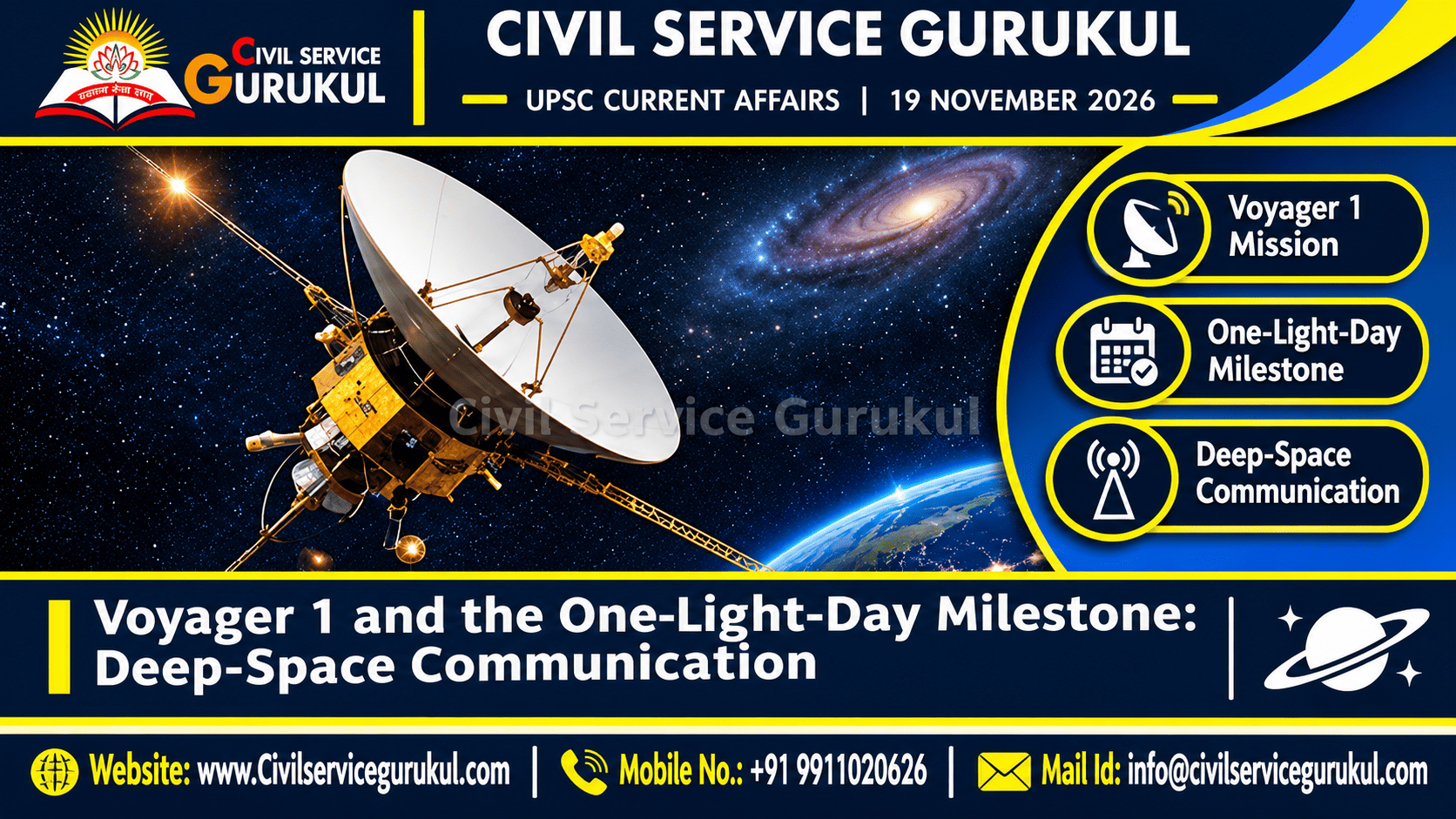
Voyager 1 Nears One Light-Day: How NASA Communicates with Humanity's Farthest Spacecraft
A comprehensive UPSC analysis of the Voyager mission, interstellar space, heliopause, radio-signal delay, NASA's Deep Space Network, spacecraft autonomy and long-duration exploration.
1. Why Is Voyager 1 in the News?
A November 2026 science current-affairs topic has highlighted Voyager 1's reported approach toward a distance of one light-day from Earth.
This is important because the spacecraft's increasing distance creates major communication and engineering challenges.
At a distance of one light-day, a radio signal travelling at light speed would take approximately 24 hours to reach the spacecraft from Earth.
2. What Is Voyager 1?
Voyager 1 is a NASA spacecraft launched in 1977 to explore the outer Solar System.
Its mission later extended to the study of the environment beyond the heliopause.
Voyager 1 entered interstellar space in 2012 by crossing the heliopause.
Important Facts About Voyager 1
NASA
1977
Robotic deep-space exploration.
Interstellar space beyond the heliopause.
3. Voyager 1 vs Voyager 2
| Parameter | Voyager 1 | Voyager 2 |
|---|---|---|
| Launch Year | 1977 | 1977 |
| Launch Order | Launched after Voyager 2. | Launched before Voyager 1. |
| Interstellar Space Entry | 2012 | 2018 |
| Distinctive Exploration | Jupiter and Saturn. | Jupiter, Saturn, Uranus and Neptune. |
4. What Is One Light-Day?
One light-day is the distance travelled by light in a vacuum over 24 hours.
The speed of light in vacuum is approximately 299,792 kilometres per second.
Calculation of One Light-Day
Distance = Speed × Time
Time = 24 × 60 × 60 = 86,400 seconds
Distance = 299,792 × 86,400 kilometres
One light-day ≈ 25.9 billion kilometres
5. Why Is the One-Light-Day Milestone Important?
The milestone illustrates the extreme scale of deep-space exploration.
As distance increases, the time needed for radio communication also increases.
This makes real-time human control impossible for spacecraft at very large distances.
Signal Delay at One Light-Day
| Communication Event | Approximate Time |
|---|---|
| Earth sends command to spacecraft | 24 hours |
| Spacecraft response travels to Earth | 24 hours |
| Minimum round-trip signal travel time | 48 hours |
These are idealised propagation times at a separation of exactly one light-day.
Actual mission communication also involves processing, scheduling and operational delays.
6. What Is the Heliosphere?
The heliosphere is the large region of space influenced by the Sun's solar wind and magnetic environment.
The solar wind consists of charged particles flowing outward from the Sun.
7. What Is the Heliopause?
The heliopause is the outer boundary of the heliosphere, where the solar wind's influence is balanced by the surrounding interstellar medium.
Voyager 1 crossed this boundary in 2012.
Important Space Regions
| Term | Meaning |
|---|---|
| Solar Wind | Stream of charged particles emitted by the Sun. |
| Heliosphere | Region influenced by the solar wind and the Sun's magnetic environment. |
| Heliopause | Outer boundary of the heliosphere. |
| Interstellar Medium | Matter and fields present in space between stars. |
| Oort Cloud | Hypothesised distant reservoir of icy bodies associated with the Solar System. |
8. Has Voyager 1 Left the Solar System?
Voyager 1 has crossed the heliopause and entered interstellar space.
However, this does not necessarily mean it has left the Solar System under every definition.
The distant Oort Cloud, associated with the Sun's gravitational influence, extends far beyond the heliopause.
9. How Does NASA Communicate with Voyager 1?
NASA uses deep-space communication infrastructure to transmit commands and receive spacecraft signals.
Radio waves are electromagnetic waves that travel at light speed in vacuum.
NASA's Deep Space Network
The Deep Space Network (DSN) is a system of large radio antennas used for communication with distant spacecraft.
Its principal complexes are located near Goldstone, California; Madrid, Spain; and Canberra, Australia.
Why Are Multiple Ground Stations Needed?
- Earth rotates continuously.
- Different stations provide communication coverage at different times.
- Large antennas help detect extremely weak signals.
- Coordinated operations support deep-space mission communication.
10. Why Do Signals Become Difficult to Detect?
As radio signals travel through space, their energy spreads over a larger area.
This reduces the signal power received by a distant antenna.
Sensitive receivers, large antennas and advanced signal-processing techniques are therefore important.
11. Major Engineering Challenges for Voyager 1
Commands and responses require increasing travel time as distance grows.
Received signal strength decreases over large distances.
Available electrical power decreases as radioisotope power systems age.
Long mission durations increase hardware reliability challenges.
Spacecraft systems need protective responses when immediate ground intervention is impossible.
Engineers must plan commands and manage limited spacecraft resources.
12. Why Is Spacecraft Autonomy Important?
Autonomy allows spacecraft systems to perform specified functions without requiring continuous human intervention.
At extreme distances, ground controllers cannot respond instantaneously to unexpected conditions.
Autonomous fault-management functions can therefore help protect critical systems while commands travel between Earth and the spacecraft.
13. Radioisotope Power Systems
Voyager spacecraft use radioisotope thermoelectric generators, or RTGs, to produce electrical power.
These systems convert heat from radioactive decay into electricity.
RTGs are different from nuclear reactors because they do not rely on a sustained controlled fission chain reaction.
14. Scientific Importance of Interstellar Exploration
Voyager 1 provides observations from an environment beyond the heliopause.
These observations help scientists study conditions in the local interstellar medium.
Important Scientific Themes
- Interactions between the heliosphere and interstellar medium.
- Charged-particle environments.
- Magnetic-field conditions.
- Long-duration spacecraft operations.
- Communication technology for distant missions.
15. Why Is Voyager 1 Important for Future Space Missions?
The Voyager programme demonstrates the scientific value of long-duration robotic exploration.
It also shows the importance of reliable spacecraft engineering, ground infrastructure and carefully planned mission operations.
Future deep-space missions can benefit from lessons concerning autonomy, communication, power management and operational resilience.
16. Lessons for Future Deep-Space Missions
- Improve spacecraft autonomy: Develop robust onboard fault-management capabilities.
- Strengthen communications: Invest in sensitive receivers and reliable ground networks.
- Improve power efficiency: Design instruments and systems for long-duration operation.
- Build redundancy: Reduce vulnerability to single-component failures where feasible.
- Plan for ageing: Account for hardware degradation and declining power.
- Support scientific continuity: Preserve data quality and mission knowledge over decades.
- Verify mission milestones: Use official spacecraft tracking data for precise distances.
17. UPSC Prelims 2027: Quick Revision
- Voyager 1 was launched by NASA in 1977.
- Voyager 2 was launched before Voyager 1.
- Voyager 1 crossed the heliopause in 2012.
- Voyager 2 entered interstellar space in 2018.
- One light-day is approximately 25.9 billion kilometres.
- A light-day measures distance, not spacecraft travel time.
- At one light-day separation, one-way radio propagation takes about 24 hours.
- The minimum round-trip propagation time is about 48 hours.
- The heliopause is the outer boundary of the heliosphere.
- Interstellar space is not necessarily beyond the entire Solar System under every definition.
- NASA uses the Deep Space Network for distant spacecraft communication.
- Voyager spacecraft use radioisotope thermoelectric generators.
18. Original UPSC Prelims MCQs
Question 1
Consider the following statements:
- A light-day is a unit of distance.
- It represents the distance travelled by a spacecraft in one day at its actual speed.
- It is approximately 25.9 billion kilometres.
Which statements are correct?
(A) 1 only
(B) 1 and 3 only
(C) 2 and 3 only
(D) 1, 2 and 3
A light-day measures the distance travelled by light in vacuum over 24 hours. It does not depend on spacecraft speed.
Question 2
Which of the following statements about Voyager 1 is correct?
(A) It was launched in 2012.
(B) It was launched by ISRO.
(C) It crossed the heliopause in 2012.
(D) It has travelled beyond the entire Solar System under every possible definition.
Voyager 1 crossed the heliopause in 2012 and entered interstellar space.
Question 3
Consider the following statements:
- The heliosphere is influenced by the solar wind.
- The heliopause is the outer boundary of the heliosphere.
- The Oort Cloud is necessarily located entirely within the heliopause.
Which statements are correct?
(A) 1 and 2 only
(B) 2 and 3 only
(C) 1 and 3 only
(D) 1, 2 and 3
The heliosphere is associated with the solar wind. The Oort Cloud is a distant hypothesised region extending far beyond the heliopause.
Question 4
At an idealised Earth-spacecraft separation of one light-day, what is the approximate minimum round-trip radio-signal propagation time?
(A) 12 hours
(B) 24 hours
(C) 48 hours
(D) 72 hours
One-way travel takes approximately 24 hours. The round trip requires about 48 hours, excluding other delays.
Question 5
Consider the following statements about deep-space missions:
- Spacecraft autonomy becomes more important as communication delays increase.
- Radioisotope thermoelectric generators convert heat from radioactive decay into electricity.
- Deep-space communication signals become easier to detect solely because distance increases.
Which statements are correct?
(A) 1 only
(B) 1 and 2 only
(C) 2 and 3 only
(D) 1, 2 and 3
Statements 1 and 2 are correct. Signal reception generally becomes more challenging at larger distances.
19. UPSC Mains Practice Question
"Interstellar exploration requires autonomous spacecraft systems and reliable long-duration communication infrastructure." Discuss with reference to the Voyager mission.
Word Limit: 250 words
20. Model UPSC Mains Answer
Introduction
Interstellar exploration involves operating spacecraft at extreme distances where communication delays and limited resources create major engineering challenges.
NASA's Voyager mission demonstrates the importance of long-duration spacecraft reliability and deep-space communication.
Major Technological Challenges
- Signal Delay: Radio communication requires increasing time as distance grows.
- Weak Signals: Received power becomes extremely low over vast distances.
- Power Constraints: Radioisotope power systems provide declining electrical output over time.
- Hardware Ageing: Decades-long missions require careful management of equipment reliability.
Importance of Autonomy
Autonomous fault-management systems help spacecraft respond to specified problems without waiting for immediate ground commands.
Role of Ground Infrastructure
Large antenna networks, sensitive receivers and coordinated mission operations support communication with distant spacecraft.
Way Forward
Future missions should strengthen autonomy, communication technology, power efficiency, redundancy and long-term operational planning.
Conclusion
The Voyager programme illustrates that successful deep-space exploration depends on sustained engineering innovation and reliable scientific infrastructure.
21. Frequently Asked Questions
What is one light-day?
It is the distance light travels in vacuum during 24 hours, approximately 25.9 billion kilometres.
When was Voyager 1 launched?
Voyager 1 was launched by NASA in 1977.
Has Voyager 1 entered interstellar space?
Yes. It crossed the heliopause in 2012.
What is the Deep Space Network?
It is NASA's network of large radio antennas used for communication with distant spacecraft.
Why is Voyager 1 important for UPSC?
It connects space science, electromagnetic communication, the heliosphere, interstellar exploration and spacecraft engineering.
22. Conclusion: Voyager 1 and the Limits of Communication
Voyager 1 represents an extraordinary example of long-duration robotic space exploration.
Its increasing distance from Earth demonstrates the growing importance of communication delay, weak-signal detection, autonomous fault management and power efficiency.
For UPSC aspirants, the central lesson is that a light-day is a distance unit and that interstellar exploration depends on both scientific knowledge and reliable engineering systems.
Master Space Science, Astronomy and Technology for UPSC 2027
Prepare with Civil Service Gurukul through concept-based current affairs, Prelims MCQs, Mains answer writing and structured mentoring.
CIVIL SERVICE GURUKUL
UPSC | IAS | State PCS | Prelims & Mains
Visit Our Website Call +91 9911020626 Email for Enquirywww.civilservicegurukul.com
Editorial Disclaimer: This original educational article expands upon a November 2026 science current-affairs topic concerning Voyager 1 and a reported one-light-day milestone. The exact current distance and milestone timing have not been independently verified against official NASA tracking information.
Prepare with Mentors Who Cleared the Exam
Get personalized study plans, evaluated answer models, and test series access.