
EV Retrofitment in India: Mobility Revolution? | UPSC Prelims and Mains Notes
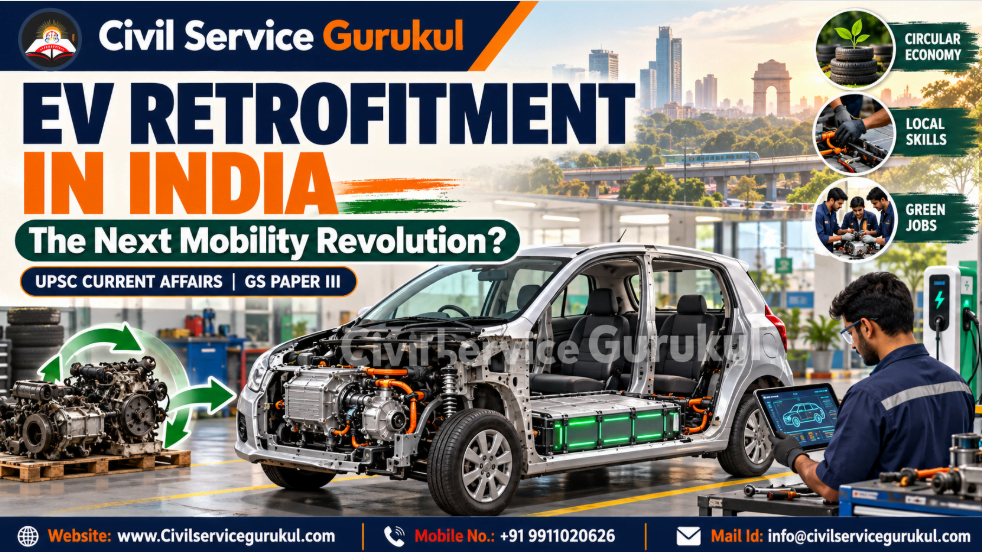
Can India Turn EV Retrofitment into the Next Mobility Revolution? UPSC Notes
India’s electric mobility transition involves both the vehicles it will manufacture tomorrow and the vehicles already operating today. Converting suitable existing petrol and diesel vehicles to electric propulsion could connect cleaner transport with resource efficiency, local enterprise and skilled employment. Whether this becomes a mobility revolution depends on safety, affordability and public trust.
1. Why Is EV Retrofitment in the News?
Recent public debate has highlighted whether India can build a scalable ecosystem for converting existing vehicles to electric operation. The larger opportunity extends beyond fitting a motor and battery: it includes vehicle diagnostics, engineering, certification, financing, installation, maintenance and responsible battery management.
For UPSC aspirants, the central question is whether India can combine its automotive capabilities and extensive repair network with credible standards to deliver an affordable, decentralised transition.
This is a potential development pathway. Its commercial success and environmental benefits must be demonstrated for specific vehicle categories and operating conditions.
2. What Is Vehicle Retrofitment?
Retrofitment means modifying an existing asset by adding or replacing systems to improve its performance or functionality. In electric mobility, a pure-electric conversion replaces the internal combustion powertrain with an electric propulsion system while retaining suitable parts of the original vehicle.
Key components of an electric conversion
- Electric motor: Converts electrical energy into mechanical motion.
- Traction battery: Stores energy used to propel the vehicle.
- Controller and power electronics: Manage power delivery and motor operation.
- Battery management system: Monitors battery conditions and supports safe operation.
- Charging and electrical protection systems: Enable charging and protect against electrical faults.
- Mechanical integration: Secures components while accounting for structural strength, vehicle balance, braking and service access.
Pure-electric conversion versus hybrid retrofitment
| Feature | Pure-electric conversion | Hybrid retrofitment |
|---|---|---|
| Powertrain | Electric propulsion replaces the combustion engine. | Electric assistance operates alongside an engine. |
| Energy source | Stored electrical energy. | Fuel and electrical energy, depending on design. |
| Tailpipe emissions | No combustion-related tailpipe emissions during electric operation. | Emissions remain when the engine operates. |
| Assessment | Battery range, charging and vehicle integration are central. | Engine-electric coordination and fuel savings are central. |
3. Why Could Retrofitment Matter for India?
A. Addressing the existing vehicle fleet
New EV sales change the composition of the fleet gradually. Retrofitment could offer an additional route for suitable vehicles that retain adequate structural condition and useful service life.
It should complement new EV manufacturing, public transport and responsible scrappage. Different vehicles require different solutions.
B. Supporting a circular economy
Retaining a serviceable body and chassis may preserve material value and reduce demand for some new components. This follows the circular-economy principle of extending useful product life.
However, conversion still requires batteries and other equipment. Resource savings must therefore be assessed across the full lifecycle.
C. Creating opportunities for MSMEs
A retrofit ecosystem could generate demand for diagnostics, installation, wiring, component integration, maintenance, software and testing services.
Local workshops could participate through authorised networks, provided technicians receive appropriate training, equipment and quality supervision.
D. Supporting a just transition
Electrification changes the skills needed in vehicle servicing. Training existing mechanics in electrical safety, diagnostics and battery systems could help them participate in the transition and reduce livelihood disruption.
E. Reducing petroleum use
Replacing fuel consumption with electricity can reduce petroleum demand in the converted vehicle’s operation. The wider energy-security benefit depends on deployment, utilisation and domestic capabilities in batteries, components and electricity supply.
F. Building an exportable service ecosystem
Other developing economies may also have price-sensitive consumers and vehicles with long ownership cycles. India could develop adaptable engineering, training and service models for such markets.
This remains an opportunity: vehicle specifications, certification requirements and operating conditions differ across countries.
4. India’s Regulatory Framework
Retrofitment is a regulated vehicle modification. Commercial availability of a conversion kit does not by itself establish that it is approved for every vehicle.
- Central Motor Vehicles Rules: Rule 115-D provides the regulatory framework for retrofitment of hybrid electric systems or electric kits.
- G.S.R. 167(E), dated 1 March 2019: The government notified provisions relating to electric and hybrid retrofitment and applicable compliance standards.
- AIS-123: The relevant part applies according to the conversion and vehicle category. Part 3 addresses electric propulsion kits intended for pure-electric conversion.
- Type approval: Applicable approval must be obtained through a testing agency specified under the regulatory framework.
- Authorised installation: Installation must follow applicable approval conditions, technical requirements and installer responsibilities.
Vehicle registration records, insurance, fitness and permit requirements must also be addressed where applicable. Conversion should not be assumed to override vehicle-age restrictions or location-specific legal requirements.
5. Is EV Retrofitment Economically Viable?
Viability depends on the individual vehicle and its duty cycle. A lower electricity cost per kilometre does not automatically make the complete conversion economical.
Costs that must be considered
- Battery, motor, controller and installation.
- Vehicle repairs required before conversion.
- Approval-related and administrative expenses.
- Charging equipment and electrical upgrades.
- Finance, insurance and conversion downtime.
- Maintenance, battery degradation and possible replacement.
- Residual value at the end of the ownership period.
Simple payback period = Net upfront conversion cost ÷ Annual net operating savings
Annual net operating savings should account for changes in energy costs, maintenance and other recurring expenses. Simple payback does not capture every financing, replacement or residual-value effect.
Which operating conditions may be promising?
- Predictable routes and daily travel distances.
- Reliable parking and charging access.
- Sufficient annual utilisation to recover investment.
- A structurally sound vehicle with adequate remaining life.
- An approved kit that preserves required payload and performance.
These conditions can help identify pilot projects. They do not establish that all vehicles within a fleet are suitable.
6. Environmental Benefits: Apply a Lifecycle Test
A pure-electric conversion removes combustion-related tailpipe emissions from the converted vehicle. Nevertheless, electricity generation, battery production, component manufacturing and end-of-life treatment still have impacts.
Three comparisons are necessary
- Continue operating the existing vehicle.
- Convert the existing vehicle.
- Replace it with a new vehicle.
The preferred option depends on remaining vehicle life, annual distance, energy consumption, battery size, electricity mix and the characteristics of the replacement vehicle.
Electrification also does not eliminate congestion, road crashes or non-exhaust pollution from tyres and road wear. Public transport and walking and cycling infrastructure remain essential.
Battery waste and producer responsibility
India’s Battery Waste Management Rules, 2022 establish an extended producer responsibility framework. A responsible retrofit ecosystem must address battery traceability, collection and compliant end-of-life management.
Reuse or second-life deployment requires appropriate assessment and safeguards. It should not be treated as automatically safe or environmentally beneficial.
7. Major Challenges and Trade-offs
| Challenge | Why it matters | Policy response |
|---|---|---|
| Vehicle diversity | Models differ in structure, condition, payload and electrical architecture. | Develop validated solutions for defined vehicle families. |
| Safety and integration | Battery placement and mass distribution can affect stability and braking. | Maintain testing, installation quality and post-conversion checks. |
| Upfront cost | Owners may struggle to finance a conversion despite potential running-cost savings. | Develop transparent finance backed by reliable performance data. |
| Warranty and liability | Responsibility may be unclear when multiple firms supply and install components. | Specify warranties, service obligations and complaint procedures. |
| Charging constraints | Unreliable charging can disrupt livelihoods and fleet operations. | Plan charging around actual routes, parking and power capacity. |
| Skill gaps | Conventional mechanical experience does not establish electrical competence. | Provide practical training, assessment and refresher programmes. |
| Weak performance data | Unverified savings and range claims undermine trust. | Publish independently assessed pilot results. |
Retrofitment versus scrappage
A vehicle with serious corrosion, structural damage or inadequate remaining life may be a poor conversion candidate. Retaining an unsafe vehicle is not resource efficiency.
Policy should use transparent technical and economic criteria to distinguish vehicles suitable for conversion from those better directed towards compliant recycling and replacement.
8. Policy Roadmap for a Responsible Retrofit Revolution
1. Build evidence through targeted pilots
Select defined vehicle models and duty cycles. Measure energy use, reliability, downtime, maintenance, battery health, safety incidents and user satisfaction.
2. Simplify administration while preserving safety
Improve coordination among testing agencies, transport authorities, installers and insurers. Publish clear procedures, documentation requirements and approval scope.
3. Develop an accountable installation network
Link authorised workshops with component suppliers and training institutions. Use installation records and periodic quality audits to improve traceability.
4. Strengthen consumer protection
Require clear disclosures on usable range, charging needs, payload changes, warranty coverage, service availability and battery-replacement terms.
5. Support appropriate financing
Encourage financing based on verified costs and operational performance. Battery leasing or service contracts may help some users, but require transparent pricing and risk allocation.
6. Invest in research and domestic capability
Support work on safe battery packaging, power electronics, diagnostics and integration for Indian operating conditions. Shared testing facilities could reduce development barriers for smaller enterprises.
7. Integrate environmental responsibility
Connect conversion programmes with battery take-back, compliant recycling and lifecycle assessment. Evaluate outcomes alongside wider urban mobility improvements.
9. How to Use the Topic in a UPSC Answer
Introduction: Define EV retrofitment and explain its relevance to the existing vehicle fleet.
Opportunities: Discuss resource efficiency, lower operational fuel use, MSME participation and workforce reskilling.
Limitations: Examine vehicle suitability, upfront costs, safety, charging, warranty and lifecycle impacts.
Way forward: Recommend evidence-based pilots, clear approvals, trained installers and credible consumer protection.
Conclusion: Present retrofitment as one component of an integrated transport transition.
10. Prelims Revision: Essential Terms
- ICE: Internal combustion engine, which produces mechanical power through fuel combustion.
- Powertrain: Components that generate and transmit power for vehicle movement.
- BMS: Battery management system, used to monitor battery conditions and support protection.
- Type approval: Assessment of a defined product or configuration against applicable requirements; it is not unrestricted approval for every vehicle.
- Circular economy: Retaining product and material value through measures such as repair, reuse, refurbishment and recycling.
- EPR: Extended producer responsibility for specified end-of-life product obligations.
- Lifecycle assessment: Evaluation of environmental impacts across relevant stages of a product’s life.
- Just transition: Managing economic change with attention to workers, livelihoods and vulnerable groups.
11. Original UPSC Mains Practice Questions
- Explain how electric vehicle retrofitment can contribute to a circular economy in India. What limitations must policymakers consider? (150 words)
- “The success of EV retrofitment depends as much on institutions and skills as on technology.” Discuss. (250 words)
- Examine the potential of vehicle retrofitment to support MSMEs and a just transition in India’s automotive sector. Suggest measures for its safe and economically viable expansion. (250 words)
12. Conclusion
India can develop retrofitment into a meaningful mobility industry if suitable vehicles are matched with safe technology, credible approvals, affordable finance and dependable service. Its contribution must be measured through operating performance, lifecycle outcomes and consumer experience.
The strongest strategy combines selective retrofitment with new EV manufacturing, cleaner electricity, responsible recycling and better public transport. This approach can connect technological change with resource conservation and inclusive employment.
Prepare with Mentors Who Cleared the Exam
Get personalized study plans, evaluated answer models, and test series access.