
Solar-Powered Farms: Agrivoltaics Explained for UPSC 2026
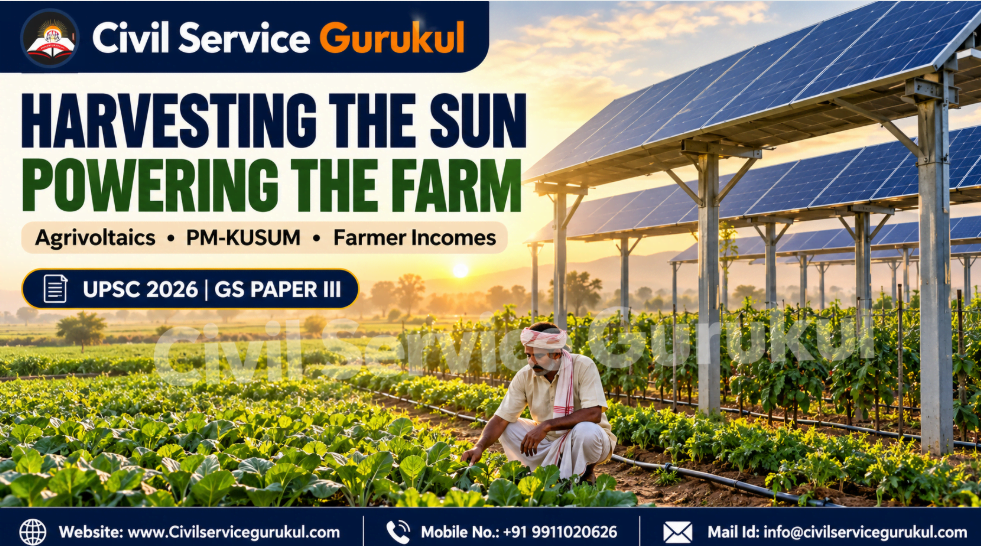
Harvesting the Sun: Farm Power UPSC 2026 Explained
Agrivoltaics combines agricultural production and solar electricity generation on the same land through carefully designed panel placement. For UPSC, it connects GS Paper III agriculture, renewable energy, infrastructure and environment with GS Paper II policy implementation. Agrivoltaics also offers Prelims concepts and Mains arguments on farmer incomes, land use and groundwater. “Harvesting the Sun, and powering the farm” captures this opportunity: farms can potentially supply food and electricity. Success, however, depends on protecting cultivation, sharing benefits fairly and matching technology with local conditions.
1. Introduction: Understanding Solar-Powered Agriculture
Agrivoltaics and Solar Irrigation Are Different
Agrivoltaics, also called AgriPV, deliberately accommodates farming and photovoltaic generation within a shared land-use system. Solar irrigation uses electricity from panels to operate pumps. A solar pump installation is not automatically an agrivoltaic project: continued agricultural production within the shared layout is the distinguishing feature.
Why the Issue Matters
Agriculture requires affordable energy, while renewable expansion requires suitable sites. Combining these objectives may reduce some land-use tensions. Nevertheless, generating electricity cannot be treated as sufficient evidence of agricultural success. Crop performance and cultivators’ welfare must remain central.
2. Background: The Food–Energy–Water Connection
Interlinked Resources
Irrigation needs energy; farming depends on water and land; electricity infrastructure uses materials and space. Decisions in one sector therefore influence the others. For example, cheaper pumping may lower cultivation costs but increase groundwater extraction unless incentives encourage conservation.
India’s Policy Context
PM-KUSUM provides an important framework for decentralised renewable generation and agricultural solarisation. Recent discussion on AgriPV extends the question beyond powering pumps to designing productive agricultural landscapes. Proposals for additional support must be distinguished from formally notified benefits and implementation rules.
3. Key Features and Policy Provisions
How Agrivoltaic Systems Work
- Shared sunlight: Panel spacing, height and orientation influence the light reaching crops.
- Farm access: Layouts must accommodate workers, machinery, irrigation and harvesting.
- Crop compatibility: Suitable crops depend on local climate, season and shade response.
- Electrical integration: Equipment requires safe installation, maintenance and an appropriate electricity-use or sale arrangement.
PM-KUSUM: Three Components
- Component A: Decentralised grid-connected renewable power plants.
- Component B: Stand-alone solar agricultural pumps.
- Component C: Solarisation of grid-connected agricultural pumps, including feeder-level solarisation.
Pump-level solarisation concerns individual pumping systems. Feeder-level solarisation supplies solar electricity through agricultural feeders serving multiple connections. Their ownership, procurement and operational arrangements differ. Neither should be equated automatically with crop-compatible agrivoltaic design.
4. Significance for India
Income Diversification and Energy Access
Depending on contracts and system design, farmers may benefit through electricity savings, lease payments or power sales. Additional revenue can diversify income, but returns depend on capital costs, debt, maintenance, tariffs and payment reliability. Solar energy can reduce diesel dependence where it replaces diesel-powered operations.
Resource Efficiency and Climate Adaptation
Carefully managed partial shade may moderate heat exposure and evaporation under suitable conditions. However, excessive shade can reduce photosynthesis and yields. The objective is improved combined performance, established through measurements rather than assumptions about universal crop benefits.
Rural Enterprise
Installation, monitoring, repairs and agricultural advisory services can support local employment. Farmer Producer Organisations may aggregate demand and negotiate services. Integration with efficient irrigation and suitable processing equipment can broaden benefits beyond electricity generation.
5. Challenges and Trade-offs
Costs, Crop Performance and Grid Constraints
Elevated structures and farm-compatible layouts can raise investment requirements. Fragmented holdings complicate project design. Crop responses vary, while inadequate evacuation capacity, connection delays or payment uncertainty can weaken financial viability. Small farmers may struggle to absorb these risks.
Groundwater and Social Equity
Low operating costs can encourage additional pumping. Energy efficiency therefore needs water governance. Landowners may also capture benefits while tenants and agricultural labourers face exclusion. Contracts should clarify access, responsibilities, compensation and dispute resolution.
Long-Term Environmental Responsibility
Projects must address drainage, soil protection, storm resistance and safe maintenance. Panel cleaning consumes resources, and damaged equipment requires responsible disposal. Planning should include decommissioning and restoration rather than focusing only on installation.
6. Way Forward
- Validate locally: Conduct multi-season trials across crops, soils and agro-climatic conditions.
- Protect cultivation: Monitor crop output and access so agricultural activity remains substantive.
- Improve finance: Offer transparent cost information, suitable lending and collective procurement.
- Secure agreements: Clarify ownership, payments, maintenance, insurance and exit obligations.
- Conserve water: Combine solarisation with appropriate irrigation scheduling and groundwater safeguards.
- Coordinate agencies: Link agriculture departments, energy agencies, researchers, DISCOMs and farmer groups.
7. Prelims Pointers and Mains Value Addition
Facts and Data to Remember
- Ministry: PM-KUSUM is administered by the Ministry of New and Renewable Energy.
- Expansion: PM-KUSUM means Pradhan Mantri Kisan Urja Suraksha evam Utthaan Mahabhiyan.
- Published target: MNRE described a 34,800 MW capacity objective by March 2026; this is a target, not an achievement figure.
- Reading official data: Distinguish sanctioned capacity, installed capacity and solarised pumps; check dashboard dates and subsequent implementation orders.
An Analytical Framework for Mains
Assess projects through four outcomes: farm profitability, agricultural productivity, water sustainability and reliable electricity. Capacity additions alone cannot reveal distributional effects. Compare benefits after financing and operating costs, examine who bears production risks, and distinguish total land-use efficiency from crop yield.
8. Conclusion
Harvesting sunlight can strengthen agriculture when energy projects are designed around farming realities. India needs evidence-based layouts, reliable contracts and inclusive institutions. Agrivoltaics should be judged by durable benefits for cultivators and ecosystems alongside clean power generation.
9. UPSC PYQs and Practice Questions
PYQ linkage: Connect this topic with recurring themes of irrigation, agricultural subsidies, renewable energy and sustainable resource management. The following are original practice questions, not attributed UPSC PYQs.
Prelims Question 1
Which statement correctly describes agrivoltaics?
- A: Replacing cultivation entirely with solar panels.
- B: Combining agriculture and photovoltaic generation within a shared land-use system.
- C: Operating any diesel pump on farmland.
- D: Generating electricity exclusively from crop residues.
Answer: B. Agrivoltaics deliberately integrates agricultural production and solar generation.
Prelims Question 2
Which PM-KUSUM component concerns stand-alone solar agricultural pumps?
- A: Component A.
- B: Component B.
- C: Component C only.
- D: None of these.
Answer: B. Component B concerns stand-alone pumps; Component C concerns solarising grid-connected pumps, including feeder-level arrangements.
Mains Question
“Agrivoltaics can reconcile agricultural development with renewable energy expansion, provided farmer welfare remains central.” Discuss. (Answer in 150 words.)
Hints: Define dual land use; explain income and energy benefits; examine crop, finance and groundwater risks; recommend local trials and fair contracts.
Key Takeaways for Revision
- Agrivoltaics combines agriculture and solar generation.
- Solar irrigation is not automatically agrivoltaics.
- Crop benefits depend on design and local conditions.
- PM-KUSUM has three principal components.
- Cheaper pumping requires groundwater safeguards.
- Farmer welfare must guide project evaluation.
Prepare with Mentors Who Cleared the Exam
Get personalized study plans, evaluated answer models, and test series access.