
Firecracker Restrictions 2026: Air Quality & UPSC
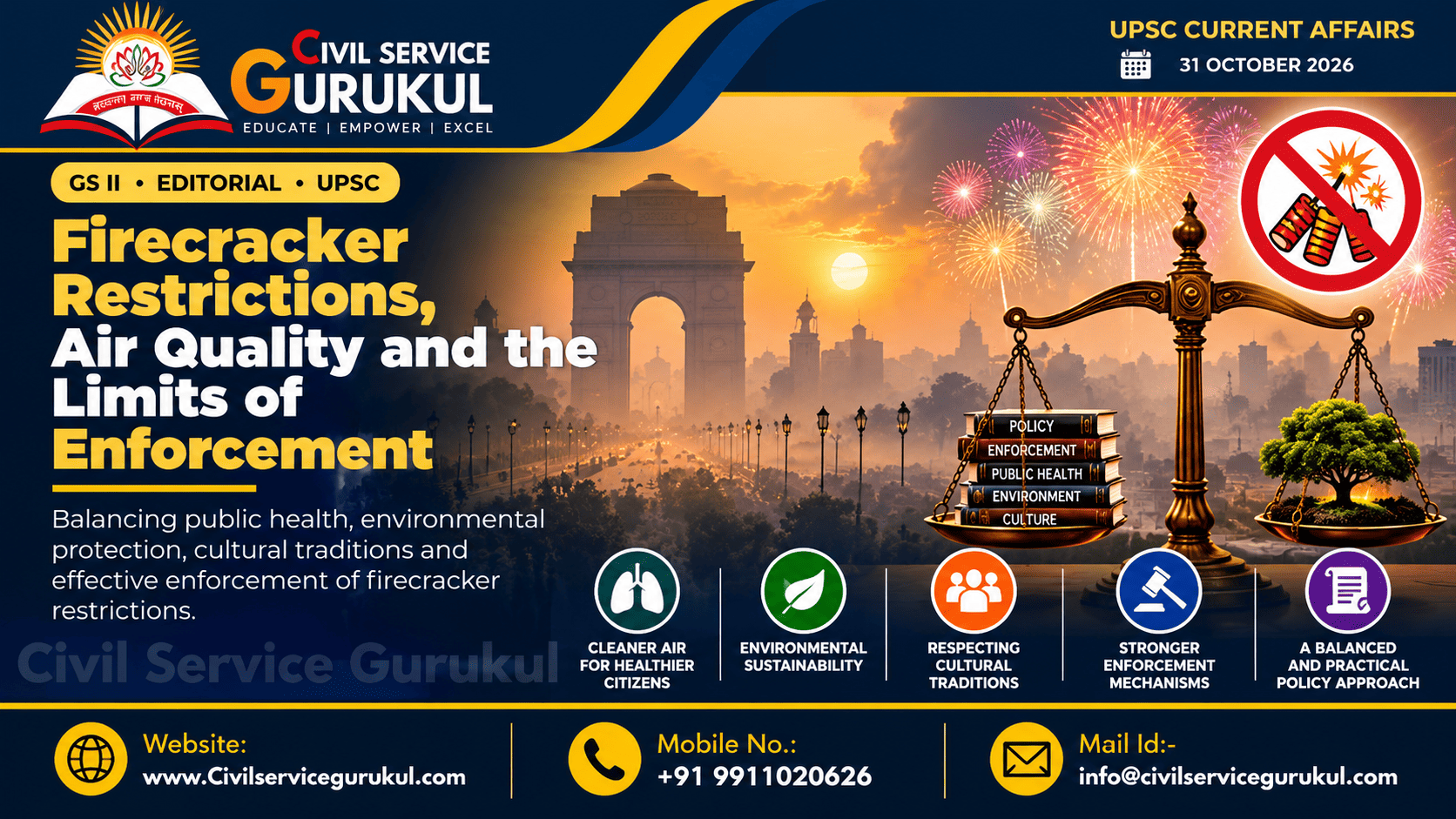
Firecracker Restrictions in India 2026: Air Pollution, Supreme Court Directions and the Challenges of Environmental Enforcement
Understanding air-quality management, firecracker regulation, judicial intervention, environmental governance, public health and the limitations of seasonal enforcement.
Firecracker restrictions have become an important environmental governance issue in India, especially in cities already experiencing poor air quality.
Fireworks can release particulate matter and gaseous pollutants, creating short-term increases in pollution. The severity of these episodes depends on existing emissions, atmospheric conditions and local geography.
Recent discussion about alleged breaches of judicial directions has highlighted the difficulty of translating environmental restrictions into effective implementation.
The larger challenge is to balance public health, environmental protection, cultural practices, livelihood concerns and the rule of law.
GS Paper II: Government policies, judicial intervention, regulatory institutions, federal coordination and implementation challenges.
GS Paper III: Environmental pollution, air-quality management, conservation, environmental impact and sustainable development.
GS Paper IV: Environmental ethics, public responsibility, accountability and balancing competing interests.
Prelims: Air pollution, PM2.5 and PM10, CAQM, pollution control boards and environmental legislation.
Why Are Firecracker Restrictions in the News?
A newspaper report discussed alleged violations of judicial directions relating to fireworks.
The development renewed debate about whether environmental restrictions are effective when administrative monitoring and public compliance remain weak.
It also raised questions about the relationship between judicial orders, executive implementation and citizens' responsibilities.
Firecracker restrictions must be understood according to the specific legal order, location and period concerned.
A restriction applicable in one jurisdiction should not automatically be described as a nationwide prohibition.
How Do Firecrackers Affect Air Quality?
Firecrackers can release fine particles, smoke and various gaseous pollutants during combustion.
These emissions may temporarily increase the concentration of pollutants in the surrounding atmosphere.
Particulate Matter
PM10 refers to inhalable particles with an aerodynamic diameter of 10 micrometres or less.
PM2.5 refers to finer particles with an aerodynamic diameter of 2.5 micrometres or less.
Fine particles are particularly important in public-health and air-quality discussions because they can penetrate deep into the respiratory system.
Meteorological Conditions
The impact of emissions depends partly on wind, temperature, atmospheric mixing and other weather conditions.
During periods of weak pollutant dispersion, pollution may accumulate closer to the ground.
Multiple Sources of Pollution
Urban air pollution is not caused by firecrackers alone.
Transport, industrial activity, construction dust, waste burning and regional emissions can also contribute.
Public Health Implications of Poor Air Quality
Exposure to polluted air can create or worsen respiratory and cardiovascular health risks.
Children, older persons and individuals with pre-existing health conditions may be particularly vulnerable.
Why Short Pollution Episodes Matter
Even when a pollution episode is temporary, elevated exposure may affect sensitive groups.
However, the contribution of any single emission source should be assessed using appropriate monitoring and scientific evidence.
Legal and Institutional Framework for Air Pollution Control
| Institution / Law | Primary Relevance | UPSC Significance |
|---|---|---|
| Air (Prevention and Control of Pollution) Act, 1981 | Statutory framework for air pollution control | Environmental legislation and regulatory governance |
| Central Pollution Control Board | Pollution control functions under applicable laws | National environmental regulatory framework |
| State Pollution Control Boards | State-level pollution control functions | Implementation and regulatory coordination |
| Commission for Air Quality Management | Air-quality coordination in the NCR and adjoining areas | Regional governance and intergovernmental coordination |
| Local Administration and Police | Enforcement of applicable orders and regulations | Administrative capacity and rule of law |
Effective air-quality management requires cooperation between regulatory bodies, local governments, law-enforcement agencies and the public.
Role of the Judiciary in Environmental Protection
Courts may intervene when disputes concern environmental protection, public health or the implementation of applicable legal duties.
Judicial directions can clarify responsibilities and require compliance with environmental standards.
Why Judicial Orders Alone May Be Insufficient
An order does not automatically ensure that every producer, seller and consumer will comply.
Implementation depends on administrative resources, public awareness, monitoring and credible enforcement.
The effectiveness of environmental regulation depends not only on the legal rule, but also on the capacity of institutions to implement it fairly.
Why Is Enforcement Difficult?
Fragmented Administrative Responsibility
Different authorities may be responsible for manufacturing, distribution, retail sales and local enforcement.
Cross-Border Supply Chains
Products may move between jurisdictions with different regulatory requirements.
Online and Informal Sales
Monitoring sales through multiple distribution channels can be administratively demanding.
Last-Minute Restrictions
Late communication of regulatory changes may create uncertainty for businesses and consumers.
Monitoring Limitations
Air-quality data can identify changes in pollution levels, but reliable attribution to individual sources may require additional evidence.
Public Compliance
Restrictions may face resistance when citizens do not understand their purpose or consider them inconsistent.
Livelihood and Social Considerations
Firecracker production and seasonal sales can support employment and small businesses.
Environmental regulation should therefore consider the adjustment costs faced by workers, manufacturers and traders.
A Balanced Policy Approach
- Provide clear regulatory information in advance.
- Support compliance with product standards.
- Consider transition assistance where appropriate.
- Avoid arbitrary or discriminatory enforcement.
- Encourage safer and less polluting forms of celebration.
Public health and livelihoods should not be treated as entirely separate concerns.
Good policy attempts to protect both through predictable rules and proportionate measures.
Key Policy Trade-offs
| Policy Objective | Potential Benefit | Implementation Challenge |
|---|---|---|
| Restricting polluting products | Reducing avoidable emissions | Monitoring production and sales |
| Strengthening penalties | Improving deterrence | Ensuring fairness and proportionality |
| Promoting cleaner alternatives | Reducing environmental impact | Testing, standards and consumer adoption |
| Protecting livelihoods | Reducing economic hardship | Financing and targeting support |
| Public awareness | Encouraging voluntary compliance | Changing established behaviour |
Way Forward: Strengthening Air-Quality Governance
- Publish clear, jurisdiction-specific rules well before seasonal events.
- Improve coordination between pollution control boards, police and local authorities.
- Strengthen product traceability and supply-chain monitoring.
- Apply proportionate and predictable penalties.
- Expand transparent ambient air-quality monitoring.
- Use scientific evidence to evaluate policy effectiveness.
- Promote public awareness and less polluting celebrations.
- Support affected workers and small traders where appropriate.
- Address transport, industrial emissions, construction dust and other year-round sources.
- Conduct independent reviews of enforcement outcomes.
Beyond Seasonal Restrictions
Air-quality governance should not be limited to festivals or short periods of heightened pollution.
Long-term improvements require sustained action across multiple emission sources.
UPSC Prelims Practice Questions
Question 1
Which institution has a specific air-quality coordination mandate in the National Capital Region and adjoining areas?
(a) Finance Commission
(b) Election Commission
(c) Commission for Air Quality Management
(d) Comptroller and Auditor General
The Commission for Air Quality Management has a statutory mandate concerning air-quality management in the NCR and adjoining areas.
Question 2
Consider the following statements:
- Firecracker emissions may contribute to short-term increases in particulate pollution.
- Firecrackers are the only source of winter air pollution in Indian cities.
Which of the statements given above is/are correct?
(a) 1 only
(b) 2 only
(c) Both 1 and 2
(d) Neither 1 nor 2
Statement 1 is correct. Firecracker emissions can increase pollution for a limited period.
Statement 2 is incorrect. Several other sources and meteorological conditions also affect air quality.
Question 3
Which legislation provides an important statutory framework for air pollution control in India?
(a) Air (Prevention and Control of Pollution) Act, 1981
(b) Representation of the People Act, 1951
(c) Companies Act, 2013
(d) Indian Contract Act, 1872
The Air (Prevention and Control of Pollution) Act, 1981 is a major law governing air pollution control in India.
Question 4
Which approach is most appropriate for improving compliance with environmental restrictions?
(a) Relying exclusively on last-minute announcements
(b) Ignoring pollution from other sources
(c) Combining clear rules, monitoring, proportionate penalties and public awareness
(d) Applying identical restrictions everywhere without examining the applicable legal framework
Effective environmental governance requires predictable rules, institutional coordination, scientific monitoring and public participation.
UPSC Mains GS Paper II and III Practice
Question: "Environmental regulation is only as effective as its implementation." Examine this statement with reference to firecracker restrictions, urban air pollution and the challenges of regulatory enforcement in India. (250 words)
Suggested Answer Framework
Introduction: Explain the connection between environmental regulation, public health and air-quality management.
Legal Framework: Discuss the Air Act, pollution control boards, CAQM and judicial directions.
Implementation Challenges: Highlight fragmented responsibilities, cross-border trade, monitoring limitations and weak compliance.
Social Dimension: Consider cultural practices, workers and small traders.
Way Forward: Recommend early communication, scientific monitoring, proportionate enforcement and year-round pollution control.
Conclusion: Sustainable environmental governance requires effective institutions, credible evidence and responsible public participation.
Frequently Asked Questions
Do firecrackers alone cause winter smog?
No. Firecrackers may worsen pollution episodes, but transport, industry, dust, regional emissions and weather also contribute.
Are firecracker restrictions identical across India?
No. Applicable restrictions may differ according to location, date and the relevant legal directions.
What is CAQM?
CAQM stands for Commission for Air Quality Management. It has a statutory air-quality mandate in the NCR and adjoining areas.
What is PM2.5?
PM2.5 refers to fine particulate matter with an aerodynamic diameter of 2.5 micrometres or less.
Why is enforcement difficult?
Enforcement can be affected by fragmented responsibilities, cross-border supply chains, weak monitoring and inconsistent compliance.
Which UPSC papers cover this topic?
The topic is relevant to GS II Governance, GS III Environment, GS IV Ethics and UPSC Prelims.
Key Takeaway for UPSC Aspirants
Firecracker restrictions illustrate the difference between making environmental rules and enforcing them.
Effective air-quality management requires scientifically informed regulation, institutional coordination, fair enforcement, public participation and sustained action against multiple pollution sources.
SEO Keywords and Tags
Prepare for UPSC with Civil Service Gurukul
Build conceptual clarity in environment, governance, Indian polity, public administration, ethics and current affairs through examination-focused UPSC preparation.
Website: www.civilservicegurukul.com
Mobile: +91 9911020626
Email: info@civilservicegurukul.com
Prepare with Mentors Who Cleared the Exam
Get personalized study plans, evaluated answer models, and test series access.