
Biofortified Potatoes 2026: Hidden Hunger & UPSC
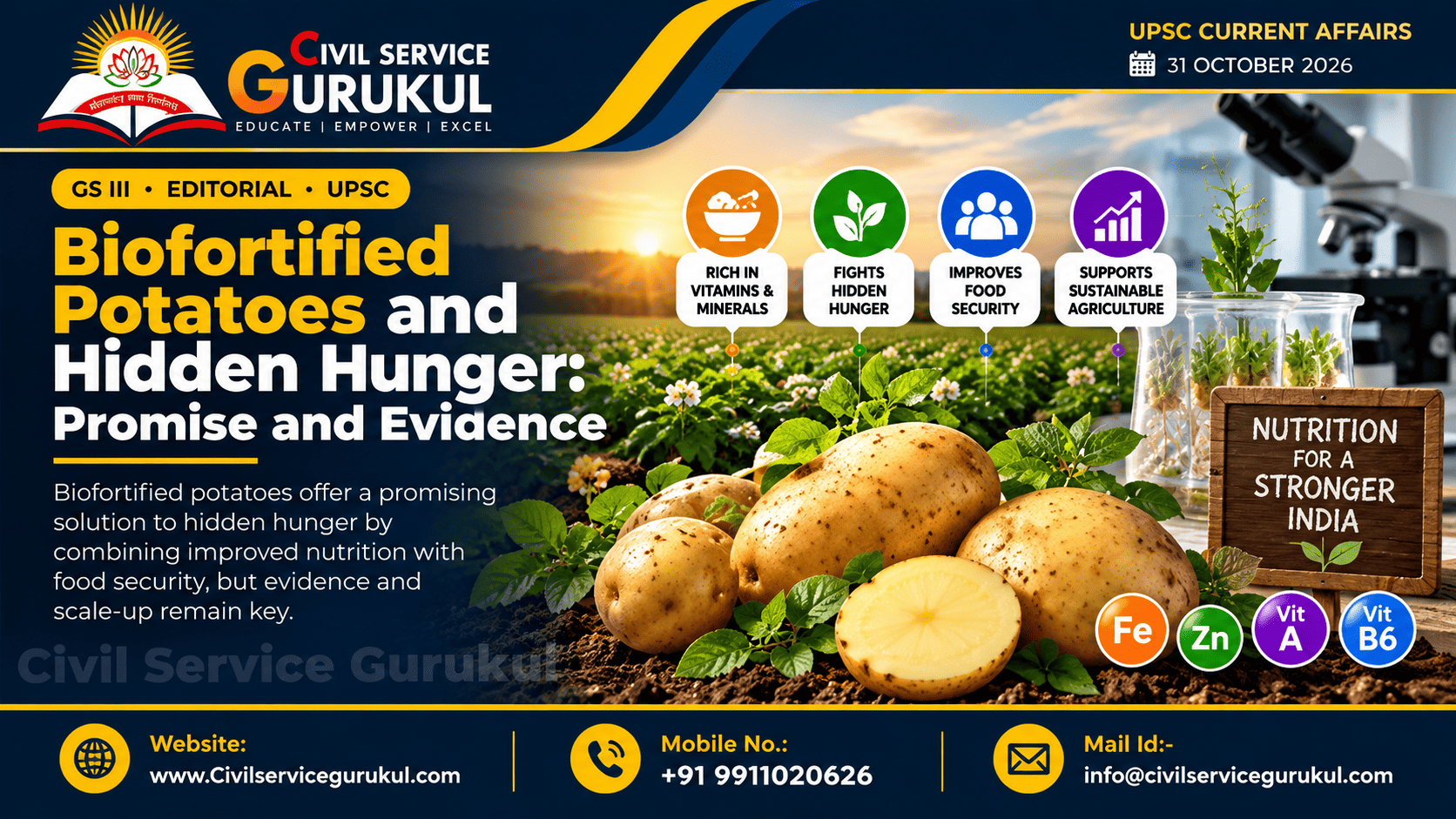
Biofortified Potatoes and Hidden Hunger in India 2026: Scientific Promise, Nutritional Evidence and Food Security
An examination-focused analysis of biofortification, micronutrient malnutrition, potato breeding, nutrient bioavailability, agricultural innovation and public-health policy.
Biofortification seeks to improve the nutritional characteristics of crops. Its potential role in reducing micronutrient deficiencies has attracted interest in India.
A recent science discussion raised the question of whether nutritionally improved potato varieties could contribute to addressing hidden hunger.
The central scientific issue is not simply whether a crop contains a desirable nutrient. Researchers must also establish whether the nutrient remains available after cooking, can be absorbed by the body and improves real-world dietary outcomes.
For UPSC aspirants, this topic connects agricultural science, food security, public health, scientific evidence and inclusive development.
GS Paper II: Health, nutrition, welfare programmes, vulnerable groups and social-sector development.
GS Paper III: Science and technology, agricultural research, food security, crop improvement and biotechnology.
Prelims: Biofortification, micronutrients, anthocyanins, nutrient bioavailability, plant breeding and food fortification.
Why Are Biofortified Potatoes in the News?
A science article discussed whether nutritionally improved potatoes could help address micronutrient deficiencies in India.
The topic is important because food security is not limited to ensuring adequate calories. Nutritional quality also matters.
A crop may be widely available and economically accessible, yet its contribution to health depends on nutrient composition, consumption patterns and the broader dietary environment.
The existence of a potato variety with an improved nutritional trait does not establish that consuming it will prevent or cure a particular micronutrient deficiency.
Such claims require evidence of nutrient content, bioavailability and meaningful dietary outcomes.
What Is Biofortification?
Biofortification is the process of improving nutritional traits in food crops through crop improvement approaches.
Depending on the programme, these may include conventional plant breeding, agronomic interventions or other approved techniques.
Conventional Breeding
Researchers select and cross plants with desirable traits and evaluate their offspring over successive generations.
Agronomic Biofortification
Appropriate nutrient management may be used to increase the concentration of certain nutrients in crops.
Other Crop Improvement Methods
Additional techniques may be considered where permitted under applicable scientific and regulatory frameworks.
Biofortification aims to improve the nutritional characteristics of the crop itself.
It is distinct from adding nutrients to a food product during industrial processing.
Biofortified Potatoes: Scientific Promise and Evidence
Potatoes are widely consumed and can form part of diverse dietary patterns.
Improving a widely consumed crop may provide an opportunity to increase nutrient intake, provided the crop is adopted and the relevant nutrients remain nutritionally useful.
The Example of Kufri Jamunia
The uploaded material identifies Kufri Jamunia as an ICAR-listed potato variety associated with high anthocyanin content.
Anthocyanins are natural plant pigments that contribute red, purple or blue coloration to some fruits and vegetables.
They are studied for their biological properties, including antioxidant activity.
What Should Not Be Assumed?
- Purple coloration does not automatically establish high iron concentration.
- Anthocyanins are not equivalent to zinc.
- Laboratory antioxidant activity does not by itself demonstrate a clinical health benefit.
- A nutrient-rich crop does not guarantee improved nutritional status in every consumer.
Why Is Nutritional Evidence Essential?
1. Nutrient Composition
Researchers must measure the relevant nutrients in the edible portion of the crop.
2. Bioavailability
Bioavailability concerns the extent to which a nutrient can be absorbed and used by the body.
A high measured concentration does not necessarily mean that the entire quantity is biologically available.
3. Cooking and Processing
Preparation methods may affect nutrient retention.
The nutritional value of the cooked food can therefore differ from laboratory measurements of the raw crop.
4. Agronomic Performance
A successful crop variety must perform adequately under relevant agricultural and climatic conditions.
5. Dietary Outcomes
Ultimately, the strongest public-health assessment examines whether the intervention improves nutritional outcomes in the intended population.
Distinguish between a promising scientific innovation, a demonstrated nutritional property and a proven public-health outcome.
Biofortification vs Food Fortification
| Basis | Biofortification | Food Fortification |
|---|---|---|
| Approach | Improves nutritional traits in crops | Adds nutrients to foods, usually during processing |
| Stage | Crop development or cultivation | Food production or processing |
| Examples | Nutrient-enhanced crop varieties | Nutrients added to selected food products |
| Key Challenge | Seed adoption, agronomic performance and nutrient bioavailability | Processing standards, quality control and consumer access |
| Public-Health Role | Potential long-term dietary improvement | Potential improvement in nutrient intake through fortified foods |
The two approaches can complement each other.
Neither eliminates the importance of dietary diversity, healthcare access or other nutrition interventions.
Potential Benefits of Biofortified Crops
Improving Nutritional Security
Where evidence supports meaningful nutrient delivery, biofortified crops may contribute to reducing dietary micronutrient gaps.
Using Existing Food Habits
Improving crops that people already consume may reduce the need for major changes in dietary behaviour.
Supporting Agricultural Innovation
Research can encourage the development of crop varieties with desirable nutritional and agronomic characteristics.
Potential Rural Benefits
Farmers may benefit if improved varieties also offer acceptable yields, market demand and manageable production costs.
Complementing Nutrition Programmes
Evidence-based biofortification could complement other food and public-health interventions.
Challenges and Limitations
- Inflated Claims: Nutrient improvements may be overstated without adequate scientific evidence.
- Seed Availability: Farmers need reliable access to suitable planting material.
- Yield Variation: Crop performance may vary across agro-climatic regions.
- Consumer Acceptance: Appearance, taste and cooking characteristics can affect adoption.
- Post-Harvest Losses: Storage and handling may influence food quality.
- Cooking Losses: Some nutritional compounds may be affected by preparation.
- Bioavailability: Measured nutrient content does not establish effective absorption.
- Dietary Diversity: Overdependence on a single crop may not address multiple nutritional deficiencies.
Public Policy Implications for India
Evidence-Based Nutrition Policy
Public programmes should prioritise interventions supported by credible scientific evaluation.
Agricultural Research
Crop improvement requires continued testing, institutional capacity and assessment of local agricultural conditions.
Food Security and Equity
An intervention should be assessed for affordability, accessibility and benefits to vulnerable populations.
Institutional Coordination
Agricultural research, food distribution, public health and nutrition education may require coordinated action.
Monitoring and Accountability
Programmes should measure real outcomes rather than relying exclusively on production targets or laboratory findings.
Way Forward: A Scientific and Inclusive Strategy
- Conduct independent trials across relevant agro-climatic zones.
- Measure nutrient content and bioavailability using appropriate methods.
- Evaluate nutrient retention after common cooking methods.
- Assess effects on real dietary and nutritional outcomes.
- Develop reliable seed supply systems.
- Study farmer economics, crop yields and market acceptance.
- Promote dietary diversity alongside biofortification.
- Integrate nutrition education with food-security efforts.
- Use phased pilot programmes before wider expansion.
- Publish evaluation results and revise interventions when evidence requires it.
UPSC Prelims Practice Questions
Question 1
What is the primary objective of biofortification?
(a) Adding nutrients only during food processing
(b) Improving nutritional traits in crops
(c) Replacing all foods with a single crop
(d) Eliminating the need for dietary diversity
Biofortification seeks to enhance nutritional characteristics of crops.
Question 2
Consider the following statements:
- Hidden hunger may occur even when calorie intake is apparently adequate.
- A crop's measured nutrient content always equals the quantity absorbed by the human body.
Which of the statements given above is/are correct?
(a) 1 only
(b) 2 only
(c) Both 1 and 2
(d) Neither 1 nor 2
Statement 1 is correct. Hidden hunger concerns micronutrient deficiencies.
Statement 2 is incorrect because bioavailability affects nutrient absorption.
Question 3
Anthocyanins are best described as:
(a) Natural plant pigments
(b) A form of dietary zinc
(c) A synthetic fertiliser
(d) A type of plant virus
Anthocyanins are plant pigments associated with red, purple and blue coloration in some plant tissues.
Question 4
Which of the following is most important before claiming that a biofortified crop reduces micronutrient deficiency in a population?
(a) Colour of the crop alone
(b) Laboratory nutrient content alone
(c) Evidence of nutrient availability and nutritional outcomes
(d) Number of advertisements promoting the crop
Public-health claims require evidence extending beyond appearance or nutrient concentration alone.
UPSC Mains Practice Question
Question: Assess the potential and limitations of crop biofortification in tackling micronutrient malnutrition in India. (250 words)
Suggested Answer Framework
Introduction: Define hidden hunger and crop biofortification.
Potential Benefits: Discuss nutrient improvement, agricultural innovation and possible public-health gains.
Scientific Limitations: Examine nutrient bioavailability, cooking losses and the need for dietary outcome evidence.
Implementation Challenges: Discuss seed access, agronomic performance, cost and consumer acceptance.
Way Forward: Recommend independent trials, nutrition monitoring, farmer support and dietary diversity.
Conclusion: Biofortification can be a complementary nutrition strategy, but scientific evidence and inclusive implementation must guide its adoption.
Frequently Asked Questions
What is hidden hunger?
Hidden hunger refers to inadequate intake or absorption of essential micronutrients, even where calorie intake appears sufficient.
What are biofortified potatoes?
They are potato varieties developed or managed to improve specified nutritional characteristics.
Is biofortification the same as food fortification?
No. Biofortification improves nutritional traits in crops, whereas conventional food fortification adds nutrients during food processing.
What is Kufri Jamunia?
It is a potato variety identified in the supplied material as having high anthocyanin content.
Can purple potatoes automatically cure anaemia?
No. Purple pigmentation does not establish an effective treatment for iron deficiency or anaemia.
Why is bioavailability important?
It helps determine how much of a nutrient can actually be absorbed and used by the body.
Which UPSC papers cover this topic?
GS Paper II covers health and nutrition. GS Paper III covers agriculture, science and food security. The basic scientific concepts are also relevant to Prelims.
Key Takeaway for UPSC Aspirants
Biofortified potatoes illustrate the promise of agricultural science in addressing nutritional challenges.
However, the success of a nutrition intervention must be judged by credible evidence, not merely by a crop's colour, laboratory nutrient content or promotional claims.
An effective national strategy should combine agricultural research, dietary diversity, nutrition education, healthcare access and measurable public-health outcomes.
SEO Keywords and Tags
Prepare for UPSC with Civil Service Gurukul
Develop conceptual clarity in science and technology, agriculture, public health, food security and current affairs through examination-focused UPSC preparation.
Website: www.civilservicegurukul.com
Mobile: +91 9911020626
Email: info@civilservicegurukul.com
Prepare with Mentors Who Cleared the Exam
Get personalized study plans, evaluated answer models, and test series access.