
Wake-Up Stroke 2026: Brain Imaging & UPSC Analysis
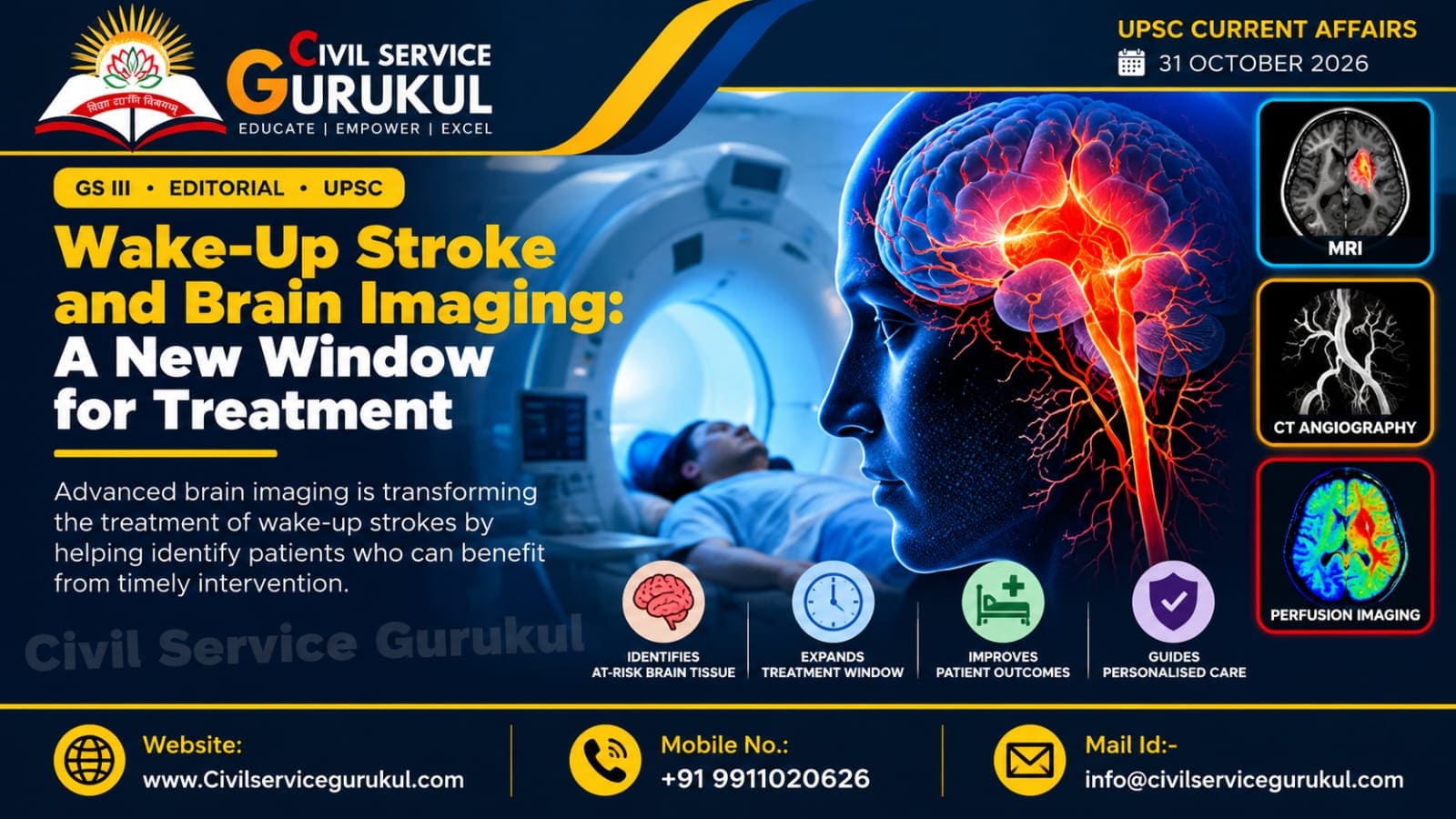
Wake-Up Stroke in India 2026: How Advanced Brain Imaging Is Transforming Emergency Stroke Treatment
An in-depth UPSC analysis of wake-up stroke, CT and MRI imaging, diffusion-FLAIR mismatch, treatment eligibility, emergency medical systems and India's healthcare infrastructure.
Stroke is a medical emergency that can occur when blood flow to part of the brain is interrupted or when bleeding occurs within the brain.
A wake-up stroke is discovered when a person awakens with stroke symptoms, making the exact time of symptom onset uncertain.
Advanced brain imaging can help doctors distinguish stroke types, evaluate the extent of brain injury and identify selected patients who may benefit from specialised treatment.
However, imaging does not automatically make every patient eligible for thrombolysis or other reperfusion treatments.
GS Paper II: Health services, public-health infrastructure, accessibility, equity and social-sector development.
GS Paper III: Science and technology, medical diagnostics, healthcare innovation and technology applications.
Prelims: Types of stroke, CT and MRI, diffusion imaging, thrombolysis, brain perfusion and emergency care.
Why Is Wake-Up Stroke in the News?
A science report discussed how modern brain imaging can assist treatment decisions for patients who awaken with symptoms of stroke.
The key challenge is the uncertainty surrounding the time at which the stroke began.
Traditionally, treatment decisions have placed substantial importance on the time elapsed since a patient was last known to be neurologically well.
Advanced imaging offers additional information about brain tissue injury, helping specialists assess some patients whose exact onset time is unknown.
Advanced imaging does not mean that all wake-up strokes can be treated with clot-dissolving medicines.
Eligibility depends on the type of stroke, imaging findings, clinical condition and established treatment protocols.
What Is a Stroke?
A stroke occurs when part of the brain is deprived of adequate blood supply or when bleeding damages brain tissue.
1. Ischemic Stroke
An ischemic stroke usually occurs when a blood vessel supplying the brain becomes blocked.
The interruption of blood flow can deprive brain cells of oxygen and essential nutrients.
2. Hemorrhagic Stroke
A hemorrhagic stroke occurs when a blood vessel ruptures and causes bleeding within or around the brain.
The distinction matters because treatments appropriate for ischemic stroke may be dangerous in patients with brain bleeding.
Stroke treatment begins with accurate identification of the stroke type.
An inappropriate intervention may increase the risk of serious complications.
What Is a Wake-Up Stroke?
A wake-up stroke is a stroke first recognised when a person awakens from sleep with neurological symptoms.
Because the individual was asleep, the exact time at which the stroke began may not be known.
Why Does Timing Matter?
Some treatments aim to restore blood flow before irreversible brain injury becomes extensive.
Treatment benefit and risk may depend on the timing, type and extent of brain injury.
Last-Known-Well Time
Last-known-well time refers to the most recent time at which the patient was known to be without the current stroke-related symptoms.
For a person who awakens with symptoms, this may be the time before sleep.
Role of CT and MRI in Stroke Assessment
| Imaging Method | Primary Role | Important Consideration |
|---|---|---|
| CT Scan | Rapid assessment, including identification of intracranial bleeding | Some early ischemic changes may be subtle |
| MRI | Detailed assessment of brain tissue and ischemic injury | Availability and patient suitability may vary |
| Diffusion-Weighted MRI | Detection of early ischemic tissue changes | Findings require specialist interpretation |
| FLAIR MRI | Assessment of tissue signal changes | Interpretation depends on the clinical context |
| Perfusion Imaging | Assessment of blood-flow patterns and potentially salvageable tissue | Used in selected patients under established protocols |
The imaging strategy depends on the patient's clinical condition, available facilities and specialist judgement.
Understanding MRI Diffusion–FLAIR Mismatch
Diffusion-weighted imaging can reveal early changes associated with acute ischemic injury.
FLAIR is another MRI sequence that may show tissue changes as an ischemic lesion evolves.
What Is a Mismatch?
A diffusion–FLAIR mismatch occurs when a lesion is visible on diffusion-weighted imaging but lacks a corresponding clear FLAIR signal change.
In selected clinical settings, this pattern may help specialists estimate whether the lesion is relatively recent.
Why Is It Important?
It can contribute to treatment selection when the exact onset time is unknown.
However, the mismatch is not a perfect clock and cannot independently determine treatment eligibility.
Diffusion–FLAIR mismatch is an imaging-based selection tool, not a universal guarantee that a treatment will be safe or effective.
Treatment Options for Selected Patients
Thrombolysis
Thrombolysis involves the use of medicines intended to dissolve an obstructing blood clot.
It may be appropriate for certain patients with ischemic stroke who meet specific eligibility criteria.
It is not appropriate for every stroke patient, particularly when brain bleeding is present.
Mechanical Thrombectomy
Mechanical thrombectomy is a specialised endovascular procedure used to remove a clot from certain blocked brain arteries.
It is considered for selected patients, including some with large-vessel occlusion, according to established clinical and imaging criteria.
Supportive Care
Stroke management may also require monitoring, appropriate supportive treatment, management of complications and rehabilitation.
Secondary Prevention
After a stroke, preventive strategies may address risk factors and reduce the likelihood of another event.
These decisions require individual medical assessment.
Public Health Significance for India
Early Recognition
Recognition of stroke symptoms can reduce delays in seeking emergency care.
Emergency Transport
Efficient ambulance and referral systems are essential to timely hospital access.
Stroke-Ready Hospitals
Hospitals need appropriate diagnostic facilities, trained teams and treatment pathways.
Tele-Neurology
Remote specialist consultation may support stroke assessment in facilities with limited specialist availability.
Rehabilitation
Rehabilitation services are important for recovery and long-term functional independence.
Major Challenges in India
- Uneven MRI Access: Advanced imaging facilities are not equally available across all regions.
- Transport Delays: Patients may reach specialised hospitals after substantial delays.
- Specialist Shortages: Some facilities lack dedicated stroke teams.
- Rural Healthcare Gaps: Referral pathways and emergency services may be inadequate.
- Financial Barriers: Diagnostic and treatment costs may affect access.
- Low Awareness: Stroke symptoms may not be recognised promptly.
- Rehabilitation Gaps: Long-term recovery services may be difficult to access.
Way Forward: Building an Integrated Stroke-Care System
- Strengthen regional stroke referral networks.
- Train emergency medical and hospital teams in rapid stroke assessment.
- Improve access to appropriate CT and MRI imaging services.
- Use evidence-based clinical eligibility criteria.
- Expand tele-neurology where clinically suitable.
- Improve ambulance triage and emergency transport.
- Increase public awareness of stroke warning signs.
- Strengthen rehabilitation and secondary prevention.
- Monitor treatment outcomes and access inequalities.
- Evaluate interventions through transparent, independent clinical audits.
Recognising Stroke Warning Signs
The FAST approach can help recognise common stroke symptoms.
- F – Face: Sudden facial drooping or asymmetry.
- A – Arms: Sudden weakness in one arm.
- S – Speech: Sudden speech difficulty.
- T – Time: Seek emergency medical assistance immediately.
Other sudden neurological symptoms can also occur.
Suspected stroke requires urgent professional assessment, even when symptoms improve.
UPSC Prelims Practice Questions
Question 1
Why does wake-up stroke create a special challenge for treatment decisions?
(a) Stroke cannot occur during sleep
(b) The exact time of stroke onset may be unknown
(c) CT imaging cannot identify any brain bleeding
(d) Rehabilitation is unnecessary
Wake-up stroke is discovered after sleep, so the precise onset time may be uncertain.
Question 2
Consider the following statements:
- Ischemic stroke may result from blockage of a blood vessel supplying the brain.
- Hemorrhagic stroke involves bleeding within or around the brain.
Which of the statements given above is/are correct?
(a) 1 only
(b) 2 only
(c) Both 1 and 2
(d) Neither 1 nor 2
Both statements correctly describe the two major stroke categories.
Question 3
MRI diffusion–FLAIR mismatch may help specialists:
(a) Determine the exact minute of stroke onset in every patient
(b) Assess selected patients with uncertain stroke onset time
(c) Eliminate all treatment risks
(d) Replace every other clinical assessment
Diffusion–FLAIR mismatch can support treatment selection in certain patients, but it is not an exact timing tool.
Question 4
Which of the following is most important for improving stroke outcomes at the population level?
(a) Relying only on advanced MRI machines
(b) Avoiding emergency referral until symptoms become severe
(c) Combining early recognition, emergency transport, appropriate imaging, specialist care and rehabilitation
(d) Assuming all patients qualify for thrombolysis
An integrated stroke-care system combines rapid recognition, transport, diagnosis, treatment and rehabilitation.
UPSC Mains Practice Question
Question: "Advances in medical diagnostics can improve health outcomes only when supported by accessible public-health systems." Discuss with reference to wake-up stroke, brain imaging and emergency healthcare in India. (250 words)
Suggested Answer Framework
Introduction: Define wake-up stroke and explain the challenge of uncertain onset time.
Scientific Dimension: Discuss CT, MRI, diffusion–FLAIR mismatch and selected treatment eligibility.
Public Health Dimension: Explain emergency transport, stroke-ready hospitals and specialist availability.
Challenges: Highlight rural access, financial barriers, transport delays and rehabilitation gaps.
Way Forward: Recommend regional stroke networks, tele-neurology, training and evidence-based care.
Conclusion: Medical innovation and equitable healthcare delivery must progress together to improve stroke outcomes.
Frequently Asked Questions
What is a wake-up stroke?
It is a stroke first recognised when a person awakens with symptoms, making the exact onset time uncertain.
Can MRI help in wake-up stroke treatment?
Yes. Selected MRI findings can help specialists assess treatment eligibility, but imaging alone does not determine treatment.
Does every wake-up stroke require an MRI?
No. Imaging choices depend on clinical assessment, available facilities and established protocols.
What is diffusion–FLAIR mismatch?
It is a pattern in which an ischemic lesion is visible on diffusion MRI without a corresponding clear FLAIR signal change.
Can every stroke patient receive thrombolysis?
No. Eligibility depends on stroke type, clinical condition, imaging findings and treatment protocols.
What should a bystander do if stroke is suspected?
Seek emergency medical care immediately and do not wait for symptoms to disappear.
Which UPSC papers cover this topic?
GS Paper II covers public health and healthcare infrastructure. GS Paper III covers science and technology. The basic concepts are also relevant to UPSC Prelims.
Key Takeaway for UPSC Aspirants
Wake-up stroke demonstrates how advances in medical imaging can expand treatment assessment for selected patients with uncertain symptom onset.
However, technological innovation alone cannot guarantee better health outcomes.
India needs an integrated stroke-care system combining public awareness, emergency transport, diagnostic access, specialist services and rehabilitation.
SEO Keywords and Tags
Prepare for UPSC with Civil Service Gurukul
Strengthen your understanding of science and technology, public health, healthcare governance and current affairs through concept-based UPSC examination preparation.
Website: www.civilservicegurukul.com
Mobile: +91 9911020626
Email: info@civilservicegurukul.com
Prepare with Mentors Who Cleared the Exam
Get personalized study plans, evaluated answer models, and test series access.