
India–Cuba UNGA Vote 2026: US Embargo & UPSC
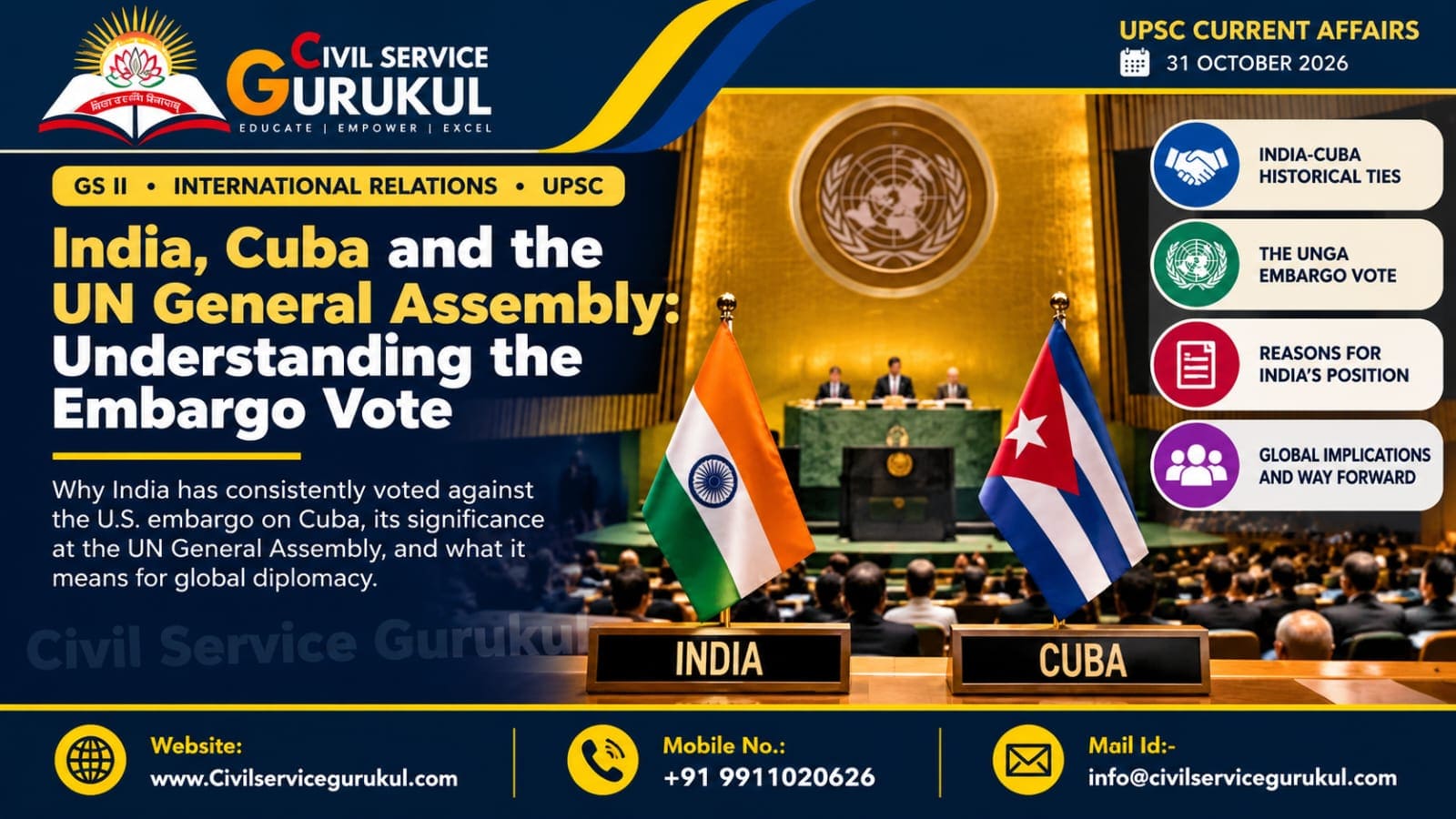
India Supports Ending US Embargo on Cuba: UN General Assembly Vote, Strategic Autonomy and Global Diplomacy
A comprehensive UPSC analysis of the Cuba embargo, UNGA resolutions, India's diplomatic position, international sanctions, state sovereignty and multilateralism.
India's reported support for a United Nations General Assembly resolution calling for an end to the United States embargo on Cuba has renewed discussion about international sanctions, sovereignty and multilateral diplomacy.
The long-running embargo is a major issue in US-Cuba relations and has repeatedly been debated at the UN.
India's position can be examined through strategic autonomy, South-South cooperation, multilateralism and concern for civilian welfare.
An important distinction is that UN General Assembly resolutions generally carry political and diplomatic weight but do not automatically change another country's domestic sanctions laws.
GS Paper II: International relations, bilateral relations, international institutions, India's foreign policy and global governance.
GS Paper IV: Ethics in international relations, humanitarian responsibility, fairness and global accountability.
Prelims: United Nations General Assembly, Security Council, economic sanctions, sovereignty and international organisations.
Why Is the India-Cuba UNGA Vote in the News?
A current-affairs report dated 30 October 2026 discussed India's support for a UN General Assembly call to end the United States embargo on Cuba.
The issue is relevant because it highlights India's approach to multilateral diplomacy, international economic measures and the principle of national sovereignty.
The United Nations has repeatedly considered resolutions concerning the economic, commercial and financial embargo against Cuba.
The uploaded source identifies the 2025 resolution as A/RES/80/4.
The precise 2026 vote totals, participating countries and official voting record should be verified against the relevant UN meeting record before publication.
What Is the US Embargo on Cuba?
An economic embargo involves restrictions on specified commercial, financial or other economic dealings.
The US embargo against Cuba has been a central feature of bilateral relations for several decades.
Its operation involves domestic legal measures and regulatory restrictions that affect certain economic activities.
Embargo vs Sanctions
Sanctions is a broad term that can include financial restrictions, trade measures, asset freezes and other limitations.
An embargo generally refers to restrictions on particular trade or economic dealings.
The precise scope depends on the relevant legal framework.
Historical Background of US-Cuba Relations
US-Cuba relations have been shaped by political disagreements, economic restrictions and wider geopolitical developments.
The embargo emerged during the Cold War period and became a longstanding source of international debate.
Over time, the UN General Assembly has repeatedly considered calls for ending the economic, commercial and financial embargo.
The issue continues to raise questions about the effectiveness and consequences of unilateral economic restrictions.
Role of the United Nations General Assembly
The United Nations General Assembly provides a forum for member states to debate international issues and express collective positions.
Annual Embargo Resolutions
The General Assembly has repeatedly adopted resolutions calling for an end to the US embargo on Cuba.
These votes communicate the diplomatic positions of member states.
Are UNGA Resolutions Binding?
Most General Assembly resolutions are recommendatory rather than legally binding.
They can nevertheless carry substantial political, diplomatic and normative significance.
Difference from the Security Council
Certain Security Council decisions adopted under the UN Charter can create binding obligations for member states.
A General Assembly resolution calling for the removal of a national embargo does not itself repeal that country's domestic law.
| Basis | UN General Assembly | UN Security Council |
|---|---|---|
| Primary Role | Deliberation and recommendations | International peace and security |
| Membership | All UN member states | 15 members |
| Legal Effect | Generally recommendatory | Certain decisions can be binding |
| UPSC Relevance | Multilateral diplomacy and global opinion | Collective security and enforcement powers |
India's Position: Strategic Autonomy and Multilateralism
Strategic Autonomy
Strategic autonomy refers to India's ability to make foreign-policy decisions based on its own interests and assessments.
Supporting a particular UN resolution does not necessarily mean adopting every policy position of the country concerned.
Multilateralism
India's participation in UN deliberations reflects the importance of international institutions as platforms for diplomatic engagement.
South-South Cooperation
India's relations with developing countries can also be analysed through the framework of South-South cooperation.
Humanitarian Considerations
India's position may be examined through concern for the effects of economic restrictions on civilian populations.
International Law, Sovereignty and Economic Sanctions
Economic sanctions raise important questions about jurisdiction, sovereignty, international obligations and humanitarian consequences.
Unilateral Sanctions
Unilateral sanctions are restrictions imposed by a state or group of states under their own legal or policy frameworks.
UN Security Council Sanctions
Security Council sanctions may be adopted under the UN Charter to address threats to international peace and security.
Extraterritorial Effects
Some national restrictions can affect persons or businesses outside the imposing state's territory.
Such effects may generate disputes over jurisdiction, trade and sovereignty.
Unilateral national sanctions should not be automatically equated with sanctions authorised by the UN Security Council.
Their legal foundations and institutional processes may differ significantly.
Competing International Perspectives
Arguments Supporting the Embargo
Supporters of economic restrictions may argue that sanctions are a tool for applying diplomatic pressure over governance, human rights or other policy disputes.
Arguments Opposing the Embargo
Critics may argue that broad economic restrictions can create humanitarian costs, disrupt commercial activity and disproportionately affect ordinary civilians.
Policy Evaluation
A balanced assessment should examine the stated objectives, legal basis, measurable outcomes and unintended consequences of sanctions.
Neither the existence of sanctions nor a call to remove them automatically resolves all underlying political and human-rights concerns.
Humanitarian and Economic Implications
Economic restrictions can influence trade, payments, investment and access to certain goods and services.
Their actual impact depends on legal exceptions, financial systems, domestic economic conditions and the behaviour of market participants.
Financial De-Risking
Financial institutions may avoid certain transactions because of perceived compliance or legal risks.
Humanitarian Access
Policymakers may need to evaluate whether humanitarian exceptions operate effectively in practice.
Civilian Welfare
The effects on ordinary households should be examined through credible evidence rather than assumed from political statements.
Strategic Significance for India's Foreign Policy
- Independent Diplomacy: India can take positions on international questions according to its own assessments.
- Multilateral Engagement: UN deliberations provide a forum for expressing policy preferences.
- Global South Relations: The issue connects with developing-country diplomatic cooperation.
- International Law: The debate raises questions about sovereignty, jurisdiction and sanctions.
- Humanitarian Responsibility: Economic policy can have consequences for civilian populations.
- Balanced Relationships: India can maintain engagement with different countries despite disagreements on particular issues.
Way Forward: Constructive Multilateral Diplomacy
- Promote dialogue between the parties.
- Encourage peaceful resolution of disputes.
- Advocate effective humanitarian access.
- Support international legal consistency.
- Evaluate sanctions through transparent evidence.
- Maintain diplomatic engagement with all sides.
- Strengthen multilateral problem-solving mechanisms.
- Protect legitimate humanitarian and commercial activities within applicable law.
UPSC Prelims Practice Questions
Question 1
Which UN body has repeatedly adopted resolutions calling for an end to the US embargo on Cuba?
(a) International Criminal Court
(b) United Nations General Assembly
(c) International Monetary Fund
(d) World Health Organization
The United Nations General Assembly has repeatedly adopted resolutions addressing the embargo against Cuba.
Question 2
Consider the following statements:
- Most UN General Assembly resolutions are recommendatory.
- A UN General Assembly resolution automatically repeals the domestic sanctions laws of every member state.
Which of the statements given above is/are correct?
(a) 1 only
(b) 2 only
(c) Both 1 and 2
(d) Neither 1 nor 2
Statement 1 is correct. Most General Assembly resolutions are not legally binding.
Statement 2 is incorrect. A General Assembly resolution does not automatically change another state's domestic legislation.
Question 3
Strategic autonomy in India's foreign policy primarily refers to:
(a) Avoiding all international institutions
(b) Making independent foreign-policy decisions based on national assessments
(c) Automatically supporting every decision of another country
(d) Ending all bilateral diplomatic relations
Strategic autonomy emphasises independent foreign-policy decision-making.
Question 4
Which statement best describes the distinction between unilateral sanctions and UN Security Council sanctions?
(a) Both necessarily have identical legal foundations
(b) Unilateral sanctions are imposed under national or coordinated state frameworks, while Security Council sanctions arise from UN Charter processes
(c) Only the UN General Assembly can impose binding Chapter VII sanctions
(d) Economic sanctions can never affect financial transactions
The legal foundations and institutional processes of unilateral sanctions and Security Council sanctions differ.
UPSC Mains GS Paper II Practice
Question: "India's voting behaviour in the United Nations reflects the interaction between strategic autonomy, multilateralism and humanitarian considerations." Discuss with reference to the UN General Assembly resolutions concerning the US embargo on Cuba. (250 words)
Suggested Answer Framework
Introduction: Explain the long-running Cuba embargo and the UNGA debate.
Strategic Autonomy: Discuss independent foreign-policy choices.
Multilateralism: Explain the role of UN deliberations and collective diplomacy.
Humanitarian Dimension: Assess the possible civilian impact of economic restrictions.
Legal Dimension: Distinguish UNGA resolutions from binding Security Council decisions.
Conclusion: India can promote dialogue, sovereignty, international legal consistency and constructive diplomacy.
Frequently Asked Questions
What is the US embargo on Cuba?
It is a longstanding set of economic, commercial and financial restrictions imposed by the United States under its legal framework.
Does a UNGA resolution automatically end the embargo?
No. Such resolutions carry diplomatic significance but do not themselves repeal US domestic law.
Why is India's position important?
It can be analysed through strategic autonomy, multilateralism, South-South cooperation and humanitarian concerns.
Are all economic sanctions imposed by the United Nations?
No. Some sanctions are imposed by states or groups of states, while others arise from Security Council decisions.
Does supporting the end of an embargo mean approving all policies of Cuba?
No. A country can oppose a particular economic restriction without endorsing every domestic policy of the affected state.
Which UPSC papers cover this topic?
GS Paper II covers international relations. GS Paper IV covers ethical dimensions of international relations. UN institutions and related concepts are relevant to Prelims.
Key Takeaway for UPSC Aspirants
India's reported support for ending the US embargo on Cuba illustrates the significance of strategic autonomy, multilateral diplomacy and humanitarian considerations in foreign policy.
For examination purposes, students should distinguish political recommendations from legally binding decisions, and evaluate sanctions through their legal basis, objectives and consequences.
SEO Keywords and Tags
Prepare for UPSC with Civil Service Gurukul
Strengthen your understanding of international relations, Indian foreign policy, global governance, international organisations and current affairs through examination-focused UPSC preparation.
Website: www.civilservicegurukul.com
Mobile: +91 9911020626
Email: info@civilservicegurukul.com
Prepare with Mentors Who Cleared the Exam
Get personalized study plans, evaluated answer models, and test series access.