
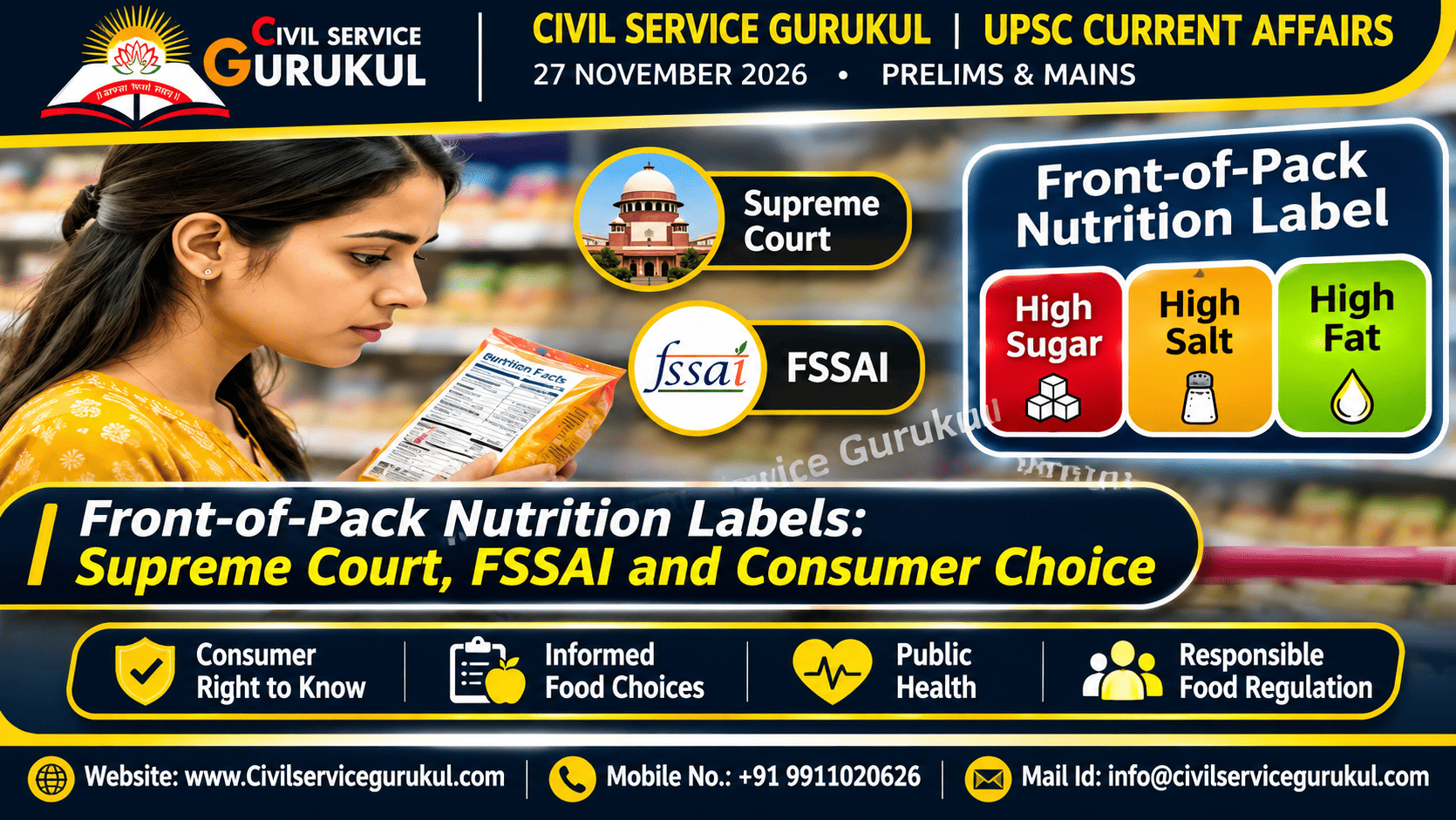
1. Why Is Front-of-Pack Nutrition Labelling in the News?
According to reports concerning the Supreme Court's directions dated 26 November 2026, the Food Safety and Standards Authority of India has been asked to advance a front-of-pack nutrition labelling framework that prominently communicates excessive levels of critical nutrients such as sugar, salt and fat.
News reports indicate that a four-month period has been provided for finalising the regulations. The development has renewed discussions regarding consumer protection, nutritional transparency and the growing burden of diet-related non-communicable diseases in India.
A Supreme Court direction to finalise regulations must not be confused with the immediate commencement of mandatory packaging requirements. Nutrient thresholds, exemptions, transition periods and implementation dates must be determined from the operative court order and applicable notified regulations.
2. What Is Front-of-Pack Nutrition Labelling?
Front-of-Pack Nutrition Labelling (FOPNL) is a consumer-information mechanism that presents important nutritional information prominently on the front surface of packaged food products.
Its primary objective is to help consumers understand the nutritional characteristics of products quickly, without requiring them to interpret detailed nutritional tables during every purchase.
Illustrative Nutrient-Specific Warning Labels
The above labels are conceptual illustrations for educational purposes. They do not represent confirmed mandatory Indian label designs.
3. Front-of-Pack vs Back-of-Pack Nutrition Labelling
| Parameter | Front-of-Pack Labelling | Back-of-Pack Labelling |
|---|---|---|
| Location | Prominent front surface of packaging. | Detailed information panel, often on the back or side. |
| Purpose | Quick nutritional assessment. | Detailed nutritional disclosure. |
| Information | Selected nutrients, warnings, ratings or colour codes. | Energy, carbohydrates, fats, protein and other prescribed information. |
| Interpretation | Designed for rapid understanding. | May require greater nutritional literacy. |
| Consumer Benefit | Supports immediate purchasing decisions. | Supports detailed nutritional comparisons. |
4. What Is FSSAI?
The Food Safety and Standards Authority of India (FSSAI) is a statutory authority established under the Food Safety and Standards Act, 2006. It operates under the Ministry of Health and Family Welfare.
| Particulars | Details |
|---|---|
| Full Form | Food Safety and Standards Authority of India. |
| Legal Framework | Food Safety and Standards Act, 2006. |
| Nature | Statutory regulatory authority. |
| Administrative Ministry | Ministry of Health and Family Welfare. |
| Headquarters | New Delhi. |
| Major Objective | Regulation of food safety and standards to protect public health. |
Major Functions of FSSAI
- Develop science-based standards for food products.
- Regulate food manufacturing, storage, distribution, sale and import.
- Establish food packaging and labelling requirements.
- Support food safety surveillance and risk assessment.
- Promote consumer awareness regarding safe and nutritious food.
- Coordinate with relevant food safety authorities.
5. What Are HFSS Foods?
HFSS stands for High Fat, Sugar and Salt. The term is generally used in nutritional policy discussions to identify foods containing high levels of specified nutrients of public-health concern.
| Nutrient | Potential Health Concerns Associated with Excess Intake |
|---|---|
| Added or Free Sugars | Excess energy intake, dental caries and increased risk of unhealthy weight gain. |
| Sodium | Elevated blood pressure and increased cardiovascular risk. |
| Saturated Fat | Elevated LDL cholesterol and cardiovascular risk, depending on overall dietary patterns. |
| Industrial Trans Fat | Increased risk of cardiovascular disease. |
Not every packaged food is an HFSS food. Classification depends on its nutritional composition and applicable nutrient-profile criteria. Fat is also an essential dietary nutrient; the type, quantity and overall dietary pattern matter.
6. Different Models of Front-of-Pack Nutrition Labelling
| Labelling Model | Major Characteristics | Potential Limitation |
|---|---|---|
| Nutrient-Specific Warning Labels | Identify products exceeding specified nutrient thresholds. | May not communicate the complete nutritional profile. |
| Traffic Light Labelling | Uses colours to indicate different nutrient levels. | Consumers may receive mixed signals across nutrients. |
| Health Star Rating | Provides an overall rating based on a nutritional assessment model. | A summary score may obscure individual nutrient concerns. |
| Nutri-Score | Uses letter grades and colours to communicate overall nutritional assessment. | Results depend on the scoring methodology and food-category treatment. |
| Reference Intake Labels | Display nutrient quantities or percentages of reference intake. | May require numerical interpretation and nutritional literacy. |
7. Nutrient-Specific Warning Labels vs Star Ratings
The reported Supreme Court development has brought renewed attention to nutrient-specific warnings rather than relying exclusively on an overall nutritional rating.
| Warning Labels | Star Rating System |
|---|---|
| Highlight individual nutrients exceeding specified thresholds. | Communicate an overall nutritional assessment. |
| Designed to identify particular nutritional concerns. | Designed to facilitate broad product comparisons. |
| May be easier to interpret for specific risk identification. | May provide a more aggregated view of nutritional composition. |
| Effectiveness depends on threshold selection and visibility. | Effectiveness depends on the scoring algorithm and consumer understanding. |
8. Why Does India Need Effective Nutrition Labelling?
Growing Burden of Non-Communicable Diseases
Unhealthy dietary patterns are among the important modifiable risk factors associated with obesity, type 2 diabetes, hypertension and cardiovascular diseases.
Changing Consumption Patterns
Urbanisation, changing lifestyles, convenience-oriented purchasing and expanding availability of packaged foods have increased the importance of clear nutritional information.
Information Asymmetry
Food manufacturers generally possess more detailed information about product composition than consumers. Effective labelling can reduce this information gap and support informed purchasing decisions.
Protection of Children
Children may be particularly susceptible to attractive packaging and promotional claims. Clear nutrition information can support parents and caregivers in evaluating food products.
Preventive Healthcare
Nutrition labelling can complement preventive healthcare by improving awareness of dietary risk factors. However, labels alone cannot eliminate lifestyle diseases.
9. Understanding Non-Communicable Diseases
Non-communicable diseases (NCDs) are generally long-duration conditions that are not directly transmitted from one person to another. They arise through interactions among genetic, physiological, environmental and behavioural factors.
| Disease or Condition | Relevant Dietary and Lifestyle Considerations |
|---|---|
| Type 2 Diabetes | Dietary patterns, physical activity, body weight and other risk factors. |
| Hypertension | Excess sodium intake, physical inactivity and other factors. |
| Cardiovascular Diseases | Unhealthy dietary patterns, tobacco use, high blood pressure and other risks. |
| Obesity | Complex interaction of energy balance, biological, social and environmental factors. |
| Certain Cancers | Multiple risk factors, including some dietary and lifestyle patterns. |
10. Double Burden of Malnutrition in India
India faces the challenge of addressing undernutrition and micronutrient deficiencies while simultaneously managing overweight, obesity and diet-related non-communicable diseases.
The coexistence of undernutrition with overweight, obesity or diet-related non-communicable diseases within individuals, households or populations.
Nutrition policy must therefore focus not only on adequate calorie availability but also on dietary quality, affordability, diversity and access to nutritious foods.
11. Illustrative Nutrition Label Comparison
Consider two hypothetical packaged beverages containing different amounts of total sugar per 100 millilitres.
| Particulars | Beverage A | Beverage B |
|---|---|---|
| Total Sugar per 100 ml | 12 grams | 4 grams |
| Package Volume | 250 ml | 250 ml |
| Total Sugar per Package | 30 grams | 10 grams |
This example demonstrates why consumers should consider both nutrient concentration and total package quantity. Whether either product requires a warning would depend on applicable regulatory definitions and thresholds.
The above figures are hypothetical and do not represent prescribed FSSAI limits.
12. Constitutional Provisions Related to Public Health and Consumer Protection
| Constitutional Provision | Relevance |
|---|---|
| Article 21 | Right to life, including judicially recognised dimensions of the right to health. |
| Article 19(1)(g) | Freedom to practise any profession or carry on an occupation, trade or business. |
| Article 19(6) | Permits reasonable restrictions on the freedom under Article 19(1)(g) in accordance with constitutional requirements. |
| Article 38 | Promotion of social welfare and reduction of inequalities. |
| Article 39(e) | Protection of the health and strength of workers and the tender age of children. |
| Article 47 | Duty of the State to raise nutritional standards, improve living standards and improve public health. |
| State List Entry 6 | Public health and sanitation, hospitals and dispensaries. |
| Concurrent List Entry 18 | Adulteration of foodstuffs and other goods. |
Article 47 → Nutrition and Public Health → Directive Principles of State Policy.
13. Consumer Protection and the Right to Information
The Consumer Protection Act, 2019 recognises consumer rights relating to safety, information, choice, redressal and protection against unfair trade practices.
Accurate nutrition labels can support consumer autonomy by enabling individuals to evaluate products according to their dietary preferences and health requirements.
However, effective consumer protection requires more than disclosure. Information must be accurate, understandable, accessible and free from misleading promotional practices.
14. International Approaches to Nutrition Labelling
| Country or Region | Notable Labelling Approach |
|---|---|
| Chile | Prominent nutrient-specific warning labels. |
| Mexico | Front-of-pack warning symbols for specified nutritional concerns. |
| United Kingdom | Traffic light nutrition labelling approach. |
| France and Several European Countries | Nutri-Score labelling approach. |
| Australia and New Zealand | Health Star Rating system. |
International experiences provide useful policy lessons, but India must design its framework according to domestic dietary patterns, linguistic diversity, consumer understanding and regulatory capacity.
15. Important Indian Government Initiatives
| Initiative | Major Objective |
|---|---|
| Eat Right India | Promote safe, healthy and sustainable food practices. |
| POSHAN Abhiyaan | Improve nutritional outcomes through coordinated interventions. |
| Saksham Anganwadi and POSHAN 2.0 | Strengthen nutrition support and related services. |
| PM POSHAN | Support nutrition among eligible schoolchildren. |
| Fit India Movement | Encourage physical activity and healthy lifestyles. |
| National Programme for Prevention and Control of Non-Communicable Diseases | Strengthen NCD prevention, screening and management. |
16. Benefits of Front-of-Pack Nutrition Labelling
- Supports informed consumer purchasing decisions.
- Improves awareness of critical nutrients.
- Reduces nutritional information asymmetry.
- May encourage healthier food choices.
- Can incentivise food manufacturers to improve product composition.
- Strengthens consumer protection and nutritional transparency.
- Complements public-health awareness and disease prevention programmes.
17. Challenges for the Food Industry and Regulators
| Challenge | Potential Policy Response |
|---|---|
| Packaging Redesign Costs | Provide reasonable transition periods. |
| Food Reformulation Costs | Encourage scientifically appropriate product improvements. |
| Small Business Compliance | Provide clear guidance and proportionate implementation support. |
| Threshold Selection | Use transparent, evidence-based nutrient-profile models. |
| Language Diversity | Develop accessible communication and consumer education. |
| Misleading Health Claims | Strengthen surveillance and enforcement. |
| Limited Consumer Awareness | Conduct public education and nutritional literacy campaigns. |
| Enforcement Capacity | Strengthen testing, monitoring and regulatory coordination. |
18. Economic and Ethical Dimensions
Nutrition labelling involves a balance between public-health objectives, consumer autonomy, commercial freedom and proportionate regulatory intervention.
While manufacturers may face additional compliance and reformulation costs, transparent information can improve market competition and enable consumers to make better-informed decisions.
- Transparency in product information.
- Corporate responsibility towards consumers.
- Informed choice and individual autonomy.
- Protection of vulnerable consumers.
- Accountability in regulatory decision-making.
- Balancing commercial interests with public welfare.
19. Front-of-Pack Labelling and Sustainable Development Goals
| SDG | Relevance |
|---|---|
| SDG 2 – Zero Hunger | Improved nutrition and dietary quality. |
| SDG 3 – Good Health and Well-being | Prevention and management of non-communicable diseases. |
| SDG 10 – Reduced Inequalities | Accessible nutritional information across population groups. |
| SDG 12 – Responsible Consumption and Production | Informed consumer choices and responsible manufacturing. |
20. Way Forward
- Evidence-Based Standards: Establish transparent nutrient thresholds supported by scientific assessment.
- Consumer-Friendly Labels: Ensure that warnings are prominent, readable and easily understood.
- Regional Accessibility: Consider linguistic diversity and varying levels of nutritional literacy.
- Industry Transition: Provide appropriate implementation periods and clear compliance guidance.
- Food Reformulation: Encourage manufacturers to improve nutritional composition without introducing misleading claims.
- Consumer Education: Integrate nutrition awareness into schools, healthcare programmes and public campaigns.
- Effective Enforcement: Monitor compliance and address inaccurate or misleading labels.
- Outcome Evaluation: Assess changes in consumer understanding, purchasing behaviour and product composition.
Transparent Nutrition Labels + Consumer Awareness + Responsible Manufacturing + Affordable Healthy Food + Effective Regulation = Better Nutritional Choices.
21. UPSC Prelims Quick Revision Capsule
| Keyword | Remember |
|---|---|
| FOPNL | Front-of-Pack Nutrition Labelling. |
| FSSAI | Statutory food safety regulatory authority. |
| FSS Act | Food Safety and Standards Act, 2006. |
| Administrative Ministry | Ministry of Health and Family Welfare. |
| HFSS | High Fat, Sugar and Salt. |
| NCDs | Non-Communicable Diseases. |
| Article 47 | Nutrition and public health. |
| Consumer Protection Act | 2019. |
| Information Asymmetry | Unequal access to relevant information between market participants. |
| SDG 3 | Good Health and Well-being. |
| Eat Right India | Safe, healthy and sustainable food practices. |
22. UPSC Prelims Practice MCQs
Question 1
With reference to the Food Safety and Standards Authority of India, consider the following statements:
- FSSAI is a statutory authority.
- It was established under the Food Safety and Standards Act, 2006.
- It operates under the Ministry of Agriculture and Farmers Welfare.
Which of the statements given above are correct?
- 1 and 2 only
- 2 and 3 only
- 1 and 3 only
- 1, 2 and 3
Reveal Answer and Explanation
FSSAI operates under the Ministry of Health and Family Welfare, not the Ministry of Agriculture and Farmers Welfare.
Question 2
Which of the following is the primary objective of front-of-pack nutrition labelling?
- To determine the market price of food products.
- To communicate important nutritional information quickly.
- To replace all food safety inspections.
- To prohibit the sale of every packaged food product.
Reveal Answer and Explanation
Front-of-pack nutrition labels support informed purchasing decisions by presenting important nutritional information prominently.
Question 3
Which Article of the Indian Constitution specifically directs the State to improve nutritional standards and public health?
- Article 32
- Article 44
- Article 47
- Article 51A
Reveal Answer and Explanation
Article 47 is a Directive Principle of State Policy dealing with nutrition, living standards and public health.
Question 4
Consider the following pairs:
- Chile – Nutrient-specific warning labels.
- United Kingdom – Traffic light labelling.
- Australia and New Zealand – Health Star Rating.
How many of the above pairs are correctly matched?
- Only one
- Only two
- All three
- None
Reveal Answer and Explanation
All three pairs identify notable nutrition labelling approaches associated with the respective countries.
Question 5
With reference to nutrition labelling and public health, consider the following statements:
- Nutrition labelling can reduce information asymmetry.
- All packaged foods are necessarily HFSS foods.
- Nutrition labelling alone can eliminate all non-communicable diseases.
Which of the statements given above is correct?
- 1 only
- 1 and 2 only
- 2 and 3 only
- 1, 2 and 3
Reveal Answer and Explanation
HFSS classification depends on nutritional composition and applicable criteria. Nutrition labelling is one public-health intervention and cannot independently eliminate all NCDs.
23. UPSC Mains Practice Question
Question: Front-of-pack nutrition labelling can play an important role in addressing India's growing burden of non-communicable diseases. Critically examine its potential benefits, regulatory challenges and implementation requirements.
Marks: 15 | Word Limit: 250 words
Reveal Model Answer
Introduction
Front-of-pack nutrition labelling is a consumer-information mechanism that communicates important nutritional characteristics of packaged foods. The reported Supreme Court directions to FSSAI highlight its significance for public health and consumer protection.
Potential Benefits
- Reduces information asymmetry in food markets.
- Supports informed purchasing decisions.
- Improves awareness of excessive sugar, sodium and unhealthy fat consumption.
- May encourage manufacturers to improve product composition.
- Complements preventive healthcare and nutritional security programmes.
Major Challenges
- Determining scientifically appropriate nutrient thresholds.
- Ensuring accessibility across linguistic and literacy groups.
- Managing packaging and reformulation costs.
- Preventing misleading health claims.
- Strengthening regulatory monitoring and enforcement.
Way Forward
- Develop evidence-based and transparent labelling standards.
- Provide proportionate industry transition periods.
- Promote nutritional literacy and public awareness.
- Improve access to affordable nutritious food.
- Evaluate changes in consumer behaviour and product composition.
Conclusion
Nutrition labelling should form part of a comprehensive public-health strategy combining consumer awareness, responsible manufacturing, healthy food environments and effective regulation. Such an approach can advance Article 47 and Sustainable Development Goal 3 while protecting consumer autonomy.
24. UPSC Syllabus Mapping
| UPSC Paper | Relevant Topic |
|---|---|
| Prelims GS Paper I | Nutrition, health, statutory authorities and government initiatives. |
| Mains GS Paper I | Urbanisation, changing lifestyles and social challenges. |
| Mains GS Paper II | Health, governance, regulatory institutions and consumer protection. |
| Mains GS Paper III | Food processing industry, economic regulation and food security. |
| Mains GS Paper IV | Corporate ethics, accountability, transparency and public welfare. |
| Essay | Preventive healthcare, nutritional security and responsible consumerism. |
| Interview | Food regulation, lifestyle diseases and public-health policy. |
25. Frequently Asked Questions
What is front-of-pack nutrition labelling?
It is a system of prominently displaying selected nutritional information on the front of packaged food products.
What did the Supreme Court reportedly direct FSSAI to do in November 2026?
Reports indicate that FSSAI was directed to advance a nutrition labelling framework with prominent nutrient-specific warnings, with a reported four-month period for finalising regulations.
Are the proposed warning labels already mandatory?
The reported court direction must be distinguished from final notified regulations. Actual mandatory requirements depend on the applicable legal framework and commencement dates.
What is the full form of FSSAI?
Food Safety and Standards Authority of India.
Under which Act was FSSAI established?
The Food Safety and Standards Act, 2006.
Which ministry administers FSSAI?
The Ministry of Health and Family Welfare.
What are HFSS foods?
HFSS refers to foods high in fat, sugar and salt according to applicable nutritional assessment criteria.
What is the difference between warning labels and star ratings?
Warning labels highlight specified nutrients exceeding relevant thresholds, while star ratings provide an overall nutritional assessment.
Which constitutional Article deals with nutrition and public health?
Article 47 of the Indian Constitution.
Can nutrition labelling prevent all lifestyle diseases?
No. It can support informed dietary decisions but must be complemented by other preventive healthcare, social and nutritional interventions.
Which Sustainable Development Goal focuses on health?
SDG 3 – Good Health and Well-being.
Why is front-of-pack nutrition labelling important for UPSC?
It connects public health, consumer protection, statutory regulation, nutritional security, food processing, corporate responsibility and ethical governance.
26. Conclusion
The reported Supreme Court directions concerning front-of-pack nutrition labelling represent an important development in India's continuing efforts to improve nutritional transparency and consumer protection.
An effective framework must balance public-health objectives with scientific validity, consumer accessibility, industry feasibility and credible enforcement.
India must move towards a comprehensive nutrition-sensitive policy ecosystem in which informed consumers, responsible businesses and accountable regulatory institutions collectively contribute to better public-health outcomes.