
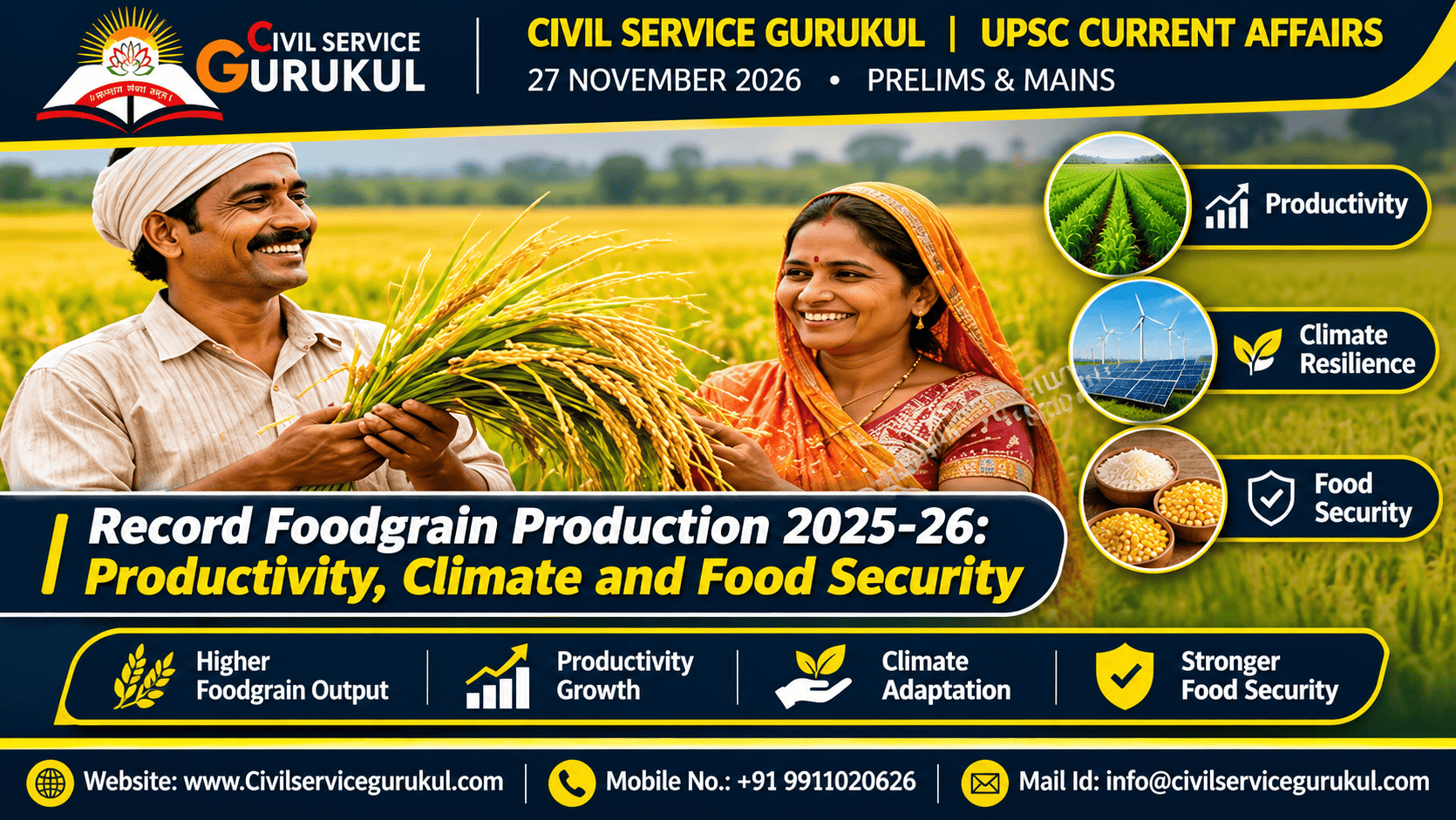
1. Why Is India's Foodgrain Production in the News?
According to the reported announcement of the Ministry of Agriculture and Farmers Welfare dated 26 November 2026, India's final foodgrain production for 2025–26 reached 3,785.38 lakh tonnes, equivalent to 378.538 million tonnes.
The Ministry also reportedly released the first advance estimate of kharif foodgrain production for 2026–27 at 1,671.43 lakh tonnes, equivalent to 167.143 million tonnes.
Record agricultural production can strengthen domestic food availability, improve market supplies and support food security. However, higher production must be accompanied by sustainable agricultural practices and remunerative prices for farmers.
2. Key Foodgrain Production Statistics
| Particulars | Lakh Tonnes | Million Tonnes | Estimate Status |
|---|---|---|---|
| Foodgrain Production 2025–26 | 3,785.38 | 378.538 | Reported Final Estimate |
| Kharif Foodgrain Production 2026–27 | 1,671.43 | 167.143 | First Advance Estimate |
The figure of 167.143 million tonnes relates only to the first advance estimate for kharif 2026–27. It is not the final foodgrain production figure for the entire agricultural year.
The two figures cover different periods and should not be directly compared to calculate annual production growth.
3. What Are Foodgrains?
Foodgrains are agricultural crops that form an important component of human food consumption and national food security. In Indian agricultural statistics, foodgrains broadly comprise cereals and pulses.
| Category | Examples |
|---|---|
| Cereals | Rice and wheat. |
| Coarse and Nutri-Cereals | Maize, jowar, bajra, ragi and other millets. |
| Pulses | Gram, tur, moong, urad and lentils. |
Foodgrains = Cereals + Pulses.
Oilseeds, sugarcane, cotton and horticultural crops are important agricultural products but are not included in the conventional foodgrain production category.
4. Major Cropping Seasons in India
| Season | General Sowing Period | General Harvesting Period | Major Crops |
|---|---|---|---|
| Kharif | June–July | September–November | Rice, maize, bajra, soybean and cotton. |
| Rabi | October–December | March–April | Wheat, gram, mustard and barley. |
| Zaid | March–April | May–June | Watermelon, cucumber and summer vegetables. |
Cropping calendars vary according to regional climatic conditions, irrigation availability, crop varieties and agricultural practices.
5. Advance Estimates vs Final Estimates
Agricultural production estimates are progressively refined as information becomes available regarding cultivated area, crop conditions, yields and actual harvests.
| Estimate | Meaning |
|---|---|
| First Advance Estimate | Preliminary assessment based on available crop and seasonal information. |
| Subsequent Advance Estimates | Revised assessments incorporating additional agricultural information. |
| Final Estimate | More complete official assessment incorporating updated production information. |
6. Agricultural Production and Agricultural Productivity
Agricultural production represents the total quantity of crops produced, whereas agricultural productivity measures output relative to an input, commonly cultivated land.
Crop Production = Area Under Cultivation × Yield Per Unit Area
Crop Productivity = Total Crop Production ÷ Area Under Cultivation
Record production may result from increased cultivated area, higher crop yields or a combination of both. Aggregate production figures alone do not establish that agricultural productivity has increased.
7. Potential Factors Supporting Agricultural Growth
Several structural and technological factors can contribute to agricultural growth. Their actual contribution to the reported 2025–26 record requires crop-wise and region-wise evidence.
- Improved seed varieties and agricultural research.
- Expansion and modernisation of irrigation infrastructure.
- Favourable rainfall and appropriate crop management.
- Agricultural mechanisation and precision farming.
- Improved access to agricultural credit and inputs.
- Better pest and disease management.
- Market connectivity and agricultural extension services.
- Adoption of climate-resilient agricultural technologies.
8. Significance of Record Foodgrain Production
National Food Security
Higher foodgrain production can improve domestic food availability and strengthen the capacity of public food distribution programmes.
Price Stability
Adequate market supplies may help moderate food inflation, although retail prices also depend on storage, transportation, demand and distribution conditions.
Rural Economic Development
Agricultural growth can support rural employment, agricultural trade, food processing and related economic activities.
Buffer Stock Management
Higher production can facilitate public procurement and maintenance of foodgrain reserves, depending on procurement policies and market conditions.
External Sector Stability
Adequate domestic production may reduce import requirements for certain commodities and create export opportunities, subject to domestic food security and trade policies.
9. Does Higher Production Guarantee Higher Farmer Income?
Record agricultural output does not necessarily translate into higher net income for every farmer. Profitability depends on production costs, market prices, crop losses, access to procurement and other economic factors.
Net Farm Income = Agricultural Revenue − Total Production and Related Costs
| Factor | Impact on Farmer Income |
|---|---|
| Higher Crop Yield | Can increase marketable output. |
| Falling Market Prices | May reduce revenue despite higher production. |
| Rising Input Costs | Can reduce net profitability. |
| Post-Harvest Losses | Reduce saleable agricultural output. |
| Market Access | Can improve price realisation and bargaining power. |
| Crop Diversification | May create alternative income opportunities and reduce concentration risks. |
10. Food Security vs Nutritional Security
Food security and nutritional security are closely connected but are not identical concepts.
| Parameter | Food Security | Nutritional Security |
|---|---|---|
| Primary Objective | Access to sufficient, safe and nutritious food. | Adequate nutritional intake and effective utilisation. |
| Major Focus | Availability, access, utilisation and stability. | Dietary quality, health and nutrient adequacy. |
| Policy Instruments | Procurement, food distribution and income support. | Dietary diversification, healthcare, nutrition education and sanitation. |
| Key Challenges | Hunger and inadequate food access. | Malnutrition and micronutrient deficiencies. |
Abundant rice and wheat production does not automatically address protein deficiencies, micronutrient gaps or inadequate access to fruits, vegetables and other nutritious foods.
11. Four Pillars of Food Security
12. Minimum Support Price and Agricultural Procurement
Minimum Support Price (MSP) is an important agricultural price-support mechanism intended to provide a degree of protection against adverse price movements for specified crops.
The Commission for Agricultural Costs and Prices (CACP) recommends MSPs, while the Central Government takes the final decision.
| Institution | Major Role |
|---|---|
| CACP | Recommends minimum support prices. |
| Central Government | Approves and announces MSPs. |
| Food Corporation of India | Participates in foodgrain procurement, storage and distribution. |
| State Procurement Agencies | Implement procurement operations according to applicable arrangements. |
Announcement of MSP does not mean that the government automatically purchases the entire production of every MSP-covered crop.
13. Food Corporation of India and Buffer Stocks
The Food Corporation of India (FCI) was established in 1965 under the Food Corporations Act, 1964.
Major Functions of FCI
- Support foodgrain procurement operations.
- Maintain and manage foodgrain stocks.
- Facilitate foodgrain movement and storage.
- Support public food distribution requirements.
- Contribute to national food security and market stabilisation measures.
Buffer stocks can help address seasonal supply disruptions, emergencies and food distribution requirements. Their effective management requires adequate storage, quality control and efficient logistics.
14. National Food Security Act, 2013
The National Food Security Act, 2013 provides a rights-based framework for access to specified food and nutritional entitlements.
| Particulars | Statutory Framework |
|---|---|
| Rural Population Coverage | Up to 75 percent. |
| Urban Population Coverage | Up to 50 percent. |
| Priority Households | 5 kg of foodgrains per person per month. |
| Antyodaya Anna Yojana Households | 35 kg of foodgrains per household per month. |
| Additional Provisions | Nutritional support for eligible children, pregnant women and lactating mothers. |
Actual coverage and distribution arrangements operate according to applicable government policies, beneficiary identification and statutory provisions.
15. Major Government Initiatives Supporting Agriculture
| Government Initiative | Major Objective |
|---|---|
| PM-KISAN | Income support to eligible farmer families. |
| Pradhan Mantri Fasal Bima Yojana | Crop insurance against specified agricultural risks. |
| Pradhan Mantri Krishi Sinchayee Yojana | Improved irrigation access and water-use efficiency. |
| Soil Health Card Scheme | Soil testing and nutrient management recommendations. |
| National Agriculture Market (e-NAM) | Electronic integration of agricultural markets. |
| Agriculture Infrastructure Fund | Financing eligible agricultural infrastructure projects. |
| Farmer Producer Organisations | Collective marketing, aggregation and improved farmer bargaining power. |
| Kisan Credit Card | Access to agricultural credit for eligible borrowers. |
| National Mission on Natural Farming | Promotion of natural farming practices. |
16. Climate Change and Indian Agriculture
Indian agriculture remains exposed to climate variability, including changes in rainfall patterns, extreme temperatures, droughts, floods and crop disease risks.
| Climate Risk | Potential Agricultural Impact |
|---|---|
| Erratic Monsoon | Disruption of sowing and crop development. |
| Heatwaves | Heat stress and reduced yields in sensitive crops. |
| Drought | Water scarcity and crop losses. |
| Floods | Crop damage, waterlogging and soil erosion. |
| Unseasonal Rainfall | Harvest losses and deterioration in crop quality. |
| Changing Pest Patterns | Increased crop protection challenges. |
17. Groundwater Depletion and Sustainable Agriculture
Agricultural sustainability depends not only on the quantity of food produced but also on the long-term availability of natural resources.
Intensive cultivation of water-demanding crops in water-stressed regions can contribute to groundwater depletion. Excessive or imbalanced use of agricultural chemicals may also affect soil and water quality.
Important Sustainable Agricultural Practices
- Drip and sprinkler irrigation where appropriate.
- Region-specific crop diversification.
- Rainwater harvesting and groundwater recharge.
- Integrated nutrient management.
- Integrated pest management.
- Conservation agriculture and crop rotation.
- Climate-resilient seed varieties.
- Scientific soil and water conservation.
18. Importance of Pulses, Millets and Oilseeds
| Crop Category | Strategic Importance |
|---|---|
| Pulses | Plant-based protein, dietary diversity and biological nitrogen fixation through suitable symbiotic associations. |
| Millets | Nutritional diversity and suitability of many varieties for relatively dry conditions. |
| Oilseeds | Domestic edible oil availability and potential reduction of import dependence. |
Agricultural diversification must be designed according to local agro-climatic conditions, market demand, farmer preferences and income opportunities.
19. Major Challenges Facing Indian Agriculture
- Unequal access to irrigation infrastructure.
- Climate variability and extreme weather events.
- Fragmented agricultural landholdings.
- Rising agricultural input costs.
- Inadequate storage and post-harvest infrastructure.
- Groundwater depletion and soil degradation.
- Price volatility and uneven procurement access.
- Regional disparities in agricultural productivity.
- Limited access to technology and extension services.
- Insufficient diversification towards nutritious and remunerative crops.
20. Constitutional Provisions Related to Agriculture and Food Security
| Constitutional Provision | Relevance |
|---|---|
| Article 21 | Right to life and judicially recognised dimensions of the right to food and dignity. |
| Article 38 | Social justice and reduction of inequalities. |
| Article 39(b) | Distribution of material resources to serve the common good. |
| Article 47 | Improvement of nutrition, living standards and public health. |
| Article 48 | Organisation of agriculture and animal husbandry on modern and scientific lines. |
| Article 48A | Protection and improvement of the environment. |
| State List Entry 14 | Agriculture, including agricultural education and research. |
| Concurrent List Entry 33 | Trade, commerce, production, supply and distribution of specified commodities, including foodstuffs. |
21. Agriculture and Sustainable Development Goals
| SDG | Relevance |
|---|---|
| SDG 1 – No Poverty | Improvement of rural livelihoods. |
| SDG 2 – Zero Hunger | Food security, nutrition and sustainable agriculture. |
| SDG 6 – Clean Water and Sanitation | Sustainable water-resource management. |
| SDG 8 – Decent Work and Economic Growth | Rural employment and agricultural value chains. |
| SDG 12 – Responsible Consumption and Production | Reduction of food waste and efficient resource utilisation. |
| SDG 13 – Climate Action | Climate-resilient agricultural practices. |
| SDG 15 – Life on Land | Soil conservation, biodiversity and ecosystem protection. |
22. Way Forward: From Record Production to Sustainable Food Security
Region-Specific Crop Diversification
Promote suitable pulses, millets, oilseeds and horticultural crops while protecting farmer profitability and market access.
Climate-Resilient Agricultural Research
Invest in crop varieties and agricultural practices capable of responding to heat stress, drought, floods and changing pest patterns.
Efficient Water Management
Encourage appropriate irrigation technologies, groundwater recharge and cultivation patterns aligned with regional water availability.
Strengthen Post-Harvest Infrastructure
Develop scientific warehouses, processing facilities, rural logistics and efficient agricultural value chains to reduce avoidable losses.
Improve Farmer Price Realisation
Strengthen market intelligence, farmer producer organisations, transparent procurement and access to competitive agricultural markets.
Improve Agricultural Data Quality
Publish timely crop-wise and district-wise information on cultivated area, productivity, rainfall, crop losses and the reliability of production estimates.
Prioritise Nutritional Security
Integrate agricultural policy with nutrition programmes, dietary diversification and equitable access to healthy food.
Higher Productivity + Remunerative Prices + Crop Diversification + Climate Resilience + Efficient Value Chains = Sustainable Agricultural Development
23. UPSC Prelims Quick Revision Capsule
| Keyword | Remember |
|---|---|
| Foodgrain Production 2025–26 | Reported final estimate: 378.538 million tonnes. |
| Kharif 2026–27 | Reported first advance estimate: 167.143 million tonnes. |
| Foodgrains | Cereals and pulses. |
| Kharif | Generally associated with monsoon sowing. |
| Rabi | Generally associated with winter cultivation. |
| CACP | Recommends MSPs. |
| FCI | Established in 1965 under the Food Corporations Act, 1964. |
| NFSA | National Food Security Act, 2013. |
| Article 47 | Nutrition and public health. |
| Article 48 | Scientific agriculture and animal husbandry. |
| State List Entry 14 | Agriculture. |
| SDG 2 | Zero Hunger. |
24. UPSC Prelims Practice MCQs
Question 1
With reference to India's reported foodgrain production estimates, consider the following statements:
- The final foodgrain production estimate for 2025–26 is 378.538 million tonnes.
- The 167.143 million tonnes figure represents the first advance estimate for kharif 2026–27.
- Both figures represent final production estimates for complete agricultural years.
Which of the statements given above are correct?
- 1 and 2 only
- 2 and 3 only
- 1 and 3 only
- 1, 2 and 3
Reveal Answer and Explanation
The second figure is a seasonal advance estimate, not a final annual production figure.
Question 2
Which of the following are included in the conventional foodgrain production category in India?
- Rice
- Pulses
- Wheat
- Oilseeds
- 1 and 2 only
- 2 and 4 only
- 1, 2 and 3 only
- 1, 2, 3 and 4
Reveal Answer and Explanation
Foodgrains comprise cereals and pulses. Oilseeds are a separate agricultural statistical category.
Question 3
Which institution recommends Minimum Support Prices for specified agricultural crops in India?
- Food Corporation of India
- Commission for Agricultural Costs and Prices
- Reserve Bank of India
- Finance Commission
Reveal Answer and Explanation
CACP recommends MSPs, while the Central Government takes the final decision.
Question 4
Consider the following statements:
- Agriculture is included under Entry 14 of the State List.
- Article 48 deals with the organisation of agriculture and animal husbandry.
- Article 47 deals with nutrition and public health.
Which of the statements given above are correct?
- 1 only
- 1 and 2 only
- 2 and 3 only
- 1, 2 and 3
Reveal Answer and Explanation
All three constitutional provisions are correctly identified.
Question 5
Which of the following constitute the four conventional pillars of food security?
- Production, procurement, exports and imports.
- Availability, access, utilisation and stability.
- Irrigation, fertilisers, mechanisation and storage.
- Income, employment, taxation and investment.
Reveal Answer and Explanation
The four conventional pillars of food security are availability, access, utilisation and stability.
25. UPSC Mains Practice Question
Question: Record foodgrain production is an important achievement but does not automatically ensure nutritional security, farmer prosperity and environmental sustainability. Critically examine the statement in the context of Indian agriculture.
Marks: 15 | Word Limit: 250 words
Reveal Model Answer
Introduction
India's reported record foodgrain production of 378.538 million tonnes in 2025–26 highlights its agricultural potential. However, sustainable agricultural development requires a broader approach encompassing economic, nutritional and environmental objectives.
Significance of Record Production
- Improves domestic food availability.
- Supports public distribution and buffer stocks.
- Can strengthen rural economic activity.
- May contribute to food price stability.
Major Limitations
- Higher production may coexist with falling farm prices and rising input costs.
- Cereal abundance does not automatically eliminate micronutrient deficiencies.
- Water-intensive cultivation may contribute to groundwater depletion.
- Climate variability threatens agricultural stability.
- Inadequate storage and logistics can result in post-harvest losses.
Way Forward
- Promote region-specific crop diversification.
- Strengthen climate-resilient agricultural research.
- Improve irrigation efficiency and soil conservation.
- Develop storage, processing and agricultural value chains.
- Improve farmer price realisation and market access.
- Integrate agricultural policies with nutritional security programmes.
Conclusion
India must transition from a production-centric agricultural strategy towards a sustainable, nutrition-sensitive and farmer-centric agricultural ecosystem. Such an approach can strengthen food security, rural prosperity and environmental resilience while advancing Sustainable Development Goal 2.
26. UPSC Syllabus Mapping
| UPSC Paper | Relevant Topic |
|---|---|
| Prelims GS Paper I | Agriculture, cropping seasons, economic institutions and environment. |
| Mains GS Paper I | Distribution of natural resources and agricultural geography. |
| Mains GS Paper II | Hunger, poverty, welfare programmes and food security. |
| Mains GS Paper III | Major crops, cropping patterns, irrigation, MSP, food processing, agricultural marketing and climate change. |
| Mains GS Paper IV | Intergenerational equity, environmental ethics and distributive justice. |
| Essay | Sustainable agriculture, food security and rural development. |
| Interview | Farmer income, agricultural reforms and climate resilience. |
27. Frequently Asked Questions
What is India's reported foodgrain production for 2025–26?
The reported final estimate is 3,785.38 lakh tonnes, equivalent to 378.538 million tonnes.
What is the first advance estimate for kharif 2026–27?
The reported first advance estimate is 1,671.43 lakh tonnes, equivalent to 167.143 million tonnes.
Is the kharif estimate the final production for 2026–27?
No. It represents a preliminary estimate for the kharif season only.
What crops are included in foodgrains?
Foodgrains broadly comprise cereals, including coarse and nutri-cereals, and pulses.
Are oilseeds included in foodgrain production?
No. Oilseeds constitute a separate agricultural statistical category.
What is the difference between agricultural production and productivity?
Production refers to total agricultural output, while land productivity measures output per unit of cultivated area.
Does record foodgrain production guarantee higher farmer income?
No. Farmer income also depends on market prices, production costs, crop losses and access to markets.
Which institution recommends MSP in India?
The Commission for Agricultural Costs and Prices recommends MSPs.
What are the four pillars of food security?
Availability, access, utilisation and stability.
Which Sustainable Development Goal focuses on zero hunger?
SDG 2 focuses on ending hunger, achieving food security, improving nutrition and promoting sustainable agriculture.
Why is crop diversification important?
Appropriate crop diversification can improve dietary diversity, reduce agricultural risks, support alternative income opportunities and promote sustainable resource management.
Why is record foodgrain production important for UPSC?
It connects agriculture, food security, farmer income, government policies, economic development, climate change and environmental sustainability.
28. Conclusion
India's reported record foodgrain production during 2025–26 represents an important agricultural milestone. Nevertheless, the long-term success of Indian agriculture must be measured through more than aggregate production figures.
Sustainable agricultural growth requires improved farmer profitability, efficient water management, soil conservation, climate resilience, crop diversification and equitable access to nutritious food.
A comprehensive agricultural development strategy can transform higher foodgrain production into lasting food security, rural prosperity and sustainable economic development.