1. Why Is Vitamin B12 Deficiency in the News?
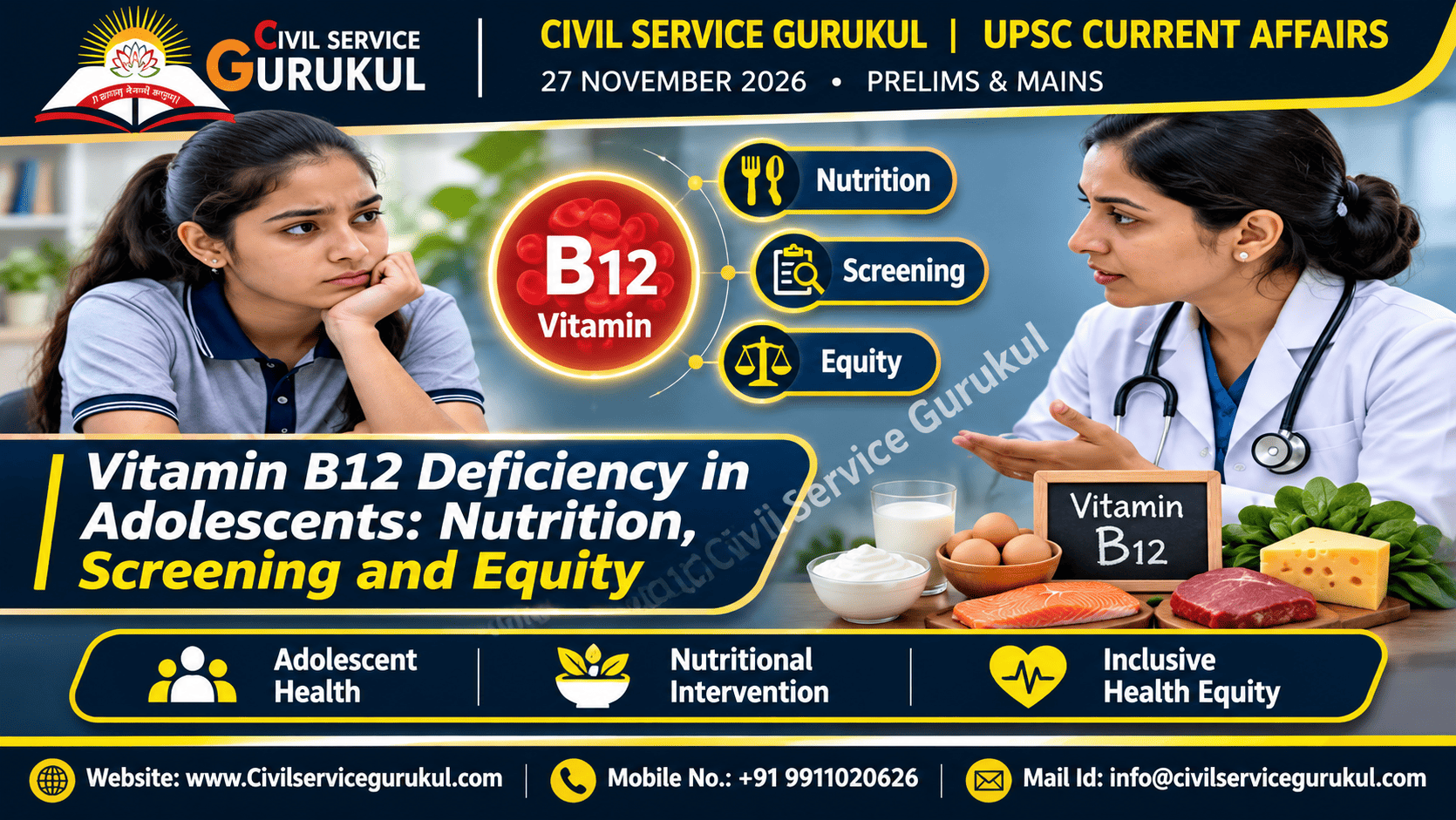
A newspaper report dated 27 November 2026 highlighted a study suggesting that approximately two-thirds of Indian adolescents may have vitamin B12 deficiency.
The reported findings raise important questions regarding adolescent nutrition, dietary diversity, micronutrient intake, healthcare accessibility and the effectiveness of India's public health interventions.
The reported two-thirds estimate should not be treated as an independently established nationwide prevalence figure without examining the original study, sample size, age groups, geographical coverage, laboratory thresholds and statistical methodology.
2. What Is Vitamin B12?
Vitamin B12, also known as cobalamin, is a water-soluble vitamin essential for several biological processes, including red blood cell formation, DNA synthesis and normal neurological functioning.
Major Functions of Vitamin B12
- Supports normal red blood cell formation.
- Participates in DNA synthesis.
- Maintains normal nervous system functioning.
- Supports the formation and maintenance of myelin.
- Participates in important metabolic reactions.
- Supports normal growth and development.
3. Important Scientific Facts About Vitamin B12
| Particulars | Details |
|---|---|
| Scientific Name | Cobalamin |
| Vitamin Category | Water-soluble vitamin |
| Important Mineral Component | Cobalt |
| Major Functions | DNA synthesis, neurological function and red blood cell formation. |
| Principal Storage Organ | Liver |
| Important Absorption Factor | Intrinsic factor produced by gastric parietal cells. |
| Principal Absorption Site | Terminal ileum of the small intestine. |
| Associated Deficiency Disorder | Megaloblastic anaemia and neurological complications. |
B12 = Cobalamin = Cobalt + Blood Cell Formation + Nervous System
4. Why Is Adolescence a Critical Stage for Nutrition?
Adolescence generally refers to the age group of 10–19 years. It represents a transitional period between childhood and adulthood involving rapid physical, psychological and cognitive development.
- Rapid physical growth increases nutritional requirements.
- Balanced nutrition supports learning and educational participation.
- Healthy dietary habits influence long-term health outcomes.
- Adolescent nutrition contributes to future reproductive and maternal health.
- Improved health supports productivity and human capital formation.
Nutritional deficiencies during adolescence may therefore have consequences extending beyond individual health to educational achievement, economic productivity and intergenerational development.
5. What Is Hidden Hunger?
Hidden hunger refers to inadequate intake or availability of essential vitamins and minerals, even when a person consumes sufficient calories.
Unlike visible hunger, micronutrient deficiencies may remain undetected for considerable periods because individuals do not necessarily appear undernourished.
| Micronutrient | Important Deficiency Consequences |
|---|---|
| Vitamin B12 | Megaloblastic anaemia and neurological problems. |
| Iron | Iron deficiency anaemia. |
| Vitamin A | Night blindness and impaired immune function. |
| Vitamin D | Rickets in children and osteomalacia in adults. |
| Iodine | Goitre and impaired development associated with iodine deficiency. |
| Folate | Megaloblastic anaemia and increased risk of neural tube defects during pregnancy. |
| Zinc | Impaired growth and immune function. |
6. Major Causes of Vitamin B12 Deficiency
Inadequate Dietary Intake
Diets lacking reliable sources of vitamin B12 may increase deficiency risk, particularly when fortified foods or appropriate supplements are unavailable.
Absorption Disorders
Certain gastrointestinal conditions and problems involving intrinsic factor may interfere with vitamin B12 absorption despite adequate dietary intake.
Economic Inequality
Limited household income may restrict access to diverse and nutrient-rich food products.
Low Nutritional Awareness
Lack of awareness regarding micronutrient requirements can contribute to inadequate dietary planning.
Healthcare Accessibility
Limited access to screening, laboratory testing and professional nutritional guidance may delay identification and treatment.
7. Dietary Sources of Vitamin B12
| Food Category | Examples | Important Consideration |
|---|---|---|
| Dairy Products | Milk, curd and cheese. | Can contribute to B12 intake in vegetarian diets. |
| Eggs | Egg-based foods. | Contain naturally occurring vitamin B12. |
| Animal-Source Foods | Fish, meat and poultry. | Common natural dietary sources. |
| Fortified Foods | B12-fortified cereals and plant-based beverages. | Check product labels for actual B12 content. |
| Supplements | Vitamin B12 preparations. | Use according to appropriate professional guidance. |
A well-planned vegetarian diet can support good health. However, ordinary unfortified fruits, vegetables, pulses and grains are not reliable sources of vitamin B12. Individuals with limited dairy or other animal-source food intake may require suitable fortified foods or professionally recommended supplementation.
Vegetarian dietary patterns alone do not establish that an individual has vitamin B12 deficiency.
8. Potential Symptoms and Health Consequences
| Category | Possible Manifestations |
|---|---|
| Haematological | Megaloblastic anaemia, weakness and fatigue. |
| Neurological | Tingling, numbness and balance difficulties. |
| Cognitive | Possible difficulties with concentration and memory. |
| Oral Health | Glossitis or inflammation of the tongue. |
| Developmental | Potential adverse effects on normal growth and development. |
These manifestations are not specific to vitamin B12 deficiency. Appropriate clinical evaluation is necessary to distinguish nutritional deficiencies from other medical conditions. Neurological manifestations can occur even without anaemia.
9. Difference Between Iron, Vitamin B12 and Folate Deficiency
| Parameter | Iron Deficiency | Vitamin B12 Deficiency | Folate Deficiency |
|---|---|---|---|
| Typical Anaemia | Microcytic anaemia | Megaloblastic anaemia | Megaloblastic anaemia |
| Red Blood Cell Size | Usually smaller | Often larger | Often larger |
| Major Biological Role | Haemoglobin formation | DNA synthesis and neurological function | DNA synthesis and cell division |
| Neurological Effects | Not the characteristic B12-related pattern | May cause characteristic neurological complications | Generally lacks the characteristic B12-related neurological pattern |
All cases of anaemia are not caused by iron deficiency. Vitamin B12 deficiency, folate deficiency, infections, chronic diseases and inherited blood disorders can also contribute to anaemia.
Combined deficiencies may alter the typical laboratory patterns described above.
10. Food Fortification, Supplementation and Dietary Diversification
| Strategy | Meaning | Example |
|---|---|---|
| Food Fortification | Adding essential micronutrients to food products. | Vitamin B12-fortified food products. |
| Supplementation | Providing specific nutrients through suitable preparations. | Professionally recommended vitamin supplements. |
| Dietary Diversification | Increasing the variety and nutritional quality of foods consumed. | Balanced meals containing diverse nutrient-rich foods. |
| Biofortification | Increasing the nutrient content of crops through breeding, agronomic or biotechnology approaches. | Iron-rich or zinc-rich crop varieties. |
These strategies are complementary but not interchangeable. Their effectiveness depends on the nutrient concerned, population requirements, scientific evidence and implementation quality.
11. Major Government Initiatives for Nutrition and Adolescent Health
| Government Initiative | Major Objective |
|---|---|
| POSHAN Abhiyaan | Improve nutritional outcomes through convergence, monitoring and community participation. |
| Mission Saksham Anganwadi and POSHAN 2.0 | Strengthen nutrition services and Anganwadi infrastructure for eligible beneficiaries. |
| PM POSHAN | Provide nutritious meals to eligible schoolchildren and support educational participation. |
| Anaemia Mukt Bharat | Reduce anaemia through preventive and therapeutic interventions. |
| Rashtriya Kishor Swasthya Karyakram | Address adolescent health requirements, including nutrition and mental health. |
| Weekly Iron and Folic Acid Supplementation | Address iron and folic acid requirements among eligible adolescents. |
| National Health Mission | Strengthen accessible and equitable healthcare delivery. |
| School Health and Wellness Programme | Promote health awareness and healthy behaviour among schoolchildren. |
These programmes provide broader nutrition and public health infrastructure. Their inclusion does not imply that every programme specifically provides vitamin B12 supplementation or screening.
12. Anaemia Mukt Bharat and the 6×6×6 Strategy
Anaemia Mukt Bharat was launched in 2018 to strengthen India's response to anaemia among vulnerable population groups.
Major Interventions
- Prophylactic iron and folic acid supplementation.
- Periodic deworming.
- Behaviour change communication.
- Testing and treatment of anaemia.
- Provision of iron and folic acid-fortified foods through relevant public programmes.
- Addressing non-nutritional causes of anaemia in endemic areas.
Iron and folic acid interventions cannot automatically correct vitamin B12 deficiency. A comprehensive approach to anaemia requires identification of its underlying causes and appropriate treatment.
13. Constitutional Provisions Related to Nutrition and Health
| Constitutional Provision | Relevance |
|---|---|
| Article 21 | Right to life, judicially interpreted to encompass important aspects of health and dignity. |
| Article 39(e) | Protection of the health and strength of workers and the tender age of children. |
| Article 39(f) | Opportunities for children to develop in a healthy manner and with dignity. |
| Article 41 | Public assistance in specified circumstances, subject to the State's economic capacity and development. |
| Article 45 | Early childhood care and education for children below six years. |
| Article 47 | Duty of the State to raise nutritional levels, improve living standards and improve public health. |
| State List Entry 6 | Public health and sanitation, hospitals and dispensaries. |
Article 47 belongs to Part IV of the Constitution, which contains the Directive Principles of State Policy.
14. Nutritional Security and Sustainable Development Goals
| SDG | Objective | Relevance to Nutrition |
|---|---|---|
| SDG 1 | No Poverty | Improves household access to nutritious food. |
| SDG 2 | Zero Hunger | Addresses hunger, food insecurity and malnutrition. |
| SDG 3 | Good Health and Well-being | Promotes healthy lives and healthcare access. |
| SDG 4 | Quality Education | Healthy nutrition supports learning and educational participation. |
| SDG 5 | Gender Equality | Addresses gender-related inequalities in food and healthcare access. |
| SDG 10 | Reduced Inequalities | Promotes equitable access to nutrition and health services. |
15. Economic and Social Consequences of Adolescent Malnutrition
Human Capital Development
Nutritional deficiencies may adversely affect physical development, educational participation and future workforce capabilities.
Healthcare Expenditure
Delayed diagnosis and management of nutritional disorders can increase healthcare requirements and household expenditure.
Educational Outcomes
Poor health and persistent fatigue may interfere with school attendance, concentration and participation in learning activities.
Demographic Dividend
India's ability to benefit from its young population depends partly on investments in nutrition, health, education and skills.
Intergenerational Malnutrition
Poor adolescent nutrition may contribute to future health vulnerabilities, making early intervention important for breaking intergenerational cycles of disadvantage.
Better Nutrition → Improved Health → Stronger Educational Participation → Human Capital Development → Higher Economic Potential
16. Major Governance Challenges
- Limited availability of representative micronutrient deficiency data.
- Variation in laboratory thresholds and diagnostic methodologies.
- Inadequate access to screening and diagnostic facilities.
- Insufficient dietary diversity among vulnerable households.
- Unequal access to healthcare and nutrition services.
- Difficulty reaching adolescents outside the formal school system.
- Weak coordination between education, health and nutrition departments.
- Limited public awareness regarding hidden hunger.
- Overemphasis on calorie availability without adequate attention to micronutrients.
17. Way Forward: Strengthening India's Adolescent Nutrition Strategy
Evidence-Based Nutritional Surveillance
Develop reliable and representative nutritional datasets with age-wise, sex-wise and regional classifications. Publish laboratory thresholds and survey methodologies transparently.
Strengthen School Nutrition Programmes
Improve dietary diversity, nutritional quality and health education through appropriate school-based interventions.
Targeted Screening and Clinical Assessment
Train primary healthcare professionals to identify nutritional risk factors, distinguish different causes of anaemia and refer adolescents for appropriate evaluation.
Evidence-Based Food Fortification
Evaluate suitable fortified foods based on nutritional requirements, affordability, safety, quality standards and scientific evidence.
Nutrition Education and Behavioural Change
Promote awareness regarding balanced diets, reliable micronutrient sources and healthy food choices without stigmatising cultural or dietary preferences.
Interdepartmental Convergence
Strengthen coordination among health departments, educational institutions, local governments and nutrition-related agencies.
Equitable Access
Ensure that vulnerable adolescents, including those outside formal schooling, can access appropriate nutritional information and healthcare services.
18. UPSC Prelims Quick Revision Capsule
| Keyword | Remember |
|---|---|
| Vitamin B12 | Cobalamin |
| Vitamin B12 Classification | Water-soluble vitamin |
| Mineral in Cobalamin | Cobalt |
| Intrinsic Factor | Supports vitamin B12 absorption |
| Terminal Ileum | Principal absorption site for vitamin B12 |
| Megaloblastic Anaemia | May result from vitamin B12 or folate deficiency |
| Hidden Hunger | Micronutrient deficiency |
| Adolescence | 10–19 years |
| Article 47 | Nutrition, standard of living and public health |
| POSHAN Abhiyaan | Improvement of nutritional outcomes |
| Anaemia Mukt Bharat | 6×6×6 strategy |
| RKSK | Adolescent health |
| SDG 2 | Zero Hunger |
| SDG 3 | Good Health and Well-being |
19. UPSC Prelims Practice MCQs
Question 1
With reference to vitamin B12, consider the following statements:
- It is a water-soluble vitamin.
- It plays an important role in DNA synthesis.
- Its deficiency may cause neurological complications.
Which of the statements given above are correct?
- 1 and 2 only
- 2 and 3 only
- 1 and 3 only
- 1, 2 and 3
Reveal Answer and Explanation
Vitamin B12 is water-soluble and supports DNA synthesis, red blood cell formation and neurological functioning.
Question 2
Which Article of the Indian Constitution specifically directs the State to improve nutritional levels and public health?
- Article 32
- Article 44
- Article 47
- Article 51
Reveal Answer and Explanation
Article 47 is a Directive Principle of State Policy dealing with nutrition, living standards and public health.
Question 3
Consider the following pairs:
- Vitamin B12 – Cobalamin.
- Vitamin C – Ascorbic acid.
- Vitamin B1 – Thiamine.
- Vitamin B2 – Riboflavin.
How many of the above pairs are correctly matched?
- Only one
- Only two
- Only three
- All four
Reveal Answer and Explanation
All four vitamins are correctly matched with their scientific names.
Question 4
The term hidden hunger primarily refers to:
- Inadequate micronutrient intake or availability.
- Complete absence of food consumption.
- Excessive protein consumption.
- Increase in agricultural productivity.
Reveal Answer and Explanation
Hidden hunger refers to deficiencies of essential vitamins and minerals, which may occur even when calorie intake is sufficient.
Question 5
Consider the following statements:
- Vitamin B12 deficiency can cause megaloblastic anaemia.
- All cases of anaemia are caused by iron deficiency.
- Food fortification involves adding essential nutrients to food products.
Which of the statements given above are correct?
- 1 and 2 only
- 1 and 3 only
- 2 and 3 only
- 1, 2 and 3
Reveal Answer and Explanation
Anaemia has multiple possible causes, including iron, vitamin B12 and folate deficiencies. Therefore, statement 2 is incorrect.
20. UPSC Mains Practice Question
Question: Micronutrient deficiencies among adolescents represent a significant challenge to India's human capital development. Examine the causes and consequences of hidden hunger and suggest measures to strengthen adolescent nutritional security.
Marks: 15 | Word Limit: 250 words
Reveal Model Answer
Introduction
Hidden hunger refers to deficiencies of essential vitamins and minerals despite potentially adequate calorie consumption. Reports of widespread vitamin B12 deficiency among Indian adolescents highlight the need for a comprehensive nutritional security strategy.
Major Causes
- Inadequate dietary diversity and micronutrient intake.
- Poverty and unequal access to nutritious foods.
- Absorption disorders and underlying health conditions.
- Limited nutritional awareness and diagnostic facilities.
- Implementation gaps in adolescent health programmes.
Consequences
- Increased risk of nutritional anaemia and neurological complications.
- Adverse effects on educational participation and development.
- Higher healthcare requirements and household expenditure.
- Reduced human capital potential.
- Possible intergenerational health disadvantages.
Way Forward
- Strengthen representative nutritional surveillance.
- Promote dietary diversification and appropriate food fortification.
- Improve targeted screening and professional nutritional guidance.
- Strengthen school nutrition and adolescent health programmes.
- Ensure convergence between health, education and nutrition departments.
- Improve access for economically and socially vulnerable adolescents.
Conclusion
Addressing hidden hunger is essential for achieving Article 47's nutritional objectives and Sustainable Development Goals 2 and 3. An evidence-based, equitable and multisectoral approach can strengthen India's demographic dividend and promote sustainable human development.
21. UPSC Syllabus Mapping
| UPSC Paper | Relevant Topic |
|---|---|
| Prelims GS Paper I | General science, vitamins, nutrition and human physiology. |
| Mains GS Paper I | Population, poverty and social development. |
| Mains GS Paper II | Health, education, hunger, poverty and social sector development. |
| Mains GS Paper III | Food security, human capital and inclusive growth. |
| Mains GS Paper IV | Equity, public welfare, accountability and ethical healthcare governance. |
| Essay | Nutrition, demographic dividend and sustainable human development. |
| Interview | Public health policy, nutritional inequality and adolescent welfare. |
22. Frequently Asked Questions
What is the scientific name of vitamin B12?
Vitamin B12 is known as cobalamin.
Is vitamin B12 water-soluble or fat-soluble?
Vitamin B12 is a water-soluble vitamin.
What type of anaemia is associated with vitamin B12 deficiency?
Vitamin B12 deficiency can cause megaloblastic anaemia and may also produce neurological complications.
Do two-thirds of all Indian adolescents have vitamin B12 deficiency?
A recent newspaper report suggested such an estimate. However, the original study methodology and population coverage must be verified before treating it as a nationwide prevalence figure.
Can vegetarian individuals obtain vitamin B12?
Yes. Dairy products, appropriately fortified foods and professionally recommended supplements can contribute to adequate vitamin B12 intake.
Does every vegetarian individual have vitamin B12 deficiency?
No. Nutritional status depends on actual intake, absorption, health conditions and other individual factors.
What is hidden hunger?
Hidden hunger refers to deficiencies of essential vitamins and minerals that may occur even when calorie intake is adequate.
Which constitutional provision deals with nutrition and public health?
Article 47 of the Indian Constitution.
What is the difference between fortification and supplementation?
Fortification adds nutrients to food products, whereas supplementation provides nutrients through specific preparations.
Can iron supplementation alone treat vitamin B12 deficiency?
No. Vitamin B12 deficiency requires appropriate assessment and management addressing the specific deficiency and its underlying cause.
Which Sustainable Development Goals are directly related to nutrition and health?
SDG 2, Zero Hunger, and SDG 3, Good Health and Well-being.
Why is adolescent nutrition important for UPSC?
It connects public health, constitutional obligations, social justice, food security, demographic dividend and human development.
23. Conclusion
Vitamin B12 deficiency among adolescents highlights the importance of moving beyond calorie-based food security towards comprehensive nutritional security.
India's nutrition strategy must address micronutrient deficiencies through reliable scientific evidence, dietary diversity, appropriate healthcare services, nutritional education and equitable access to public welfare programmes.
Investing in adolescent nutrition is not merely a healthcare intervention. It is also an investment in human capital, educational development, economic productivity and India's long-term demographic potential.