
Kuno Cheetah Death 2026: Project Cheetah UPSC Notes
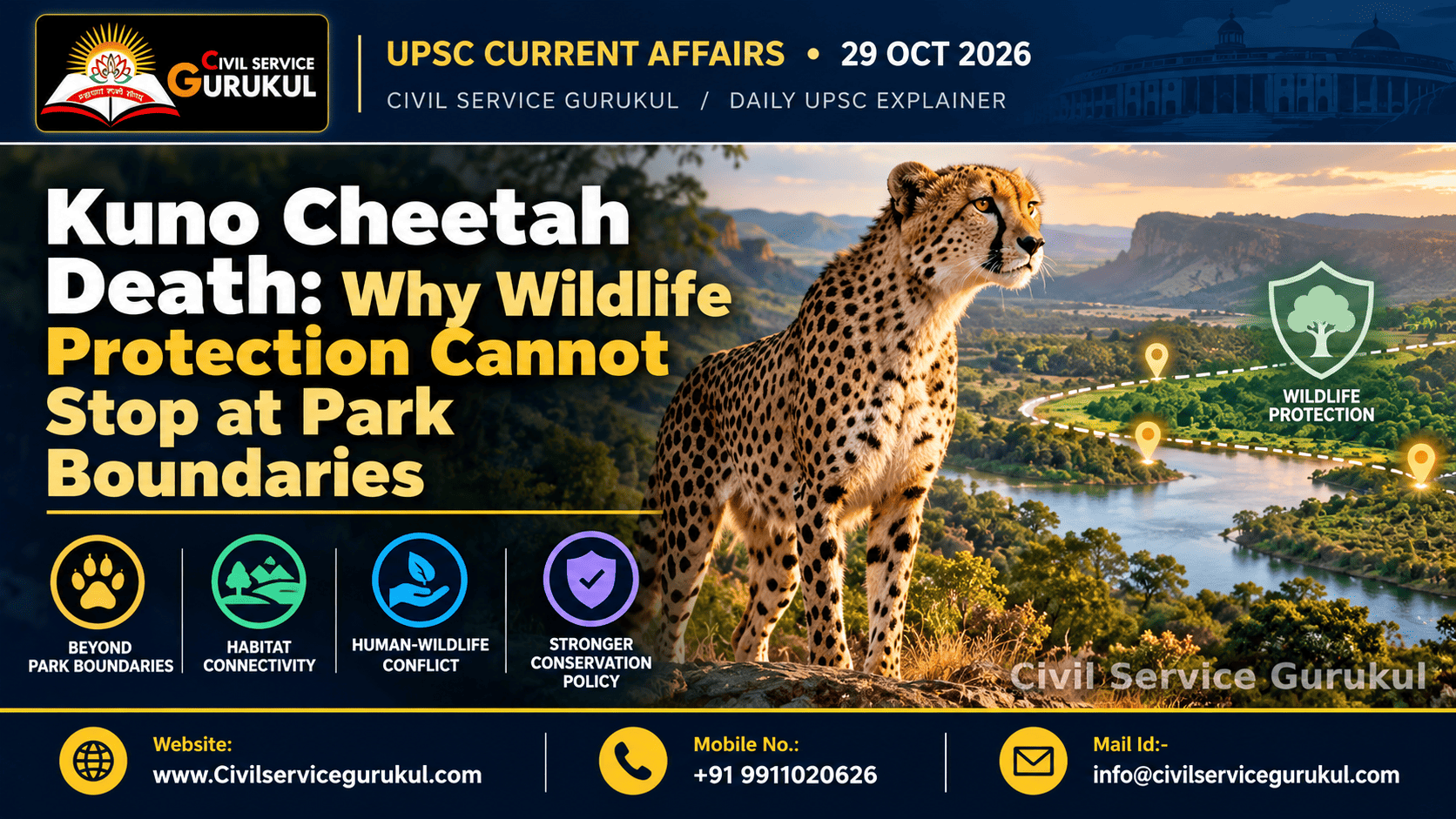
Kuno Cheetah Death 2026: What the Incident Reveals About Project Cheetah and Wildlife Conservation in India
A reported fatal injury to a young cheetah outside Kuno's protected area highlights the need for landscape conservation, wildlife security and community participation.
The Union Environment Ministry reportedly announced a high-level investigation on 28 October 2026 following the death of a 19-month-old male cheetah, KNG22.
According to the reported account, the cheetah was found injured outside Kuno's protected area on 25 October and died on 27 October.
The incident raises important questions about wildlife protection beyond national park boundaries.
GS Paper III: Biodiversity, Environmental Conservation, Wildlife Protection, Ecological Restoration.
GS Paper IV: Public Accountability, Institutional Responsibility, Ethical Governance.
Prelims: National Parks, Protected Areas, Project Cheetah, NTCA, WCCB, Wildlife Conservation.
Why Is the Kuno Cheetah Death in the News?
On 28 October 2026, the Union Environment Ministry reportedly announced a high-level investigation into the death of a young male cheetah identified as KNG22.
The animal was reportedly found injured outside Kuno's protected area on 25 October.
Five firearm pellets were recovered during treatment, according to the supplied account.
The cheetah died on 27 October 2026.
At the time of reporting, the identity and motive of any shooter had not been established.
Project Cheetah: India's Wildlife Reintroduction Initiative
India launched Project Cheetah in 2022 with the introduction of African cheetahs into Kuno National Park in Madhya Pradesh.
Cheetahs were declared extinct in India in 1952.
The reintroduction programme aims to establish a viable, free-ranging cheetah population.
It also seeks to support the restoration of ecological functions in grassland and open-forest landscapes.
Kuno National Park: Location and Conservation Importance
Kuno National Park is located in Madhya Pradesh.
It serves as a major site for India's cheetah reintroduction programme.
The surrounding landscape includes forest areas, villages, agricultural land and other human-used spaces.
This makes coordination beyond the national park important for free-ranging wildlife.
Reported KNG22 Incident: What Is Known?
| Date | Reported Development |
|---|---|
| 25 October 2026 | KNG22 was reportedly found injured outside Kuno's protected area. |
| During treatment | Five firearm pellets were reportedly recovered. |
| 27 October 2026 | The cheetah reportedly died. |
| 28 October 2026 | The Union Environment Ministry reportedly announced an investigation. |
The incident requires a careful distinction between reported injury findings and conclusions about responsibility.
The available account does not establish a confirmed motive or identify a perpetrator.
Why Wildlife Conservation Must Extend Beyond Park Boundaries
Wild animals do not necessarily remain within administrative boundaries.
Cheetahs may move beyond national parks while following prey and suitable habitat.
Their movement can bring them into territorial forests, revenue land and human-used landscapes.
Landscape-level conservation recognises that wildlife protection requires connected habitats and coordinated management across different jurisdictions.
Human-Wildlife Conflict and Community Participation
Conservation landscapes may include villages, livestock, roads and agricultural activities.
Wildlife presence can create concerns among nearby communities.
Effective conservation requires transparent communication, timely response to livestock losses and community engagement.
Important measures
- Village-level awareness programmes.
- Prompt compensation mechanisms.
- Rapid wildlife conflict-response teams.
- Clear public safety guidance.
- Community participation in monitoring.
Role and Limitations of Radio Collars in Wildlife Monitoring
Radio collars help conservation teams monitor the location and movement of animals.
They can support tracking and field coordination.
However, a radio collar cannot physically prevent attacks or eliminate every risk encountered by free-ranging wildlife.
Technology must be supported by field staff, veterinary response, anti-poaching measures and institutional coordination.
Wildlife Governance: NTCA, WCCB and State Authorities
The supplied account states that the Centre's investigation team included officials from the National Tiger Conservation Authority and the Wildlife Crime Control Bureau.
Madhya Pradesh also reportedly formed a state-level task force.
The episode illustrates the importance of coordination among park authorities, territorial forest divisions, police and district administration.
| Institution | Relevant Role |
|---|---|
| NTCA | Wildlife conservation governance and relevant Project Cheetah oversight functions. |
| WCCB | Coordination and intelligence relating to wildlife crime. |
| State forest authorities | Field protection, monitoring and local wildlife management. |
| District and police authorities | Public safety, law enforcement and inter-agency coordination. |
Major Challenges in Cheetah Conservation
- Protection outside notified park boundaries.
- Habitat connectivity and dispersal corridors.
- Availability of suitable prey.
- Human-wildlife conflict.
- Rapid veterinary response.
- Coordination across administrative jurisdictions.
- Community trust and compensation systems.
- Transparent ecological monitoring.
Conservation measures must balance wildlife protection with legitimate local livelihood needs.
How Should the Success of Project Cheetah Be Evaluated?
A single incident should not be used to declare the entire reintroduction programme a success or failure.
Evaluation requires evidence over time.
Important indicators
- Population survival.
- Successful reproduction.
- Genetic diversity.
- Habitat suitability.
- Prey availability.
- Movement and dispersal patterns.
- Human-wildlife conflict outcomes.
- Effectiveness of protection measures.
Transparent monitoring can help identify problems and improve management decisions.
Way Forward: Strengthening Landscape-Level Wildlife Protection
- Investigate the reported pellet injuries using forensic evidence.
- Publish a reasoned outcome after the investigation.
- Develop shared protocols among park, forest and police authorities.
- Improve rapid veterinary and conflict-response capacity.
- Strengthen livestock compensation and village-level outreach.
- Monitor dispersal corridors and wildlife movement.
- Publish ecological outcome indicators for programme evaluation.
UPSC Prelims Revision Capsule
| Concept | Important Fact |
|---|---|
| Project Cheetah | Launched in India in 2022. |
| Kuno National Park | Located in Madhya Pradesh. |
| Cheetah extinction in India | Declared extinct in 1952. |
| NTCA | National Tiger Conservation Authority. |
| WCCB | Wildlife Crime Control Bureau. |
| Landscape conservation | Wildlife management beyond individual protected-area boundaries. |
| Radio collar | Technology used to monitor animal movement and location. |
UPSC Prelims Practice MCQs
With reference to Project Cheetah, consider the following statements:
- Project Cheetah was launched in 2022.
- Kuno National Park is located in Madhya Pradesh.
- Cheetahs were declared extinct in India in 1952.
Which of the statements given above are correct?
(A) 1 and 2 only
(B) 2 and 3 only
(C) 1 and 3 only
(D) 1, 2 and 3
All three statements are correct. Project Cheetah began in 2022, Kuno is in Madhya Pradesh, and cheetahs were declared extinct in India in 1952.
Which of the following best explains the concept of landscape-level conservation?
(A) Wildlife protection limited to a single national park.
(B) Wildlife management across connected habitats and administrative boundaries.
(C) Protection through radio collars alone.
(D) Conservation without local community participation.
Landscape-level conservation recognises that wildlife movement and ecological processes extend beyond protected-area boundaries.
What is the primary role of radio collars in wildlife conservation?
(A) Physically preventing all attacks.
(B) Monitoring animal movement and location.
(C) Replacing forest protection staff.
(D) Eliminating human-wildlife conflict.
Radio collars help track animal movements but cannot prevent every dangerous encounter.
UPSC Mains Answer Writing Practice
"The success of wildlife reintroduction depends as much on governance outside protected areas as on habitat conditions inside them."
Discuss with reference to Project Cheetah and the challenges of landscape-level conservation in India.
Suggested Answer Approach:
- Introduce species reintroduction.
- Explain the need for connected habitats.
- Discuss human-wildlife conflict.
- Examine institutional coordination.
- Suggest community-centred conservation measures.
Model Answer Framework
Species reintroduction requires suitable habitat, prey availability, effective protection and long-term ecological monitoring.
Project Cheetah, launched in 2022, aims to establish a viable free-ranging cheetah population in India.
However, wild animals may move beyond notified protected areas into landscapes shared with local communities.
This creates challenges relating to habitat connectivity, wildlife security, human-wildlife conflict and institutional coordination.
India should strengthen landscape-level protection, community participation, compensation mechanisms, rapid response and transparent programme evaluation.
Frequently Asked Questions
What is Project Cheetah?
Project Cheetah is India's cheetah reintroduction programme launched in 2022.
Where is Kuno National Park located?
Kuno National Park is located in Madhya Pradesh.
Was the person responsible for KNG22's injuries identified?
The supplied October 2026 account did not establish a confirmed perpetrator or motive.
Why is landscape conservation important?
Wildlife often moves across administrative boundaries and requires coordinated protection across connected habitats.
Why is this topic relevant for UPSC?
It connects biodiversity, species reintroduction, protected areas, human-wildlife conflict and environmental governance.
Civil Service Gurukul — Key Takeaway
A viable wildlife population requires safe and connected landscapes, not merely a protected core area.
For UPSC, connect Project Cheetah with biodiversity conservation, institutional accountability, community participation and evidence-based wildlife management.
Prepare Environment and Ecology Current Affairs with Civil Service Gurukul
Civil Service Gurukul provides UPSC-focused current affairs analysis, Prelims revision, Mains answer-writing practice and syllabus-based study material.
Website: www.civilservicegurukul.com
Mobile: +91 9911020626
Email: info@civilservicegurukul.com
Educational note: This article is prepared for UPSC Civil Services Examination study using the supplied October 2026 wildlife incident summary. The identity and motive of any person responsible for the reported injuries were not established in that account.
Prepare with Mentors Who Cleared the Exam
Get personalized study plans, evaluated answer models, and test series access.