
Medicine Prices in India 2026: Supreme Court, NPPA & UPSC
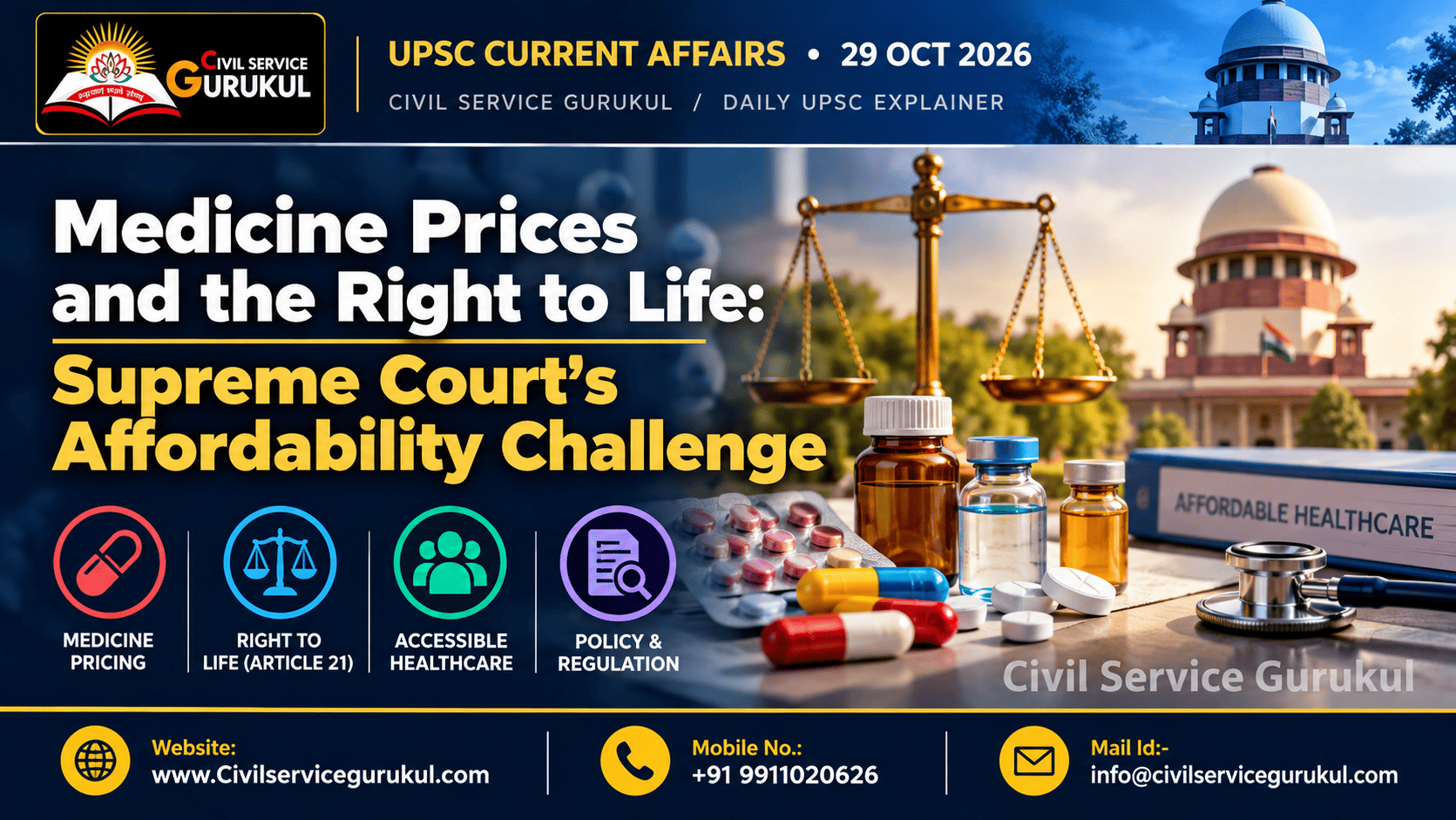
Supreme Court Questions High Medicine Prices in India: NPPA, Right to Health and Affordable Healthcare Explained
Understanding medicine price regulation, the constitutional right to life, pharmaceutical trade margins and the challenge of affordable treatment.
Supreme Court proceedings reported in late October 2026 raised concerns about large differences between medicine purchase prices and retail MRPs.
Separately, a reported regulatory intervention covered 137 non-scheduled anti-cancer medicines, with revised prices due to apply from 9 November 2026.
The issue highlights the importance of affordable medicines, transparent pricing, effective regulation and constitutional health-related obligations.
GS Paper II: Fundamental Rights, Health Governance, Social Justice, Government Policies and Judicial Accountability.
GS Paper III: Pharmaceutical Economy, Market Regulation, Competition and Innovation.
GS Paper IV: Ethics, Public Interest, Distributive Justice and Regulatory Accountability.
Prelims: NPPA, DPCO 2013, Article 21, Scheduled and Non-Scheduled Medicines.
Why Are Medicine Prices in India in the News?
During hearings reported in late October 2026, the Supreme Court questioned large differences between medicine purchase prices and retail MRPs.
The reported proceedings raised questions about accountability, transparency and the affordability of essential medical treatment.
The Centre and the National Pharmaceutical Pricing Authority were among the authorities whose accountability was discussed.
Importantly, judicial observations made during a hearing must not be treated as a final binding judgment.
Why Is Medicine Pricing a Public Policy Concern?
Medicines differ from ordinary consumer goods.
Patients may not be able to postpone treatment or freely substitute one medicine for another.
Clinical decisions often require professional medical advice.
Prices may also be affected by manufacturing costs, patents, imports, distribution and hospital procurement practices.
This creates a strong public interest in ensuring transparent and reasonable medicine pricing.
What Is the National Pharmaceutical Pricing Authority (NPPA)?
The National Pharmaceutical Pricing Authority is India's pharmaceutical price regulator.
It administers medicine price regulation under the Drugs (Prices Control) Order, 2013.
Its regulatory functions are important for monitoring pharmaceutical prices and implementing applicable price control measures.
NPPA stands for National Pharmaceutical Pricing Authority.
DPCO stands for Drugs (Prices Control) Order.
Drugs (Prices Control) Order, 2013: Key Features
The Drugs (Prices Control) Order, 2013 provides an important framework for regulating medicine prices in India.
The framework distinguishes between scheduled and non-scheduled formulations.
Scheduled formulations are subject to applicable ceiling-price regulation.
Non-scheduled medicines are regulated differently, with specified monitoring and intervention powers.
Scheduled vs Non-Scheduled Medicines
| Category | Regulatory Approach |
|---|---|
| Scheduled formulations | Subject to applicable ceiling-price regulation under the DPCO framework. |
| Non-scheduled formulations | Subject to different monitoring and intervention provisions. |
| Price monitoring | Helps identify potential concerns about pharmaceutical pricing. |
| Regulatory intervention | May be used where legally permitted and justified by the applicable framework. |
The distinction is important for understanding the limits and scope of medicine price regulation.
Medicine MRP, Procurement Prices and Trade Margins Explained
Medicine pricing can involve several stages between manufacturing and final patient purchase.
These may include the ex-factory price, price to stockist, distribution margins, hospital procurement price and retail MRP.
A trade margin generally refers to the difference between specified upstream and downstream prices, calculated under the applicable regulatory method.
An MRP is not necessarily the same as the manufacturer's factory-gate price.
Article 21 and the Constitutional Right to Health
Article 21 of the Constitution of India protects life and personal liberty.
Indian constitutional jurisprudence has recognised important obligations relating to health and access to medical care.
Medicine affordability therefore raises questions about the effective enjoyment of health-related constitutional protections.
At the same time, courts must consider the roles of legislatures, regulators and administrative institutions.
Reported 2026 Intervention Covering Anti-Cancer Medicines
The supplied October 2026 account reports a notified intervention covering 137 non-scheduled anti-cancer medicines.
Revised prices were reportedly due to apply from 9 November 2026.
This intervention should be distinguished from the Supreme Court's reported observations during hearings.
The two developments are related to medicine affordability but should not be treated as the same legal action.
Why Can Medicine Markets Fail to Deliver Affordable Prices?
Patients often have limited information about clinical alternatives, price structures and distribution margins.
Emergency treatment may further reduce the ability to compare prices.
Exclusive procurement arrangements or limited therapeutic substitutes can also weaken effective competition.
These conditions make medicine markets different from markets where consumers can easily delay purchases or compare equivalent products.
Affordable Medicines vs Pharmaceutical Innovation: Finding the Balance
Medicine price regulation can help improve access to essential treatment.
However, poorly calibrated price ceilings may affect product availability or incentives for genuine innovation.
A balanced policy must consider actual production costs, supply reliability, competition, research incentives and patient affordability.
Evidence-based regulation is preferable to relying only on ad hoc interventions.
Policy Reforms for Affordable Healthcare in India
- Greater transparency in medicine price structures.
- Effective NPPA monitoring and regulatory enforcement.
- Independent review of hospital billing practices.
- Quality-assured generic medicine access.
- Public procurement and pooled purchasing.
- Clear patient information about treatment costs.
- Evidence-based review of pricing interventions.
- Effective grievance-redress mechanisms.
Improved price transparency can complement competition, public procurement and quality assurance.
Way Forward: Balancing Access, Affordability and Availability
- Improve disclosure of medicine price and trade-margin information where legally feasible.
- Strengthen NPPA surveillance and product-level price monitoring.
- Expand access to quality-assured generic medicines.
- Use pooled public procurement to improve purchasing power.
- Review hospital billing practices and patient information systems.
- Evaluate actual patient savings and medicine availability after regulatory interventions.
- Maintain predictable rules that support both access and pharmaceutical innovation.
UPSC Prelims Revision Capsule
| Concept | Important Point |
|---|---|
| NPPA | National Pharmaceutical Pricing Authority. |
| DPCO 2013 | Drugs (Prices Control) Order, 2013. |
| Scheduled medicines | Subject to applicable ceiling-price regulation. |
| Non-scheduled medicines | Regulated under different monitoring and intervention provisions. |
| Article 21 | Protection of life and personal liberty; relevant to health-related constitutional jurisprudence. |
| Trade margin | Difference between specified upstream and downstream prices under the relevant calculation method. |
| MRP | Maximum Retail Price. |
UPSC Prelims Practice MCQs
With reference to medicine price regulation in India, consider the following statements:
- NPPA administers pharmaceutical price regulation under the DPCO framework.
- Scheduled and non-scheduled medicines are regulated in exactly the same manner.
- The DPCO 2013 is relevant to medicine price regulation.
Which of the statements given above are correct?
(A) 1 and 2 only
(B) 1 and 3 only
(C) 2 and 3 only
(D) 1, 2 and 3
Statements 1 and 3 are correct. Scheduled and non-scheduled medicines are not regulated identically.
Which constitutional provision is most directly relevant to India's jurisprudence on the right to life and access to healthcare?
(A) Article 14 only
(B) Article 21
(C) Article 32 only
(D) Article 368
Article 21 protects life and personal liberty and is relevant to constitutional jurisprudence on access to healthcare.
Which statement about medicine pricing is most accurate?
(A) MRP always equals the factory-gate price.
(B) Judicial observations during hearings are always final judgments.
(C) Medicine price regulation must consider affordability and availability.
(D) All medicines are completely outside price regulation.
Medicine pricing policy must balance patient affordability, reliable supply and appropriate incentives for innovation.
UPSC Mains Answer Writing Practice
"Affordable access to medicines is an essential dimension of effective public health governance."
Examine the role of medicine price regulation, constitutional health-related obligations and institutional accountability in ensuring affordable healthcare in India.
Suggested Answer Approach:
- Introduce the public-interest dimension of medicine affordability.
- Explain NPPA and the DPCO framework.
- Discuss Article 21 and health-related obligations.
- Analyse pricing transparency and market failures.
- Recommend balanced, evidence-based regulation.
Model Answer Framework
Affordable medicines are essential to meaningful access to healthcare. Patients often have limited ability to delay treatment or compare clinical alternatives.
The National Pharmaceutical Pricing Authority administers price regulation under the DPCO framework.
Article 21 and related constitutional jurisprudence provide an important foundation for examining access to medical care.
However, medicine pricing policy must also consider manufacturing costs, reliable supply, competition and innovation incentives.
A balanced approach should combine transparent pricing, effective regulation, quality-assured generics, public procurement and accountable healthcare institutions.
Frequently Asked Questions
What is NPPA?
NPPA is the National Pharmaceutical Pricing Authority, which administers medicine price regulation under the DPCO framework.
What is DPCO 2013?
The Drugs (Prices Control) Order, 2013 provides an important framework for pharmaceutical price regulation in India.
Did the Supreme Court impose a uniform cap on all medicines?
The reported October 2026 observations were part of court proceedings and should not be treated as a universal final order.
Why is Article 21 relevant?
Article 21 protects life and personal liberty and is relevant to health-related constitutional jurisprudence.
Why is this topic important for UPSC?
It connects constitutional rights, health governance, market regulation, public accountability and distributive justice.
Civil Service Gurukul — Key Takeaway
The public interest is best served when medicines are both affordable and reliably available.
For UPSC, connect medicine price regulation with Article 21, NPPA, DPCO 2013, market failures, health governance and distributive justice.
Prepare Polity, Governance and Public Health Current Affairs with Civil Service Gurukul
Civil Service Gurukul provides UPSC-focused current affairs analysis, Prelims revision, Mains answer-writing practice and syllabus-based study material.
Website: www.civilservicegurukul.com
Mobile: +91 9911020626
Email: info@civilservicegurukul.com
Educational note: This article is prepared for UPSC Civil Services Examination study using the supplied October 2026 medicine-pricing summary. The reported Supreme Court observations should not be mistaken for a final judgment.
Prepare with Mentors Who Cleared the Exam
Get personalized study plans, evaluated answer models, and test series access.