
PFAS in India: Why Water Treatment Plants Fail | UPSC 2026
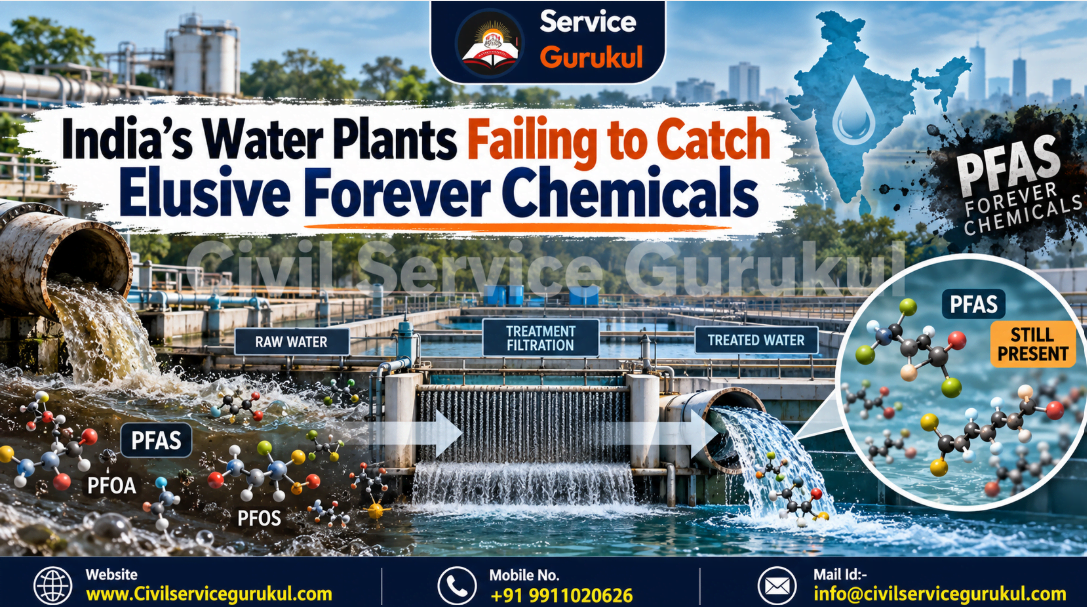
India's Water Treatment Plants Struggle to Remove Forever Chemicals: PFAS Pollution, Health Risks and Solutions
Emerging scientific evidence has raised serious concerns about per- and polyfluoroalkyl substances (PFAS), commonly known as forever chemicals, in India's water resources. These highly persistent synthetic chemicals can pass through many conventional drinking-water and wastewater treatment processes.
An IIT Madras study discussed in October 2026 reported that concentrations of eight targeted PFAS compounds were between 5% and 103% higher in treated water than in raw water at a studied treatment facility in Chennai.
The finding does not establish that every treatment plant increases PFAS concentrations. It demonstrates the importance of monitoring contaminants that conventional treatment systems are not specifically designed to remove.
The issue has brought attention to gaps in India's drinking-water standards, industrial pollution management and the need for advanced water purification technologies.
- Full form: Per- and polyfluoroalkyl substances.
- Common name: Forever chemicals.
- Chemical characteristic: Many contain highly stable carbon-fluorine bonds.
- Examples: PFOA, PFOS and PFHxS.
- Applications: Non-stick coatings, water-resistant materials and some firefighting foams.
- Main concern: Environmental persistence and potential health effects.
- Indian drinking-water standard: BIS IS 10500:2012.
- Regulatory gap: No individual PFAS-specific limits in the cited standard.
- Research focus: Chennai, Visakhapatnam and other Indian locations.
- Advanced removal: Activated carbon, ion exchange and membrane filtration.
1. Why in the News?
Scientific research has highlighted the difficulty of detecting and removing PFAS from India's water resources.
In October 2026, discussions surrounding studies from Chennai and Visakhapatnam drew attention to the limitations of traditional water treatment and the possible presence of PFAS in water entering urban treatment systems.
1.1 IIT Madras Study
Research involving water samples from Chennai reported PFAS contamination in different water environments.
At one studied treatment plant, concentrations of all eight targeted PFAS were reported to be higher in treated water than in untreated incoming water.
The reported increases ranged from approximately 5% to 103%.
1.2 Why Could Concentrations Increase?
One scientific explanation is the transformation of PFAS precursor compounds into more stable, measurable PFAS during treatment.
Other factors, including sampling variability and chemical behaviour, must also be evaluated when interpreting individual measurements.
1.3 Regulatory Concerns
India's drinking-water specification IS 10500:2012 does not prescribe individual numerical limits for PFAS compounds.
This creates an important challenge for systematic testing, reporting and targeted regulatory action.
2. What Are Forever Chemicals?
Per- and polyfluoroalkyl substances are a large group of manufactured chemicals characterised by fluorinated carbon structures.
Many PFAS are exceptionally persistent because of strong carbon-fluorine bonds.
2.1 Why Are They Called Forever Chemicals?
The term forever chemicals refers to their resistance to natural environmental degradation.
Many PFAS persist for long periods in soil, water and other environmental media.
However, persistence and bioaccumulation vary across different PFAS compounds.
2.2 Important PFAS Examples
- PFOA: Perfluorooctanoic acid.
- PFOS: Perfluorooctane sulfonic acid.
- PFHxS: Perfluorohexane sulfonic acid.
- PFNA: Perfluorononanoic acid.
- PFBS: Perfluorobutane sulfonic acid.
2.3 Important Chemical Properties
- High environmental persistence.
- Resistance to many degradation processes.
- Water and oil repellency in various applications.
- Potential mobility through soil and water.
- Different bioaccumulation behaviour across compounds.
3. Major Sources of PFAS Pollution
PFAS have been used in industrial and consumer applications for decades.
3.1 Industrial Manufacturing
PFAS may be released during chemical production and manufacturing processes involving fluorinated materials.
3.2 Firefighting Foams
Certain aqueous film-forming firefighting foams have historically contained PFAS.
Contamination can occur around some airports, industrial installations and firefighting training areas.
3.3 Consumer Products
Some fluorinated substances have been used in:
- Non-stick cookware coatings.
- Water-resistant textiles.
- Stain-resistant materials.
- Grease-resistant packaging.
- Selected industrial coatings.
3.4 Waste Disposal Sites
Landfills and waste-processing facilities may contribute to PFAS contamination through leachate and wastewater.
3.5 Sewage and Industrial Effluents
PFAS released into wastewater systems may pass through conventional treatment processes and enter rivers or coastal waters.
3.6 Contaminated Groundwater
PFAS may migrate through soil and enter aquifers, potentially affecting groundwater used for drinking and irrigation.
4. Recent Research Findings in India
4.1 Chennai
Studies discussed in 2026 reported PFAS in several water environments in Chennai.
An IIT Madras investigation of fourteen water samples reported particularly concerning concentrations in groundwater near waste disposal locations.
At a studied water treatment facility, concentrations of eight targeted PFAS increased between raw water and treated water.
The reported increase of 5% to 103% illustrates how conventional treatment may not effectively eliminate certain contaminants.
4.2 Visakhapatnam
Research on coastal and wastewater environments near Visakhapatnam has identified several PFAS compounds.
One study examined 77 targeted PFAS and reported detection of 38 compounds in the sampled environment.
The findings raised concerns about wastewater contributions to coastal contamination.
4.3 Wider Indian Evidence
Previous investigations have identified PFAS in different environmental media across India, demonstrating the need for broader monitoring.
4.4 Limitations of the Evidence
These findings do not establish that all Indian drinking-water systems contain unsafe PFAS levels.
Reliable national conclusions require representative sampling, validated laboratory methods and comparisons with compound-specific health standards.
5. Why Do Conventional Water Treatment Plants Struggle?
Conventional treatment systems are mainly designed to remove suspended particles, improve clarity and control microbial contamination.
5.1 Coagulation and Flocculation
These processes help suspended materials aggregate into particles that can be separated from water.
Many dissolved PFAS are not removed efficiently by this approach.
5.2 Sedimentation
Sedimentation removes settleable particles, but many PFAS remain dissolved in water.
5.3 Sand Filtration
Conventional sand filters are useful for particles, but are generally not specifically designed to capture dissolved PFAS.
5.4 Chlorination
Chlorination is mainly used for disinfection.
It cannot be relied upon for effective destruction of persistent PFAS compounds.
5.5 Biological Treatment
Many PFAS resist conventional biological breakdown due to their chemical stability.
5.6 Transformation of Precursors
Some PFAS precursor chemicals can transform into persistent terminal PFAS during environmental or treatment processes.
This may result in higher measured concentrations of particular compounds.
6. Health and Ecological Risks of PFAS
The health effects of PFAS vary by compound, exposure level, duration and individual circumstances.
Research has associated exposure to certain PFAS with several adverse health outcomes.
6.1 Immune System
Exposure to some PFAS has been associated with reduced antibody responses to certain vaccines.
6.2 Cholesterol
Some studies have found associations between PFAS exposure and increased cholesterol levels.
6.3 Liver Effects
Certain PFAS exposures have been associated with changes in liver enzymes and other indicators of liver function.
6.4 Reproductive and Developmental Effects
Research has examined associations with pregnancy outcomes and developmental effects, including lower birth weight for some exposures.
6.5 Cancer Risk
Evidence concerning some well-studied PFAS, including PFOA, has raised concerns about cancer risk.
It is not scientifically accurate to assume that every PFAS has the same carcinogenic potential.
6.6 Ecological Consequences
- Contamination of aquatic ecosystems.
- Accumulation of certain PFAS in organisms.
- Exposure through aquatic food webs.
- Long-term environmental persistence.
- Potential effects on wildlife health.
7. Regulatory Framework in India
7.1 Bureau of Indian Standards
The Bureau of Indian Standards publishes IS 10500, the Indian drinking-water specification.
IS 10500:2012 includes requirements for various physical, chemical and microbiological water-quality parameters.
7.2 PFAS Regulatory Gap
The cited standard does not establish individual numerical limits for PFAS such as PFOA and PFOS.
This limits the availability of a dedicated national benchmark for routine PFAS compliance assessment.
7.3 Central Pollution Control Board
The Central Pollution Control Board performs important pollution monitoring and regulatory functions under India's environmental framework.
Strengthening PFAS surveillance may require coordination among pollution control boards, water authorities and accredited laboratories.
7.4 Water (Prevention and Control of Pollution) Act, 1974
The Water Act provides an important legal framework for the prevention and control of water pollution in India.
7.5 Environment (Protection) Act, 1986
The Environment (Protection) Act provides broad powers for environmental regulation and pollution-control measures.
7.6 Jal Jeevan Mission
Jal Jeevan Mission focuses on improving access to safe and adequate drinking water for rural households.
Monitoring emerging pollutants is relevant to the broader objective of reliable drinking-water quality.
7.7 National Monitoring Requirements
A stronger PFAS framework would require clear sampling protocols, validated detection methods, appropriate standards and reporting arrangements.
8. International Regulation of PFAS
8.1 Stockholm Convention
The Stockholm Convention is a global treaty addressing persistent organic pollutants.
Certain PFAS are covered by its international control provisions.
Relevant examples include PFOS, PFOA and PFHxS, subject to their respective listings and exemptions.
8.2 United States
The United States Environmental Protection Agency has developed drinking-water regulations and treatment guidance for selected PFAS.
Regulatory requirements and implementation timelines may change, so current official rules should be consulted.
8.3 European Union
The European Union has adopted controls addressing selected PFAS and drinking-water quality.
8.4 International Scientific Cooperation
Countries can cooperate on analytical methods, pollution monitoring, safer alternatives and advanced treatment research.
9. Advanced Technologies for PFAS Removal
Specialised technologies can substantially reduce many PFAS concentrations in drinking water.
9.1 Granular Activated Carbon
Granular activated carbon removes contaminants through adsorption onto porous carbon surfaces.
It can be effective for many longer-chain PFAS, but performance depends on water chemistry, operating conditions and filter replacement.
9.2 Ion Exchange Resins
Certain ion-exchange resins can capture negatively charged PFAS compounds.
Their effectiveness depends on compound characteristics, competing substances and resin management.
9.3 Reverse Osmosis
Reverse osmosis uses pressure-driven membranes to separate water from many dissolved contaminants.
Appropriately designed RO systems can achieve substantial removal of many PFAS.
9.4 Nanofiltration
Nanofiltration membranes can reject certain dissolved compounds, including selected PFAS, depending on membrane properties and water quality.
9.5 Emerging Destruction Technologies
Researchers are investigating technologies intended to destroy PFAS, including selected electrochemical, plasma-based and other advanced processes.
Many emerging methods require further evaluation of energy consumption, treatment effectiveness, byproducts and commercial scalability.
9.6 PFAS Waste Disposal
Removing PFAS from water does not always mean destroying them.
Contaminants captured in spent carbon, resin or membrane reject water require suitable management.
| Technology | Basic Principle | Key Limitation |
|---|---|---|
| Granular activated carbon | Adsorption on porous carbon. | Limited capacity; less effective for some short-chain PFAS. |
| Ion exchange | Selective binding of dissolved ions. | Resin management and competing contaminants. |
| Reverse osmosis | Membrane-based separation. | Energy, membrane maintenance and contaminated reject water. |
| Nanofiltration | Pressure-driven membrane separation. | Removal varies by PFAS and membrane characteristics. |
| Emerging destruction methods | Chemical or physical breakdown. | Scale, cost and byproduct verification. |
10. Challenges in Managing PFAS Pollution
10.1 Expensive Monitoring
PFAS measurement often requires specialised analytical instruments, trained personnel and quality-control procedures.
10.2 Numerous Compounds
PFAS represent a large chemical class with varying properties, complicating testing and regulation.
10.3 Treatment Costs
Advanced purification can require substantial capital expenditure and recurring operating costs.
10.4 Industrial Discharges
Inadequate controls on PFAS-containing industrial waste can undermine water-treatment efforts.
10.5 Contaminated Residues
Captured PFAS may remain concentrated in used filtration materials or waste streams.
10.6 Limited Public Awareness
Many communities may be unfamiliar with the significance of emerging dissolved chemical contaminants.
10.7 Lack of Comprehensive Data
More representative monitoring is necessary to estimate the scale of PFAS contamination across India's different water sources.
11. Why PFAS Pollution Matters for India
11.1 Drinking-Water Security
Clean drinking water is essential to public health and human development.
Emerging contaminants create additional water-quality challenges beyond conventional microbiological pollution.
11.2 Industrial Development
Sustainable industrialisation requires adequate management of chemical manufacturing and industrial effluents.
11.3 Urban Water Infrastructure
Urban treatment facilities may need improved monitoring and targeted upgrades where PFAS contamination is established.
11.4 Groundwater Protection
Groundwater contamination can be difficult and costly to remediate, increasing the importance of pollution prevention.
11.5 Sustainable Development Goals
Addressing PFAS contamination supports wider objectives concerning health, safe water and sustainable consumption.
- SDG 3: Good Health and Well-being.
- SDG 6: Clean Water and Sanitation.
- SDG 12: Responsible Consumption and Production.
- SDG 14: Life Below Water.
11.6 Environmental Justice
Communities near pollution sources may face unequal exposure risks, highlighting the importance of environmental justice.
12. Way Forward for India
- National Monitoring: Develop representative PFAS monitoring programmes for drinking water, surface water and groundwater.
- Drinking-Water Standards: Evaluate science-based, compound-specific PFAS standards and testing rules.
- Industrial Source Control: Improve reporting and management of PFAS-containing discharges and waste.
- Laboratory Capacity: Strengthen accredited analytical facilities and validated sampling methods.
- Targeted Treatment: Apply advanced filtration where contamination measurements justify it.
- Research and Innovation: Support Indian research into affordable detection, removal and destruction.
- Waste Management: Establish suitable approaches for PFAS-contaminated residuals from treatment.
- Polluter-Pays Principle: Consider appropriate accountability mechanisms for contamination attributable to identifiable sources.
- Public Communication: Provide understandable, evidence-based information on local water quality.
13. UPSC Examination Relevance
| UPSC Paper | Relevant Topics |
|---|---|
| GS Paper II | Public health, drinking-water governance, institutional responsibilities and environmental policy. |
| GS Paper III | Pollution, environmental degradation, emerging contaminants, water treatment and scientific innovation. |
| UPSC Prelims | PFAS chemistry, sources, BIS, CPCB, Stockholm Convention and treatment technologies. |
| Essay | Water security, sustainable development, environmental justice and industrial pollution. |
| Environment Optional Themes | Persistent pollutants, toxicology, environmental monitoring and remediation. |
- PFAS stands for per- and polyfluoroalkyl substances.
- PFAS are commonly called forever chemicals.
- Many PFAS contain stable carbon-fluorine bonds.
- Important examples include PFOA and PFOS.
- PFAS may be found in industrial emissions and wastewater.
- Conventional treatment does not reliably remove all PFAS.
- IIT Madras research raised concerns about PFAS in Chennai water samples.
- IS 10500:2012 is India's drinking-water specification.
- Granular activated carbon, ion exchange and RO can reduce many PFAS.
- The Stockholm Convention controls certain persistent organic pollutants, including selected PFAS.
14. UPSC Prelims Practice MCQs
Question 1
The term forever chemicals is commonly associated with:
(a) Chlorofluorocarbons only
(b) Per- and polyfluoroalkyl substances
(c) Carbon dioxide
(d) Calcium carbonate
PFAS are commonly described as forever chemicals because many persist for long periods in the environment.
Question 2
The high persistence of many PFAS is associated with:
(a) Carbon-fluorine bonds
(b) Sodium-chlorine bonds
(c) Weak hydrogen bonding only
(d) Metallic bonding
Strong carbon-fluorine bonds contribute to the stability of many PFAS.
Question 3
Which of the following technologies can help remove PFAS from drinking water?
- Granular activated carbon
- Ion exchange
- Reverse osmosis
Select the correct answer.
(a) 1 only
(b) 1 and 2 only
(c) 2 and 3 only
(d) 1, 2 and 3
All three technologies can remove many PFAS when appropriately designed and maintained.
Question 4
IS 10500:2012 primarily concerns:
(a) Drinking-water specifications
(b) Vehicle emission standards
(c) Food packaging labels
(d) Industrial electricity tariffs
IS 10500 is the Bureau of Indian Standards specification for drinking water.
Question 5
The Stockholm Convention mainly addresses:
(a) International maritime boundaries
(b) Persistent organic pollutants
(c) Nuclear disarmament
(d) Ozone-layer monitoring
The Stockholm Convention is a treaty addressing persistent organic pollutants.
Question 6
Consider the following statements about PFAS:
- All PFAS are equally toxic.
- Some PFAS can be persistent in groundwater.
- Conventional chlorination reliably destroys all PFAS.
Which statements are correct?
(a) 1 only
(b) 2 only
(c) 1 and 3 only
(d) 1, 2 and 3
PFAS differ in toxicological characteristics. Some persist in groundwater, and conventional chlorination cannot be relied on for complete destruction.
Question 7
Why may measured concentrations of certain PFAS increase after conventional treatment?
(a) Transformation of precursor compounds
(b) Complete destruction of all pollutants
(c) Removal of all dissolved chemicals
(d) Elimination of all organic substances
Some precursors can transform into persistent, measurable PFAS. This is one possible explanation for observed increases.
15. UPSC Mains Practice Questions
"Emerging contaminants such as PFAS present a new challenge for conventional water-treatment infrastructure in India."
Discuss the sources and environmental impacts of PFAS. Examine the limitations of conventional treatment technologies and suggest suitable policy responses.
15 Marks | 250 WordsSuggested Answer Framework
Introduction:
Define PFAS and explain their environmental persistence.
Body — Sources:
- Industrial production.
- Firefighting foams.
- Waste disposal sites.
- Consumer products.
- Wastewater discharges.
Body — Challenges:
- Resistance to conventional treatment.
- Expensive laboratory testing.
- Absence of specific drinking-water limits.
- Persistent contamination in water systems.
- Management of contaminated treatment residues.
Body — Solutions:
- Targeted PFAS monitoring.
- Source-control regulations.
- Activated carbon and ion exchange.
- Membrane filtration.
- Research and laboratory capacity.
Conclusion:
India needs a preventive, science-based and integrated approach to emerging chemical pollutants that combines monitoring, regulation and appropriate technology.
Explain the limitations of conventional drinking-water treatment in addressing emerging contaminants. How can scientific research and regulatory reform improve water security in India?
10 Marks | 150 Words16. Conclusion
PFAS contamination represents an increasingly important environmental and public-health challenge because many compounds are persistent, mobile and difficult to remove using conventional treatment.
The Chennai research discussed in October 2026 demonstrates why treatment performance must be assessed for specific emerging contaminants rather than inferred from conventional water-quality indicators alone.
The issue also exposes regulatory and institutional questions concerning drinking-water standards, industrial pollution, laboratory capacity and treatment investment.
The long-term response should combine pollution prevention, credible monitoring, scientifically appropriate limits, cost-effective treatment and safe management of contaminated waste.
For UPSC aspirants, PFAS pollution offers a valuable case study connecting chemistry, environmental degradation, public health, regulatory governance and sustainable development.
References and Further Reading
- Environmental Pollution Research: Addressing PFAS Contamination in India, 2026. Read Research Article
- Bureau of Indian Standards: IS 10500 Drinking-Water Testing Guidance. Read BIS Document
- US Environmental Protection Agency: PFAS Drinking-Water Treatment Technologies. Read Technical Guidance
- US Environmental Protection Agency: PFAS Water Research. Read Research Overview
- India Water Portal: Forever Chemicals in India's Water Resources. Read India-Focused Overview
Prepare with Mentors Who Cleared the Exam
Get personalized study plans, evaluated answer models, and test series access.