
UPI Transaction Fee Rollout Postponed Beyond Deepavali: Why Traders Opposed the 0.4% Merchant Charge
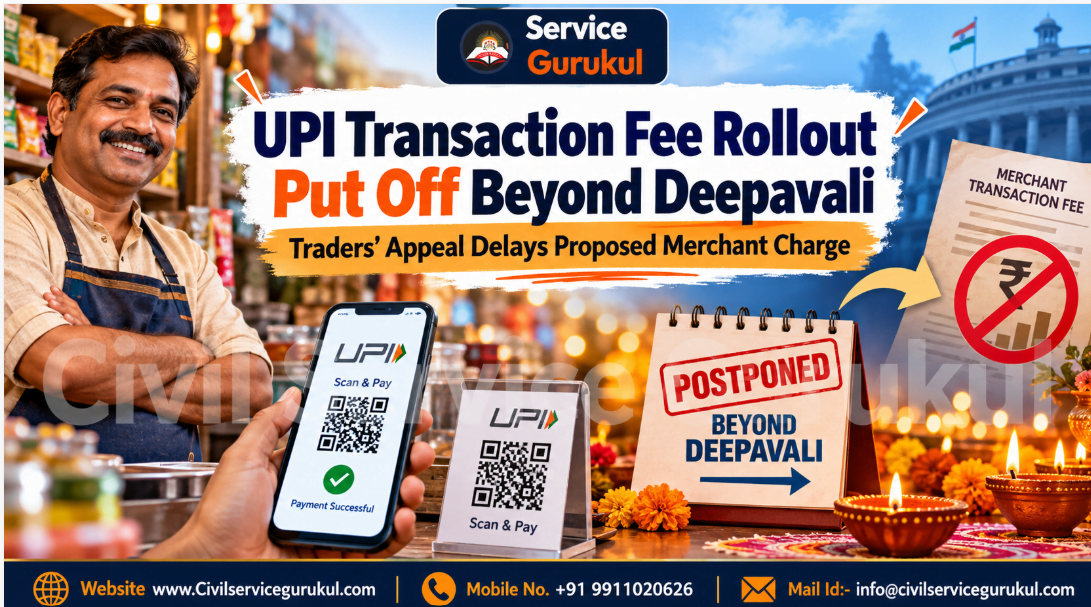
UPI Transaction Fee Rollout Put Off Beyond Deepavali: Traders' Appeal, Proposed 0.4% MDR and Impact on India's Digital Economy
The National Payments Corporation of India (NPCI) has postponed the proposed introduction of a Merchant Discount Rate (MDR) on select Unified Payments Interface (UPI) merchant transactions until after Deepavali 2026. The decision followed objections and representations from traders' associations concerned about additional business costs during the festive shopping season.
Under the proposed framework, a merchant fee of 0.4% was to apply to eligible person-to-merchant UPI transactions exceeding Rs. 2,000, subject to a maximum charge of Rs. 300 per transaction.
The revised system had been scheduled to become operational on 15 October 2026. However, following consultations, implementation was deferred. A new effective date had not been announced as of 16 October 2026.
The development has generated an important policy debate concerning the affordability of digital payments, financial inclusion, the interests of small businesses, and sustainable financing of India's expanding payment infrastructure.
- Institution: National Payments Corporation of India (NPCI).
- Payment system: Unified Payments Interface (UPI).
- Proposed fee: Merchant Discount Rate (MDR).
- Proposed rate: 0.4% for specified eligible payments.
- Transaction threshold: Above Rs. 2,000.
- Proposed maximum fee: Rs. 300 per transaction.
- Original implementation date: 15 October 2026.
- Postponement announced: 13 October 2026.
- Revised date: Yet to be announced as of 16 October 2026.
- Major concern: Merchant costs during the festive retail season.
1. Why in the News?
On 13 October 2026, NPCI announced the postponement of the proposed Merchant Discount Rate on select UPI person-to-merchant transactions until after the Deepavali festival.
The decision came shortly before the proposed implementation date of 15 October 2026.
Industry representatives had expressed concern that introducing additional payment-processing costs during the festive retail season could affect small businesses, purchasing behaviour and transaction-system readiness.
The Retailers Association of India welcomed the deferment, describing it as temporary relief for the retail sector.
NPCI indicated that the new implementation date would be announced separately.
2. What Is Unified Payments Interface (UPI)?
Unified Payments Interface is a real-time digital payment system developed by the National Payments Corporation of India.
It enables users to transfer money between bank accounts and make payments to merchants using supported mobile applications.
2.1 Major Features of UPI
- Real-time transfer of funds.
- Round-the-clock availability.
- Interoperability among participating banks.
- Payments through mobile applications.
- QR-code-based merchant payments.
- Use of UPI IDs and other supported payment identifiers.
- Digital transactions without exchanging physical cash.
2.2 Who Operates UPI?
NPCI operates the UPI system as part of India's retail digital payments infrastructure.
Participating banks, payment service providers and applications facilitate transactions through the UPI network.
2.3 Role of the Reserve Bank of India
The Reserve Bank of India is the country's central bank and regulates payment systems under the applicable legal framework.
NPCI functions within India's regulated payment ecosystem.
3. What Is Merchant Discount Rate (MDR)?
Merchant Discount Rate refers to a payment acceptance charge imposed on merchants for processing eligible digital payment transactions.
Depending on the payment arrangement, the fee may support participating banks, payment processors and other payment infrastructure service providers.
3.1 How Does MDR Work?
Suppose a merchant receives a payment of Rs. 5,000.
Under a hypothetical MDR rate of 0.4%, the charge would be:
Rs. 5,000 x 0.4% = Rs. 20
Thus, the merchant would incur an MDR cost of Rs. 20, before considering any other applicable contractual or statutory adjustments.
3.2 Who Pays the MDR?
MDR is generally a merchant-side payment acceptance charge.
The proposed UPI MDR framework should not be interpreted as automatically authorising a direct charge on consumers.
3.3 MDR vs UPI Transfer Fee
A merchant discount rate is different from a fee charged directly to an individual for sending money to another person.
4. Proposed UPI Merchant Fee Structure
The September 2026 proposal provided for introducing MDR on selected merchant UPI payments.
| Transaction Category | Proposed Treatment |
|---|---|
| Person-to-person UPI transfer | Outside the proposed merchant MDR framework. |
| Eligible merchant payment of Rs. 2,000 or less | No proposed MDR. |
| Eligible merchant payment above Rs. 2,000 | Proposed MDR of 0.4%. |
| Maximum MDR per eligible transaction | Rs. 300. |
| Small merchants with monthly UPI transactions up to Rs. 1 lakh | Proposed exemption, subject to final framework. |
| Original rollout | 15 October 2026. |
| Status on 16 October 2026 | Implementation deferred; revised date not announced. |
4.1 Illustrative Fee Calculation
| Eligible Payment | 0.4% Calculation | Illustrative MDR |
|---|---|---|
| Rs. 1,500 | Below threshold | Rs. 0 |
| Rs. 2,000 | At exempt threshold | Rs. 0 |
| Rs. 5,000 | 5,000 x 0.004 | Rs. 20 |
| Rs. 10,000 | 10,000 x 0.004 | Rs. 40 |
| Rs. 50,000 | 50,000 x 0.004 | Rs. 200 |
| Rs. 1,00,000 | 400 before cap | Rs. 300 |
These are examples based on the reported proposal. They are not charges currently being collected under the deferred framework.
5. Why Was the Fee Postponed Beyond Deepavali?
5.1 Festive Retail Demand
Deepavali is an important shopping season in India. Retail demand generally increases across sectors such as clothing, consumer products, electronics and household goods.
Introducing additional payment costs during this period could complicate business operations.
5.2 Appeals from Traders
Retail associations and trade bodies requested reconsideration or postponement of the proposed fee structure.
5.3 Pressure on Merchant Margins
Businesses operating with narrow profit margins may be sensitive to even relatively small transaction charges.
5.4 Operational Readiness
Banks, merchants and payment service providers would need to configure systems for classifying eligible transactions, applying exemptions and reconciling charges.
5.5 Consumer Behaviour
Retailers expressed concerns that additional merchant expenses could influence pricing practices or increase the attractiveness of cash payments.
6. Role of Traders' Associations
Organized retail and trading associations raised concerns regarding the timing and potential effects of the proposal.
6.1 Retailers Association of India
The Retailers Association of India submitted a representation seeking reconsideration of the proposed MDR.
On 13 October 2026, the association welcomed the deferment until after Diwali, while stating that broader issues concerning the charging framework still required attention.
6.2 Confederation of All India Traders
Trade organizations, including the Confederation of All India Traders, were among the stakeholders concerned about additional merchant costs.
6.3 Concerns of Smaller Businesses
- Additional payment acceptance costs.
- Possible reduction in merchant margins.
- Complexity in transaction classification.
- Uncertainty about fee exemptions.
- Potential impact on pricing and cash usage.
6.4 Importance of Stakeholder Consultation
The episode illustrates the role of stakeholder consultation in economic policymaking.
Payment reforms may require coordination among regulators, network operators, commercial banks, payment firms, consumers and merchants.
7. Background of India's Zero-MDR UPI Policy
7.1 Promotion of Digital Payments
India has promoted digital payment adoption as part of its financial inclusion and digital economy objectives.
7.2 Zero-MDR Framework
The zero-MDR policy for specified payment modes, including UPI, took effect from January 2020 following changes in the statutory framework.
The purpose was to encourage merchants to accept digital payments without bearing direct MDR charges on covered transactions.
7.3 Why Was Zero MDR Important?
- It reduced payment acceptance costs.
- It encouraged wider use of QR codes.
- It helped small businesses adopt digital payments.
- It supported cashless transactions.
- It increased familiarity with digital payment infrastructure.
7.4 Sustainability Debate
As UPI transaction activity expanded, concerns arose regarding the cost of operating, upgrading and securing payment infrastructure.
Banks and payment-service companies require investments in technology, fraud prevention, customer support and transaction processing.
7.5 Policy Trade-Off
Policymakers therefore face a balance between maintaining affordable digital payments and ensuring that service providers have sustainable funding arrangements.
8. Economic Impact of the Postponement
8.1 Temporary Relief for Retailers
The deferment allows affected merchants to continue accepting eligible UPI payments without the proposed new MDR being introduced during the festive period.
8.2 Support for Festive Consumption
Avoiding an immediate new payment cost may help reduce uncertainty during a major retail shopping season.
8.3 Limited Immediate Pricing Pressure
Merchants would not need to respond immediately to the proposed fee through changes in product pricing.
8.4 Digital Payment Adoption
Continued affordability may support businesses and customers who prefer digital transactions.
8.5 Impact on Informal Businesses
Small retailers and informal-sector businesses can benefit from low-cost payment acceptance, although the actual impact depends on their transaction size and eligibility.
8.6 Limits of the Deferment
The postponement does not resolve the long-term question of how India's payment infrastructure should be funded.
9. Impact on Banks and Fintech Companies
9.1 Payment Infrastructure Costs
Payment systems require expenditure on servers, secure network infrastructure, processing capacity, compliance and customer support.
9.2 Cybersecurity
Increasing digital transactions require continuous investment in cybersecurity, fraud monitoring and resilient payment systems.
9.3 Revenue Sustainability
MDR is one possible mechanism for providing transaction-related revenue to payment ecosystem participants.
9.4 Fintech Innovation
Sustainable revenue models may support future investment in payment technologies, consumer protection and new financial services.
9.5 Short-Term Effect of Delay
The postponement delays any potential revenue arising from the proposed MDR framework.
The ultimate financial impact depends on the final rules, exemptions, implementation date and commercial arrangements.
10. UPI, Financial Inclusion and Digital India
10.1 Financial Inclusion
Digital payments can help individuals and businesses participate more actively in the formal financial system.
10.2 Empowering Small Merchants
QR-code-based acceptance allows many merchants to receive payments without traditional card-terminal infrastructure.
10.3 Digital Transaction Records
Digital payment records can improve transaction tracking, subject to financial literacy, privacy and data protection.
10.4 Cashless Economy
Widespread digital payment use can reduce dependence on physical cash for certain transactions.
10.5 Digital Public Infrastructure
UPI is an important component of India's digital public infrastructure ecosystem.
Its interoperability supports transactions across participating banks and payment applications.
11. Arguments For and Against UPI MDR
| Arguments Supporting MDR | Arguments Opposing MDR |
|---|---|
| May provide revenue for payment infrastructure. | May increase merchant operating costs. |
| Can support cybersecurity and system upgrades. | May discourage adoption among price-sensitive merchants. |
| May reduce dependence on public financial support. | Could indirectly affect consumer prices. |
| Can help payment firms develop sustainable business models. | May encourage some businesses to favour cash. |
| A targeted framework may preserve small-payment exemptions. | Eligibility and classification rules may be difficult to implement. |
Neither a fully free system nor a fee-based system is automatically optimal in every circumstance.
Policy design must consider merchant affordability, consumer interests, innovation incentives and system-wide costs.
12. Major Policy Challenges
12.1 Balancing Affordability and Sustainability
Payment infrastructure must remain affordable while supporting operational and security expenses.
12.2 Protecting Small Traders
The final system should avoid disproportionate burdens on small and low-margin businesses.
12.3 Clear Eligibility Rules
Banks and merchants need precise rules concerning transaction thresholds, merchant classifications and exemptions.
12.4 Consumer Protection
Regulations and disclosure requirements should minimise misleading charges and unexpected payment costs.
12.5 Technology Readiness
Payment platforms must be able to identify transactions, calculate charges and reconcile merchant accounts.
12.6 Maintaining Public Confidence
Frequent or unclear policy changes may create confusion among consumers and businesses.
12.7 Fraud and Cyber Risks
Higher transaction activity makes fraud prevention, authentication and payment infrastructure resilience increasingly important.
13. Way Forward
- Stakeholder Consultation: Continue dialogue among NPCI, regulators, banks, fintech firms and traders' associations.
- Transparent Rules: Publish clear eligibility, exemption and fee-calculation requirements before implementation.
- Small-Merchant Protection: Ensure that any final framework adequately considers the needs of smaller businesses.
- Digital Infrastructure Funding: Evaluate multiple sustainable financing mechanisms for the payment ecosystem.
- Consumer Awareness: Explain the distinction between merchant fees and personal UPI transfers.
- Fraud Prevention: Strengthen cybersecurity, monitoring and grievance redressal.
- Implementation Readiness: Allow sufficient time for banks and payment providers to test the final charging system.
- Evidence-Based Evaluation: Assess the impact on merchant adoption, payment volumes and competition before making long-term changes.
14. UPSC Civil Services Examination Relevance
| UPSC Paper | Relevant Topics |
|---|---|
| GS Paper II | Government policies, institutional regulation, stakeholder consultation and governance. |
| GS Paper III | Digital economy, payment systems, financial inclusion, infrastructure and economic development. |
| UPSC Prelims | NPCI, UPI, MDR, RBI, P2P and P2M transactions and proposed fee exemptions. |
| Essay | Digital India, financial inclusion, technology and inclusive economic growth. |
| Economics Optional | Payment systems, transaction costs, financial intermediation and digital markets. |
- UPI stands for Unified Payments Interface.
- NPCI stands for National Payments Corporation of India.
- MDR stands for Merchant Discount Rate.
- The proposed MDR was 0.4% on specified eligible merchant payments.
- The proposed transaction threshold was above Rs. 2,000.
- The reported cap was Rs. 300 per transaction.
- The original rollout date was 15 October 2026.
- NPCI confirmed deferment on 13 October 2026.
- The rollout was postponed until after Deepavali.
- The new implementation date had not been announced as of 16 October 2026.
15. UPSC Prelims Practice MCQs
Question 1
Which organization operates the Unified Payments Interface in India?
(a) Securities and Exchange Board of India
(b) National Payments Corporation of India
(c) Insurance Regulatory and Development Authority of India
(d) Competition Commission of India
NPCI operates UPI as part of India's retail payment infrastructure.
Question 2
What is the full form of MDR in the digital payments context?
(a) Merchant Deposit Ratio
(b) Monetary Discount Regulation
(c) Merchant Discount Rate
(d) Money Distribution Rule
MDR generally refers to a payment acceptance charge borne by merchants.
Question 3
The proposed UPI MDR framework discussed in October 2026 provided for a rate of:
(a) 0.1%
(b) 0.4%
(c) 2%
(d) 5%
The proposal specified a 0.4% fee on certain eligible merchant payments above Rs. 2,000.
Question 4
Consider the following statements regarding the October 2026 UPI MDR proposal:
- It concerned specified merchant transactions.
- All person-to-person payments were to be charged 0.4%.
- Its implementation was postponed until after Deepavali.
Which statements are correct?
(a) 1 only
(b) 1 and 3 only
(c) 2 and 3 only
(d) 1, 2 and 3
The proposal targeted selected merchant payments, not all personal UPI transfers. The rollout was deferred until after Deepavali.
Question 5
The original proposed implementation date of the revised UPI MDR framework was:
(a) 1 January 2026
(b) 15 October 2026
(c) 31 March 2027
(d) 1 April 2027
The implementation was originally scheduled for 15 October 2026 before being postponed.
Question 6
Under the proposed 0.4% MDR framework, what would be the illustrative charge on an eligible Rs. 10,000 payment?
(a) Rs. 4
(b) Rs. 20
(c) Rs. 40
(d) Rs. 400
Rs. 10,000 x 0.004 = Rs. 40. This is an illustrative calculation under the deferred proposal.
Question 7
Which of the following best explains the major policy challenge associated with MDR?
(a) Balancing merchant affordability with payment infrastructure sustainability
(b) Eliminating all bank accounts
(c) Replacing the Reserve Bank of India
(d) Abolishing digital payment systems
MDR policy involves balancing the cost of accepting digital payments against the financing needs of payment infrastructure.
16. UPSC Mains Practice Questions
"The postponement of the proposed UPI Merchant Discount Rate reflects the challenge of balancing digital payment affordability with the financial sustainability of payment infrastructure."
Examine the economic implications of the proposed UPI MDR framework and discuss the challenges involved in designing an inclusive digital payments policy.
15 Marks | 250 WordsSuggested Answer Framework
Introduction:
Define UPI and MDR, and mention the October 2026 deferment.
Body — Economic Implications:
- Potential revenue for payment infrastructure.
- Additional costs for eligible merchants.
- Possible effects on digital payment adoption.
- Consumer pricing concerns.
- Cybersecurity and payment system investment.
Body — Challenges:
- Small-business affordability.
- Merchant classification and exemptions.
- Transparent communication.
- Operational readiness.
- Balancing innovation and financial inclusion.
Conclusion:
A carefully designed, transparent and consultative framework can preserve financial inclusion while supporting the long-term resilience of India's payment ecosystem.
Discuss the role of UPI in promoting financial inclusion and digital public infrastructure in India. What measures can ensure that digital payments remain affordable and financially sustainable?
10 Marks | 150 Words17. Conclusion
The decision to postpone the proposed UPI merchant fee beyond Deepavali 2026 demonstrates the importance of balancing the interests of traders, consumers, banks and fintech service providers.
India's digital payments revolution has benefited from affordability, convenience and widespread accessibility.
At the same time, rapid growth creates financing needs related to cybersecurity, infrastructure upgrades and operational resilience.
The MDR debate highlights the need for a sustainable model that does not undermine the progress achieved in digital financial inclusion.
The October 2026 postponement provides an opportunity for further consultation and policy evaluation before any revised framework is implemented.
References and Further Reading
- Retailers Association of India: Proposed rollout of UPI MDR deferred until after Diwali, 13 October 2026. Read Association Statement
- Mint: UPI MDR rollout deferred until after Diwali, 13 October 2026. Read Report
- The Economic Times: UPI MDR rollout deferred beyond Diwali, 13 October 2026. Read Report
- National Payments Corporation of India: Official information on UPI and payment systems. NPCI Official Website
- Reserve Bank of India: Payment and Settlement Systems. RBI Official Website
Prepare with Mentors Who Cleared the Exam
Get personalized study plans, evaluated answer models, and test series access.