
Weimar Triangle 2026: France, Germany & Poland, European Security and UPSC Analysis
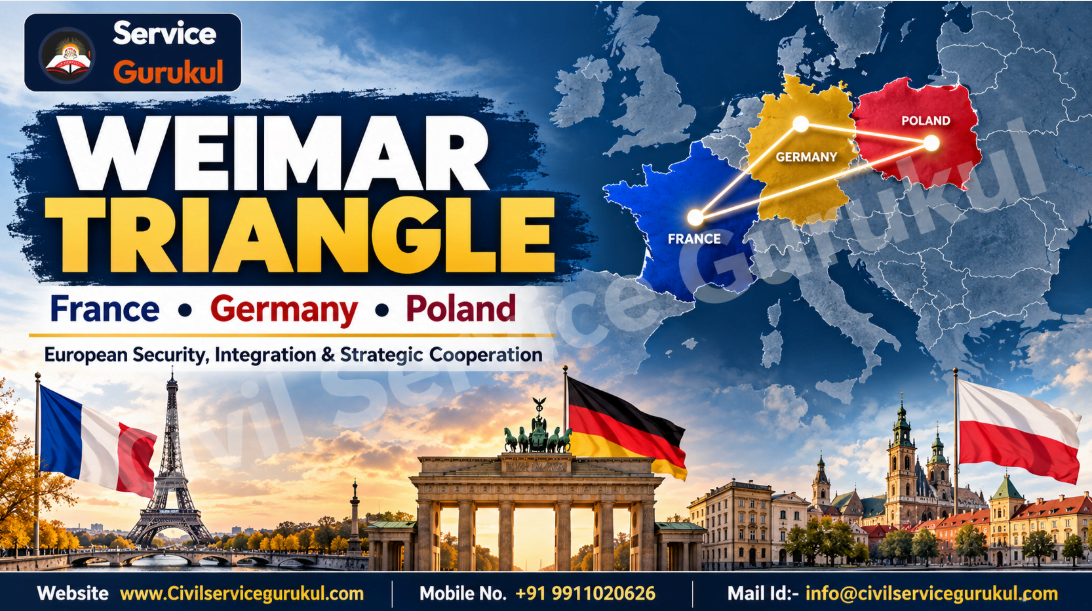
Weimar Triangle 2026: France, Germany and Poland's Role in European Security, Integration and Strategic Autonomy
The Weimar Triangle is an informal diplomatic cooperation framework comprising France, Germany and Poland. Established in August 1991 in the German city of Weimar, the grouping was designed to support reconciliation, European integration and cooperation after the Cold War.
In 2026, the Weimar Triangle completed 35 years of cooperation. Its contemporary importance lies in European security, support for Ukraine, defence preparedness, economic resilience, countering hybrid threats and strengthening the European Union's ability to act.
On 3 September 2026, the foreign ministers of Germany, France and Poland met in Weimar and adopted a joint declaration marking the grouping's 35th anniversary.
- Members: France, Germany and Poland.
- Foundation: 28 August 1991.
- Founding location: Weimar, Thuringia, Germany.
- Nature: Informal trilateral diplomatic forum.
- Founding ministers: Hans-Dietrich Genscher, Roland Dumas and Krzysztof Skubiszewski.
- Original purpose: Reconciliation and European integration.
- Permanent supranational headquarters: None.
- 35th anniversary: 2026.
- Anniversary meeting: 3 September 2026, Weimar.
- Main 2026 priorities: Ukraine, security, economic resilience and stronger European cooperation.
1. Why in the News?
The Weimar Triangle attracted renewed attention in September 2026 because of its 35th anniversary and fresh ministerial consultations on European security.
On 3 September 2026, foreign ministers Johann Wadephul of Germany, Jean-Noël Barrot of France and Radosław Sikorski of Poland met in the city of Weimar.
Their discussions focused on the European Union's effectiveness, defence cooperation, Ukraine, hybrid threats, disinformation and economic security.
The ministers expressed their determination to strengthen Europe's capacity for coordinated international action.
2. What Is the Weimar Triangle?
The Weimar Triangle is a consultation and cooperation mechanism involving:
- France
- Germany
- Poland
Its central purpose is to promote cooperation among these three European countries and support a stable, integrated and secure Europe.
2.1 Why Is It Called the Weimar Triangle?
The forum takes its name from Weimar, a historic German city associated with cultural and intellectual history.
The three founding foreign ministers met in Weimar in August 1991, giving the framework its name.
2.2 Is It an International Organization?
The Weimar Triangle is not a treaty-based supranational organization comparable to the European Union.
It operates primarily through diplomatic consultations, ministerial meetings, leadership-level dialogue and civil-society cooperation.
2.3 Is It a Military Alliance?
No. Although all three members are NATO allies, the Weimar Triangle itself is not a collective defence alliance.
3. Historical Background
3.1 Post-Cold War Europe
The end of the Cold War transformed Europe's geopolitical landscape.
Democratic transitions in Central and Eastern Europe, the decline of communist regimes and German reunification created opportunities for new partnerships.
3.2 Founding in 1991
On 28 August 1991, the foreign ministers of Germany, France and Poland met in Weimar to establish the cooperation framework.
The founding ministers were:
- Hans-Dietrich Genscher — Germany.
- Roland Dumas — France.
- Krzysztof Skubiszewski — Poland.
Their cooperation was intended to overcome historical divisions and promote a shared European future.
3.3 German-Polish Reconciliation
The historical relationship between Germany and Poland had been affected by conflict, territorial disputes and the Second World War.
The Weimar Triangle helped create a framework for rebuilding trust and political cooperation.
3.4 Franco-German Reconciliation
France and Germany had already developed significant cooperation following the Second World War.
Their experience demonstrated how former adversaries could create durable institutions and shared economic interests.
3.5 Poland's European Integration
The Weimar Triangle supported dialogue as Poland pursued closer relations with European and Euro-Atlantic institutions.
Poland joined NATO in 1999 and the European Union in 2004.
3.6 Transformation After EU Enlargement
Following Poland's EU accession, the grouping increasingly addressed shared European and international policy challenges.
| Year | Major Event |
|---|---|
| 1991 | Foundation of the Weimar Triangle. |
| 1999 | Poland becomes a NATO member. |
| 2004 | Poland joins the European Union. |
| 2014 | Weimar foreign ministers participate in diplomatic efforts concerning Ukraine. |
| 2022 | Russia's full-scale invasion of Ukraine increases the importance of European security cooperation. |
| 2024 | Renewed consultations among the three countries on European security. |
| 2025 | Foreign ministers address Ukraine, airspace violations and European defence. |
| 2026 | 35th anniversary and joint declaration in Weimar. |
4. Main Objectives of the Weimar Triangle
4.1 European Unity
Encourage cooperation that strengthens European political integration and institutional effectiveness.
4.2 Historical Reconciliation
Build trust and promote understanding among France, Germany and Poland.
4.3 Foreign Policy Coordination
Develop shared approaches to international diplomatic and security challenges.
4.4 European Security
Strengthen consultations concerning defence preparedness, regional threats and NATO.
4.5 Economic Cooperation
Encourage competitiveness, economic resilience, infrastructure development and industrial cooperation.
4.6 Cultural and Social Cooperation
Promote educational exchanges, cultural dialogue, parliamentary interaction and civil-society engagement.
5. Institutional Structure and Functioning
The Weimar Triangle has an informal structure and relies on the cooperation of national governments and related institutions.
5.1 Heads of Government Meetings
Leaders may meet to discuss major strategic questions, European integration and foreign policy.
5.2 Foreign Ministers' Meetings
Foreign ministers conduct consultations and issue statements on shared international challenges.
5.3 Defence Cooperation
Defence ministers and officials can coordinate discussions on military capabilities and European security priorities.
5.4 Parliamentary Dialogue
Parliamentary representatives contribute to political exchanges and democratic cooperation.
5.5 Civil-Society Partnerships
Cultural institutions, universities, researchers and civic organizations participate in trilateral activities.
6. Weimar Triangle's 35th Anniversary in 2026
The Weimar Triangle celebrated 35 years of cooperation in 2026.
6.1 Foreign Ministers' Meeting
On 3 September 2026, the foreign ministers of Germany, France and Poland met in Weimar.
- Johann Wadephul — Germany.
- Jean-Noël Barrot — France.
- Radosław Sikorski — Poland.
6.2 Joint Declaration
The ministers reaffirmed their commitment to a united, secure and resilient Europe.
They supported stronger European cooperation in foreign policy, defence and economic security.
6.3 European Union Reform
The ministers highlighted the need for more effective decision-making in EU external action.
Their declaration discussed strengthening the coordination role of EU foreign-policy institutions.
6.4 NATO Cooperation
The three countries emphasised strengthening European defence capabilities within a strong NATO.
6.5 Economic Security
The discussions recognised risks associated with supply-chain dependencies, economic coercion and critical raw materials.
6.6 Hybrid Threats
The ministers discussed cooperation against disinformation, cyber threats and foreign interference.
7. Role in Ukraine and European Security
7.1 Support for Ukraine
France, Germany and Poland have supported Ukraine's sovereignty and territorial integrity following Russia's invasion.
The countries participate in wider European efforts to provide diplomatic, humanitarian and defence support.
7.2 NATO's Eastern Flank
Poland's geographical position gives it an important role in NATO's eastern security environment.
Cooperation among the three states helps connect western and central European strategic perspectives.
7.3 Defence Industrial Capacity
European defence readiness depends partly on industrial capacity, reliable supply chains and effective procurement.
Trilateral dialogue can contribute to common approaches to these challenges.
7.4 Countering Disinformation
Foreign information manipulation and interference can undermine democratic institutions and public confidence.
The member countries have emphasised operational cooperation against these threats.
7.5 Cybersecurity
Cyber threats against infrastructure, institutions and critical industries are increasingly relevant to national security.
7.6 Regional Stability
The grouping provides a diplomatic platform for coordination on broader regional security challenges.
8. Weimar Triangle vs EU and NATO
The Weimar Triangle operates separately from the European Union and NATO, although its members participate in both organizations.
| Feature | Weimar Triangle | European Union | NATO |
|---|---|---|---|
| Nature | Diplomatic forum | Political and economic union | Collective defence alliance |
| Year | 1991 | 1993 (Maastricht Treaty in force) | 1949 |
| Members | France, Germany, Poland | EU member countries | European and North American allies |
| Primary role | Policy consultation | European integration | Collective defence |
| Permanent institutions | No comparable supranational institutions | Yes | Yes |
8.1 Relationship with the European Union
The grouping can help align national positions before wider discussions within EU institutions.
8.2 Relationship with NATO
All three countries participate in NATO's collective defence system.
Their trilateral consultations can complement NATO without replacing its institutional structure.
9. Strategic Significance of the Weimar Triangle
9.1 Bridging Western and Central Europe
The grouping links France and Germany with Poland, helping connect different historical and geopolitical perspectives within Europe.
9.2 Encouraging European Integration
Trilateral discussions can support consensus-building among European governments.
9.3 Strengthening Security
Cooperation can contribute to common approaches on defence preparedness, regional security and deterrence.
9.4 European Strategic Autonomy
Strategic autonomy refers to the ability to pursue important policy objectives with sufficient independent capabilities and resilience.
The Weimar Triangle can help advance debates on Europe's defence, economic and technological capabilities.
9.5 Economic Security
Economic security includes resilience against excessive supply-chain concentration, restrictions on critical inputs and economic coercion.
9.6 Defending Democratic Institutions
Countering foreign interference, disinformation and cyber threats can help protect democratic governance.
9.7 Diplomatic Coordination
The grouping allows its members to address differences and identify shared positions before participating in broader international negotiations.
10. Relevance of the Weimar Triangle for India
India is not a member of the Weimar Triangle. However, its activities have indirect implications for India's engagement with Europe.
10.1 India-EU Relations
France, Germany and Poland influence wider discussions within the European Union.
Coordination among them may affect the environment for India-EU cooperation.
10.2 Trade and Investment
European economic resilience, competitiveness and industrial policy can influence trade opportunities involving India.
10.3 Defence Cooperation
India maintains important defence and technology partnerships with France and Germany.
Broader European security developments may therefore be relevant to India's strategic planning.
10.4 Strategic Autonomy
European debates on strategic autonomy provide useful comparisons with India's approach to multi-alignment and diversified partnerships.
10.5 Russia-Ukraine Conflict
Europe's responses to the Russia-Ukraine war shape the geopolitical environment in which India conducts diplomacy.
10.6 Global Supply Chains
European efforts to diversify supply chains may create opportunities for Indian manufacturing, technology and industrial cooperation.
11. Challenges and Limitations
11.1 Divergent National Interests
France, Germany and Poland may have different priorities relating to defence spending, economic policy and relations with other countries.
11.2 Different Strategic Cultures
Their historical experiences influence their approaches to military security and diplomacy.
11.3 Domestic Political Changes
Changes in government may affect the intensity and direction of trilateral cooperation.
11.4 Informal Structure
The absence of permanent independent executive institutions limits the group's direct implementation capacity.
11.5 Dependence on EU and NATO
Many decisions must ultimately be implemented by national governments or through established European institutions.
11.6 External Security Pressures
The Ukraine conflict, hybrid threats, economic coercion and uncertainty in transatlantic relations create continuing challenges.
12. Way Forward
- Regular Dialogue: Conduct sustained ministerial and leadership-level consultations.
- European Defence: Support coordinated defence planning and capability development.
- Economic Resilience: Strengthen industrial and critical-material supply chains.
- Cybersecurity: Expand cooperation against cyberattacks and disinformation.
- EU Reform: Encourage more effective European foreign-policy coordination.
- Civil Society: Promote cultural, academic and youth exchanges.
- Policy Coordination: Resolve differences through consultation and consensus-building.
13. UPSC Civil Services Examination Relevance
| UPSC Paper | Relevant Topics |
|---|---|
| GS Paper I | Cold War history, European geography and post-1991 political transformation. |
| GS Paper II | International relations, regional groupings, European integration and India-EU relations. |
| GS Paper III | Security cooperation, hybrid threats, cyber risks and economic resilience. |
| Preliminary Examination | Member countries, foundation year, founding city and institutional differences. |
| Essay | Regionalism, reconciliation, diplomacy, multilateralism and strategic autonomy. |
- Members: France, Germany and Poland.
- Established: 28 August 1991.
- Founding location: Weimar, Germany.
- German founder: Hans-Dietrich Genscher.
- French founder: Roland Dumas.
- Polish founder: Krzysztof Skubiszewski.
- Poland joined NATO in 1999.
- Poland joined the EU in 2004.
- The forum completed 35 years in 2026.
- Anniversary meeting: 3 September 2026.
14. UPSC Prelims Practice MCQs
Question 1
Which countries constitute the Weimar Triangle?
(a) France, Germany and Poland
(b) Germany, Italy and France
(c) France, Spain and Portugal
(d) Germany, Poland and Austria
The Weimar Triangle is an informal diplomatic cooperation framework among these three countries.
Question 2
The Weimar Triangle was established in:
(a) 1949
(b) 1985
(c) 1991
(d) 2004
It was founded in Weimar, Germany, on 28 August 1991.
Question 3
Consider the following statements:
- The Weimar Triangle is an informal diplomatic forum.
- All its member countries belong to NATO.
- It possesses an independent collective defence treaty.
Which statements are correct?
(a) 1 only
(b) 1 and 2 only
(c) 2 and 3 only
(d) 1, 2 and 3
The Weimar Triangle is an informal forum, and its members are NATO allies. It does not have its own collective defence treaty.
Question 4
Which was an original objective of the Weimar Triangle?
(a) Creating a European currency
(b) Promoting reconciliation and European integration
(c) Replacing NATO
(d) Creating a United Nations agency
The grouping was founded to strengthen cooperation, reconciliation and European integration after the Cold War.
Question 5
The Weimar Triangle completed how many years in 2026?
(a) 25
(b) 30
(c) 35
(d) 40
The forum was established in 1991 and completed 35 years in 2026.
Question 6
Which of the following is NOT a member of the Weimar Triangle?
(a) Poland
(b) France
(c) Germany
(d) Italy
The members are France, Germany and Poland only.
Question 7
In September 2026, the foreign ministers of the Weimar Triangle commemorated the group's anniversary in:
(a) Brussels
(b) Paris
(c) Weimar
(d) Warsaw
The meeting was held in the founding city on 3 September 2026.
15. UPSC Mains Practice Questions
"The Weimar Triangle has evolved from a mechanism of post-Cold War reconciliation into a platform for European strategic cooperation."
Discuss its historical evolution, contemporary relevance and limitations in addressing European security challenges.
15 Marks | 250 WordsSuggested Answer Framework
Introduction:
Define the Weimar Triangle, identify its members and mention its founding in 1991.
Body — Historical Evolution:
- Post-Cold War reconciliation.
- German-Polish cooperation.
- Poland's NATO and EU integration.
- European policy consultations.
Body — Contemporary Importance:
- Support for Ukraine.
- European defence readiness.
- Economic security.
- Countering cyber and hybrid threats.
- EU external-action coordination.
Body — Challenges:
- Differences in national priorities.
- Informal institutional structure.
- Dependence on EU and NATO processes.
- Domestic political changes.
Conclusion:
Emphasise the significance of flexible diplomatic cooperation in supporting regional stability, reconciliation and European strategic resilience.
Examine the role of informal regional diplomatic groupings such as the Weimar Triangle in contemporary international relations. How can European policy coordination affect India's engagement with the European Union?
10 Marks | 150 Words16. Conclusion
The Weimar Triangle represents an important model of regional diplomatic cooperation that emerged after the Cold War.
What began as a framework for reconciliation and European integration has evolved into a platform for discussing security, economic resilience and the future of European cooperation.
The 35th anniversary meeting in September 2026 reinforced the importance of the grouping amid continuing geopolitical uncertainty in Europe.
Nevertheless, the group's influence depends on sustained political engagement, coordination with EU and NATO institutions, and the willingness of its members to reconcile different priorities.
For UPSC aspirants, the Weimar Triangle provides a useful case study in post-Cold War European history, regionalism, diplomatic coordination and contemporary security politics.
Official References and Further Reading
- German Federal Foreign Office: The Weimar Triangle: 35 Years of Cooperation, 30 April 2026. Read Official Background
- German Federal Foreign Office: 35 Years of the Weimar Triangle, 3 September 2026. Read Anniversary Report
- French Ministry for Europe and Foreign Affairs: Joint Declaration on the 35th Anniversary, 3 September 2026. Read Joint Declaration
- Polish Ministry of Foreign Affairs: 35 Years of Weimar Triangle, 3 September 2026. Read Polish Government Report
Prepare with Mentors Who Cleared the Exam
Get personalized study plans, evaluated answer models, and test series access.