
Diego Garcia 2026: Chagos Islands Dispute, UK–Mauritius Treaty & UPSC Analysis
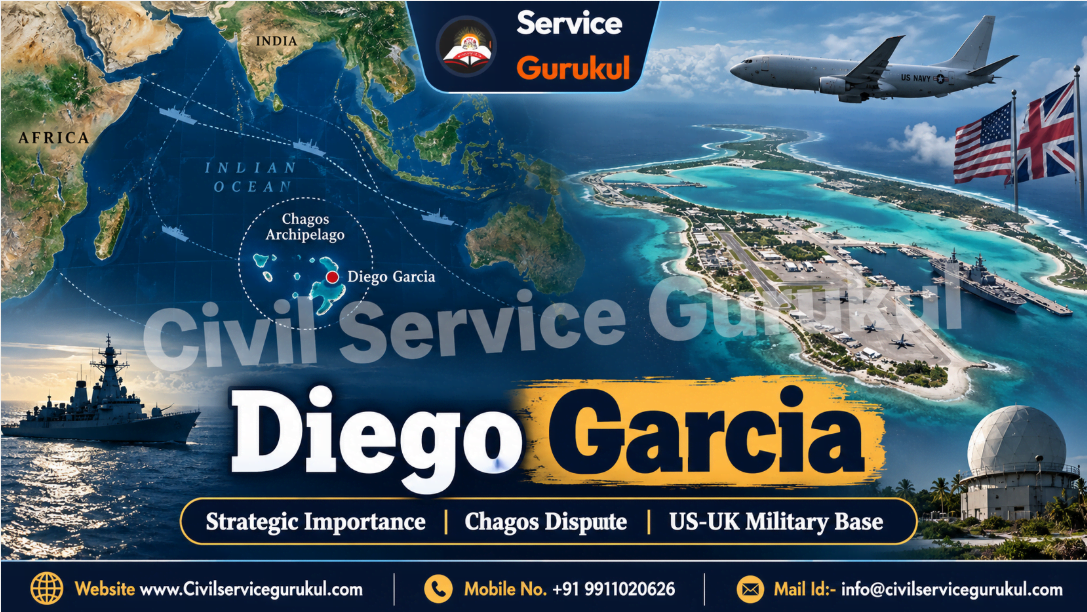
Diego Garcia Island: Strategic Importance, Chagos Sovereignty Dispute, US-UK Military Base and India's Interests
Diego Garcia is a strategically important coral atoll located in the Chagos Archipelago in the central Indian Ocean. It hosts a major joint United States-United Kingdom military facility, making it an important location for maritime security, military logistics and regional power projection.
The island is also central to the longstanding sovereignty dispute between Mauritius and the United Kingdom over the Chagos Archipelago.
On 22 May 2025, the UK and Mauritius signed a landmark treaty concerning sovereignty over the archipelago and the future operation of the Diego Garcia military facility.
However, as of 16 October 2026, the treaty has not entered into force. The UK retains administrative control while Mauritius continues to assert sovereignty over the territory.
- Location: Central Indian Ocean.
- Archipelago: Chagos Archipelago.
- Island type: Coral atoll.
- Land area: Approximately 27 sq. km.
- Present administration: United Kingdom, as part of the British Indian Ocean Territory.
- Sovereignty claimant: Mauritius.
- Military facility: Joint US-UK defence base.
- Important legal development: ICJ Advisory Opinion, 2019.
- Important treaty: UK-Mauritius Agreement, 22 May 2025.
- October 2026 status: Treaty signed but not yet in force.
1. Why in the News?
Diego Garcia has remained an important subject in international affairs following the agreement signed between the United Kingdom and Mauritius on 22 May 2025.
The treaty envisages recognition of Mauritian sovereignty over the Chagos Archipelago while safeguarding the long-term operation of the joint US-UK military base on Diego Garcia.
In October 2026, the issue continued to attract attention because the agreement had not entered into force.
A UK House of Commons Library research briefing published on 8 October 2026 reported that UK ratification had been paused pending an understanding with the United States on the future of the military base.
Mauritius also reiterated its sovereignty claim in an official statement dated 14 October 2026 and expressed concern over the delay in ratification.
2. Geographical Location of Diego Garcia
Diego Garcia is the largest island in the Chagos Archipelago, located in the central Indian Ocean.
The archipelago comprises numerous coral islands and atolls situated south of the Maldives and northeast of Mauritius.
2.1 Relative Location
- North: Maldives and the broader equatorial Indian Ocean.
- Southwest: Mauritius and the western Indian Ocean region.
- West: Indian Ocean maritime routes towards East Africa.
- East: Central Indian Ocean routes towards Southeast Asia.
2.2 Physical Characteristics
Diego Garcia is a low-lying coral atoll with a curved horseshoe-like shape.
Its main geographical features include:
- Extensive coral reef formations.
- A large sheltered lagoon.
- Low elevation above sea level.
- Tropical oceanic climate.
- Coastal vegetation and marine ecosystems.
- Limited freshwater resources.
2.3 Why Is Its Location Important?
Diego Garcia is relatively distant from major continental population centres while occupying a central position within the Indian Ocean.
This combination provides strategic advantages for military logistics, naval support, surveillance and long-range operations.
3. Historical Background of Diego Garcia
3.1 Colonial History
The Chagos Archipelago was historically administered as a dependency of colonial Mauritius.
After British control was established over Mauritius in the nineteenth century, the Chagos Islands continued under British administration.
3.2 Separation in 1965
In 1965, the United Kingdom separated the Chagos Archipelago from Mauritius before Mauritian independence.
The territory was incorporated into a newly created administrative entity known as the British Indian Ocean Territory (BIOT).
3.3 Mauritius Becomes Independent
Mauritius gained independence in 1968.
However, the Chagos Archipelago remained under British administration, resulting in a long-running sovereignty dispute.
3.4 Development of Military Facilities
The United Kingdom and the United States entered into arrangements concerning defence facilities on Diego Garcia during the 1960s.
The military facility subsequently expanded and became a significant installation supporting naval and air operations.
3.5 Displacement of Chagossians
Between 1967 and 1973, the indigenous population of the Chagos Archipelago was forcibly removed or prevented from returning.
Many Chagossians were relocated to Mauritius and Seychelles.
Their displacement remains a major human-rights concern associated with the territory.
4. Diego Garcia: US-UK Military Base
Diego Garcia hosts a major joint United States-United Kingdom military facility.
The base supports military aircraft, ships, logistics operations and other defence functions relevant to the wider Indian Ocean and adjoining strategic regions.
4.1 Military Functions
- Long-range aircraft operations.
- Naval logistics and replenishment.
- Military transportation and supply.
- Communications and operational support.
- Regional defence and surveillance activities.
4.2 Strategic Advantages
The island's remote position and established infrastructure allow military operations without dependence on a densely populated mainland base.
Its facilities can support operations affecting the Indian Ocean, the Middle East and other strategically important surrounding regions.
4.3 Importance to the United States
Diego Garcia provides the United States with a strategic facility for supporting long-range military activities.
It also contributes to defence cooperation between Washington and London.
4.4 Importance to the United Kingdom
For the United Kingdom, the facility represents an important part of its defence relationship with the United States.
Maintaining reliable access to the installation is a major objective of British security policy.
5. Chagos Islands Sovereignty Dispute
The sovereignty dispute concerns whether the United Kingdom lawfully separated the Chagos Archipelago from Mauritius before independence.
5.1 Mauritius' Position
Mauritius maintains that the Chagos Archipelago formed part of its territory under colonial administration.
It argues that the 1965 separation violated the principle of territorial integrity and the right to self-determination.
5.2 Historical UK Position
The United Kingdom continued to administer the archipelago as the British Indian Ocean Territory for decades after Mauritius gained independence.
The 2025 agreement represented a major shift towards recognising Mauritian sovereignty while preserving British control over the Diego Garcia military facility for defence purposes.
5.3 Why the Dispute Matters
- Decolonization and territorial integrity.
- The right of peoples to self-determination.
- International law and UN institutions.
- Human rights of displaced Chagossians.
- Geopolitical competition in the Indian Ocean.
6. International Court of Justice Advisory Opinion, 2019
On 25 February 2019, the International Court of Justice issued an advisory opinion concerning the legal consequences of separating the Chagos Archipelago from Mauritius in 1965.
6.1 Major Findings
- The decolonization of Mauritius had not been lawfully completed when it became independent in 1968.
- The separation of the Chagos Archipelago was inconsistent with the applicable right to self-determination.
- The United Kingdom was under an obligation to bring its administration of the archipelago to an end as rapidly as possible.
- UN member states were expected to cooperate in completing the decolonization process.
6.2 Legal Nature of the Opinion
The ICJ's opinion was advisory rather than a contentious judgment between two states.
Advisory opinions are generally not legally binding in the same manner as judgments in contentious cases.
Nevertheless, they carry significant legal authority and influence international diplomatic and institutional action.
6.3 UN General Assembly Resolution, 2019
On 22 May 2019, the United Nations General Assembly adopted Resolution 73/295, welcoming the ICJ advisory opinion.
The resolution called for the United Kingdom to withdraw its colonial administration from the Chagos Archipelago within six months.
7. UK-Mauritius Agreement of 22 May 2025
The United Kingdom and Mauritius signed a landmark treaty on 22 May 2025 concerning the Chagos Archipelago, including Diego Garcia.
The treaty seeks to address the sovereignty dispute while maintaining the long-term functioning of the strategically important military base.
7.1 Main Provisions
- The treaty provides for Mauritian sovereignty over the Chagos Archipelago.
- The UK would retain extensive rights and operational control relating to the military base on Diego Garcia.
- The arrangement provides an initial 99-year period for UK rights over Diego Garcia.
- The treaty includes provisions concerning financial arrangements and long-term security.
- It also addresses aspects of the future of the Chagos Archipelago and its inhabitants.
7.2 Why the Agreement Was Significant
The proposed arrangement attempts to reconcile Mauritius' sovereignty claim with the security interests of the United Kingdom and the United States.
It also represents a response to decades of international legal and diplomatic pressure concerning the decolonization of the Chagos Archipelago.
7.3 Sovereignty vs Military Base Rights
The key conceptual distinction is between territorial sovereignty and rights to operate a military facility.
A state may exercise sovereignty over a territory while granting another state agreed rights for defence purposes.
8. Latest Status: October 2026
As of 16 October 2026, the 2025 UK-Mauritius treaty had not entered into force.
A House of Commons Library briefing published on 8 October 2026 stated that UK ratification was paused pending agreement with the United States concerning the future of the Diego Garcia base.
Mauritius reiterated its claim to sovereignty over the Chagos Archipelago in a statement dated 14 October 2026.
The Mauritian government expressed dissatisfaction with the lack of ratification and indicated that legal options could be considered if the issue remained unresolved.
| Issue | Status as of 16 October 2026 |
|---|---|
| 2025 UK-Mauritius treaty | Signed, but not yet in force. |
| Current administration | United Kingdom. |
| Mauritian sovereignty claim | Maintained and reaffirmed. |
| Diego Garcia base | Continues operating under existing UK-US arrangements. |
| Ratification | UK ratification paused according to the October 2026 parliamentary briefing. |
| Proposed 99-year arrangement | Part of the signed treaty, not yet operational under that treaty. |
9. Chagossian People and Human Rights
The Chagossians are people originating from the Chagos Archipelago.
Their displacement during the development of military facilities remains one of the most important human-rights issues associated with Diego Garcia.
9.1 Forced Displacement
Between 1967 and 1973, Chagossian inhabitants were removed or prevented from returning to their islands.
9.2 Major Concerns
- Right to return and resettlement.
- Recognition of historical injustice.
- Compensation and rehabilitation.
- Cultural heritage and community identity.
- Participation in decisions concerning the islands.
9.3 Significance for Human Rights
The Chagossian issue demonstrates how strategic military interests and colonial policies can have lasting consequences for indigenous communities.
The future of resettlement also involves the interests of different Chagossian groups, security arrangements and environmental limitations.
10. Strategic Importance of Diego Garcia
10.1 Central Indian Ocean Location
Diego Garcia's central location makes it useful for supporting operations across a broad maritime region.
10.2 Naval Logistics
The island provides an important logistical platform for naval support and military supplies.
10.3 Air Operations
Its airfield infrastructure supports long-range military aviation and strategic mobility.
10.4 Maritime Surveillance
Military facilities in the central Indian Ocean can support wider maritime awareness, communications and regional defence coordination.
10.5 Middle East and Indo-Pacific Security
Diego Garcia has operational relevance to the wider Indian Ocean, the Middle East and the broader Indo-Pacific security environment.
10.6 Great-Power Competition
The island's military value attracts attention amid competition among major powers for influence over Indian Ocean security and connectivity.
10.7 Maritime Trade Routes
The Indian Ocean carries important international commercial shipping, including energy supplies and container traffic.
Diego Garcia is not itself a major commercial shipping chokepoint, but its location gives the base strategic relevance to the security of surrounding maritime routes.
11. Importance of Diego Garcia for India
11.1 India's Indian Ocean Security
India has major security and economic interests in the Indian Ocean.
Developments concerning Diego Garcia are relevant to regional military activity, maritime stability and strategic competition.
11.2 India-Mauritius Relations
Mauritius is an important maritime and diplomatic partner of India.
India has supported Mauritius' position on completing the decolonization of the Chagos Archipelago.
11.3 Maritime Security Cooperation
India cooperates with Indian Ocean partners on maritime domain awareness, capacity building, disaster response and regional security.
11.4 SAGAR Vision
India's SAGAR approach, or Security and Growth for All in the Region, emphasises regional cooperation and inclusive maritime security.
The Chagos issue is relevant to India's broader interest in a stable, secure and rules-based Indian Ocean.
11.5 India-US Strategic Partnership
India's growing cooperation with the United States adds another dimension to its assessment of Indian Ocean security.
India must balance support for Mauritius' territorial position with its broader interests in regional security and stable international partnerships.
11.6 Importance of UNCLOS
The United Nations Convention on the Law of the Sea (UNCLOS) provides the principal legal framework for maritime zones and many aspects of ocean governance.
Sovereignty over islands can affect maritime entitlements, including territorial seas and exclusive economic zones, subject to applicable law.
12. Environmental Significance and Challenges
Diego Garcia and the Chagos Archipelago contain important coral reef and marine ecosystems.
12.1 Marine Biodiversity
Coral reefs, lagoons and surrounding waters provide habitats for many marine organisms.
12.2 Climate Change
Low-lying coral islands are vulnerable to:
- Sea-level rise.
- Coral bleaching.
- Coastal erosion.
- Extreme weather events.
- Changes in marine ecosystems.
12.3 Conservation and Development
Future arrangements must balance environmental protection, military operations and legitimate human resettlement interests.
12.4 Blue Economy
The surrounding marine region may also be relevant to sustainable fisheries, marine conservation and ocean-based economic activity, subject to environmental and legal safeguards.
13. Major Challenges
13.1 Treaty Ratification
The delay in ratification complicates the implementation of the proposed sovereignty and military-base arrangements.
13.2 Military Security
The United Kingdom and United States place significant strategic importance on the continuity of military operations at Diego Garcia.
13.3 Chagossian Rights
The concerns of displaced Chagossians must be addressed through meaningful participation, rehabilitation and appropriate legal mechanisms.
13.4 Geopolitical Competition
Competing strategic interests in the Indian Ocean can complicate long-term political arrangements.
13.5 Environmental Sustainability
Marine conservation, climate vulnerability and infrastructure requirements must be carefully balanced.
13.6 Sovereignty and Base Administration
Any final arrangement must clearly define sovereign rights, operational jurisdiction, financial commitments and dispute-resolution procedures.
14. Way Forward
- Complete Legal Processes: Resolve outstanding treaty and ratification questions through lawful procedures.
- Preserve Regional Stability: Maintain transparent arrangements that reduce strategic uncertainty.
- Address Chagossian Rights: Ensure meaningful participation and fair consideration of community interests.
- Protect Marine Ecology: Strengthen biodiversity conservation and climate resilience.
- Support Maritime Cooperation: Promote dialogue among Indian Ocean stakeholders.
- Respect International Law: Encourage peaceful resolution of sovereignty-related issues consistent with international legal principles.
- Balance Security and Sovereignty: Clarify rights and responsibilities regarding future military operations.
15. UPSC Civil Services Examination Relevance
| UPSC Paper | Relevant Topics |
|---|---|
| GS Paper I | Indian Ocean geography, coral atolls, island ecosystems and mapping. |
| GS Paper II | Decolonization, international relations, ICJ, UN General Assembly and India-Mauritius relations. |
| GS Paper III | Maritime security, military logistics, strategic infrastructure and regional security. |
| UPSC Prelims | Diego Garcia location, Chagos Islands, BIOT, treaty dates and international institutions. |
| Essay | Colonial legacies, sovereignty, security, human rights and international law. |
- Diego Garcia lies in the central Indian Ocean.
- It is part of the Chagos Archipelago.
- It is a coral atoll.
- The UK separated the Chagos Archipelago from Mauritius in 1965.
- The British Indian Ocean Territory was established in 1965.
- Mauritius gained independence in 1968.
- The ICJ issued its Chagos advisory opinion in February 2019.
- UN General Assembly Resolution 73/295 was adopted in May 2019.
- The UK-Mauritius treaty was signed on 22 May 2025.
- The treaty had not entered into force as of 16 October 2026.
16. UPSC Prelims Practice MCQs
Question 1
Diego Garcia is located in:
(a) Caribbean Sea
(b) Central Indian Ocean
(c) South China Sea
(d) Mediterranean Sea
Diego Garcia forms part of the Chagos Archipelago in the central Indian Ocean.
Question 2
Diego Garcia belongs to which archipelago?
(a) Lakshadweep
(b) Andaman Islands
(c) Chagos Archipelago
(d) Seychelles Archipelago
Diego Garcia is the largest island in the Chagos Archipelago.
Question 3
The International Court of Justice issued its advisory opinion on the Chagos Archipelago in:
(a) 2015
(b) 2017
(c) 2019
(d) 2025
The ICJ issued the advisory opinion on 25 February 2019.
Question 4
Consider the following statements:
- Diego Garcia is a coral atoll.
- It hosts a joint US-UK military facility.
- The 2025 UK-Mauritius treaty had entered into force by October 2026.
Which statements are correct?
(a) 1 and 2 only
(b) 2 and 3 only
(c) 1 and 3 only
(d) 1, 2 and 3
Diego Garcia is a coral atoll hosting a US-UK military base. The 2025 treaty had not entered into force as of 16 October 2026.
Question 5
The UK-Mauritius treaty concerning the Chagos Archipelago was signed on:
(a) 25 February 2019
(b) 22 May 2025
(c) 15 August 2024
(d) 26 January 2026
The United Kingdom and Mauritius signed the Chagos agreement on 22 May 2025.
Question 6
Which statement correctly describes the main legal conclusion of the ICJ's 2019 Chagos advisory opinion?
(a) The Chagos Archipelago was never part of Mauritius.
(b) The decolonization of Mauritius was not lawfully completed in 1968.
(c) Diego Garcia became sovereign US territory.
(d) Mauritius had no connection with Chagos.
The Court concluded that the decolonization of Mauritius had not been lawfully completed following the separation of the Chagos Archipelago.
17. UPSC Mains Practice Questions
"The Diego Garcia dispute reflects the continuing influence of colonial history on contemporary maritime geopolitics."
Examine the significance of the Chagos Archipelago sovereignty dispute in the context of international law, decolonization and Indian Ocean security.
15 Marks | 250 WordsSuggested Answer Framework
Introduction:
Introduce Diego Garcia and explain the 1965 separation of the Chagos Archipelago.
Body:
- Geographical importance of Diego Garcia.
- UK-US defence cooperation.
- Historical separation from Mauritius.
- 2019 ICJ advisory opinion.
- 2025 UK-Mauritius treaty.
- October 2026 ratification status.
- Chagossian human-rights concerns.
- India's maritime and diplomatic interests.
Conclusion:
Emphasise a balanced approach based on international law, legitimate security interests, human rights and regional stability.
Discuss the strategic significance of Diego Garcia for Indian Ocean security. How can developments in the Chagos Archipelago affect India's maritime interests?
10 Marks | 150 Words18. Conclusion
Diego Garcia is one of the most strategically important island locations in the Indian Ocean.
Its importance arises from a combination of geographical position, military infrastructure, maritime connectivity and international political interests.
At the same time, the Chagos Archipelago dispute highlights unresolved questions relating to colonialism, self-determination and the rights of displaced communities.
The 2025 UK-Mauritius treaty was an important diplomatic milestone, but its delayed entry into force continued to create uncertainty in October 2026.
For India, the issue has implications for its relationship with Mauritius, maritime security, international law and the evolving strategic environment of the Indian Ocean.
Official References and Further Reading
- UK House of Commons Library: International Law and the Chagos Archipelago, 8 October 2026. Read the Parliamentary Research Briefing
- Government of Mauritius: Prime Minister reaffirms Chagos sovereignty, 14 October 2026. Read the Official Statement
- International Court of Justice: Advisory Opinion of 25 February 2019. Read the ICJ Advisory Opinion
- UK Government: Agreement concerning the Chagos Archipelago, including Diego Garcia, 22 May 2025. Read the 2025 Treaty
- United Nations General Assembly: Chagos Archipelago Resolution, 22 May 2019. Read the UN Summary
Prepare with Mentors Who Cleared the Exam
Get personalized study plans, evaluated answer models, and test series access.