
Additive Manufacturing in India: NSAM 2.0, 3D Printing and the Future of Advanced Manufacturing
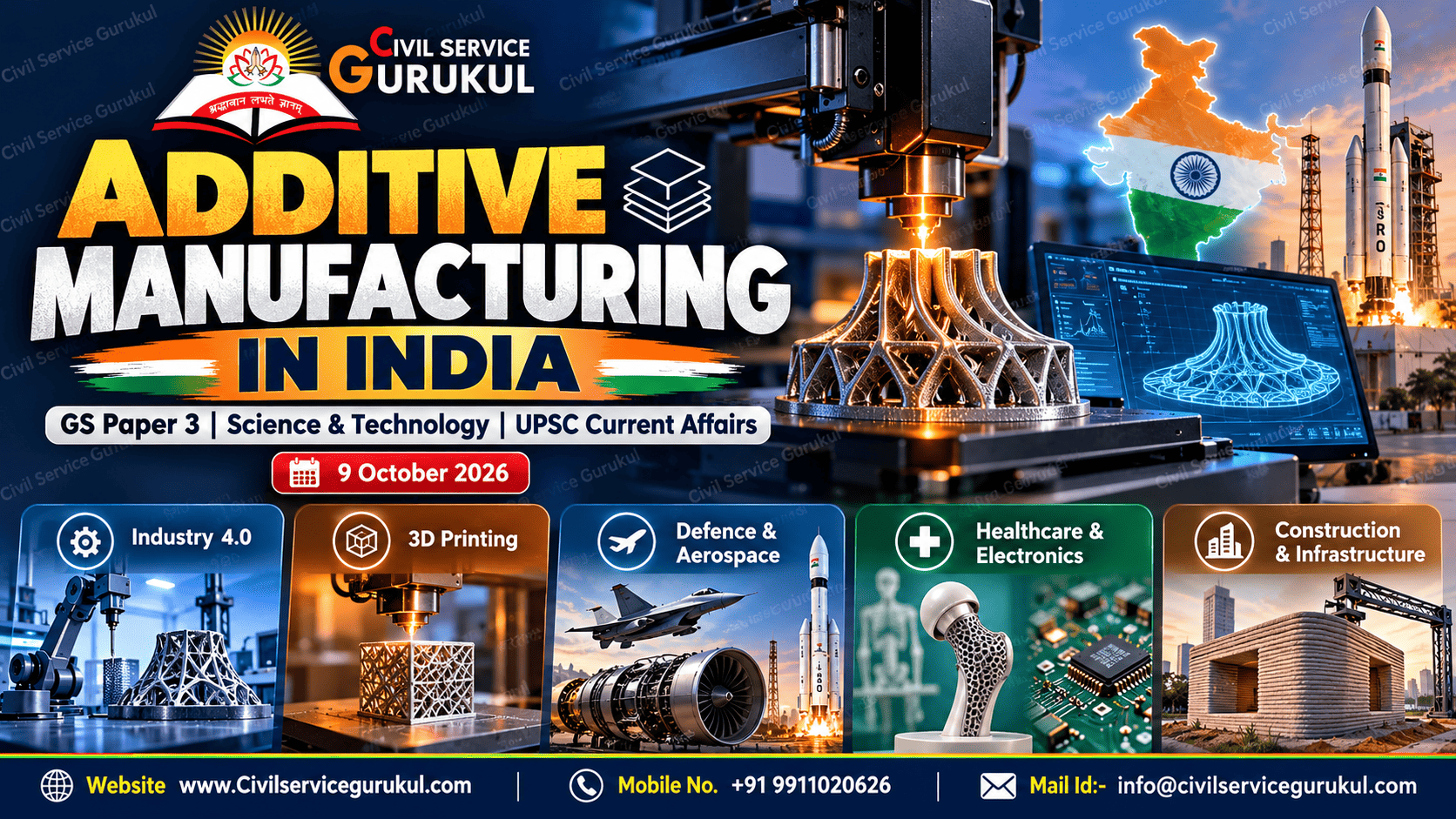
Additive Manufacturing in India: NSAM 2.0, 3D Printing and the Future of Advanced Manufacturing
India’s additive manufacturing strategy is moving from experimentation toward commercial scale. NSAM 2.0 seeks to strengthen indigenous technologies, reduce import dependence, support startups and MSMEs, and build manufacturing capabilities across aerospace, defence, healthcare, electronics and construction.
Excerpt / Brief Summary
What Is Additive Manufacturing?
Additive manufacturing is a digital engineering process in which three-dimensional objects are manufactured by depositing or fusing material layer by layer.
It differs from conventional manufacturing methods such as:
- Milling;
- Cutting;
- Turning;
- Forging;
- Casting.
Traditional methods frequently remove material from a larger block, while additive manufacturing builds only the material required for the final object.
The Digital-to-Physical Manufacturing Process
- 3D Design: The component is designed using CAD, laser scanners or digital imaging.
- Digital File Conversion: The design is converted into a format such as STL.
- Slicing: Software divides the model into hundreds or thousands of thin digital layers.
- Layer-by-Layer Printing: The machine deposits or fuses material based on each digital layer.
- Post-Processing: The component may undergo heat treatment, polishing, finishing or support removal.
Common Additive Manufacturing Techniques
| Technique | Basic Principle |
|---|---|
| Selective Laser Melting | Laser melts metal powder to create dense components |
| Binder Jetting | A binding agent joins powder particles layer by layer |
| Stereolithography | Light cures liquid resin into solid structures |
| Material Extrusion | Material is pushed through a nozzle and deposited layer by layer |
| Bioprinting | Biomaterials or living cells are arranged to create biological structures |
Why Additive Manufacturing Is Different
The technology can produce geometries that are difficult or impossible to manufacture using traditional machining.
Its important advantages include:
- Complex product design;
- Rapid prototyping;
- Lower material waste;
- Part consolidation;
- Mass customisation;
- Decentralised manufacturing;
- Shorter product-development cycles.
National Strategy for Additive Manufacturing
India launched its first National Strategy for Additive Manufacturing in 2022 to develop a domestic ecosystem for 3D printing and advanced manufacturing. :chatgpt-content-reference{index="1"}
Its original targets included:
- Capturing 5% of the global additive-manufacturing market;
- Adding approximately $1 billion to GDP;
- Developing 50 indigenous technologies;
- Supporting 100 startups;
- Creating 500 products.
India’s Progress So Far
| Indicator | Progress |
|---|---|
| People trained | More than 1.54 lakh |
| Startups funded | 56 |
| Indigenous technologies developed | 65 |
| National centres | Seven |
This shows that India has moved beyond policy formulation toward building a broader ecosystem of skills, research and startups. :chatgpt-content-reference{index="2"}
What Is NSAM 2.0?
NSAM 2.0 represents the next phase of India’s additive-manufacturing strategy.
Its focus is shifting from basic capacity creation toward commercialisation, intellectual property and strategic industrial deployment.
- Domestic patent and intellectual-property generation;
- Commercialisation of indigenous technologies;
- National digital manufacturing networks;
- Shared infrastructure for MSMEs;
- Strengthening additive electronics;
- Defence and strategic-sector applications;
- Alignment with international quality standards.
1. Aerospace and Space Applications
Aerospace is one of the most promising sectors for additive manufacturing because every gram of weight matters.
3D printing enables:
- Lightweight components;
- Complex internal channels;
- Fewer individual parts;
- Lower assembly requirements;
- Rapid design iteration.
A prominent Indian example is the use of a single-piece 3D-printed semi-cryogenic engine by Agnikul Cosmos for its Agnibaan demonstrator. :chatgpt-content-reference{index="3"}
2. Defence and Battlefield Logistics
Additive manufacturing can reduce dependence on long logistics chains for replacement parts and equipment.
Potential defence applications include:
- Forward repair facilities;
- Spare-parts production;
- Temporary shelters;
- Fortifications;
- Specialised equipment;
- Rapid maintenance and repair.
The Indian Army has already experimented with 3D-printed defence structures and rapid construction. :chatgpt-content-reference{index="4"}
3. Healthcare and Patient-Specific Implants
Conventional implants are generally manufactured in standard dimensions. But human anatomy varies significantly from patient to patient.
Additive manufacturing enables customised implants based on individual medical imaging.
Potential applications include:
- Dental implants;
- Bone scaffolds;
- Orthopaedic implants;
- Prosthetics;
- Surgical models.
Indian startups are already developing bioceramic and silk-based bone scaffolds for such applications. :chatgpt-content-reference{index="5"}
4. Electronics and Photonics
Additive manufacturing is expanding beyond mechanical components.
Advanced systems can print:
- Conductive circuits;
- Antennas;
- Passive components;
- Battery structures;
- Photonic components.
Research institutions such as IISc Bengaluru have demonstrated additive manufacturing applications in photonic integrated circuits. :chatgpt-content-reference{index="6"}
5. Construction and Infrastructure
Large-scale concrete printers can manufacture walls and structural elements directly from digital designs.
Potential benefits include:
- Faster construction;
- Reduced labour requirements;
- Lower material waste;
- Greater design flexibility;
- Potential reduction in carbon emissions.
3D concrete printing may offer significant cost and carbon savings in suitable applications. :chatgpt-content-reference{index="7"}
Why Additive Manufacturing Matters for MSMEs
Advanced industrial 3D printers can be extremely expensive. This creates a barrier for smaller manufacturers.
NSAM 2.0 therefore proposes shared facilities where MSMEs can access high-end machines on a pay-per-use basis. :chatgpt-content-reference{index="8"}
High machine cost → Common facility centre → Shared access by MSMEs → Lower capital barrier → Faster product innovation
Major Challenges Facing India
1. Dependence on Imported Advanced Materials
India remains dependent on imported high-grade metal powders, superalloys and engineering resins.
This creates strategic vulnerability, especially in aerospace and defence applications.
2. High Cost of Industrial Machines
Metal additive-manufacturing systems require substantial upfront investment.
This makes adoption difficult for smaller firms without shared infrastructure or financial support.
3. Lack of Unified Quality Standards
Mission-critical components must satisfy rigorous safety and performance standards.
India still needs stronger domestic standards relating to:
- Material certification;
- Fatigue testing;
- Mechanical strength;
- Medical-device approval;
- Aerospace quality control.
4. Software and IP Dependence
Many industrial CAD, slicing and machine-control systems remain proprietary foreign technologies.
This creates the risk of:
- Vendor lock-in;
- High licence costs;
- Cybersecurity dependence;
- Limited domestic customisation.
Why Domestic Feedstock Is Strategically Important
A country may possess 3D-printing machines but still remain dependent if the raw materials are imported.
Domestic machine + Imported critical powder = Partial technological dependence
Domestic machine + Domestic material + Domestic software = Stronger manufacturing sovereignty
Way Forward for India
- Develop Domestic Feedstock: Support local production of advanced metal powders, engineering resins and bioceramics.
- Create Common Facility Centres: Provide affordable high-end AM infrastructure for MSMEs.
- Develop Indian Quality Standards: Accelerate BIS and sector-specific certification frameworks.
- Support Domestic Software: Encourage indigenous CAD, slicing and machine-control platforms.
- Link with Semiconductor Mission: Promote printed electronics, sensors and photonic components.
- Expand Defence Applications: Use AM for localised repair and battlefield logistics.
- Strengthen Industry-Academia Collaboration: Move technologies from laboratory prototypes to commercial products.
Additive Manufacturing and Make in India
The technology complements Make in India because it reduces the importance of large centralised factories for certain categories of production.
Digital designs can potentially be transmitted and manufactured close to the point of demand.
This can create:
- Localised manufacturing;
- Shorter supply chains;
- Reduced spare-parts inventory;
- Greater resilience during disruptions.
Additive Manufacturing and Industry 5.0
Industry 5.0 emphasises closer interaction between advanced technology and human creativity.
Additive manufacturing supports this transition through:
- AI-assisted design;
- Digital twins;
- Custom manufacturing;
- Flexible production;
- Decentralised factories.
UPSC GS Paper III Relevance
- 3D printing;
- Emerging manufacturing technology;
- Indigenous technology development;
- Applications of technology in everyday life.
- Manufacturing;
- MSMEs;
- Industrial policy;
- Make in India;
- Startup ecosystem.
- Defence indigenisation;
- Supply-chain resilience;
- Strategic autonomy.
UPSC Prelims Quick Revision
- Additive manufacturing creates objects layer by layer.
- 3D printing is an important form of additive manufacturing.
- CAD files are digitally sliced before printing.
- Selective laser melting is used for metal components.
- NSAM was first launched in 2022.
- NSAM 2.0 focuses strongly on commercialisation and indigenous IP.
- Additive manufacturing is relevant to aerospace, defence, healthcare and electronics.
UPSC Practice MCQ
1. It builds objects layer by layer from a digital model.
2. It can reduce material wastage compared with several subtractive processes.
3. It has applications in aerospace and patient-specific medical implants.
4. It can only be used with polymer materials.
Which of the statements given above are correct?
A. 1 and 2 only
B. 1, 2 and 3 only
C. 2, 3 and 4 only
D. 1, 2, 3 and 4
Answer: B
Statement 4 is incorrect because additive manufacturing can use metals, ceramics, polymers and even biological materials.
UPSC Mains Practice Question
“Additive manufacturing has the potential to transform India from a traditional manufacturing economy into a flexible digital-production ecosystem.” Discuss its advantages, strategic applications and structural challenges in India.
Suggested Marks: 15
Suggested Word Limit: 250 words
Mains Answer Framework
Introduction:
Define additive manufacturing and briefly mention NSAM 2.0.
Body:
- Explain the digital-to-physical process;
- Discuss aerospace, defence, healthcare and electronics applications;
- Mention MSME and startup opportunities;
- Highlight import dependence and high equipment cost;
- Discuss lack of standards and software dependence;
- Suggest domestic materials, common facilities and Indian IP.
Conclusion:
Link additive manufacturing with manufacturing sovereignty,
Make in India and Viksit Bharat 2047.
Key Terms for Answer Enrichment
Conclusion
Additive manufacturing has the potential to fundamentally alter how India designs, produces and distributes advanced industrial products.
Its importance extends far beyond conventional 3D printing. It can strengthen aerospace, defence logistics, personalised healthcare, electronics, construction and MSME innovation.
However, India’s long-term success will depend on moving beyond imported machines and materials toward indigenous feedstock, domestic software, globally recognised quality standards and commercial-scale Indian technologies.
SEO Tags
Prepare with Mentors Who Cleared the Exam
Get personalized study plans, evaluated answer models, and test series access.