
Environmental-Economic Accounting in India: Why the 2026–2030 Strategy Matters for Green Growth
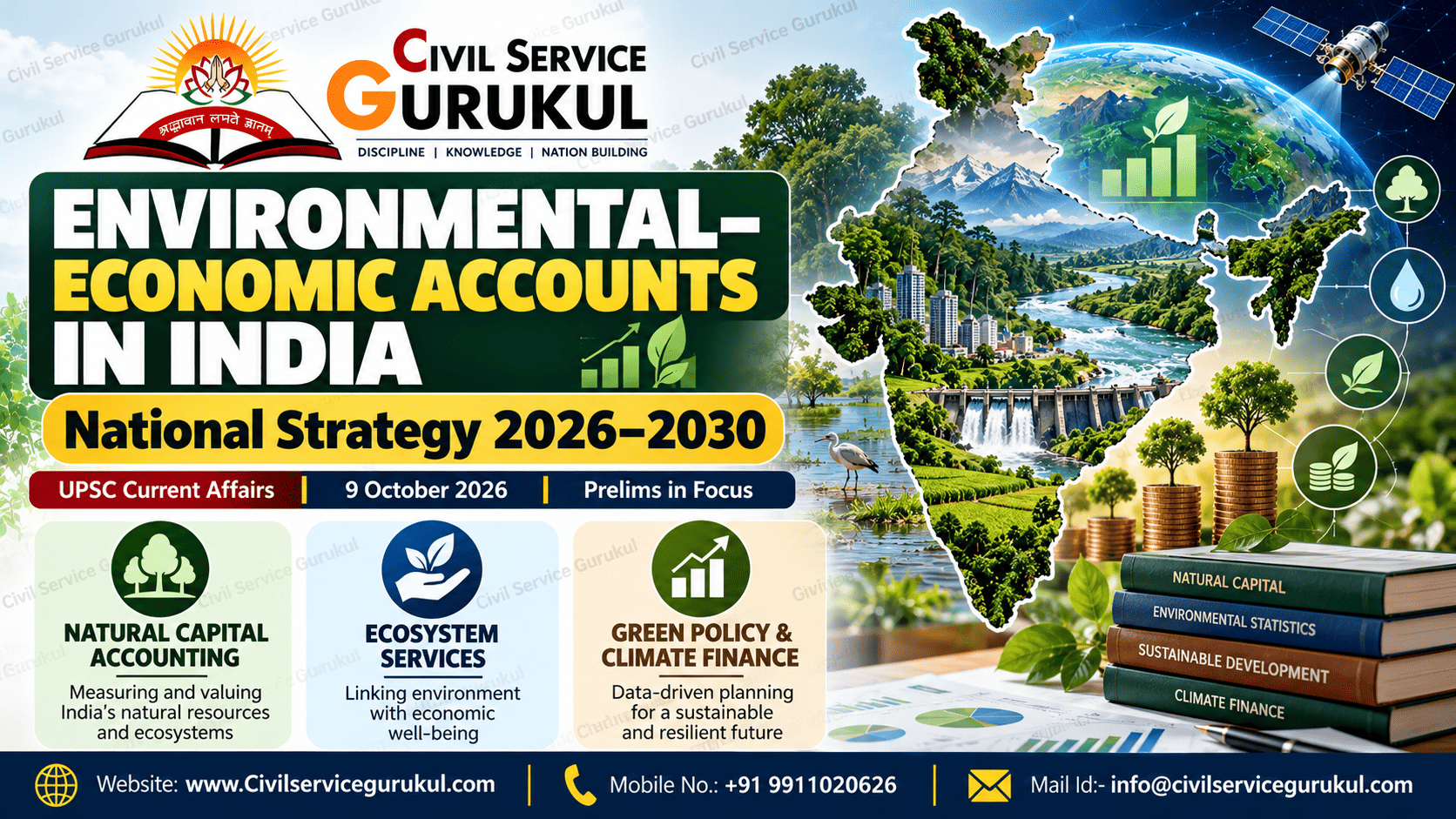
Environmental-Economic Accounting in India: Why the 2026–2030 Strategy Matters for Green Growth
India is moving toward an economic accounting system that looks beyond conventional GDP. The new environmental-economic accounting strategy seeks to measure forests, water, minerals, soil, biodiversity, carbon stocks and ecosystem services alongside economic activity.
Excerpt / Brief Summary
What Is Environmental-Economic Accounting?
Traditional national accounts primarily measure production, income, expenditure and economic growth.
However, economic activity often depends heavily on nature. For example:
- Agriculture depends on soil, water and pollinators;
- Industry depends on minerals and energy resources;
- Cities depend on water and land;
- Coastal economies depend on mangroves and marine ecosystems;
- Tourism depends on forests, biodiversity and landscapes.
Environmental-economic accounting attempts to bring these natural assets into a structured statistical framework.
Why Conventional GDP Is Incomplete
GDP measures the market value of final goods and services, but it does not automatically deduct losses caused by:
- Forest degradation;
- Groundwater depletion;
- Soil erosion;
- Biodiversity loss;
- Mineral depletion;
- Air and water pollution.
A country can therefore record high economic growth while simultaneously degrading its natural-resource base.
More groundwater extraction → Higher agricultural output → Higher measured GDP
But if aquifers are depleted, the underlying natural asset has declined. Environmental-economic accounting helps capture this hidden cost.
What Is the Strategy for Environmental-Economic Accounts 2026–2030?
It is a five-year national roadmap designed to standardise and institutionalise environmental-economic accounting in India.
| Particular | Details |
|---|---|
| Period | 2026–2030 |
| Implementing Agency | National Statistical Office |
| Lead Ministry | Ministry of Statistics and Programme Implementation |
| Core Purpose | Integrate environmental and economic statistics |
| Policy Focus | Natural capital, ecosystem services, resource depletion and sustainable development |
Main Objectives
- Measure natural capital systematically;
- Track resource depletion;
- Value ecosystem services;
- Identify environmental degradation;
- Improve environmental statistics;
- Support green policymaking;
- Strengthen climate-finance decisions;
- Improve international environmental reporting.
1. Pollination Services Accounts
Pollinators such as bees, butterflies, insects and birds provide important ecosystem services to agriculture.
Their contribution is rarely reflected directly in conventional economic statistics.
Pollination accounts seek to estimate their contribution to:
- Crop yields;
- Food security;
- Agricultural productivity;
- Farm incomes;
- Biodiversity.
2. Soil Accounts
Soil is a critical natural asset, but its degradation can remain invisible in national accounts.
Soil accounts may track:
- Soil erosion;
- Fertility decline;
- Land degradation;
- Organic carbon loss;
- Nutrient depletion.
Such data can support more sustainable agricultural policies.
3. Carbon Stock Accounts
Carbon accounting is becoming increasingly important for climate policy and carbon markets.
Carbon stocks can include carbon stored in:
- Forests;
- Soils;
- Wetlands;
- Mangroves;
- Coastal ecosystems;
- Blue-carbon systems.
Tracking changes in these stocks helps assess whether ecosystems are acting as carbon sinks or losing their sequestration capacity.
4. Water Accounts
Water accounts provide a structured picture of water availability, use and depletion.
They can track:
- Freshwater availability;
- Surface-water use;
- Groundwater extraction;
- Aquifer depletion;
- Industrial water consumption;
- Agricultural demand;
- Water stress.
Water accounting connects with groundwater depletion, inter-State water conflicts, water-use efficiency, crop patterns and climate adaptation.
5. Land Accounts
Land accounts track changes in land use and land condition.
They can help analyse:
- Urban expansion;
- Forest conversion;
- Agricultural land loss;
- Wetland degradation;
- Industrial expansion;
- Infrastructure development.
This can improve land-use planning and environmental impact assessment.
6. Mineral Accounts
Minerals are finite natural assets. Their extraction increases current output but reduces future resource stocks.
Mineral accounts can help measure:
- Resource reserves;
- Extraction volumes;
- Depletion rates;
- Remaining stocks;
- Economic dependence on mineral extraction.
This is especially relevant to resource-rich states and mining-dependent regions.
7. Forest and Biodiversity Accounts
Forest accounting goes beyond merely recording total forest area.
It can examine:
- Forest quality;
- Biomass;
- Carbon storage;
- Biodiversity;
- Ecosystem services;
- Habitat conditions.
This is important because equal areas of forest can have very different ecological values.
8. Environmental Activity Accounts
These accounts track economic activity associated with environmental protection and resource management.
They may include:
- Government environmental expenditure;
- Pollution-control spending;
- Environmental taxes;
- Green subsidies;
- Waste-management investment;
- Renewable-energy expenditure.
Core Accounting Modules
| Accounting Domain | Focus |
|---|---|
| Pollination Services | Contribution of pollinators to agriculture |
| Soil Accounts | Erosion, fertility and land degradation |
| Carbon Stock Accounts | Forests, soil carbon and blue carbon |
| Environmental Activity Accounts | Environmental expenditure, taxes and subsidies |
| Water Accounts | Availability, use and depletion |
| Land Accounts | Land-use change and asset condition |
| Mineral Accounts | Extraction, depletion and remaining stocks |
| Forest & Biodiversity Accounts | Ecosystems, biodiversity and ecosystem services |
Role of Satellite and Earth Observation Data
Environmental accounting requires large amounts of spatial information.
Satellite data can help monitor:
- Forest cover;
- Land-use change;
- Wetlands;
- Water bodies;
- Crop patterns;
- Coastal ecosystems;
- Urban expansion.
The strategy seeks greater standardisation of Earth-observation protocols, including sensor intervals, spatial resolution and digital mapping.
Why Standardisation Matters
Different states may otherwise use different datasets, measurement methods or mapping scales.
Without uniform standards, comparisons can become unreliable.
- Comparable state-level datasets;
- Better national aggregation;
- Consistent environmental indicators;
- More credible policy evaluation.
State-Level Environmental Accounting
Environmental challenges often vary significantly from state to state.
For example:
- Punjab may face groundwater stress;
- Rajasthan may face desertification;
- Himalayan states may focus on forest ecosystems;
- Coastal states may emphasise mangroves and blue carbon;
- Mining states may need mineral accounts.
The strategy therefore encourages state-level institutional coordination.
Link with Kunming–Montreal Global Biodiversity Framework
India’s accounting framework is also being aligned with the Kunming–Montreal Global Biodiversity Framework.
This can help measure progress relating to:
- Biodiversity conservation;
- Ecosystem restoration;
- Sustainable resource use;
- Nature-related policy targets.
Link with Multilateral Environmental Agreements
Environmental-economic accounts can also support international reporting under frameworks such as:
- Convention on Biological Diversity;
- Ramsar Convention;
- Montreal Protocol;
- Other environmental agreements.
Standardised domestic data can improve the credibility of international environmental reporting.
What Is Natural Capital?
Natural capital refers to stocks of natural assets that provide benefits to people and the economy.
Examples include:
- Forests;
- Rivers;
- Groundwater;
- Soil;
- Minerals;
- Wetlands;
- Biodiversity;
- Coastal ecosystems.
What Are Ecosystem Services?
Ecosystem services are the benefits humans obtain from nature.
| Type | Examples |
|---|---|
| Provisioning | Food, timber, freshwater |
| Regulating | Pollination, flood control, carbon sequestration |
| Cultural | Tourism, recreation, spiritual value |
| Supporting | Soil formation, nutrient cycling |
Environmental Accounts and Green GDP
Environmental accounting can contribute to broader efforts to assess economic performance beyond conventional GDP.
Economic production
Green accounting approach
Economic production − environmental degradation − resource depletion + value of ecosystem services
Although no single metric can capture all dimensions, the approach improves understanding of whether growth is environmentally sustainable.
Why This Matters for Climate Finance
Reliable environmental accounts can improve climate-finance decisions.
They can help identify:
- Carbon sinks;
- Restoration priorities;
- Water-stressed regions;
- Nature-based climate solutions;
- Blue-carbon assets;
- Climate-vulnerable ecosystems.
Better data can support more credible allocation of green investment.
Policy Benefits
- Natural-resource management;
- Budget allocation;
- Climate adaptation planning;
- Forest policy;
- Mining policy;
- Water governance;
- Urban planning;
- Biodiversity conservation;
- Green taxation;
- Environmental subsidies.
Challenges in Environmental-Economic Accounting
Many ecosystem services do not have clear market prices.
2. Data Gaps
Environmental datasets may be fragmented across ministries and states.
3. Methodological Differences
Valuation assumptions can significantly change results.
4. Institutional Coordination
Multiple departments collect overlapping data.
5. Capacity Constraints
States require trained statisticians, economists, ecologists and GIS professionals.
6. Risk of Oversimplification
Not every ecological value can or should be reduced purely to money.
Why Nature Should Not Be Reduced Only to Monetary Value
Monetary valuation is useful for policy, but ecosystems also have ecological, cultural and ethical significance.
For example, a sacred forest may have:
- Economic value;
- Biodiversity value;
- Cultural value;
- Spiritual value;
- Intergenerational value.
Good environmental accounting should therefore support conservation, not convert every ecological asset into a commodity.
Way Forward
- Improve Data Integration: Create interoperable environmental datasets across ministries and states.
- Strengthen State Capacity: Train officials in statistics, ecology, remote sensing and GIS.
- Use Satellite Technology: Expand Earth-observation and geospatial monitoring.
- Standardise Methodology: Develop common valuation and measurement protocols.
- Link Accounts with Budgeting: Use natural-capital data in public investment decisions.
- Strengthen Public Access: Publish open datasets for researchers and citizens.
- Integrate Climate Finance: Use accounts to identify restoration and carbon-sequestration opportunities.
UPSC Prelims Quick Revision
- The strategy covers the period 2026–2030.
- It is implemented by the National Statistical Office.
- It integrates environmental and economic statistics.
- It covers natural capital and ecosystem services.
- Core modules include water, land, minerals, soil, carbon and biodiversity.
- It supports sustainable development and climate finance.
- It is aligned with global biodiversity and environmental-reporting frameworks.
UPSC Practice MCQ
1. It integrates environmental information with economic statistics.
2. It can include accounting for groundwater depletion and carbon stocks.
3. It excludes ecosystem services because they do not have market prices.
4. It can support sustainable development planning.
Which of the statements given above are correct?
A. 1 and 2 only
B. 1, 2 and 4 only
C. 2, 3 and 4 only
D. 1, 2, 3 and 4
Answer: B
Statement 3 is incorrect because ecosystem services are an important component of environmental-economic accounting.
UPSC Mains Practice Question
“Economic growth cannot be considered sustainable if it is accompanied by persistent depletion of natural capital.” In this context, discuss the significance of environmental-economic accounting for India.
Suggested Marks: 15
Suggested Word Limit: 250 words
Mains Answer Framework
Introduction:
Define environmental-economic accounting and mention the 2026–2030 strategy.
Body:
- Explain limitations of conventional GDP;
- Discuss natural capital and ecosystem services;
- Mention water, soil, forest, biodiversity and carbon accounts;
- Explain relevance to climate finance and sustainable development;
- Highlight data, valuation and institutional challenges;
- Suggest stronger state capacity and standardisation.
Conclusion:
Link environmental accounting with sustainable growth,
intergenerational equity and Viksit Bharat.
Key Terms for Answer Enrichment
Conclusion
India’s Strategy for Environmental-Economic Accounts 2026–2030 represents an important evolution in the way economic progress is measured.
By accounting for forests, water, soil, minerals, carbon stocks, biodiversity and ecosystem services, policymakers can obtain a more realistic picture of the relationship between economic growth and environmental sustainability.
The deeper policy message is simple: a country does not become richer in the long run by destroying the natural assets on which future prosperity depends.
SEO Tags
Prepare with Mentors Who Cleared the Exam
Get personalized study plans, evaluated answer models, and test series access.