
World Development Report 2026: Can Artificial Intelligence Bridge the Global Development Divide?
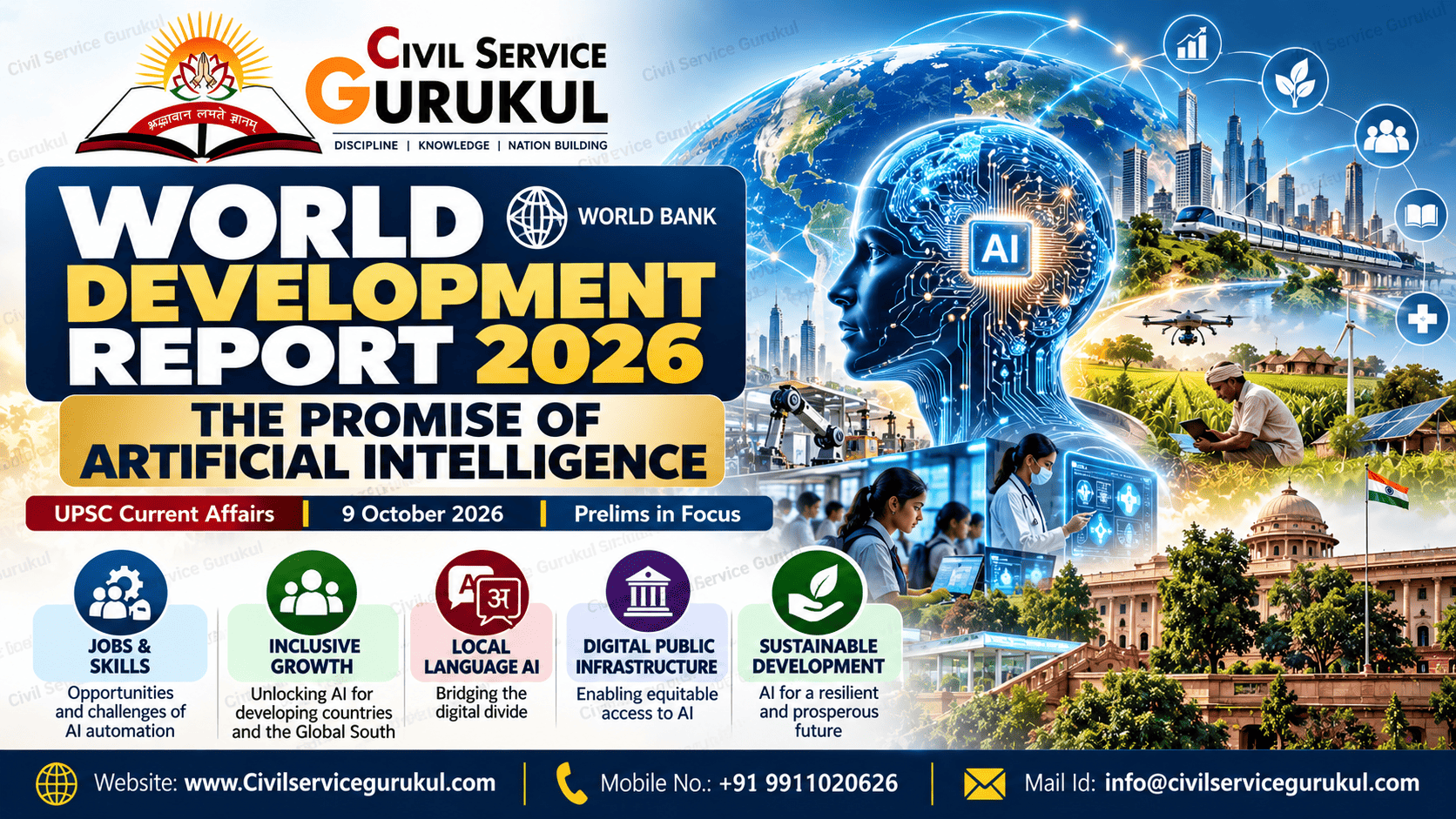
World Development Report 2026: Can Artificial Intelligence Bridge the Global Development Divide?
A comprehensive examination of the World Bank's AI development framework, India's emerging digital economy, the future of employment, technological sovereignty and inclusive growth.
1. Why Is the World Development Report 2026 in the News?
The World Bank Group's World Development Report 2026, titled "The Promise of Artificial Intelligence," has brought renewed attention to the development potential of AI in emerging and developing economies.
The report was launched in New Delhi in an event associated with India's Ministry of Electronics and Information Technology and the IndiaAI Mission.
It examines how artificial intelligence can influence productivity, employment, economic development, public service delivery and technological inequality.
2. What Is the World Development Report?
The World Development Report is an annual flagship research publication of the World Bank Group.
Each edition examines an important development policy challenge and provides research-based analysis and recommendations for policymakers.
Publishing Organisation
World Bank Group
Report Edition
World Development Report 2026
Central Theme
The Promise of Artificial Intelligence
Primary Focus
AI adoption, global development, jobs, inequality and institutional readiness.
3. What Does the Report Say About AI and Development?
Artificial intelligence offers opportunities to improve efficiency and widen access to knowledge. However, countries differ significantly in their ability to harness its benefits.
Developing nations must overcome barriers involving computing resources, affordable connectivity, electricity, skills, data availability and institutional capacity.
Adopt and Adapt Instead of Building Everything
An important policy idea discussed in the report is the Adopt and Adapt Strategy.
Under this approach, countries can use existing AI models and adapt them to local languages, administrative systems, agricultural conditions and development needs.
This may be more affordable than trying to build costly frontier models independently for every use case.
4. Important Findings Highlighted in the Report
The report summary suggests that India's immediate job automation exposure is lower than that of many advanced economies.
However, lower immediate automation exposure should not be confused with the absence of employment risk. Individual occupations, firms and regional labour markets may experience very different impacts.
AI Talent and Brain Drain
India has a substantial AI talent base, but retaining specialised researchers and advanced technology professionals remains a challenge.
The report summary discusses international movement of elite AI researchers, highlighting the need for stronger domestic research opportunities, funding and innovation ecosystems.
AI Preparedness Gap
Many low-income countries lack adequate institutional capacity, digital infrastructure and national strategies for responsible AI adoption.
Consequently, AI could either reduce developmental gaps or reinforce existing inequalities.
5. Artificial Intelligence and Employment
AI is capable of automating certain repetitive and information-processing tasks.
It can also augment human capabilities by assisting with research, analysis, customer support, administration and software development.
| Sector | AI Opportunity | Potential Challenge |
|---|---|---|
| IT & BPO | Productivity and advanced services | Automation of routine tasks |
| Healthcare | Decision support and screening | Privacy and clinical reliability |
| Education | Personalised learning | Unequal technology access |
| Agriculture | Crop advisories and forecasting | Data quality and digital literacy |
| Public Administration | Efficient service delivery | Bias and accountability risks |
| Manufacturing | Quality control and predictive maintenance | Workforce reskilling requirements |
A balanced national strategy should support employment transition through retraining, digital skills and strengthened social protection.
6. What Does the Report Mean for India?
A. Opportunity for Digital Public Infrastructure
India's digital infrastructure provides an opportunity to develop population-scale AI applications in public services.
AI can potentially complement digital identity, payment systems, government service platforms and agricultural information systems.
B. Multilingual AI Innovation
India's linguistic diversity creates strong demand for AI tools capable of interacting through regional languages and voice interfaces.
Such technologies could improve access to health information, educational assistance and government services for digitally underserved populations.
C. AI in Agriculture
AI-assisted crop advisories, weather forecasting, pest identification and resource management may improve farm-level decision-making.
D. AI in Healthcare
AI-assisted screening and clinical decision support could help expand healthcare capacity in resource-constrained settings when appropriately validated and supervised by qualified professionals.
E. Startup and Innovation Ecosystem
Affordable access to computing, research infrastructure, high-quality datasets and skilled professionals can encourage the growth of domestic AI startups.
7. Understanding the IndiaAI Mission
The IndiaAI Mission is a Government of India initiative associated with the Ministry of Electronics and Information Technology.
It aims to strengthen the country's AI ecosystem through computing infrastructure, innovation, datasets, skills and responsible AI development.
Important Areas of the Mission
- AI Compute: Support access to computing resources needed for AI development.
- Innovation: Encourage research and development of AI models and applications.
- Datasets: Improve access to useful and responsibly governed datasets.
- AI Skills: Develop a workforce capable of working with emerging AI technologies.
- Startup Support: Facilitate entrepreneurship and commercial innovation.
- Responsible AI: Promote trustworthy and socially beneficial AI.
8. What Is AI Sovereignty?
AI sovereignty refers to a country's capacity to make meaningful decisions over its AI infrastructure, technology choices, data governance and strategic capabilities.
It does not necessarily require complete technological self-sufficiency.
Even countries operating domestic data centres may depend on foreign semiconductors, cloud technologies, software and global supply chains.
9. Challenges for Developing Countries
Digital Divide
Unequal internet connectivity, devices and digital literacy can concentrate AI benefits among already advantaged groups.
Computing Infrastructure
Advanced AI systems may require expensive hardware, reliable electricity and specialised technical facilities.
Data Governance
Sensitive information, data protection, consent and cybersecurity raise important regulatory concerns.
Labour Market Disruption
Automation and changing job requirements may create uneven employment impacts.
AI Bias
Poor-quality or unrepresentative datasets may produce unfair outcomes in automated decisions.
Fiscal Sustainability
Expensive public subsidies for AI infrastructure may divert resources from other development priorities.
10. Policy Roadmap for Inclusive AI Development
- Affordable AI Access: Improve access to suitable computing resources for universities, startups and public institutions.
- Invest in Human Capital: Expand AI literacy, technical education and lifelong reskilling.
- Promote Local Innovation: Develop AI applications for Indian languages, healthcare, agriculture and education.
- Encourage Open and Interoperable Systems: Reduce avoidable vendor lock-in while safeguarding security and intellectual property.
- Protect Citizens: Strengthen privacy, cybersecurity and mechanisms for contesting harmful automated decisions.
- Evaluate Public Spending: Assess AI infrastructure incentives against measurable development outcomes.
- Support Small Enterprises: Help MSMEs adopt appropriate AI tools through training, technical assistance and affordable services.
- International Cooperation: Engage in global AI governance while preserving domestic policy flexibility.
11. Relevance for UPSC Civil Services Examination
| UPSC Paper | Relevant Areas |
|---|---|
| Prelims | World Bank Group, World Development Report, IndiaAI Mission, AI terminology and international organisations. |
| GS Paper 2 | Governance, public service delivery, digital inclusion, data protection and international institutions. |
| GS Paper 3 | Science and technology, digital economy, employment, innovation, startups and inclusive growth. |
| GS Paper 4 | Algorithmic fairness, transparency, accountability, privacy and ethical AI. |
| Essay | Technology and humanity, innovation and inequality, the future of work and inclusive technological development. |
12. UPSC Prelims Quick Revision
- The World Development Report is published by the World Bank.
- The World Development Report 2026 is titled The Promise of Artificial Intelligence.
- The IndiaAI Mission is associated with MeitY.
- AI can both automate tasks and complement human work.
- AI sovereignty is broader than the domestic ownership or location of data centres.
- Digital inclusion and human capital are central to equitable AI adoption.
13. UPSC Prelims Practice Questions
Question 1
Which organisation publishes the World Development Report?
(A) International Monetary Fund
(B) World Bank
(C) World Trade Organization
(D) United Nations Environment Programme
Correct Answer: (B)
Explanation: The World Development Report is a flagship annual research publication of the World Bank.
Question 2
With reference to AI adoption, consider the following statements:
- Developing countries can adapt existing AI models for local use.
- Domestic data centres alone guarantee complete AI sovereignty.
- AI applications can potentially improve public service delivery.
Which statements are correct?
(A) 1 only
(B) 1 and 2 only
(C) 1 and 3 only
(D) 1, 2 and 3
Correct Answer: (C)
Explanation: Statements 1 and 3 are correct. AI sovereignty depends on several capabilities beyond domestic data centres.
14. UPSC Mains Answer Writing Practice
"Artificial intelligence can either narrow or widen the development divide." Discuss this statement in the context of the World Development Report 2026 and suggest a strategy for inclusive AI-led growth in India.
Suggested Answer Framework
Introduction: Explain AI's growing role in productivity, governance and economic transformation.
Potential Benefits: Discuss agriculture, education, healthcare, MSME productivity and public service delivery.
Major Risks: Examine digital inequality, automation, technological dependence, data protection and concentration of economic power.
Way Forward: Recommend affordable AI access, skills development, responsible governance, public infrastructure and local-language innovation.
Conclusion: Emphasise that AI should function as an instrument of human development rather than an end in itself.
15. Frequently Asked Questions
What is the theme of World Development Report 2026?
The theme is "The Promise of Artificial Intelligence," focusing on AI's opportunities and challenges for global development.
Who publishes the World Development Report?
The World Bank Group publishes the World Development Report.
Why is this report important for India?
It examines AI adoption, digital infrastructure, labour-market change, innovation, technological dependence and inclusive development.
What is the Adopt and Adapt approach?
It encourages countries to use and customise suitable existing AI technologies rather than unnecessarily recreating expensive systems.
Which UPSC subjects cover this report?
It is relevant to international organisations, GS Paper 2, GS Paper 3, technology governance, economic development and ethics.
16. Conclusion: Making Artificial Intelligence a Development Multiplier
The World Development Report 2026 offers a broader lesson: technological progress alone does not guarantee equitable economic development.
Artificial intelligence can support human welfare, increase productivity and improve essential services. However, these gains depend on how technologies are accessed, governed and integrated into social and economic systems.
For India, the strategic priority should be the creation of affordable, responsible, multilingual and inclusive AI capabilities that strengthen human development while supporting innovation and economic competitiveness.
Prepare Smarter with Civil Service Gurukul
Strengthen your UPSC preparation with exam-oriented current affairs, Prelims concepts, GS Mains analysis, practice questions and answer-writing guidance.
Website:
www.Civilservicegurukul.com
Mobile:
+91 9911020626
Email:
info@civilservicegurukul.com
Educational Disclaimer: This article is prepared for UPSC Civil Services Examination preparation and general educational awareness. Statistical estimates and policy developments should be interpreted in their original context. Students should verify official updates when preparing current affairs.
Prepare with Mentors Who Cleared the Exam
Get personalized study plans, evaluated answer models, and test series access.