
Ayush Services Sector Report 2026: Women, Wellness and India’s Traditional Healthcare Economy
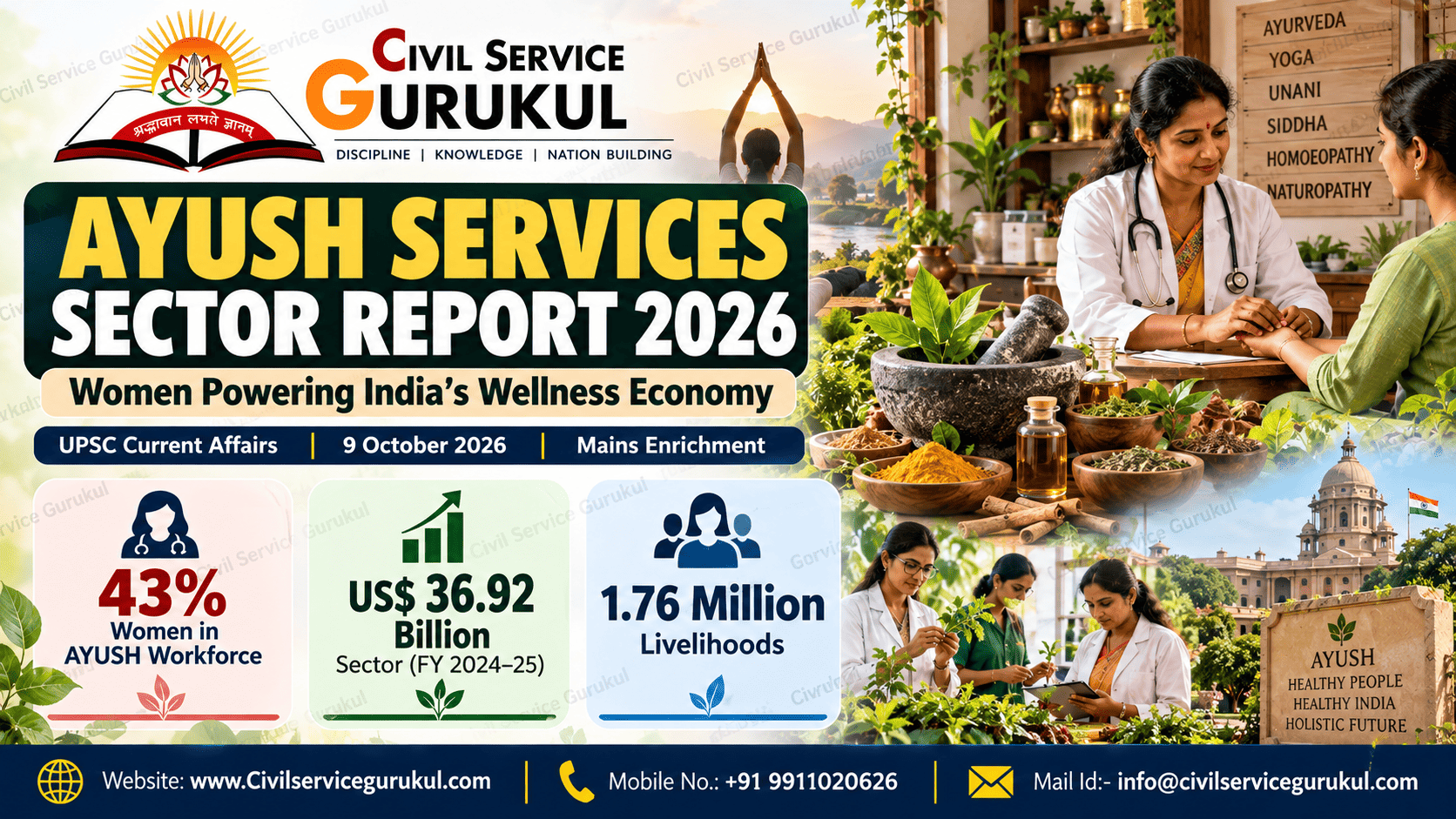
Ayush Services Sector Report 2026: Women, Wellness and India’s Traditional Healthcare Economy
India’s Ayush ecosystem is increasingly emerging not only as a healthcare system, but also as a source of employment, women-led participation, entrepreneurship, wellness services, medical tourism and economic growth.
Excerpt / Brief Summary
What Is the Ayush Services Sector Report 2026?
The report is a sectoral assessment of India’s Ayush services ecosystem, examining its economic size, employment contribution, women’s participation and future growth potential.
It covers services associated with systems such as:
- Ayurveda;
- Yoga and Naturopathy;
- Unani;
- Siddha;
- Homoeopathy;
- Wellness and preventive-health services.
The report helps shift the policy discussion from viewing Ayush only as traditional medicine toward understanding it as an expanding healthcare and services economy.
Key Findings at a Glance
| Indicator | Finding |
|---|---|
| Women in Overall Workforce | 43% |
| Ayush Services Economy | US$36.92 billion in FY2024-25 |
| Recent CAGR | 16.91% |
| Livelihoods Supported | Approximately 1.76 million |
| Standalone Clinics Revenue | US$16.21 billion |
| Standalone Clinics Share | 43.9% |
| Day-Care Centres | US$10.13 billion |
| Ayurveda Revenue Share | Nearly 48% |
| Medical Value Travel | US$1.77 billion |
| Long-Term Projection | US$216–318 billion by 2047 |
Women Are Central to the Ayush Services Economy
One of the most important findings is the high level of women’s participation. Women account for around 43% of the total workforce.
Their representation is even higher in several organised segments:
| Segment | Women’s Representation |
|---|---|
| Spas and wellness resorts | More than 60% |
| Educational institutions | 58% |
| Day-care centres | 57% |
| Hospitals | 53% |
Why Women’s Participation Matters
Women’s employment in Ayush has significance beyond headline workforce numbers.
It can contribute to:
- Financial independence;
- Higher household decision-making power;
- Professional participation;
- Entrepreneurship;
- Rural livelihoods;
- Healthcare access;
- Gender-inclusive economic growth.
Ayush as an Employment Generator
The sector supports approximately 1.76 million livelihoods.
More than one million of these are concentrated in standalone and local clinics across rural and urban India.
Unlike sectors concentrated only in metropolitan cities, Ayush services can create employment across:
- Small towns;
- Rural areas;
- District centres;
- Tourism destinations;
- Local healthcare markets.
Standalone Clinics Form the Largest Revenue Segment
Standalone clinics contribute approximately US$16.21 billion, representing nearly 43.9% of the sector’s total revenue.
This shows that decentralised healthcare establishments remain central to the Ayush economy.
Such clinics can play a role in:
- Primary healthcare;
- Preventive care;
- Chronic-condition management;
- Local employment;
- Small-business entrepreneurship.
Day-Care Centres Are Another Major Segment
Day-care centres account for approximately US$10.13 billion of sectoral revenue.
These facilities can provide therapies and wellness services without requiring full hospital admission.
Their expansion reflects changing consumer preferences toward preventive, outpatient and wellness-oriented healthcare.
Ayurveda Remains the Economic Anchor
Ayurveda contributes nearly 48% of total Ayush services revenue.
Its importance arises from a combination of:
- Large practitioner base;
- Strong cultural acceptance;
- Wellness applications;
- Panchakarma and therapeutic services;
- Growing global interest;
- Medical tourism potential.
Wellness Is Becoming a Major Growth Engine
The wellness segment recorded strong growth, with a CAGR of around 21.29%.
The category includes:
- Ayurveda wellness programmes;
- Yoga retreats;
- Spas;
- Naturopathy;
- Preventive health programmes;
- Rejuvenation therapies.
India’s healthcare economy is gradually expanding from treatment of disease toward prevention, lifestyle management and wellness.
Medical Value Travel and India’s Soft Power
Ayush-related medical value travel generated around US$1.77 billion.
International demand for:
- Ayurveda;
- Yoga;
- Naturopathy;
- Wellness retreats;
- Traditional therapies
creates an important connection between healthcare, tourism and cultural diplomacy.
Ayush and India’s Services-Sector Growth
India’s services economy is generally associated with IT, finance and professional services.
The Ayush sector demonstrates that traditional knowledge can also create a modern services economy.
Its economic linkages include:
- Healthcare;
- Education;
- Tourism;
- Hospitality;
- Wellness;
- Skill development;
- Digital consultation;
- Research.
Traditional Knowledge Can Generate Modern Livelihoods
The Ayush sector illustrates how traditional knowledge systems can be integrated into a contemporary economic framework.
↓
Scientific validation and standardisation
↓
Professional services
↓
Entrepreneurship and employment
↓
Domestic and international markets
Why the Sector Matters for Rural India
Ayush services can create economic opportunities outside large cities because many practitioners and local clinics operate in smaller towns and villages.
This supports:
- Decentralised employment;
- Local entrepreneurship;
- Community healthcare;
- Reduced urban migration;
- Women-led livelihoods.
Entrepreneurship Opportunities
The wider ecosystem creates opportunities in:
- Clinics;
- Wellness centres;
- Yoga institutions;
- Therapy centres;
- Training academies;
- Healthcare tourism;
- Digital health platforms;
- Consultation services.
This makes Ayush relevant not only to public health policy but also to MSME and startup development.
Challenges Facing the Ayush Services Sector
Service quality may vary substantially across practitioners and institutions.
2. Scientific Validation
Traditional practices need stronger evidence-based research and clinical validation.
3. Regulation
Rapid market expansion can increase risks from unqualified practitioners and misleading claims.
4. Skill Gaps
International-quality wellness and healthcare services require continuous training.
5. Data Availability
Better economic and employment data are required for effective policymaking.
6. Global Recognition
International acceptance requires credible standards and transparent evidence.
Need for Evidence-Based Traditional Medicine
The long-term credibility of the sector depends on combining traditional knowledge with modern scientific research.
Policy should encourage:
- Clinical research;
- Outcome measurement;
- Standard treatment protocols;
- Evidence-based claims;
- Pharmacovigilance;
- International peer-reviewed research.
Quality Standards Are Essential for Medical Tourism
Foreign patients generally expect transparent quality standards, professional accreditation and predictable service quality.
India therefore needs:
- Accredited hospitals;
- Qualified practitioners;
- International treatment protocols;
- Clear pricing;
- Patient-safety systems;
- Strong grievance mechanisms.
Ayush and Women-Led Entrepreneurship
The high female participation rate creates opportunities to promote women as business owners rather than only employees.
Policy support can focus on:
- Credit access;
- Skill programmes;
- Digital marketing;
- Business incubation;
- Tourism linkages;
- Self-help groups;
- Women-led wellness enterprises.
The Ayush economy can be used as an example of “care economy + women’s empowerment + traditional knowledge + entrepreneurship.”
Ayush and Preventive Healthcare
India faces a rising burden of lifestyle and non-communicable diseases. Preventive healthcare therefore has increasing policy relevance.
Ayush-based wellness services can complement the wider health system through:
- Yoga;
- Diet counselling;
- Wellness programmes;
- Lifestyle modification;
- Stress management;
- Preventive health awareness.
However, such services should complement rather than replace evidence-based medical treatment where clinically required.
Ayush and SDGs
| SDG | Ayush Linkage |
|---|---|
| SDG 3 | Good Health and Well-being |
| SDG 5 | Gender Equality |
| SDG 8 | Decent Work and Economic Growth |
| SDG 10 | Reduced Inequalities through decentralised livelihood opportunities |
Way Forward
- Strengthen Scientific Research: Build greater evidence for safety and efficacy.
- Improve Accreditation: Develop credible quality standards for clinics, hospitals and wellness centres.
- Promote Women Entrepreneurs: Improve access to finance, skilling and market networks.
- Integrate Digital Health: Support teleconsultation and digital records while ensuring quality.
- Build Medical-Tourism Clusters: Integrate healthcare with hospitality, travel and wellness infrastructure.
- Expand Global Standards: Improve international recognition of qualified services.
- Strengthen Skill Development: Create professional training pathways across wellness and healthcare services.
UPSC GS Paper II Relevance
- Healthcare delivery;
- Traditional medicine;
- Women’s empowerment;
- Inclusive healthcare;
- Government initiatives in health.
UPSC GS Paper III Relevance
- Employment generation;
- Services-sector growth;
- Entrepreneurship;
- Women’s workforce participation;
- Medical tourism;
- MSME development.
Essay Relevance
The topic can enrich essays dealing with:
- Women and economic development;
- Traditional knowledge in modern India;
- Healthcare and human development;
- India’s soft power;
- Inclusive growth;
- Employment-led development.
UPSC Mains Practice Question
“The Ayush sector represents the convergence of traditional knowledge, women’s economic participation, employment generation and India’s wellness economy.” Discuss the economic and social significance of the Ayush services sector in India.
Suggested Marks: 15
Suggested Word Limit: 250 words
Mains Answer Framework
Mention the economic size of the Ayush services sector and the high level of women’s participation.
Body:
- Economic contribution;
- 1.76 million livelihoods;
- 43% women workforce participation;
- Ayurveda’s revenue share;
- Wellness and medical tourism;
- Rural entrepreneurship;
- Soft-power potential;
- Quality and scientific-validation challenges.
Emphasise evidence-based growth, quality regulation and women-led entrepreneurship.
Key Data for Mains Answers
- 43% – women in overall Ayush workforce;
- 60%+ – women in spas and wellness resorts;
- US$36.92 billion – sector size in FY2024-25;
- 16.91% – recent CAGR;
- 1.76 million – livelihoods supported;
- 43.9% – standalone clinics’ revenue share;
- Nearly 48% – Ayurveda’s revenue contribution;
- US$1.77 billion – medical value travel;
- US$216–318 billion – projected sector size by 2047.
Key Terms for Answer Enrichment
Conclusion
The Ayush Services Sector Report 2026 shows that India’s traditional healthcare systems are developing into a significant services economy.
Its importance lies not only in revenue growth, but also in its ability to generate decentralised employment, expand women’s economic participation, support entrepreneurship and enhance India’s global wellness profile.
The next phase of growth must focus on scientific validation, professional standards, credible regulation, women-led entrepreneurship and international quality benchmarks.
SEO Tags
Prepare with Mentors Who Cleared the Exam
Get personalized study plans, evaluated answer models, and test series access.