
Gaganyaan Mission: Astronaut Training & Safety UPSC 2027
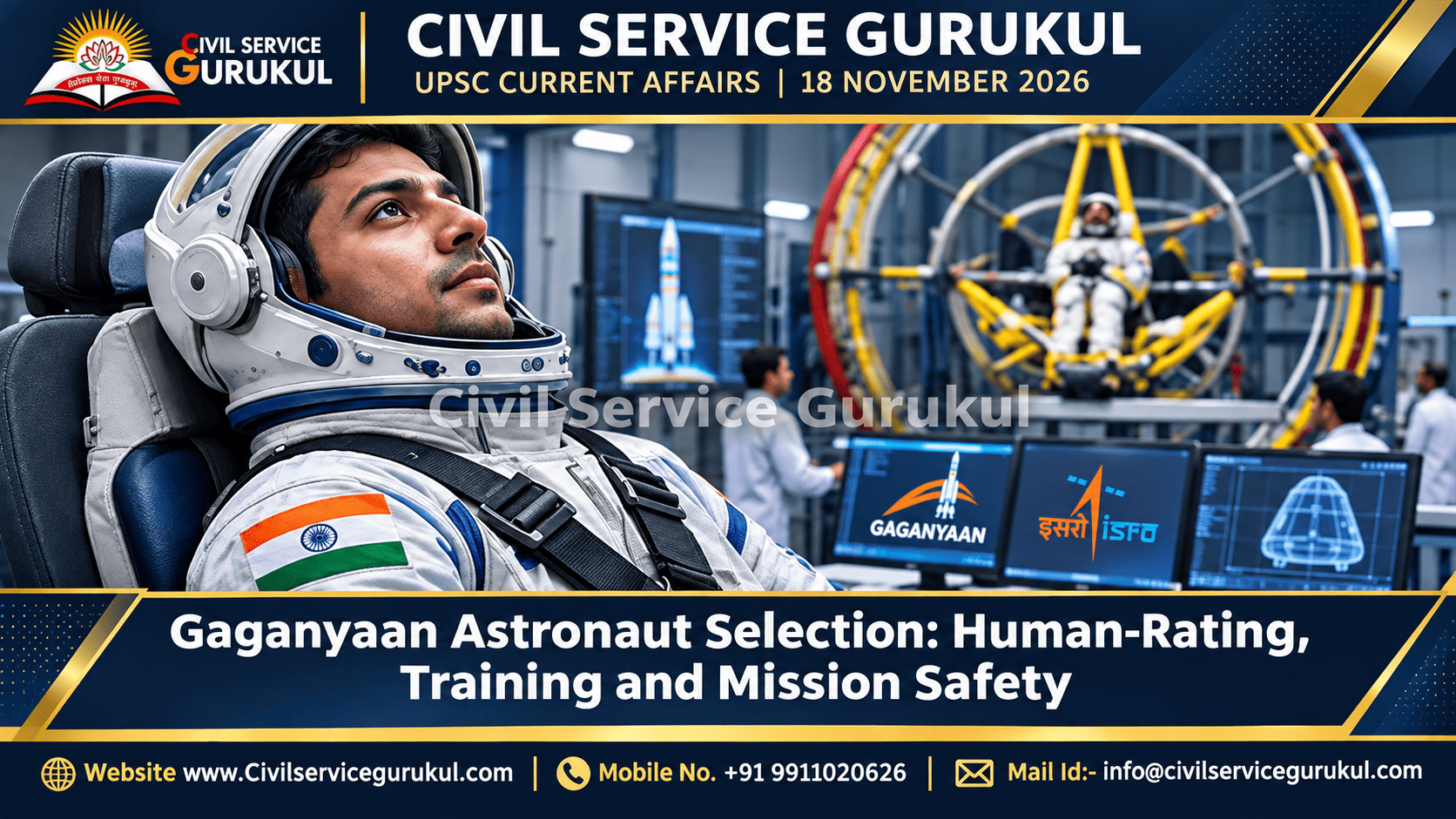
Gaganyaan Mission: How India Selects and Trains Astronauts for Safe Human Spaceflight
A comprehensive UPSC analysis of ISRO's human spaceflight programme, astronaut selection, training, human-rating, crew escape systems, life-support technology and mission safety.
1. Why Is Gaganyaan Important for India?
Gaganyaan represents India's effort to develop indigenous capabilities for human spaceflight.
Unlike uncrewed satellite missions, human spaceflight requires the protection of human life throughout launch, orbital operations, re-entry and recovery.
This introduces additional engineering, medical, operational and organisational requirements.
2. What Is the Gaganyaan Mission?
Gaganyaan is India's human spaceflight programme led by the Indian Space Research Organisation (ISRO).
It aims to develop and demonstrate capabilities needed to send humans into space and return them safely.
Major Technological Requirements
- Human-rated launch systems.
- Crew module and associated spacecraft systems.
- Environmental control and life support.
- Emergency escape capability.
- Communication and mission monitoring.
- Re-entry and recovery systems.
- Trained astronauts and mission controllers.
3. Human Spaceflight vs Uncrewed Missions
| Parameter | Uncrewed Mission | Human Spaceflight |
|---|---|---|
| Primary Payload | Scientific instruments, satellites or other equipment. | Human crew and supporting systems. |
| Life Support | Not generally required for human habitation. | Essential for crew survival. |
| Emergency Escape | Mission-dependent spacecraft protection. | Specialised crew-protection requirements. |
| Medical Monitoring | Not applicable to human crew. | Important for astronaut health. |
| Safety Engineering | Mission-specific reliability requirements. | Additional human-safety requirements. |
4. How Are Astronauts Selected?
Astronaut selection is a demanding process because spaceflight exposes crew members to unusual physical, psychological and operational conditions.
Selection frameworks generally consider medical fitness, technical capability, psychological suitability and the ability to work effectively under pressure.
Important Selection Considerations
Capacity to withstand demanding mission conditions.
Ability to understand spacecraft systems and operational procedures.
Ability to manage stress, uncertainty and confined environments.
Effective coordination with fellow crew members and mission control.
Ability to respond accurately during time-sensitive situations.
Capacity to learn and perform in unfamiliar environments.
5. Astronaut Training for Gaganyaan
Astronaut training prepares crew members to operate safely and effectively during normal and emergency mission conditions.
Training must combine physical preparation, technical understanding, simulations, communication and coordinated decision-making.
Major Training Components
Supports fitness for demanding mission operations.
Prepares astronauts for unexpected mission situations.
Recreates operational scenarios for
Prepare with Mentors Who Cleared the Exam
Get personalized study plans, evaluated answer models, and test series access.