India–China LAC Negotiations 2026 – UPSC 2027
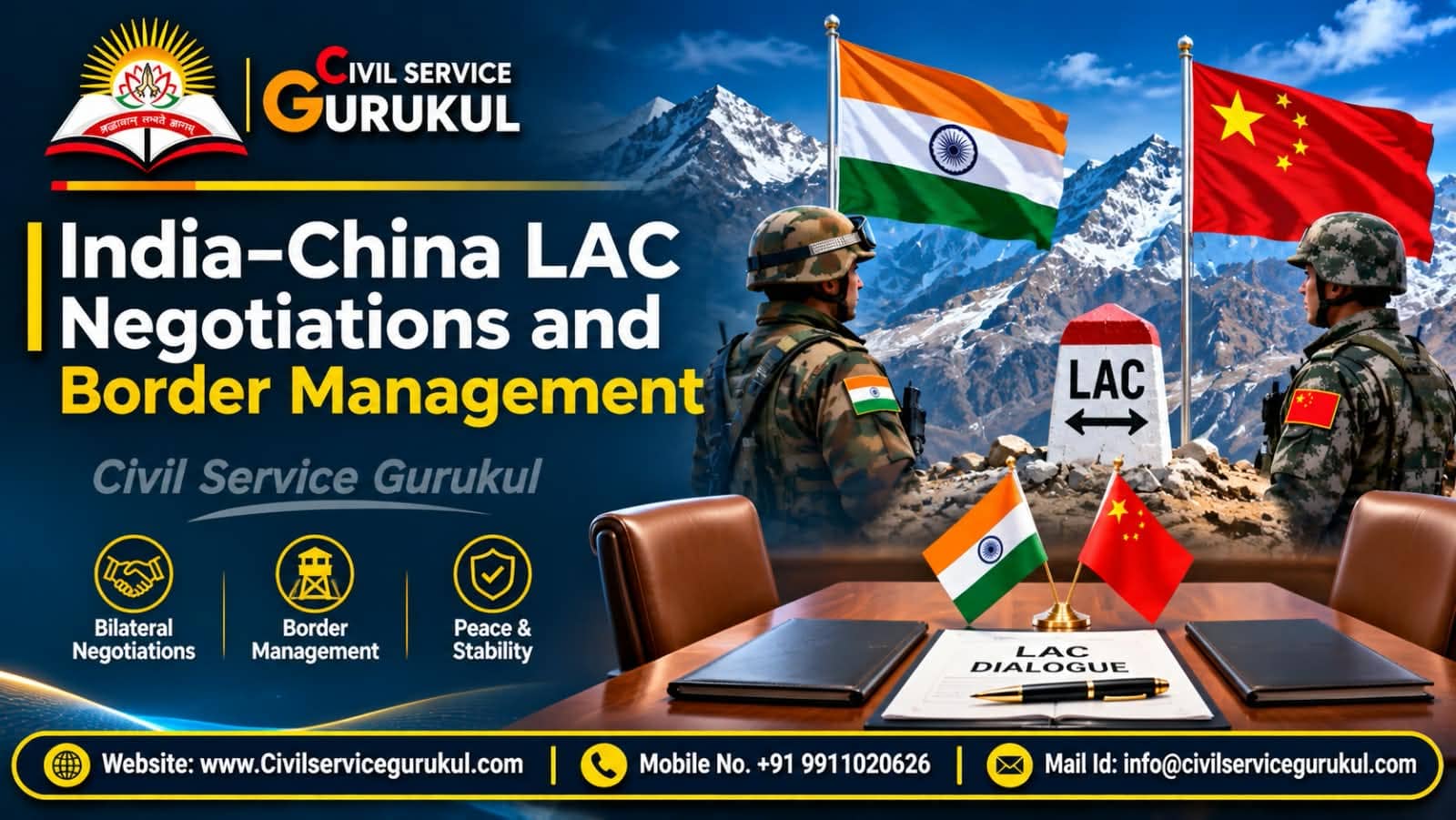
India–China LAC Negotiations 2026: From Border Tensions to Strategic Dialogue, Peace and Sustainable Border Management
India and China continue to pursue diplomatic and military engagement to manage their disputed Himalayan frontier. Recent negotiations highlight the importance of mutual trust, effective communication, strategic preparedness and sustainable border development in maintaining peace along the Line of Actual Control.
Why in the News?
India and China have reportedly conducted another round of military discussions in Arunachal Pradesh during November 2026 to manage differences along the Line of Actual Control (LAC) and reduce the possibility of renewed confrontations.
Reports published on 23 and 24 November 2026 describe nearly ten days of military engagement aimed at improving coordination and maintaining stability along the eastern frontier.
These discussions follow the 25th round of Special Representatives' talks held in Beijing on 25 August 2026 between India's National Security Adviser Ajit Doval and Chinese Foreign Minister Wang Yi.
The August meeting produced an eight-point understanding concerning boundary negotiations, border-management mechanisms, communication channels and cross-border cooperation.
The developments indicate continued efforts to stabilize bilateral relations. However, the ultimate settlement of the India–China boundary question remains unresolved.
UPSC CSE Syllabus Relevance
| UPSC Paper | Relevant Syllabus Topics |
|---|---|
| Prelims GS Paper I | Indian geography, international boundaries, government schemes and current affairs |
| Mains GS Paper I | Himalayan geography, regional development, population and migration |
| Mains GS Paper II | India and its neighbourhood, bilateral relations, international diplomacy and foreign policy |
| Mains GS Paper III | Border management, security challenges, infrastructure and disaster management |
| Mains GS Paper IV | Diplomatic ethics, conflict resolution, accountability and human welfare |
| Essay Paper | Peace, national security, international cooperation and development |
What Is the Line of Actual Control?
The Line of Actual Control, commonly abbreviated as LAC, refers to the line separating areas under Indian and Chinese control along their disputed frontier.
Unlike a mutually settled and formally demarcated international boundary, the alignment of the entire LAC has not been jointly agreed upon by India and China.
Differences in the perception of its alignment have historically contributed to tensions, competing territorial assertions and difficulties in border management.
India officially identifies the length of its boundary with China as approximately 3,488 kilometres. China uses a different assessment of the boundary's extent.
The LAC is a practical line of control pending a final boundary settlement. It does not independently determine internationally agreed sovereignty over disputed territories.
Difference Between LAC, LOC and International Boundary
| Particulars | LAC | LOC | International Boundary |
|---|---|---|---|
| Full Form | Line of Actual Control | Line of Control | International Boundary |
| Countries | India and China | India and Pakistan | Respective neighbouring countries |
| Nature | Line of control with differing perceptions in certain areas | Agreed military control line in the Jammu and Kashmir region | Generally recognized territorial boundary |
| Relevant Agreement | 1993 border peace agreement and subsequent arrangements | Simla Agreement, 1972 | Applicable boundary treaties and legal arrangements |
| Final Sovereignty Settlement | No | No | Generally represents an agreed territorial division |
Three Sectors of the India–China Boundary
For geographical and diplomatic analysis, the disputed India–China boundary is generally divided into western, middle and eastern sectors. The Sikkim frontier has a distinct historical treaty background.
| Sector | Geographical Region | Major Issues |
|---|---|---|
| Western Sector | Ladakh | Aksai Chin and historical differences concerning boundary alignment |
| Middle Sector | Himachal Pradesh and Uttarakhand | Differences in certain areas of boundary alignment |
| Eastern Sector | Arunachal Pradesh | McMahon Line and competing territorial claims |
| Sikkim Frontier | Sikkim | Distinct historical arrangements, with differences concerning certain adjoining areas and tri-junctions |
1. Western Sector
The western sector includes the Ladakh frontier and Aksai Chin.
Aksai Chin is administered by China and claimed by India as part of its territory. Historical differences regarding the alignment of the boundary remain central to the dispute.
2. Middle Sector
The middle sector broadly covers the Himalayan frontier of Himachal Pradesh and Uttarakhand.
Although differences remain, this sector has historically involved fewer major territorial disputes than the western and eastern sectors.
3. Eastern Sector
The eastern sector primarily concerns Arunachal Pradesh and the historical boundary alignment associated with the McMahon Line.
India maintains that Arunachal Pradesh is an integral and inalienable part of India. China claims substantial parts of the state and rejects the historical boundary arrangement.
The Indian states sharing a boundary with China are Himachal Pradesh, Uttarakhand, Sikkim and Arunachal Pradesh, along with the Union Territory of Ladakh.
Important Geographical Locations for UPSC
| Location | Geographical Significance |
|---|---|
| Aksai Chin | Disputed high-altitude region in the western sector |
| Pangong Tso | High-altitude lake extending across areas controlled by India and China |
| Galwan Valley | River valley in the Ladakh region associated with the 2020 border crisis |
| Depsang Plains | High-altitude plains in northern Ladakh |
| Demchok | Border region in eastern Ladakh |
| Nathu La | Mountain pass in Sikkim connecting India and the Tibetan region of China |
| Lipulekh Pass | Himalayan pass associated with border trade and pilgrimage |
| Tawang | Historically and culturally important region of Arunachal Pradesh |
| Doklam | Disputed plateau between Bhutan and China near the India–Bhutan–China tri-junction |
Doklam is not a bilateral India–China territorial dispute in the same sense as Aksai Chin. It concerns competing claims between Bhutan and China, while its proximity to India gives it wider strategic significance.
Historical Background of the India–China Boundary Dispute
1. Colonial-Era Boundary Proposals
During British rule, different boundary proposals were considered for the western Himalayan region.
The absence of a mutually accepted final settlement contributed to subsequent differences regarding territorial claims.
2. Simla Convention and McMahon Line, 1914
The McMahon Line emerged from negotiations involving British India and Tibet during the Simla Convention process of 1913–1914.
India regards the line as the basis of the boundary in the eastern sector. China rejects the agreement as a valid boundary settlement.
3. Panchsheel Agreement, 1954
India and China signed an agreement concerning trade and intercourse with the Tibet region of China in 1954.
Its preamble incorporated the Five Principles of Peaceful Coexistence, popularly known as Panchsheel.
4. India–China War, 1962
Unresolved territorial differences culminated in armed conflict in 1962, profoundly affecting bilateral relations and mutual confidence.
5. Diplomatic Normalization
The visit of Indian Prime Minister Rajiv Gandhi to China in 1988 marked an important stage in efforts to normalize relations and establish mechanisms for addressing the boundary question.
6. Border Peace Agreements
Beginning in 1993, India and China developed agreements and confidence-building arrangements intended to preserve peace pending a final boundary settlement.
7. Eastern Ladakh Border Crisis, 2020
The border crisis of 2020, including the Galwan Valley confrontation, caused a serious deterioration in bilateral trust.
Subsequent military and diplomatic negotiations focused on disengagement and restoration of stability.
8. Patrolling Agreement, October 2024
On 21 October 2024, India and China reached an agreement concerning patrolling arrangements in Depsang and Demchok.
According to India's Ministry of External Affairs, this resulted in disengagement at the remaining friction points arising from the 2020 developments.
The agreement did not constitute a final settlement of the broader territorial dispute.
9. Diplomatic and Military Engagements in 2026
Continued discussions during 2026 have focused on improving existing communication mechanisms and advancing negotiations over boundary management and eventual settlement.