
JAIMEX 2026: India–Japan Maritime Cooperation for UPSC
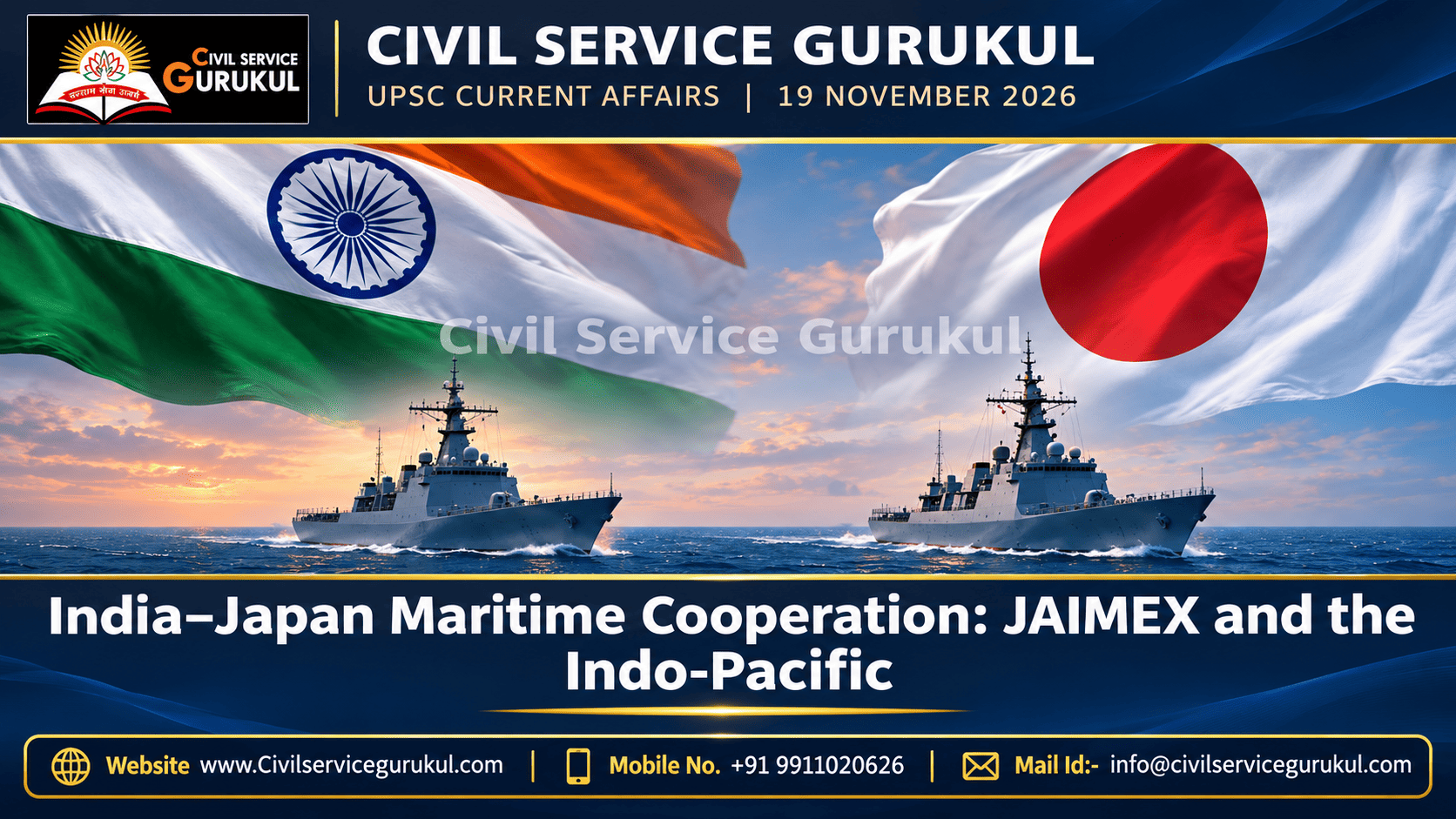
India–Japan Maritime Partnership: How JAIMEX 2026 Strengthens Indo-Pacific Security and India's Strategic Autonomy
A comprehensive UPSC analysis of JAIMEX, INS Sahyadri, India–Japan defence cooperation, the Quad, maritime trade routes, ASEAN centrality and strategic autonomy.
1. Why Is India–Japan Maritime Cooperation in the News?
A November 2026 current affairs topic has highlighted India–Japan maritime engagement through the reported participation of INS Sahyadri in JAIMEX 2026.
The discussion also refers to high-level defence engagement between India and Japan.
The broader significance lies in the increasing importance of naval cooperation, maritime awareness and operational coordination in the Indo-Pacific.
2. What Is JAIMEX?
JAIMEX refers to the Japan–India Maritime Exercise, a bilateral naval exercise associated with cooperation between the Indian Navy and Japan's Maritime Self-Defense Force.
Such exercises provide opportunities to strengthen professional engagement, operational coordination and mutual understanding between participating naval forces.
Major Objectives of Maritime Exercises
Improve the ability of different naval forces to operate together.
Strengthen coordination through shared procedures and communication practices.
Support better understanding of activities and risks in maritime areas.
Improve coordination relevant to maritime emergency responses.
Encourage learning and cooperation between naval personnel.
Improve preparedness for relevant maritime situations.
3. Why Are Joint Naval Exercises Important?
Naval exercises help participating forces develop shared procedures, improve communication and identify operational challenges.
They can strengthen the ability to coordinate during maritime emergencies and other relevant situations.
However, the specific activities undertaken in a particular exercise should be confirmed through official exercise documentation.
4. India–Japan Strategic Relations
India and Japan maintain a broad strategic relationship that includes economic, diplomatic, technological and security cooperation.
Maritime engagement is one component of this wider partnership.
Important Areas of Cooperation
- Maritime security and naval engagement.
- Economic and infrastructure cooperation.
- Technology and industrial partnerships.
- Regional diplomatic coordination.
- Resilient supply chains.
- Cooperation within Indo-Pacific institutions and groupings.
5. Defence Diplomacy and Maritime Partnerships
Defence diplomacy uses professional military engagement, dialogue and cooperation to support wider foreign-policy objectives.
Naval exercises can improve confidence and coordination between countries.
Their strategic value should be assessed alongside diplomatic dialogue, crisis-management mechanisms and regional stability.
6. What Is the Indo-Pacific Region?
The Indo-Pacific is a strategic and geographic concept connecting the Indian and Pacific Ocean regions.
It is important because major maritime trade routes, energy flows and regional security interests intersect across these waters.
Why Is the Indo-Pacific Important for India?
Maritime routes support international commercial connectivity.
Sea routes are important for the movement of energy supplies.
Predictable maritime conditions support economic and security interests.
Partnerships can support maritime awareness and coordination.
7. Sea Lines of Communication
Sea Lines of Communication, or SLOCs, refer to maritime routes important for trade, transportation and strategic movement.
Their security matters because disruption can affect supply chains, energy movement and economic activity.
8. Maritime Domain Awareness
Maritime Domain Awareness refers broadly to understanding maritime activities that may affect security, safety, economic interests or the marine environment.
It can support timely decision-making, risk identification and coordination between relevant authorities.
9. India, Japan and the Quad
India and Japan are members of the Quadrilateral Security Dialogue, commonly called the Quad.
The Quad also includes Australia and the United States.
It is a diplomatic partnership that addresses a range of regional priorities.
| Member | Region |
|---|---|
| India | South Asia / Indian Ocean |
| Japan | East Asia / Pacific Ocean |
| Australia | Oceania / Indo-Pacific |
| United States | North America / Pacific and wider Indo-Pacific |
10. ASEAN Centrality in the Indo-Pacific
ASEAN centrality refers to the importance of ASEAN-led processes and institutions in the regional diplomatic architecture.
India's approach to Indo-Pacific engagement can support cooperation with regional partners while recognising ASEAN's role.
A balanced regional strategy should combine security engagement with diplomatic dialogue and inclusive cooperation.
11. Strategic Autonomy and India's Foreign Policy
Strategic autonomy refers to India's capacity to make foreign-policy and security decisions according to its national interests without automatic alignment with another country's positions.
India can participate in naval exercises and security dialogues while retaining independent decision-making.
Naval Exercise vs Military Alliance
| Parameter | Naval Exercise | Military Alliance |
|---|---|---|
| Purpose | Training and operational cooperation. | Formal security commitments, depending on treaty terms. |
| Legal Obligation | Participation alone does not create collective-defence obligations. | May include binding defence commitments. |
| Decision-Making | Participating countries retain their sovereign decisions. | Subject to the alliance's agreed obligations. |
| Example | JAIMEX | NATO |
12. How Maritime Cooperation Supports Strategic Autonomy
- Builds operational capabilities through cooperation.
- Strengthens partnerships without requiring automatic military alignment.
- Supports independent maritime awareness.
- Improves diplomatic engagement with multiple regional actors.
- Can contribute to crisis preparedness and regional stability.
13. Challenges in Indo-Pacific Maritime Cooperation
Rivalries among major powers can complicate regional cooperation.
Misperceptions and incidents can increase tensions.
Forces may use different systems and procedures.
Sustained engagement requires capacity and investment.
Cooperation must be managed alongside other regional relationships.
Smaller states and ASEAN-led institutions remain important.
14. International Law and Maritime Security
Maritime governance involves principles of international law, including the United Nations Convention on the Law of the Sea (UNCLOS).
UNCLOS establishes a legal framework for maritime zones and various rights and obligations of states.
However, the specific rights associated with navigation and maritime activity depend on the relevant maritime zone and legal conditions.
15. Way Forward for India–Japan Maritime Cooperation
- Strengthen interoperability: Continue appropriate professional naval engagement.
- Improve maritime awareness: Support lawful information sharing and coordination.
- Develop crisis-management mechanisms: Reduce misperception and escalation risks.
- Support regional inclusion: Maintain dialogue with ASEAN and other partners.
- Build institutional capacity: Invest in personnel, technology and operational readiness.
- Protect strategic autonomy: Maintain independent national decision-making.
- Measure outcomes: Evaluate exercises through relevant operational and diplomatic indicators.
- Verify developments: Use official announcements for exercise-specific and ministerial-visit details.
16. UPSC Prelims 2027: Quick Revision
- JAIMEX is a bilateral maritime exercise involving India and Japan.
- Japan's naval service is the Japan Maritime Self-Defense Force.
- India and Japan are members of the Quad.
- The other Quad members are Australia and the United States.
- Naval exercises do not automatically create mutual-defence obligations.
- SLOC means Sea Line of Communication.
- The Indo-Pacific links the Indian and Pacific Ocean regions.
- ASEAN centrality is important in regional diplomatic architecture.
- Strategic autonomy involves independent foreign-policy decision-making.
- UNCLOS provides an important legal framework for maritime governance.
17. Original UPSC Prelims MCQs
Question 1
Consider the following statements about JAIMEX:
- It is associated with maritime cooperation between India and Japan.
- Participation automatically creates a binding mutual-defence treaty.
- Such exercises may improve operational coordination.
Which statements are correct?
(A) 1 only
(B) 1 and 3 only
(C) 2 and 3 only
(D) 1, 2 and 3
Statements 1 and 3 are correct. Statement 2 is incorrect: participation in an exercise does not itself create a defence treaty.
Question 2
Which of the following countries are members of the Quad?
- India
- Japan
- Australia
- United States
(A) 1 and 2 only
(B) 1, 2 and 3 only
(C) 2, 3 and 4 only
(D) 1, 2, 3 and 4
The Quad consists of India, Japan, Australia and the United States.
Question 3
Sea Lines of Communication are primarily associated with:
(A) Land-based agricultural corridors.
(B) Maritime routes important for transportation and trade.
(C) Boundaries between Indian states.
(D) Satellite communication frequencies.
SLOCs are important maritime routes used for transport and strategic movement.
Question 4
Consider the following statements:
- Strategic autonomy allows independent foreign-policy decision-making.
- Participation in a joint naval exercise necessarily ends strategic autonomy.
- Maritime cooperation can support crisis preparedness.
Which statements are correct?
(A) 1 and 3 only
(B) 1 and 2 only
(C) 2 and 3 only
(D) 1, 2 and 3
Statements 1 and 3 are correct. Statement 2 is incorrect because cooperation does not automatically eliminate independent decision-making.
Question 5
Which statement best describes ASEAN centrality?
(A) ASEAN is a collective-defence alliance controlling the Indo-Pacific.
(B) ASEAN-led institutions and processes play an important role in regional diplomacy.
(C) ASEAN membership is compulsory for all Indo-Pacific countries.
(D) ASEAN directly commands the naval forces of its dialogue partners.
ASEAN centrality recognises the importance of ASEAN-led regional processes and institutions.
18. UPSC Mains Practice Question
"India–Japan maritime cooperation can reinforce regional security without compromising India's strategic autonomy." Critically examine in the context of the Indo-Pacific.
Word Limit: 250 words
19. Model UPSC Mains Answer
Introduction
India–Japan maritime cooperation is an important component of their broader strategic relationship. Exercises such as JAIMEX provide opportunities to improve operational coordination and support regional maritime stability.
Strategic Significance
- Interoperability: Joint exercises strengthen professional coordination.
- Maritime Security: Cooperation supports awareness of risks affecting sea routes.
- Economic Interests: Stable maritime routes support trade and energy movement.
- Regional Engagement: Cooperation complements wider Indo-Pacific diplomacy.
Strategic Autonomy
India's participation in naval exercises does not automatically create binding collective-defence obligations.
India can strengthen partnerships while retaining independent foreign-policy decisions.
Challenges
- Strategic competition and escalation risks.
- Operational and technological differences.
- Resource constraints.
- The need to maintain diplomatic balance and ASEAN centrality.
Way Forward
India should strengthen interoperability, maritime awareness and crisis-management mechanisms while supporting inclusive regional dialogue and international law.
Conclusion
India–Japan maritime cooperation can support regional stability and national security when guided by strategic autonomy, practical coordination and responsible diplomacy.
20. Frequently Asked Questions
What is JAIMEX?
JAIMEX is the Japan–India Maritime Exercise, associated with bilateral naval cooperation.
Which countries are members of the Quad?
India, Japan, Australia and the United States.
Does JAIMEX create a military alliance?
No. Participation in a naval exercise does not automatically create a binding mutual-defence treaty.
Why is the Indo-Pacific important for India?
The region contains important maritime trade routes and has major economic, energy-security and strategic significance.
What is strategic autonomy?
It is the capacity to make independent foreign-policy and security decisions according to national interests.
21. Conclusion: Cooperation Without Compromising Autonomy
India–Japan maritime cooperation reflects the importance of professional naval engagement in the Indo-Pacific.
Exercises such as JAIMEX can improve interoperability, communication and operational preparedness.
However, they should not be confused with binding military alliances.
For UPSC aspirants, the central lesson is that India's maritime diplomacy seeks to combine security cooperation, regional stability and independent strategic decision-making.
Master International Relations & Maritime Security for UPSC 2027
Prepare with Civil Service Gurukul through concept-based current affairs, Prelims MCQs, Mains answer writing and structured mentoring.
CIVIL SERVICE GURUKUL
UPSC | IAS | State PCS | Prelims & Mains
Visit Our Website Call +91 9911020626 Email for Enquirywww.civilservicegurukul.com
Editorial Disclaimer: This original educational article expands upon a November 2026 current-affairs topic concerning India–Japan maritime cooperation. The reported participation of INS Sahyadri in JAIMEX 2026 and related high-level engagements should be checked against official announcements before being treated as independently verified operational details.
Prepare with Mentors Who Cleared the Exam
Get personalized study plans, evaluated answer models, and test series access.