
Executive Summary
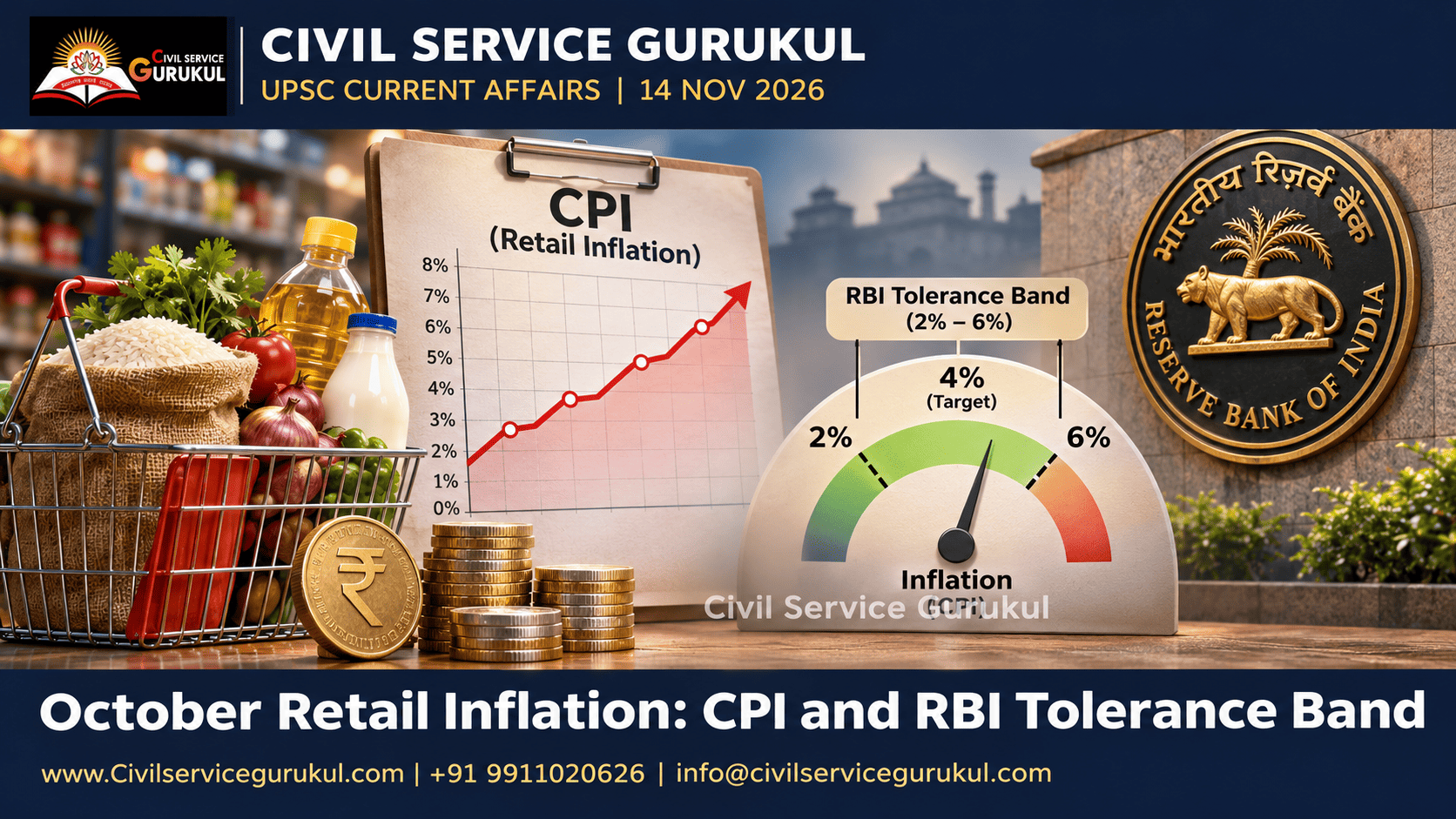
India's retail inflation, measured by the Consumer Price Index (CPI), increased to 6.09% in October 2026, compared with 5.54% in September 2026.
The provisional data were released by the National Statistics Office (NSO), under the Ministry of Statistics and Programme Implementation (MoSPI), on 12 November 2026.
The October reading exceeded the Reserve Bank of India's upper inflation tolerance limit of 6% by 0.09 percentage points.
Food inflation reached 8.94%, with significant price increases in onions, garlic and other selected items.
The development is important for UPSC because it connects inflation measurement, monetary policy, food security, household welfare and economic stability.
RBI's inflation target is 4%, with a tolerance band of 2% to 6%. A single monthly reading above 6% does not, by itself, constitute the formal statutory failure to meet the inflation target.
1. Why in News?
India's October 2026 retail inflation reached 6.09%, moving above the RBI's 6% upper tolerance threshold.
The increase was largely associated with rising food prices, although inflationary pressures were also visible across several other consumption categories.
The reading was the highest in approximately two years and renewed debate about inflation control, food supply management and the monetary policy outlook.
Three Important Developments
- Headline CPI inflation increased by 0.55 percentage points from September.
- Consumer Food Price Index inflation increased to 8.94%.
- Rural inflation remained above urban inflation.
2. October 2026 CPI Inflation: Key Statistics
| Indicator | September 2026 | October 2026 |
|---|---|---|
| Headline CPI Inflation | 5.54% | 6.09% |
| Rural CPI Inflation | 6.08% | 6.63% |
| Urban CPI Inflation | 4.88% | 5.41% |
| Food Inflation (CFPI) | 7.74% | 8.94% |
| Rural Food Inflation | 8.06% | 9.09% |
| Urban Food Inflation | 7.18% | 8.68% |
September figures are final, while October figures are provisional. The CPI series uses base year 2024 = 100.
Selected Commodity Price Changes
| Commodity | October Inflation |
|---|---|
| Onion | 116.22% |
| Garlic | 60.74% |
| Ginger | 48.32% |
| Lemon | 47.30% |
| Potato | -14.24% |
| Cauliflower | -10.57% |
The figures demonstrate that inflation can vary significantly across individual goods. Some commodities experienced sharp increases, while others recorded year-on-year price declines.
3. What Is the Consumer Price Index?
The Consumer Price Index measures changes in the retail prices of a representative basket of goods and services purchased by households.
It is an important measure of inflation because it reflects changes in the cost of household consumption.
How Is CPI Inflation Calculated?
For example, if the CPI rises from 100 to 106 over one year, the inflation rate is 6%.
Why Is CPI Important?
- Measures changes in household prices.
- Supports monetary policy decisions.
- Helps analyse purchasing power.
- Provides information about inflation trends.
- Supports economic research and planning.
CPI vs WPI
| Basis | CPI | WPI |
|---|---|---|
| Full Form | Consumer Price Index | Wholesale Price Index |
| Price Level | Retail / Consumer | Wholesale |
| Services | Included | Generally excluded |
| Policy Relevance | RBI inflation targeting | Wholesale price trends |
4. CPI Base Year 2024: Why It Matters
The October 2026 CPI release uses 2024 = 100 as its base.
A base year provides the reference against which price index values are measured.
Important Features
- The base-year index is assigned a value of 100.
- Basket weights represent the relative importance of consumption categories.
- Periodic revisions help improve the relevance of inflation measurement.
- The food and beverages division carries a combined weight of 36.75% in the October 2026 CPI release.
The CPI base year and the RBI inflation target are different concepts. The base year is a statistical reference; the inflation target is a monetary policy objective.
5. RBI Inflation Target and Tolerance Band
India's flexible inflation-targeting framework operates through the Reserve Bank of India Act, 1934, as amended.
The central government, in consultation with the RBI, determines the inflation target under the statutory framework.
Inflation Target
4% is the central inflation target.
Tolerance Band
2% to 6% is the permitted tolerance range.
What Happened in October 2026?
CPI inflation reached 6.09%, which is 0.09 percentage points, or 9 basis points, above the upper tolerance limit.
Does One Monthly Breach Mean RBI Has Failed?
No. The statutory framework distinguishes a single monthly breach from the formal failure to meet the inflation target.
Under the applicable failure criterion, inflation must remain outside the prescribed tolerance band for three consecutive quarters.
If the statutory failure condition is met, the RBI must provide the central government with a report explaining the reasons, proposed remedial actions and the estimated period for returning inflation to target.
One month above 6% does not automatically trigger the formal failure-reporting mechanism.
6. What Caused October 2026 Inflation?
A. Rising Food Prices
Food inflation reached 8.94%, making it an important contributor to headline CPI inflation.
B. Vegetable Price Pressures
Significant increases in the prices of onions, garlic and selected other items contributed to household inflation pressures.
C. Supply-Side Disruptions
Weather variability, agricultural supply disruptions and logistics constraints can affect food availability and prices.
D. Input Cost Pressures
Energy, transportation and agricultural input costs can influence prices across the supply chain.
E. Broader Price Pressures
Inflation was also elevated in certain services and non-food categories, indicating that the issue was not confined to a single commodity.
These are economic transmission mechanisms and reported contributing pressures. A precise causal attribution requires detailed component-level statistical analysis.
7. Why Was Rural Inflation Higher?
Rural inflation reached 6.63%, compared with 5.41% in urban areas.
Rural and urban inflation can differ because their consumption patterns, expenditure weights, local market conditions and price movements differ.
Possible Reasons
- Different consumption basket weights.
- Variation in local food prices.
- Transport and distribution costs.
- Regional supply conditions.
- Differences in household spending patterns.
Higher rural inflation can be especially important for households with limited disposable income because essential expenditure occupies a substantial part of their budgets.
8. Economic Implications of Higher Inflation
Households
Higher prices reduce purchasing power when incomes do not rise proportionately.
Businesses
Rising input costs can affect production expenses and margins.
Savings
Inflation reduces the real value of savings when returns fail to keep pace with price increases.
Economic Growth
Persistent inflation can create uncertainty for investment and consumption decisions.
Real Interest Rate
An approximate real interest rate can be calculated by subtracting expected inflation from the nominal interest rate.
For example, a nominal return of 7% with expected inflation of 6% implies an approximate real return of 1%.
9. How Can RBI Respond to Higher Inflation?
The Monetary Policy Committee (MPC) assesses inflation and growth conditions while deciding the policy repo rate.
Potential Monetary Policy Responses
- Maintaining a restrictive monetary policy stance when necessary.
- Increasing the policy repo rate if inflation risks justify tightening.
- Monitoring inflation expectations.
- Assessing credit, liquidity and economic growth conditions.
- Communicating the inflation outlook.
Monetary Transmission
A repo rate increase can influence market interest rates, borrowing costs, credit demand and aggregate spending.
However, monetary policy cannot directly produce more food or eliminate a crop-related supply shortage.
Demand-driven inflation is generally more responsive to monetary tightening than short-term supply-driven food inflation.
10. Policy Measures to Control Inflation
Short-Term Measures
- Improve availability of essential commodities.
- Reduce avoidable supply-chain bottlenecks.
- Monitor hoarding and market disruptions.
- Use appropriate buffer-stock operations.
- Coordinate fiscal and monetary responses.
Long-Term Measures
- Improve agricultural productivity.
- Strengthen cold storage infrastructure.
- Expand efficient food-processing capacity.
- Improve market access for farmers.
- Strengthen climate-resilient agriculture.
- Improve logistics and distribution systems.
A balanced response should address inflation without unnecessarily damaging employment, investment and long-term growth.
11. UPSC Prelims and Mains Relevance
| Paper | Relevant Areas |
|---|---|
| Prelims GS I | CPI, WPI, CFPI, RBI, MPC, inflation targeting |
| Mains GS III | Indian economy, inflation, monetary policy, growth |
| Mains GS II | Institutional accountability and economic governance |
| Essay | Price stability, inequality and inclusive development |
Important One-Liners
- October 2026 CPI inflation: 6.09%.
- September 2026 CPI inflation: 5.54%.
- October 2026 CFPI inflation: 8.94%.
- Rural CPI inflation: 6.63%.
- Urban CPI inflation: 5.41%.
- RBI inflation target: 4%.
- RBI tolerance band: 2% to 6%.
- CPI base year: 2024 = 100.
- CPI data are released by NSO under MoSPI.
- Formal failure criterion: three consecutive quarters outside the tolerance band.
12. UPSC Prelims Practice MCQs
Consider the following statements regarding India's inflation-targeting framework:
- The central inflation target is 4%.
- The upper tolerance limit is 6%.
- A single monthly inflation reading above 6% automatically constitutes formal failure to meet the target.
Which statements are correct?
(a) 1 and 2 only
(b) 2 and 3 only
(c) 1 and 3 only
(d) 1, 2 and 3
View Answer and Explanation
Correct Answer: (a)
Statements 1 and 2 are correct. Statement 3 is incorrect because the formal failure criterion concerns three consecutive quarters.
With reference to October 2026 inflation data, consider the following:
- Headline CPI inflation was 6.09%.
- Food inflation was 8.94%.
- Urban inflation was higher than rural inflation.
Which statements are correct?
(a) 1 only
(b) 1 and 2 only
(c) 2 and 3 only
(d) 1, 2 and 3
View Answer and Explanation
Correct Answer: (b)
Statements 1 and 2 are correct. Statement 3 is incorrect: rural inflation was 6.63%, while urban inflation was 5.41%.
Which of the following institutions releases India's Consumer Price Index statistics?
(a) Reserve Bank of India
(b) National Statistics Office
(c) Securities and Exchange Board of India
(d) Finance Commission
View Answer and Explanation
Correct Answer: (b)
The National Statistics Office, under MoSPI, releases the Consumer Price Index statistics.
Consider the following statements:
- CPI includes services in its consumption basket.
- Monetary policy can directly eliminate crop failures.
- CPI is relevant to the RBI's inflation-targeting framework.
Which statements are correct?
(a) 1 and 2 only
(b) 2 and 3 only
(c) 1 and 3 only
(d) 1, 2 and 3
View Answer and Explanation
Correct Answer: (c)
Statements 1 and 3 are correct. Statement 2 is incorrect: monetary policy cannot directly reverse a physical supply shock such as crop failure.
13. UPSC Mains Answer Writing Practice
"The rise in India's retail inflation above the RBI's upper tolerance threshold highlights the limitations of monetary policy in addressing supply-side inflation."
Discuss the causes of food-led inflation and suggest an integrated policy framework for price stability.
Suggested Answer Structure
Introduction: Mention October 2026 CPI inflation of 6.09% and the RBI's 2–6% tolerance band.
Body: Explain food supply shocks, agricultural volatility, logistics costs and inflation expectations. Discuss the role and limitations of monetary policy.
Way Forward: Recommend better agricultural infrastructure, storage, market integration, supply management and credible monetary policy.
Conclusion: Price stability requires coordinated action to address both demand-side and supply-side inflation pressures.
14. Frequently Asked Questions
What was India's retail inflation rate in October 2026?
India's provisional CPI inflation was 6.09%.
What is the RBI inflation tolerance band?
The RBI's inflation target is 4%, with a tolerance band of 2% to 6%.
What was food inflation in October 2026?
Consumer Food Price Index inflation was 8.94%.
Which was higher: rural or urban inflation?
Rural inflation was higher, at 6.63%, compared with urban inflation of 5.41%.
What is the CPI base year in 2026?
The CPI series used for the October 2026 release has base year 2024 = 100.
Does one month above 6% mean RBI has formally failed?
No. Formal failure is assessed using the prescribed three-consecutive-quarter criterion.
Why is this topic important for UPSC?
It connects inflation measurement, RBI monetary policy, food prices, economic stability and household welfare.
Prepare Smarter for UPSC Prelims 2027
Join Civil Service Gurukul for concept-based current affairs, Indian Economy preparation, Prelims practice and Mains answer-writing guidance.
Explore Civil Service GurukulWebsite: www.civilservicegurukul.com
Mobile: +91 9911020626
Email: info@civilservicegurukul.com
Editorial Note: This article is an original educational analysis based on the provisional October 2026 CPI release dated 12 November 2026. Statistical figures may be revised in subsequent releases. Monetary policy discussion is explanatory and does not predict a specific RBI policy decision.