
Daily News Analysis
Our daily news analysis consists of two integral parts — Daily News Analysis and Important Editorials curated rigorously from The Hindu, The Indian Express, LiveMint, PIB, and Sansad TV debates. Content is mapped directly to UPSC CSE and State PCS syllabi.

Gig Workers in India: Rights, Challenges & UPSC Notes
Understand gig workers in India, their economic role, social security framework and workplace challenges. Explore policy developments and key UPSC takeaways. Gig work creates income opportunities through flexible, task-based arrangements but raises concerns about earnings, safety and social protection. This article examines gig and platform workers, India’s policy framework, implementation challenges, and measures to promote decent work.

Duopolies in India: Telecom, Food Delivery & Aviation | UPSC
Why do a few firms dominate India’s telecom, food delivery, and aviation markets? Explore market concentration, consumer impacts, and competition policy for UPSC. This article distinguishes duopoly from oligopoly and examines the benefits, risks, and regulatory responses.

Non-Performing Assets: Meaning, Types & Solutions | UPSC
Understand NPAs, the 90-day rule, asset classification, and their impact on India’s banking system. Explore recovery mechanisms and UPSC practice questions. Non-performing assets reflect repayment stress in a bank’s loan portfolio. These notes explain NPA identification, classification, key ratios, economic consequences, and resolution mechanisms, including the distinction between a technical write-off and a loan waiver.
Ease of Doing Business in India | UPSC Mains 2027
Explore India's Ease of Doing Business reforms for UPSC Mains 2027, including BRAP, Jan Vishwas Acts, NSWS, digital governance, MSME challenges, investment climate, and the roadmap to Viksit Bharat 2047. Comprehensive GS Paper III notes by Civil Service Gurukul.
Falling Net FDI in India: Causes & Impact – UPSC 2027
Why is India's net FDI weak despite substantial foreign investment inflows? Explore gross versus net FDI, investor repatriation, overseas investment, India's balance of payments, manufacturing competitiveness, policy challenges and solutions in comprehensive UPSC Mains 2027 notes by Civil Service Gurukul.

AI-Powered Financial Inclusion in India – UPSC 2027
Discover how Artificial Intelligence is reshaping financial inclusion in India through intelligent credit scoring, digital banking, fraud detection, personalised financial services and multilingual financial assistance. Explore India's Digital Public Infrastructure, UPI, RBI's FREE-AI framework, regulatory challenges and policy solutions with comprehensive UPSC Mains 2027 notes by Civil Service Gurukul.
Productivity Growth in India | UPSC Mains 2027
Why is productivity more important than GDP growth alone for India's Viksit Bharat 2047 vision? Explore Total Factor Productivity, labour productivity, manufacturing reforms, MSMEs, structural transformation, innovation, infrastructure and policy solutions through comprehensive UPSC Mains 2027 notes by Civil Service Gurukul.
GST 2.0 Reforms in India 2026 – UPSC Notes
Explore India's GST 2.0 reforms after the 56th and 57th GST Council meetings. Understand tax-rate rationalisation, input tax credit, automated refunds, MSME compliance, cooperative federalism, GSTAT, economic benefits and remaining policy challenges through comprehensive UPSC Mains 2027 notes by Civil Service Gurukul.
State Fiscal Space in India – UPSC Mains 2027
Why are Indian States facing fiscal pressure despite rising economic activity? Explore the 16th Finance Commission, tax devolution, cesses and surcharges, State debt, revenue deficits, borrowing limits, fiscal federalism and reforms for restoring State fiscal space. Comprehensive UPSC Mains 2027 notes by Civil Service Gurukul.
Labour Protests in India – Causes & Reforms UPSC 2027
Explore labour protests in India, their economic and social causes, wage insecurity, trade unions, gig workers, industrial relations and the implementation of four Labour Codes. Comprehensive UPSC Mains 2027 notes on labour rights, social protection, constitutional safeguards and the future of industrial harmony by Civil Service Gurukul.
16th Finance Commission: Concerns – UPSC 2027
Analyse the Sixteenth Finance Commission's 2026–31 recommendations, including 41% tax devolution, GDP contribution criteria, changes in grants, cesses and surcharges, State fiscal autonomy and the equity-versus-efficiency debate. Original UPSC Mains 2027 notes by Civil Service Gurukul.

Creative Industries in India – UPSC Mains 2027
Explore India's Orange Economy and the rise of creative industries as engines of growth, employment and global influence. Understand AVGC-XR, gaming, cinema, design, digital creators, intellectual property, WAVES 2025, IICT and Budget 2026–27 initiatives through comprehensive UPSC Mains 2027 notes by Civil Service Gurukul.
PLFS Annual Report 2025 – UPSC Mains 2027
Explore the PLFS Annual Report 2025 with key findings on unemployment, LFPR, WPR, women workers, youth employment, self-employment, manufacturing, vocational education and the challenges of job quality in India. Complete UPSC Mains 2027 notes by Civil Service Gurukul.
Rebellion in the Air: Dissent & Democracy | UPSC Notes
An original UPSC-oriented analysis of the democratic questions raised by “Inside Track: Rebellion in the Air”: how governments should respond to protests, why political parties experience internal dissent, and how constitutional institutions sustain public trust. Explore dissent, peaceful protests, political party democracy and institutional accountability in India. Read exam-focused UPSC notes with constitutional provisions, analysis and practice questions.
EV Retrofitment in India: Mobility Revolution? | UPSC Prelims and Mains Notes
Can India turn petrol and diesel vehicles into an affordable electric mobility revolution? Explore EV retrofitment, circular economy, jobs, and policy challenges for UPSC. EV retrofitment could help India electrify suitable existing vehicles while creating opportunities for mechanics, MSMEs, and technology firms. These original UPSC notes explain the technology, regulatory framework, environmental benefits, economic challenges, and reforms needed for responsible expansion.

Solar-Powered Farms: Agrivoltaics Explained for UPSC 2026
Explore agrivoltaics, PM-KUSUM, solar irrigation, and farmer incomes for UPSC 2026. Learn prelims facts and mains analysis on sustainable farming.
CERT-In Cybersecurity Advisory: UPSC 2026 Explained
Decode the CERT-In cybersecurity advisory for UPSC 2026 Prelims and Mains. Learn AI agent risks, digital safeguards and governance challenges.
India’s 21.9M Developers: UPSC 2026 Explained
Who gains from India’s developers? Learn value capture, IP, startup finance, and platform economics for UPSC 2026 Prelims and Mains.

RBI Integrated Ombudsman Scheme: UPSC 2026 Explained
Learn RB-IOS 2026 for UPSC Prelims and Mains: coverage, complaint deadlines, compensation, appeals, and financial consumer protection explained.
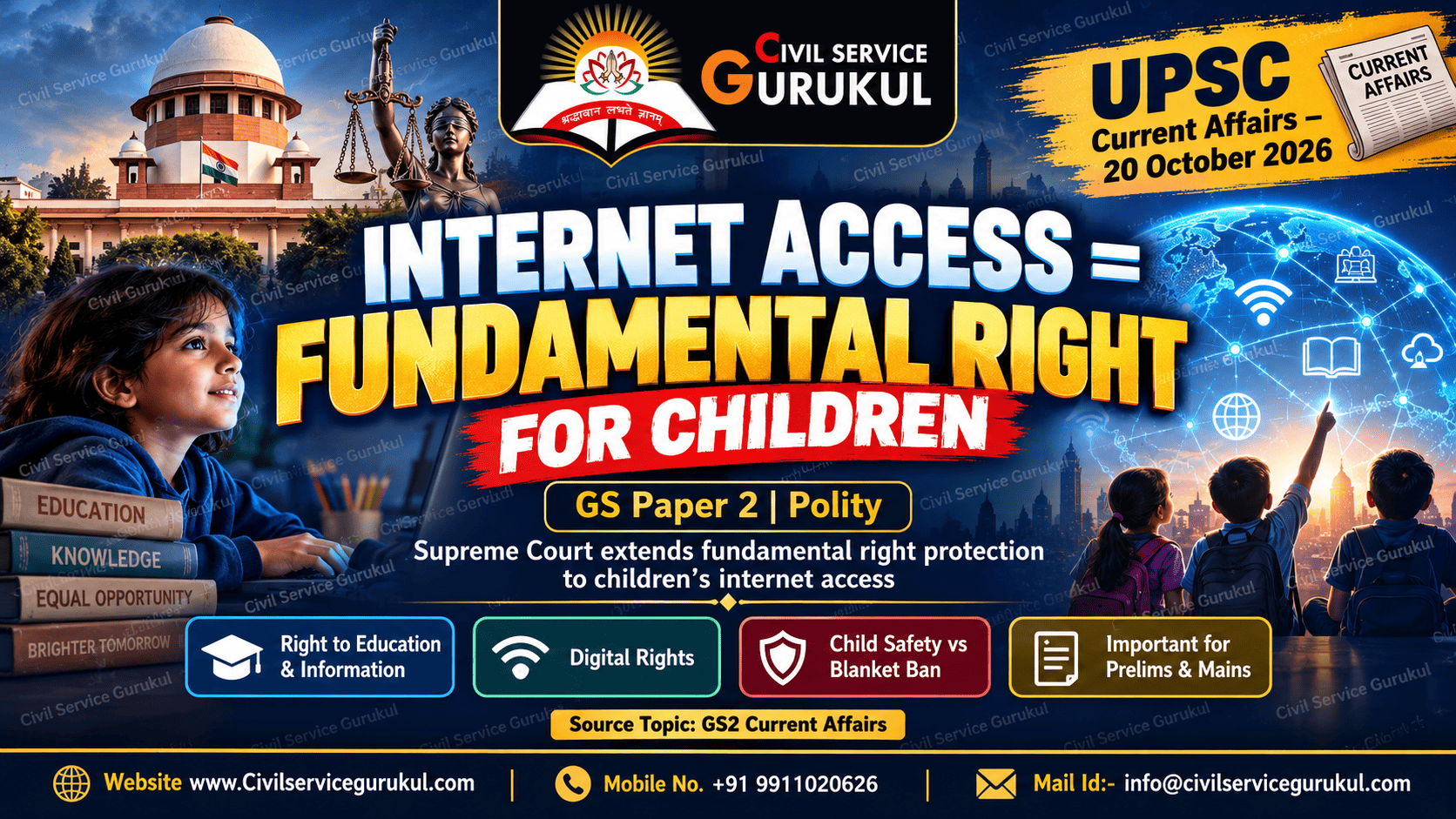
Internet Access as Fundamental Right: UPSC Notes 2026
The Supreme Court's October 2026 ruling recognised the fundamental right to access and use the internet for all individuals, including children, under Articles 19(1)(a) and 21 of the Indian Constitution. Instead of blanket age-based bans, the Court emphasised child-centred online protections, privacy, proportionate regulation and stronger measures against child sexual exploitation and abuse material (CSEAM). These Civil Service Gurukul notes examine the constitutional foundation, judicial precedents, significance, governance challenges and policy solutions, with Prelims MCQs and a model UPSC Mains answer.