
Daily News Analysis
Our daily news analysis consists of two integral parts — Daily News Analysis and Important Editorials curated rigorously from The Hindu, The Indian Express, LiveMint, PIB, and Sansad TV debates. Content is mapped directly to UPSC CSE and State PCS syllabi.
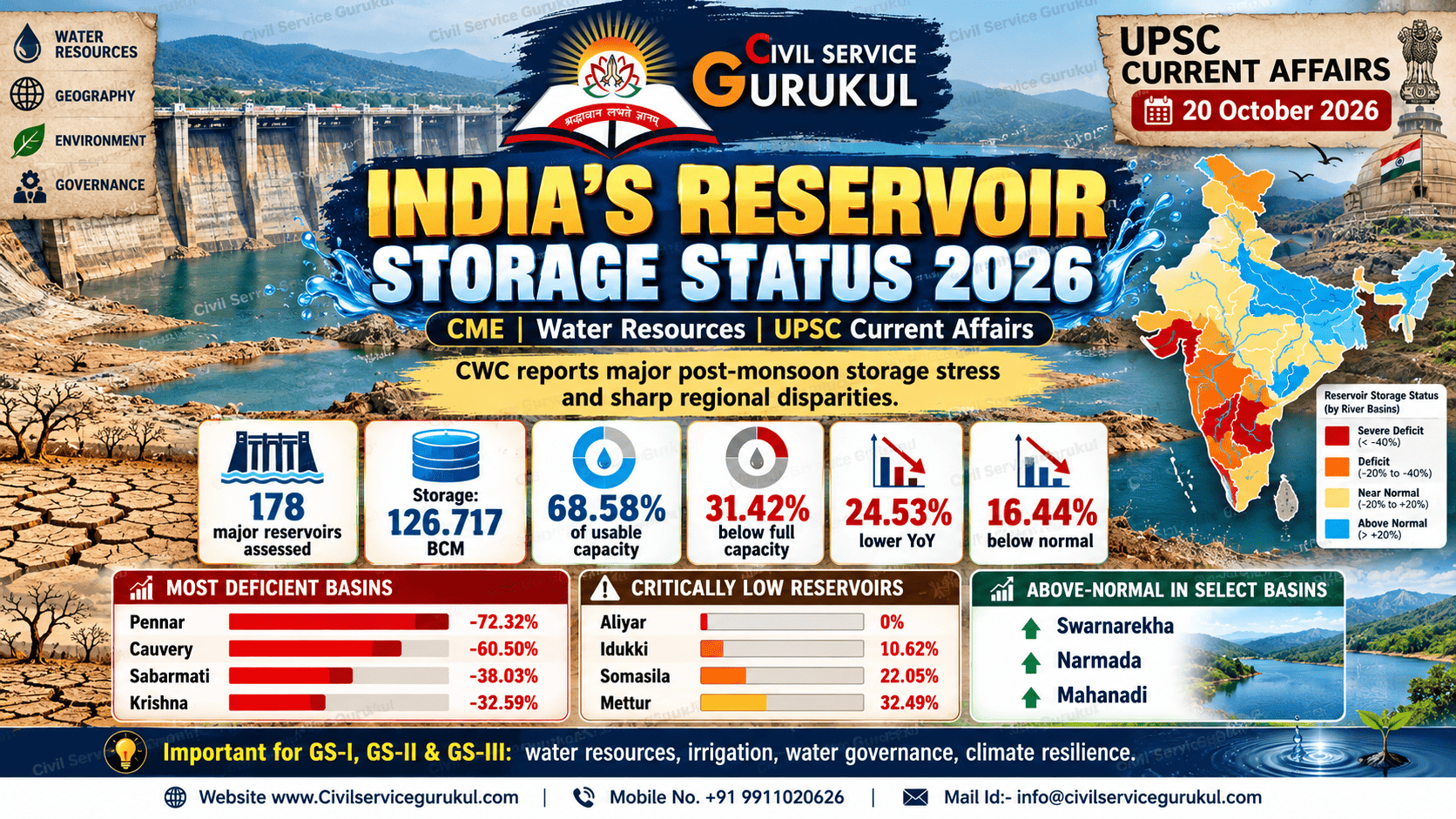
India Reservoir Storage 2026: Complete UPSC Notes
India's water security faces a serious post-monsoon challenge. The Central Water Commission's 15 October 2026 bulletin reported that 178 monitored reservoirs collectively stored 126.717 BCM, just 68.58% of their usable capacity and 16.44% below normal. The Pennar and Cauvery basins recorded deficits of 72.32% and 60.50% respectively, raising concerns about rabi irrigation, drinking-water supply, hydropower generation and climate resilience. These original Civil Service Gurukul notes explain reservoir geography, regional disparities, CWC functions, major dams, causes and implications of storage stress, and solutions for UPSC Prelims and Mains 2027.

Bismillah Khan Yuva Puraskar 2026: UPSC Notes
The Ustad Bismillah Khan Yuva Puraskar has returned to the national spotlight with the selection of 106 talented young artists for the award years 2024 and 2025. Instituted by the Sangeet Natak Akademi in 2006, this national recognition honours exceptional practitioners up to 40 years of age across music, dance, theatre, traditional performing arts and scholarship. The award consists of ₹25,000, a Tamrapatra and an Angavastram. These Civil Service Gurukul notes explain the award's history, eligibility, selection mechanism, the life and legacy of shehnai maestro Ustad Bismillah Khan, India's performing arts institutions, and their importance for UPSC Prelims and Mains 2027.

Baltic Sea Crisis 2026: Complete UPSC Notes
The Baltic Sea has returned to the international environmental agenda as Nordic countries explore stronger measures against nutrient pollution, eutrophication, oxygen-depleted seabeds and declining fish stocks. Situated in Northern Europe, the Baltic Sea is a semi-enclosed brackish-water sea connected to the North Sea through the Danish Straits and bordered by nine countries. Its restricted water exchange, low salinity and stratification make it particularly vulnerable to ecological degradation. These original Civil Service Gurukul UPSC notes explain the Baltic Sea's geographical characteristics, surrounding countries, major gulfs and rivers, causes of eutrophication, HELCOM's Baltic Sea Action Plan, maritime significance and lessons for marine conservation.

RBI’s PSL Reforms: Who Benefits from Priority Sector Credit?
Decode RBI Priority Sector Lending norms for UPSC 2026 Prelims and Mains: targets, revised eligibility, financial inclusion, and policy challenges. The principal overhaul was issued on March 24, 2025, effective April 1, 2025, followed by amendments in 2026. RBI’s consolidated directions reviewed here are updated through September 11, 2026. This should not be described as an entirely new “PSL Scheme 2026.

Baltic Sea 2026: Complete UPSC Geography Notes
The Baltic Sea, a semi-enclosed brackish sea in Northern Europe, is facing persistent ecological stress due to nutrient pollution, eutrophication, oxygen-depleted seabeds and declining fish populations. On 19 October 2026, the Nordic Council highlighted the need for stronger regional cooperation and marine conservation initiatives. Bordered by nine countries and connected to the North Sea through the Danish Straits, the Baltic Sea is an important topic for UPSC map-based questions and environmental studies. These original Civil Service Gurukul notes cover physical geography, coastal countries, gulfs, straits, major rivers, marine pollution, HELCOM, the Baltic Sea Action Plan, Prelims MCQs and Mains model answers.
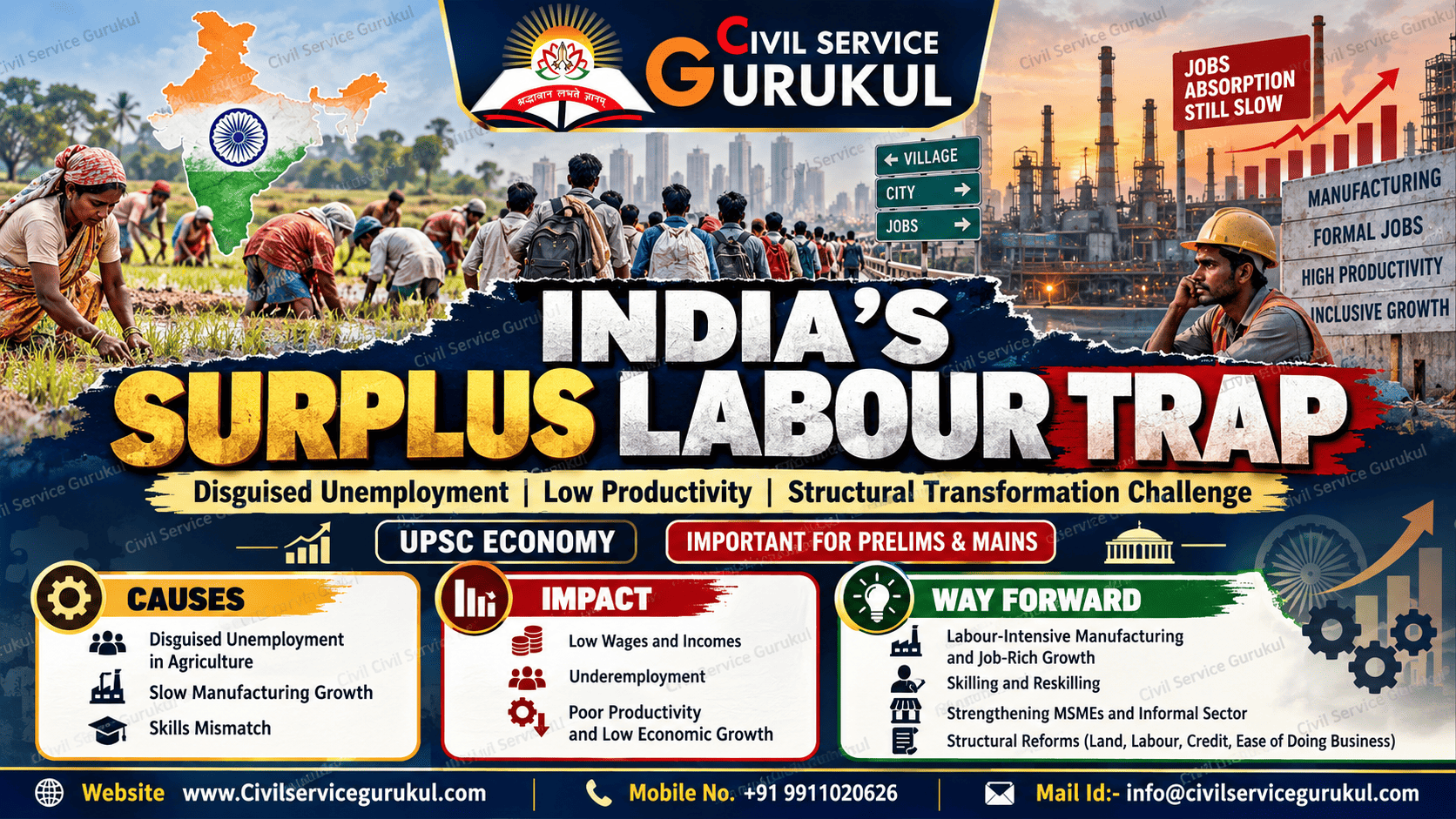
India's Surplus Labour Trap: UPSC Notes 2027
India's surplus labour trap describes an economic challenge in which workers remain concentrated in low-productivity agriculture, informal employment and underpaid self-employment because sufficient remunerative jobs are not emerging elsewhere. Although headline employment indicators have improved, the quality and productivity of work remain critical concerns. The PLFS Annual Report 2025 recorded that regular wage and salaried workers accounted for 23.6% of employment, while the Economic Survey 2025–26 highlighted agriculture's substantial share of the workforce. This original Civil Service Gurukul article explains disguised unemployment, the Lewis dual-sector model, structural transformation, jobless growth, demographic dividend, labour-market data and comprehensive policy measures, with UPSC Prelims MCQs and a GS-III Mains model answer
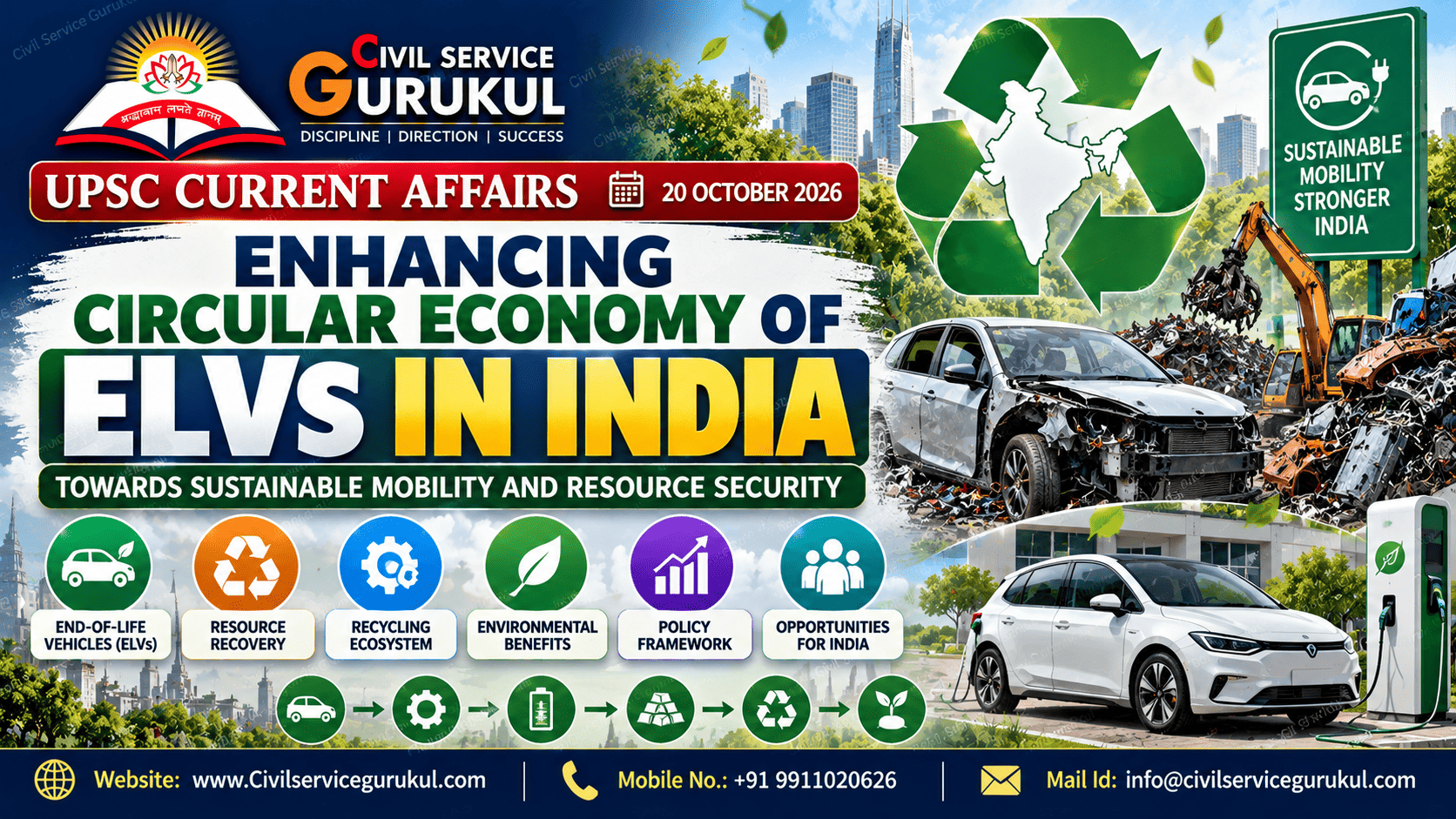
ELV Circular Economy Report 2026: UPSC Notes
India's rapidly growing automobile sector faces a major waste-management challenge as the projected stock of end-of-life vehicles approaches 50 million by 2030. NITI Aayog's January 2026 report, prepared with TERI, calls for the expansion of Registered Vehicle Scrapping Facilities, stronger Extended Producer Responsibility, improved fitness-testing infrastructure, incentives linked to Certificates of Deposit and digital reforms through VAHAN. A scientifically managed vehicle recycling ecosystem can recover steel and other valuable materials, reduce pollution and support green employment. These original Civil Service Gurukul notes analyse the report's findings, India's vehicle scrappage framework, formal-versus-informal recycling challenges, policy solutions, UPSC Prelims facts and a GS-III Mains model answer.
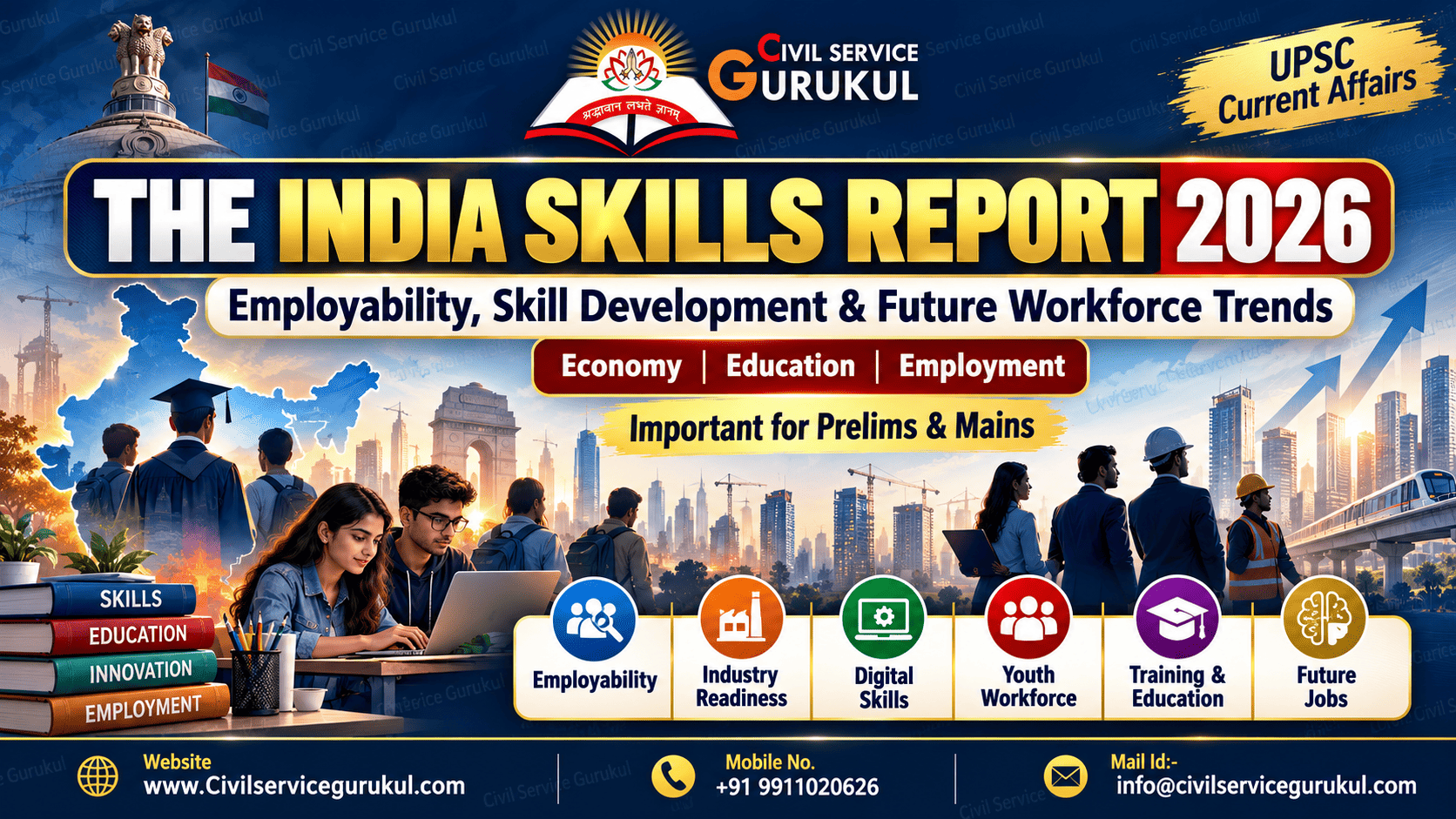
India Skills Report 2026: Complete UPSC Notes
The India Skills Report 2026 reveals a gradual improvement in India's workforce readiness, with national employability reaching 56.35%, up from 54.81% in 2025. Female employability surpassed male employability among assessed candidates, while AI, data analytics, cybersecurity and digital skills are reshaping employer demand. The report also identifies changes in hiring intent, vocational education, youth career preferences and the growing importance of Tier-2 and Tier-3 cities. These original Civil Service Gurukul notes examine the report's methodology, discipline-wise employability, skill mismatches, demographic dividend, government initiatives and policy recommendations, with UPSC Prelims MCQs and a GS-III Mains model answer.
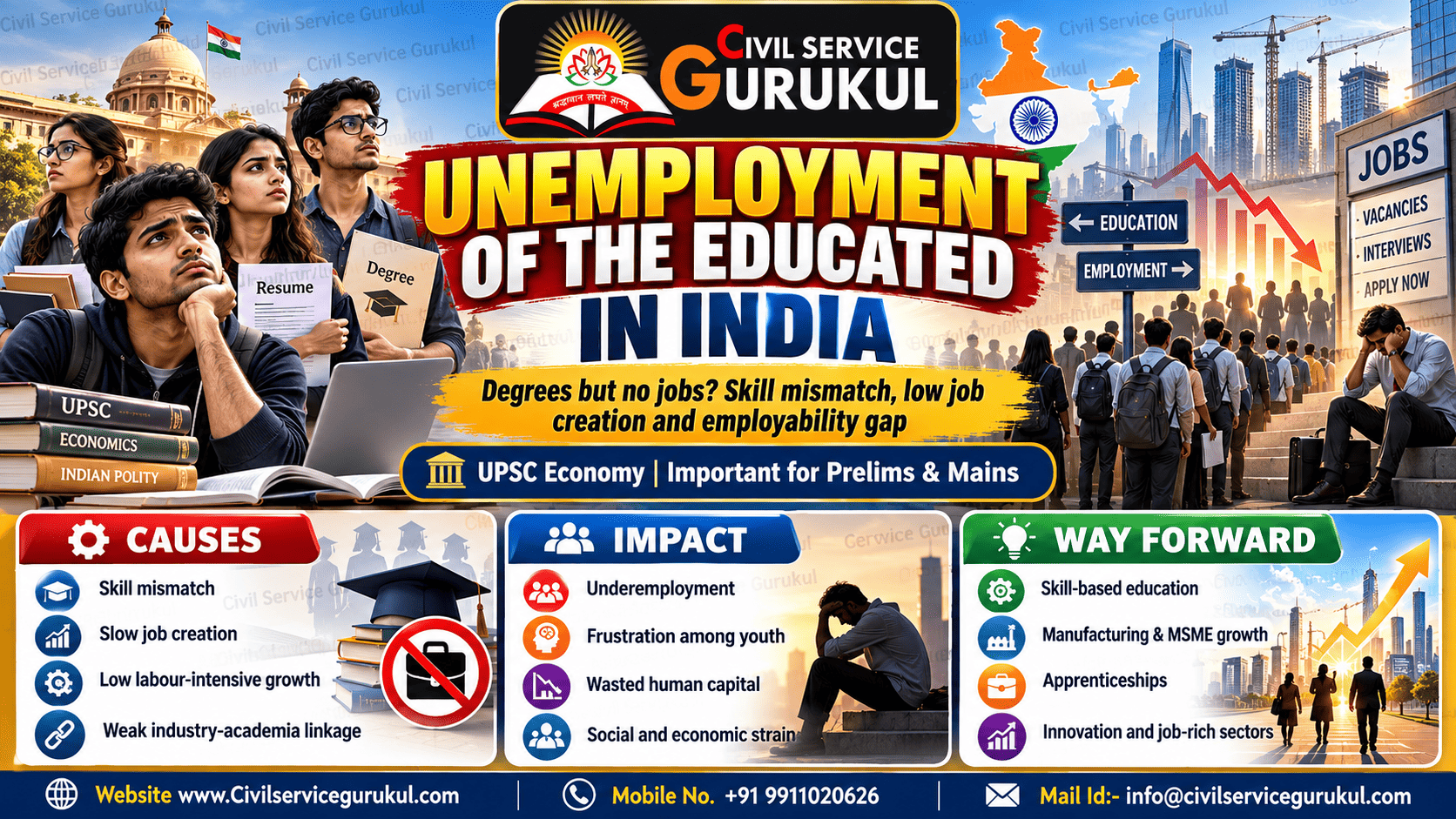
Educated Unemployment in India: UPSC Notes 2027
Educated unemployment remains a significant structural challenge in India's labour market, even as recent official surveys indicate improvements. According to the PLFS Annual Report 2025, unemployment among persons aged 15 and above with secondary education or higher declined from 7.0% in 2024 to 6.5% in 2025, while unemployment among youth aged 15–29 stood at 9.9%. The ILO–IHD India Employment Report 2024 also identified the concentration of unemployment among educated young people, particularly graduates and young women. These original Civil Service Gurukul notes examine educational qualifications versus employability, labour demand, skill mismatches, structural unemployment, the demographic dividend and policy reforms, with UPSC Prelims questions and a GS-III Mains model answer.
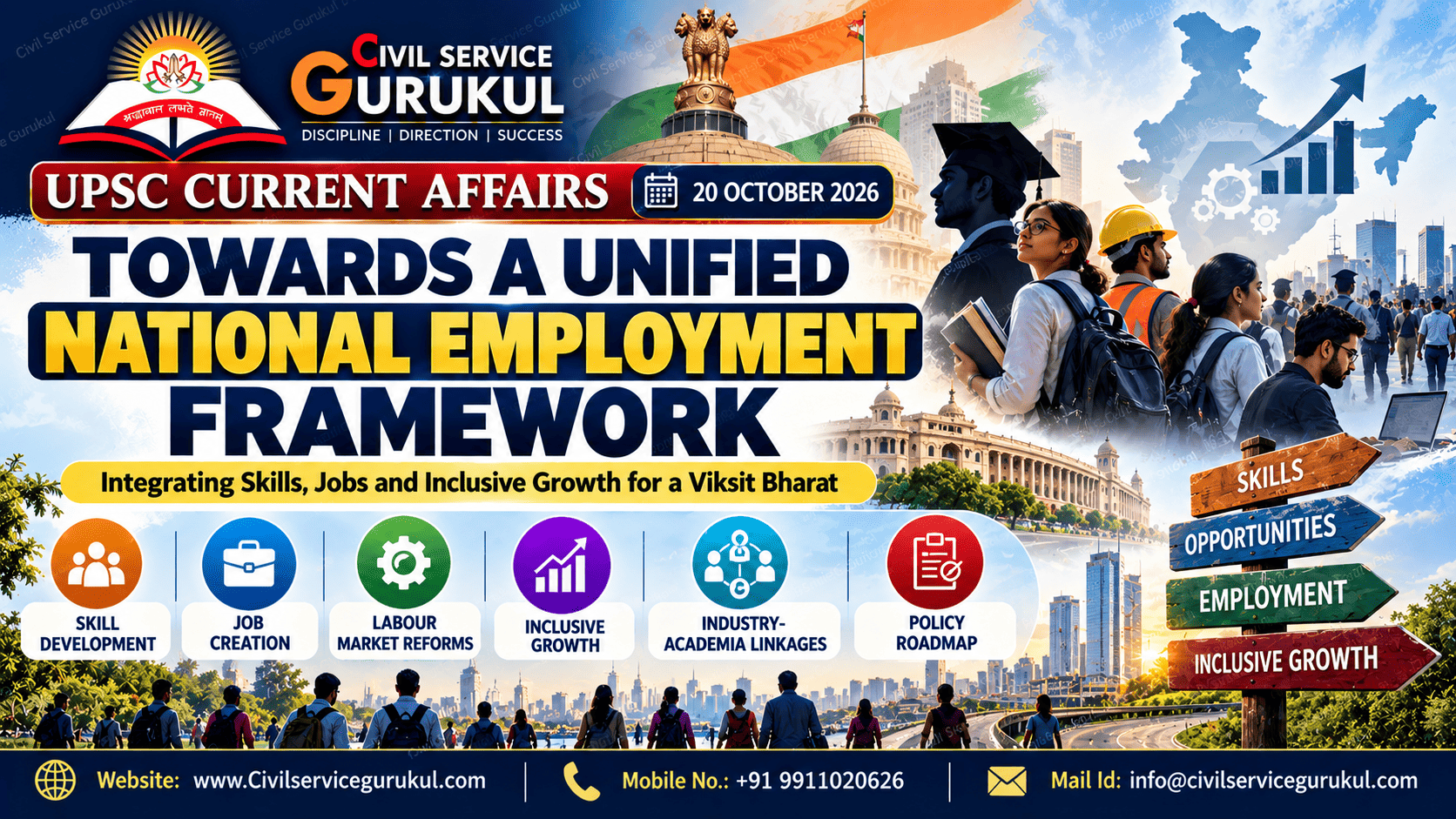
National Employment Framework: UPSC Notes 2026
India requires an integrated employment strategy that connects educational institutions, skilling centres, employers, industrial investment, digital job platforms and worker protection. Fragmented implementation can limit the effectiveness of individual programmes even when public investment is substantial. Calls for a Unified National Employment Framework emphasise employment-focused policymaking, stronger Centre–State coordination, a better National Career Service ecosystem, support for women's employment, and opportunities in manufacturing, MSMEs and emerging sectors. The draft Shram Shakti Niti 2025 and NITI Aayog's 2026 initiatives provide important contemporary context. These original Civil Service Gurukul notes examine the proposed framework's rationale, institutional architecture, demographic challenges, government initiatives, implementation barriers, Prelims concepts and a GS-III Mains model answer.

Break the PDS Ration-Shop Monopoly: UPSC 2026 Explained
Learn how PDS portability, dealer competition, and accountability can end ration-shop monopolies. UPSC Prelims facts and Mains reform analysis.

Seven Big Cats, One Future: India’s Conservation Push | UPSC 2026
Explore seven big cats, IBCA, habitat threats, and India's conservation role for UPSC 2026 Prelims and Mains, with facts and practice questions.

Star Labelling UPSC 2026 Explained: BEE Ratings & Savings
Understand BEE Star Labelling, energy ratings, ISEER and electricity savings for UPSC 2026 Prelims and Mains, with challenges and practice questions.

Digital Public Infrastructure UPSC 2026: Complete Notes
India's Digital Public Infrastructure has emerged as a foundational system for digital identity, payments, consent-based data exchange and citizen-centric public services. This comprehensive UPSC GS Paper 2 guide explains Aadhaar, UPI, DigiLocker, Account Aggregators, Direct Benefit Transfer, ONDC and India Stack, along with digital inclusion, cybersecurity, the Digital Personal Data Protection Act, international cooperation, Prelims concepts and Mains answer-writing strategy. Prepared as original exam-oriented notes for Civil Service Gurukul.
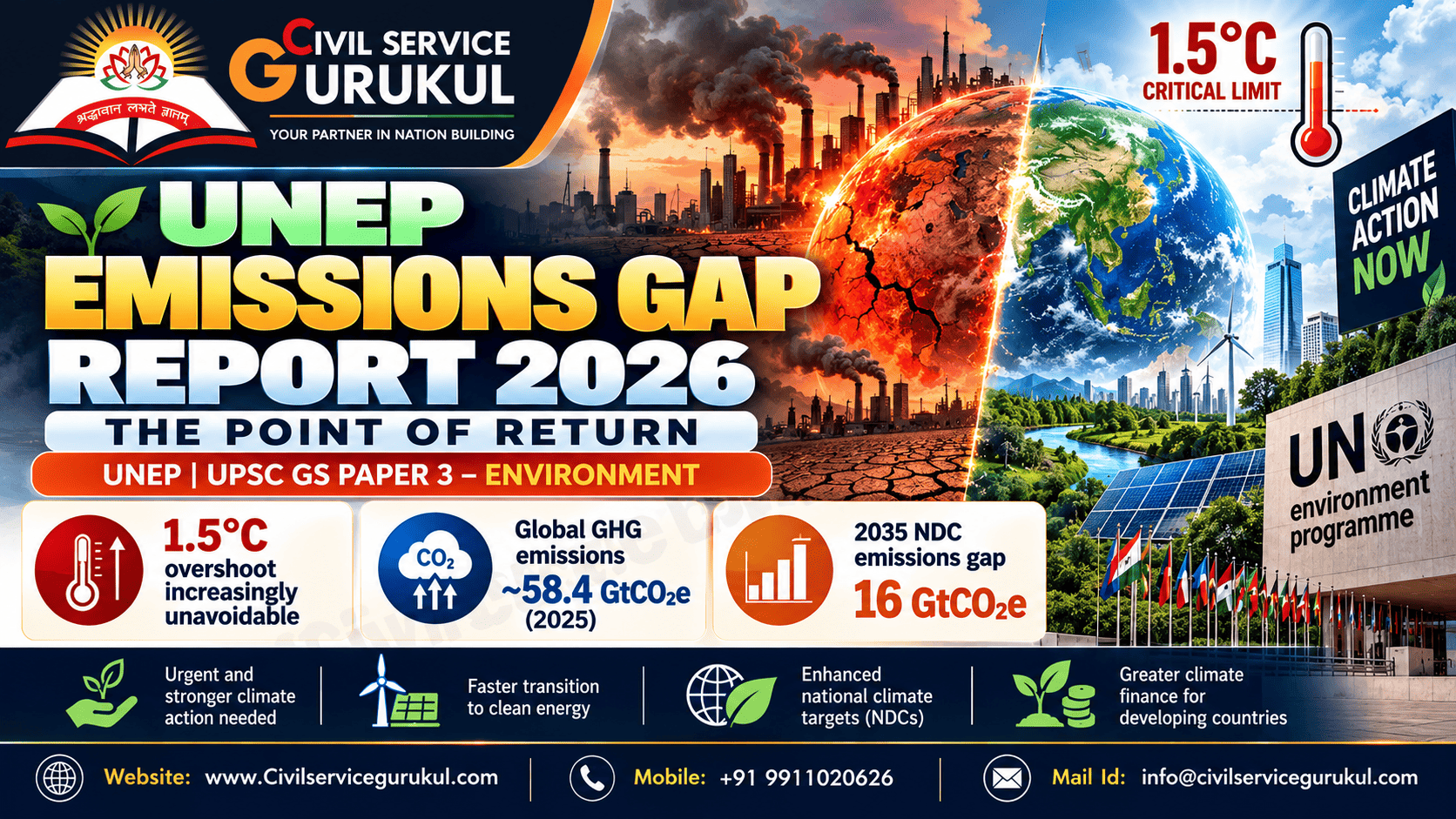
UNEP Emissions Gap Report 2026 | UPSC Complete Notes
UNEP's 17th Emissions Gap Report, The Point of Return (2026), warns that avoiding any overshoot of the Paris Agreement's 1.5°C temperature threshold is no longer realistically possible. Its lowest-overshoot pathway requires global greenhouse gas emissions to fall 18% by 2030, 45% by 2035 and 69% by 2040, compared with 2025 levels. These original Civil Service Gurukul UPSC notes explain the emissions gap, warming scenarios, Nationally Determined Contributions, carbon dioxide removal, Global Stocktake, India's climate commitments, Prelims MCQs and a GS Paper 3 Mains model answer.

Global Economic Prospects 2026: Growth, Risks and India | Complete UPSC guide
Explore World Bank Global Economic Prospects, growth forecasts, debt risks, and India's outlook for UPSC 2026 Prelims and Mains preparation.

SUVIKALP Initiative UPSC 2026: Complete Notes
The Coal Controller Organisation's SUVIKALP Initiative received the SKOCH Gold Award 2026 for data-driven decision-making in sustainable mine repurposing. Developed under the Ministry of Coal, SUVIKALP evaluates alternative uses for closed coal mines using technical, environmental, social and economic criteria, while the associated PRISM model supports project implementation. These original Civil Service Gurukul UPSC notes explore scientific mine closure, environmental rehabilitation, just transition, community livelihoods, SDGs, governance, Prelims MCQs and a GS Paper 3 Mains model answer.

eMudhra Certificates UPSC 2026: Complete Notes
In October 2026, Google, Mozilla and other major technology providers responded to a critical cryptographic weakness affecting eight intermediate certification authority certificates associated with eMudhra's global web trust services. The problem originated in an April 2025 key-generation process and highlighted vulnerabilities in Public Key Infrastructure (PKI), digital certificates and browser trust. These original Civil Service Gurukul notes explain asymmetric encryption, certificate authorities, HTTPS/TLS, the trust chain, CERT-In's response, India's digital signature framework, cybersecurity governance, UPSC Prelims MCQs and a GS Paper 3 Mains model answer.

Coking Coal UPSC Complete Guide: Steel, Imports and Policy
Learn how coking coal supports steelmaking and why India imports it. Master key facts, government initiatives and challenges for UPSC Prelims and Mains.

Badr MoU 2026 UPSC: Complete Defence Partnership Notes
On 21 October 2026, Türkiye, Pakistan, Qatar and Indonesia signed the Badr Memorandum of Understanding in Doha to expand defence manufacturing, industrial cooperation, technology development and military training. The four-country arrangement reflects growing interest in diversified defence supply chains and technological self-reliance. This original Civil Service Gurukul guide explains the agreement's objectives, participating countries, institutional framework, geopolitical context and potential implications for India's security and diplomacy, with UPSC Prelims questions, a Mains model answer and essential revision notes.