
Daily News Analysis
Our daily news analysis consists of two integral parts — Daily News Analysis and Important Editorials curated rigorously from The Hindu, The Indian Express, LiveMint, PIB, and Sansad TV debates. Content is mapped directly to UPSC CSE and State PCS syllabi.
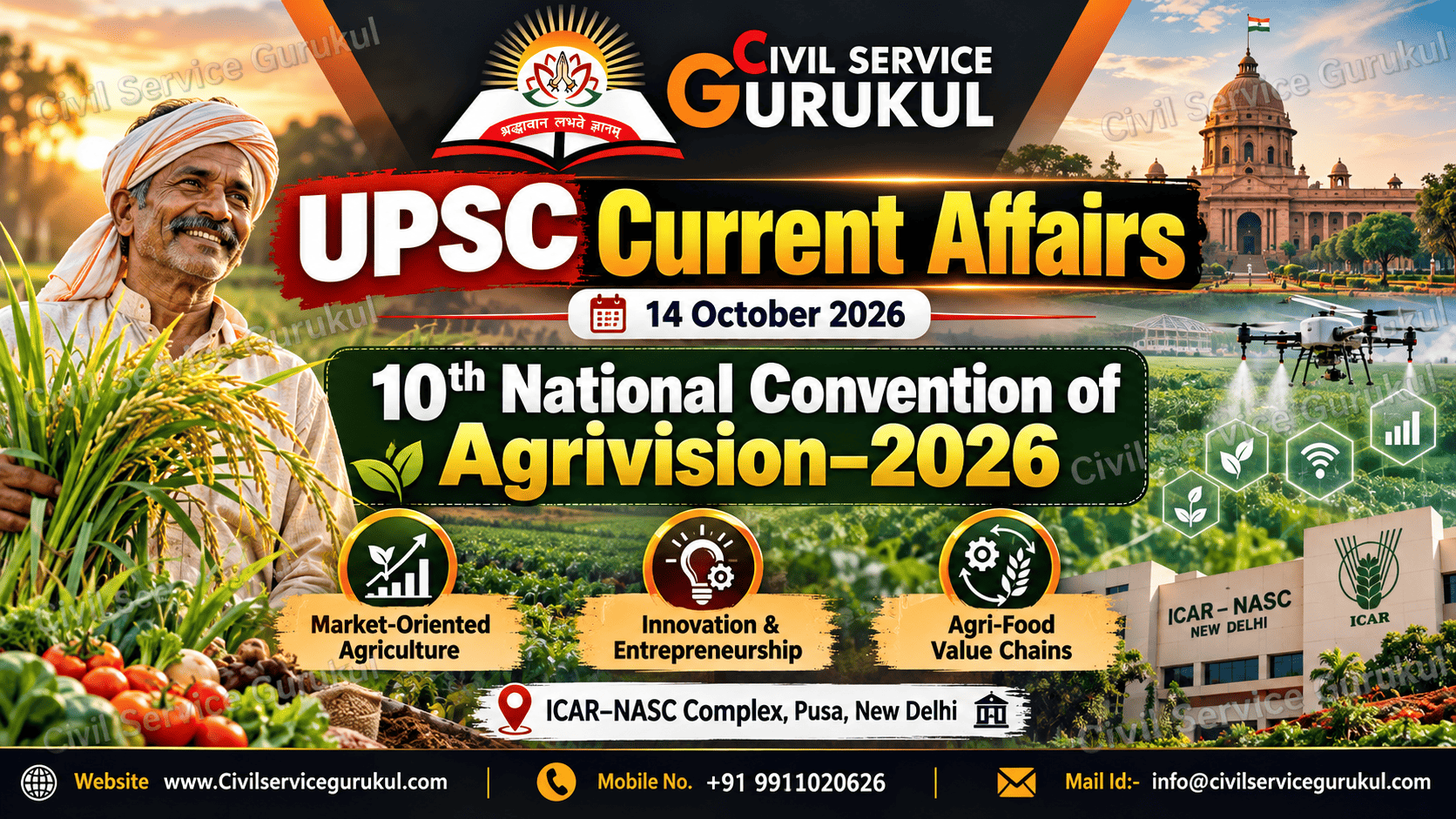
Agrivision 2026: Transforming Indian Agriculture Through Innovation, Market-Driven Farming and Agri-Food Value Chains | UPSC Current Affairs
Bengaluru-based recommerce startup Circle has raised ₹25 crore in seed funding led by Nexus Venture Partners, with participation from Titan Capital, Raveen Sastry and Ajith Pai. Founded in 2025, Circle uses AI-powered pricing, product verification and managed logistics to simplify buying and selling pre-owned goods. DhanCapital Ventures explores the startup's business model, expansion strategy, early traction and the growing investment potential of India's circular commerce ecosystem.
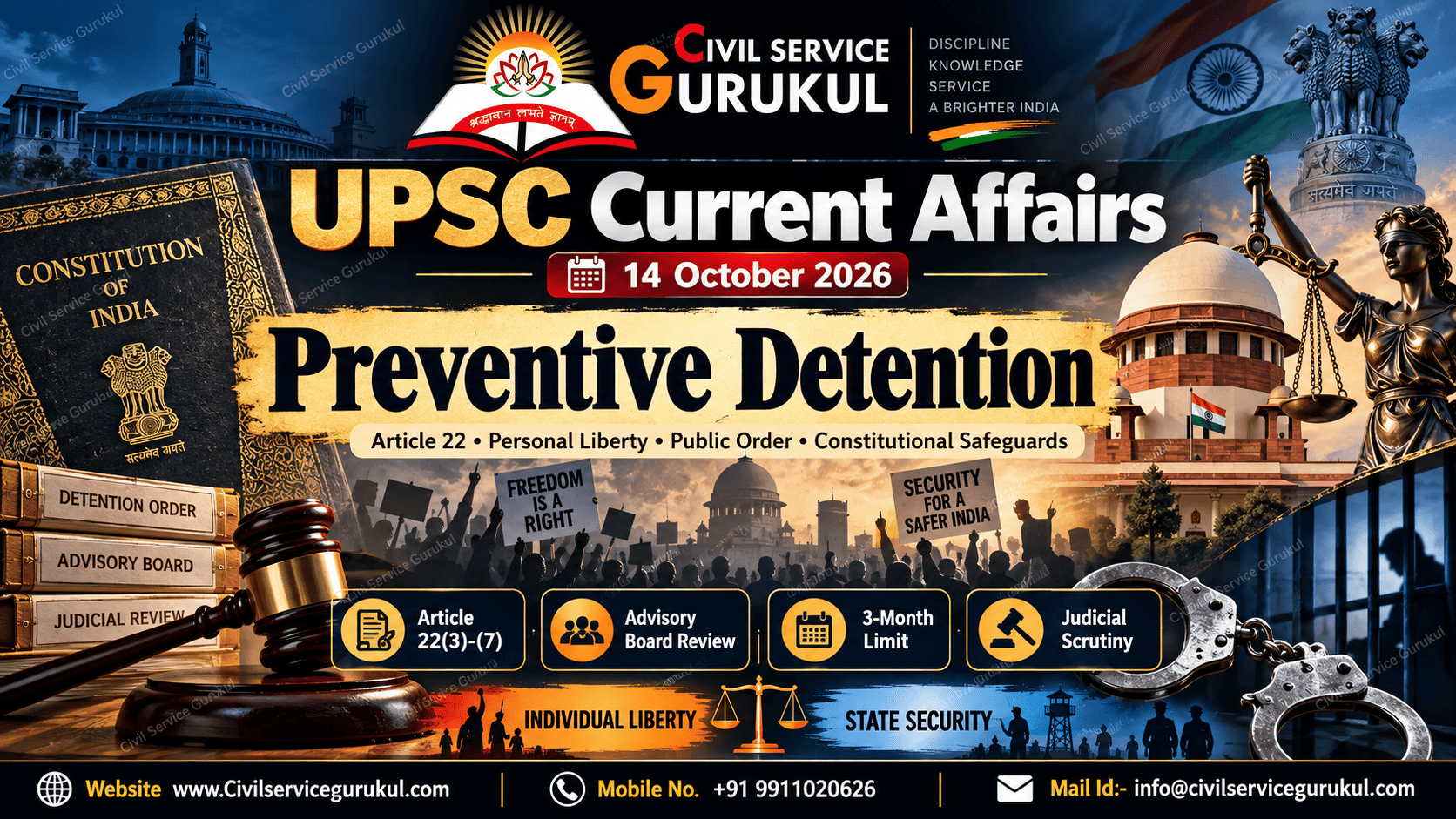
Preventive Detention in India: Article 22, Supreme Court Safeguards and the Right to Personal Liberty | UPSC 2026
Preventive detention in India allows authorities to detain individuals without a criminal trial to prevent certain anticipated threats to national security, public order or essential supplies. Recent judicial scrutiny has brought renewed attention to Article 22, procedural safeguards, the distinction between public order and ordinary law-and-order issues, and the constitutional protection of personal liberty. This Civil Service Gurukul article examines the legal framework, relevant Supreme Court judgments, limitations on detention powers and important UPSC Prelims and Mains concepts.
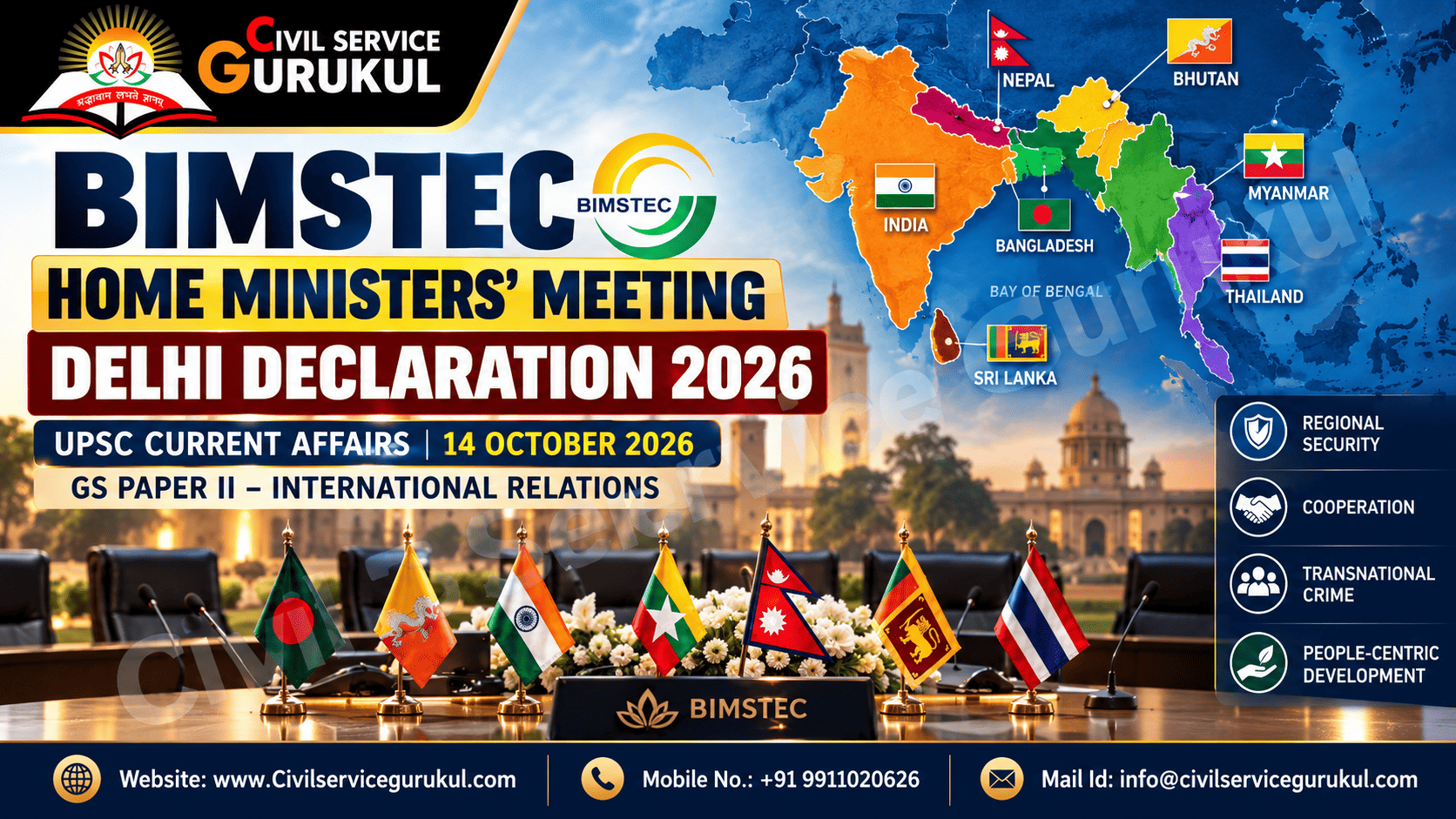
BIMSTEC Delhi Declaration 2026: First Home Ministers' Meeting, India's Security Diplomacy & UPSC Prelims–Mains Analysis
The first BIMSTEC Home Ministers' Meeting, held in New Delhi on 13 October 2026, adopted the landmark Delhi Declaration to strengthen regional security cooperation among seven Bay of Bengal countries. The declaration focuses on counterterrorism, terror financing, cybercrime, transnational organised crime, human trafficking, drug trafficking and intelligence-sharing mechanisms. For India, the initiative strengthens its Neighbourhood First and Act East policies while reinforcing security cooperation between South Asia and Southeast Asia. Civil Service Gurukul explains the declaration, BIMSTEC's institutional framework, India's strategic interests, UPSC Prelims facts, original practice MCQs and GS Paper II Mains answer-writing points.

Exercise IBSAMAR IX 2026: INS Tarkash, India–Brazil–South Africa Naval Cooperation & UPSC Prelims–Mains Analysis
Exercise IBSAMAR IX 2026 is the ninth edition of the trilateral naval exercise involving India, Brazil and South Africa under the IBSA cooperation framework. Hosted by South Africa, the exercise features India's guided-missile stealth frigate INS Tarkash, supported by an onboard Chetak helicopter. Naval activities include anti-submarine warfare, surface warfare, maritime interdiction, anti-piracy operations, search and rescue, and damage-control training. Civil Service Gurukul explains the exercise's objectives, participating warships, IBSA Dialogue Forum, India's maritime security interests and strategic significance for the Global South, along with original UPSC Prelims MCQs, Mains practice questions and quick revision notes.
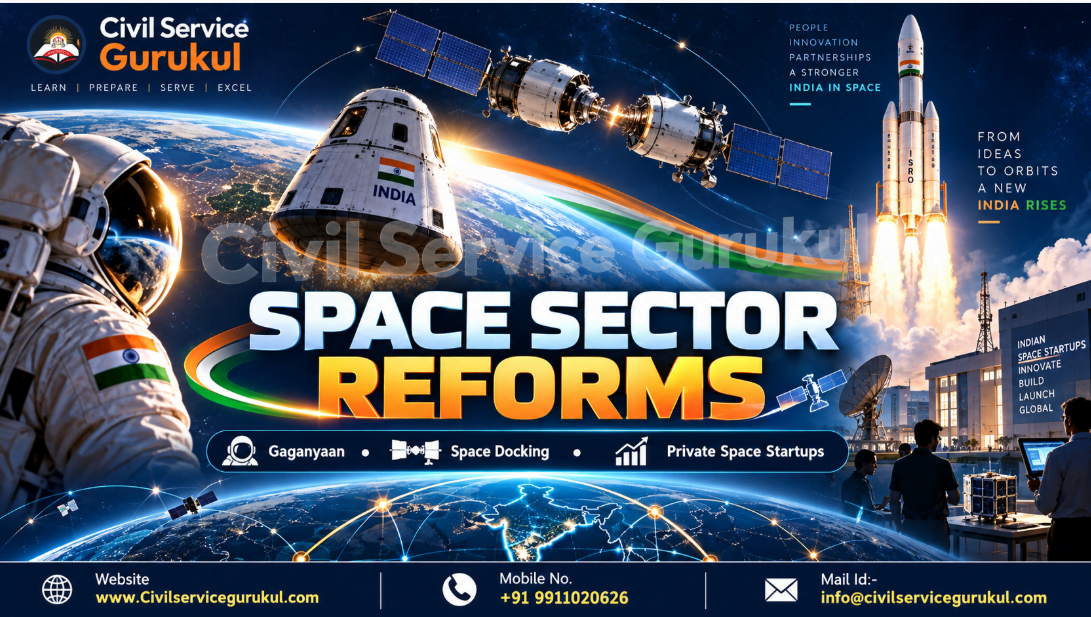
India's Space Sector Reforms 2026: Gaganyaan, SpaDeX & UPSC PYQs
India's space sector is undergoing a historic transformation driven by human spaceflight ambitions, indigenous orbital docking capabilities and the rapid expansion of private space enterprises. ISRO's Gaganyaan programme aims to establish human spaceflight capability, while the SpaDeX mission successfully demonstrated autonomous docking and undocking in 2025. Reforms introduced since 2020, including IN-SPACe, the Indian Space Policy 2023 and liberalised foreign investment rules, have accelerated commercial participation. As of August 2026, around 440 space-technology startups were registered in India. This comprehensive UPSC analysis explores technological milestones, the space economy, national security, regulatory challenges and important previous-year examination themes
Third Path Doctrine 2026: Carney, Middle Powers & UPSC PYQs
At the World Economic Forum in Davos on 20 January 2026, Canadian Prime Minister Mark Carney outlined a new approach to international cooperation amid intensifying US–China rivalry and declining confidence in the rules-based international order. Often described as the Third Path or Carney Doctrine, this approach emphasises values-based realism, strategic autonomy, domestic resilience and issue-specific coalitions among middle powers. For India, the framework has strong connections with multi-alignment, the Quad, BRICS, G20, SCO and Global South diplomacy. This UPSC-focused article explains the doctrine, its opportunities and limitations, previous-year examination questions and priority topics for 2027.
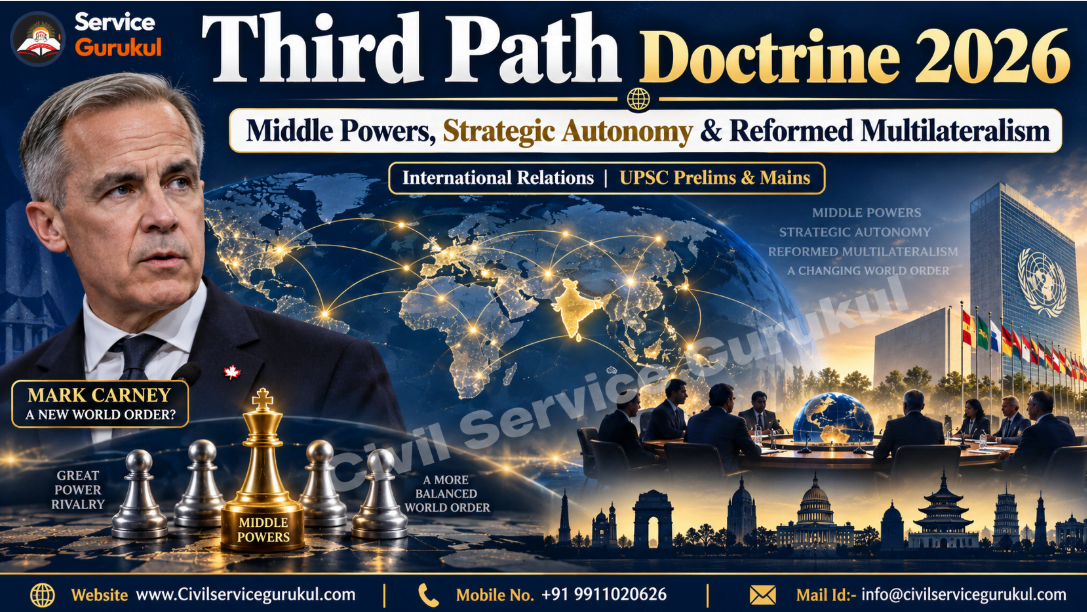
Third Path Doctrine 2026 Explained | UPSC Prelims & Mains
Canadian Prime Minister Mark Carney's Third Path Doctrine, presented at the World Economic Forum in Davos on 20 January 2026, advocates value-based realism, middle-power cooperation, and a reformed, inclusive international order. The framework seeks alternatives to domination by major powers through diversified partnerships, economic resilience, and networked multilateralism. This comprehensive UPSC guide examines the doctrine, India's strategic autonomy, Global South diplomacy, relevant Prelims and Mains PYQs, trend analysis, practice questions, and priority revision topics.
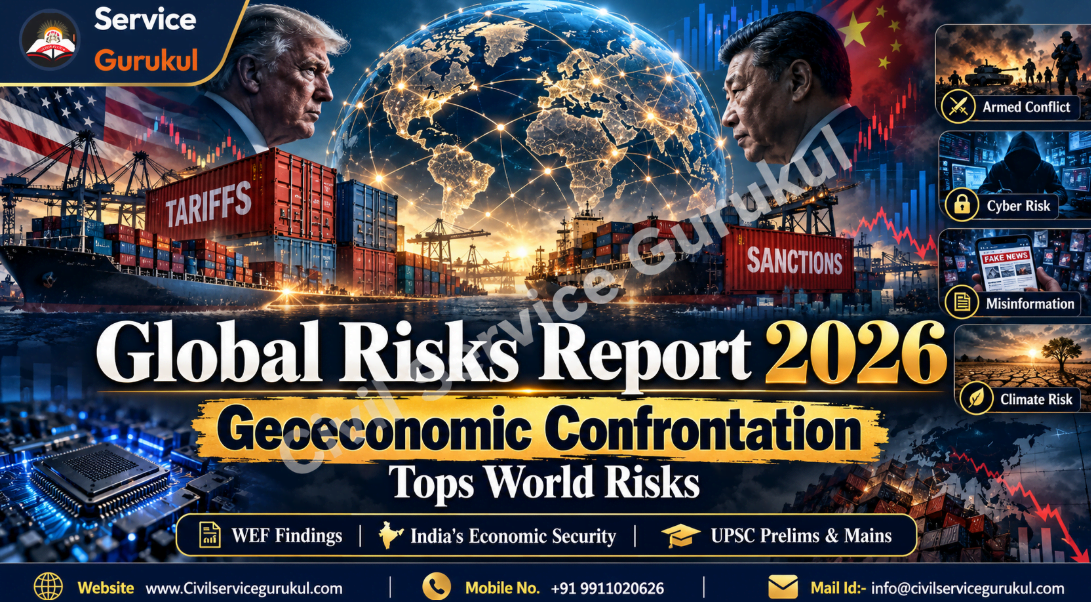
Global Risks Report 2026: Geoeconomic Confrontation | UPSC
The World Economic Forum's **Global Risks Report 2026** identifies **geoeconomic confrontation as the world's leading immediate risk**, reflecting rising trade tensions, economic sanctions, geopolitical rivalry, and supply-chain vulnerabilities. Based on insights from more than 1,300 experts and leaders, the report highlights growing threats from armed conflicts, misinformation, societal polarisation and economic instability, while environmental risks dominate the long-term outlook. This comprehensive **Civil Service Gurukul UPSC analysis** explains the report's major findings, global risk rankings, geoeconomic confrontation, India's economic and strategic challenges, and policy responses. It includes important prelims facts, practice MCQs with explanations, GS Paper II and III Mains answer-writing guidance, and priority-wise revision topics for the UPSC Civil Services Examination 2027.
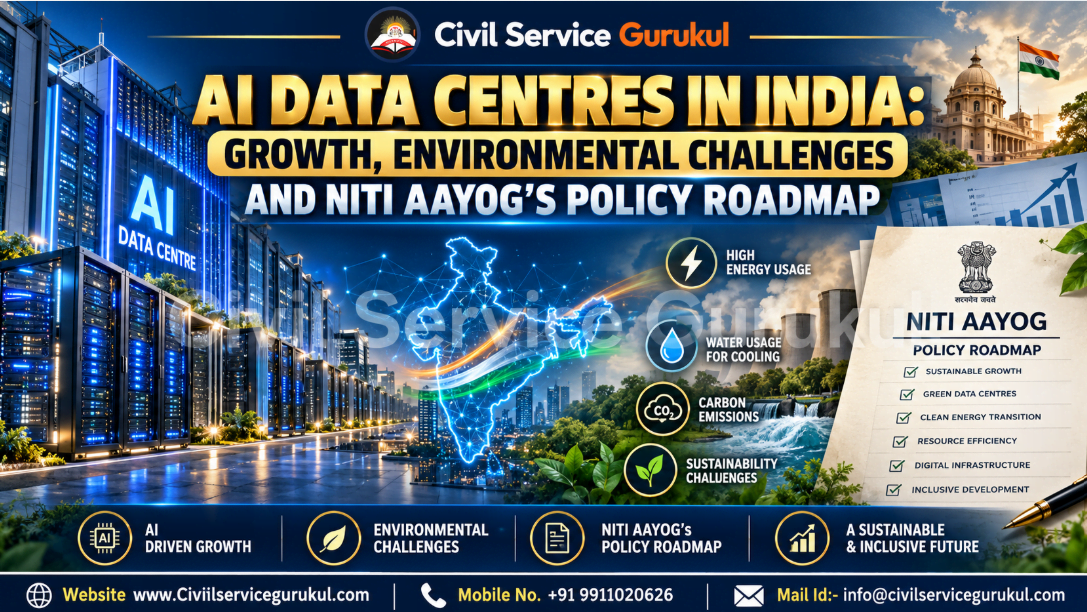
AI Data Centres in India: Challenges & NITI Aayog Roadmap | CSG
India’s AI data centre industry is expanding rapidly, creating opportunities for digital growth, cloud computing and technological self-reliance. However, rising electricity demand, water consumption, emissions and limited direct employment raise important policy questions. Explore NITI Aayog’s proposed framework and its significance for sustainable development, digital infrastructure and UPSC GS Paper III.

Pax Silica 2026: India, AI Alliance & Semiconductor Security | UPSC
This Civil Service Gurukul analysis explains the Pax Silica Declaration, participating economies, the concept of the silicon stack, India's strategic opportunities, emerging technology geopolitics, UPSC Prelims facts, practice MCQs, and GS Paper II and III Mains preparation.

Spain Joins IPOI 2026: India's Maritime Strategy | UPSC
This Civil Service Gurukul analysis examines Spain's participation, India's SAGAR vision, maritime diplomacy, the blue economy, the significance of European cooperation, UPSC Prelims practice questions, and GS Paper II and III Mains preparation.

UAE President's India Visit 2026: $200 Billion Trade Target, Defence Partnership, LNG Agreement, AI Cooperation & UPSC Prelims–Mains Analysis
UAE President's India visit 2026 explained: $200 billion trade target, LNG agreement, defence, AI, Dholera investment and key outcomes for UPSC.
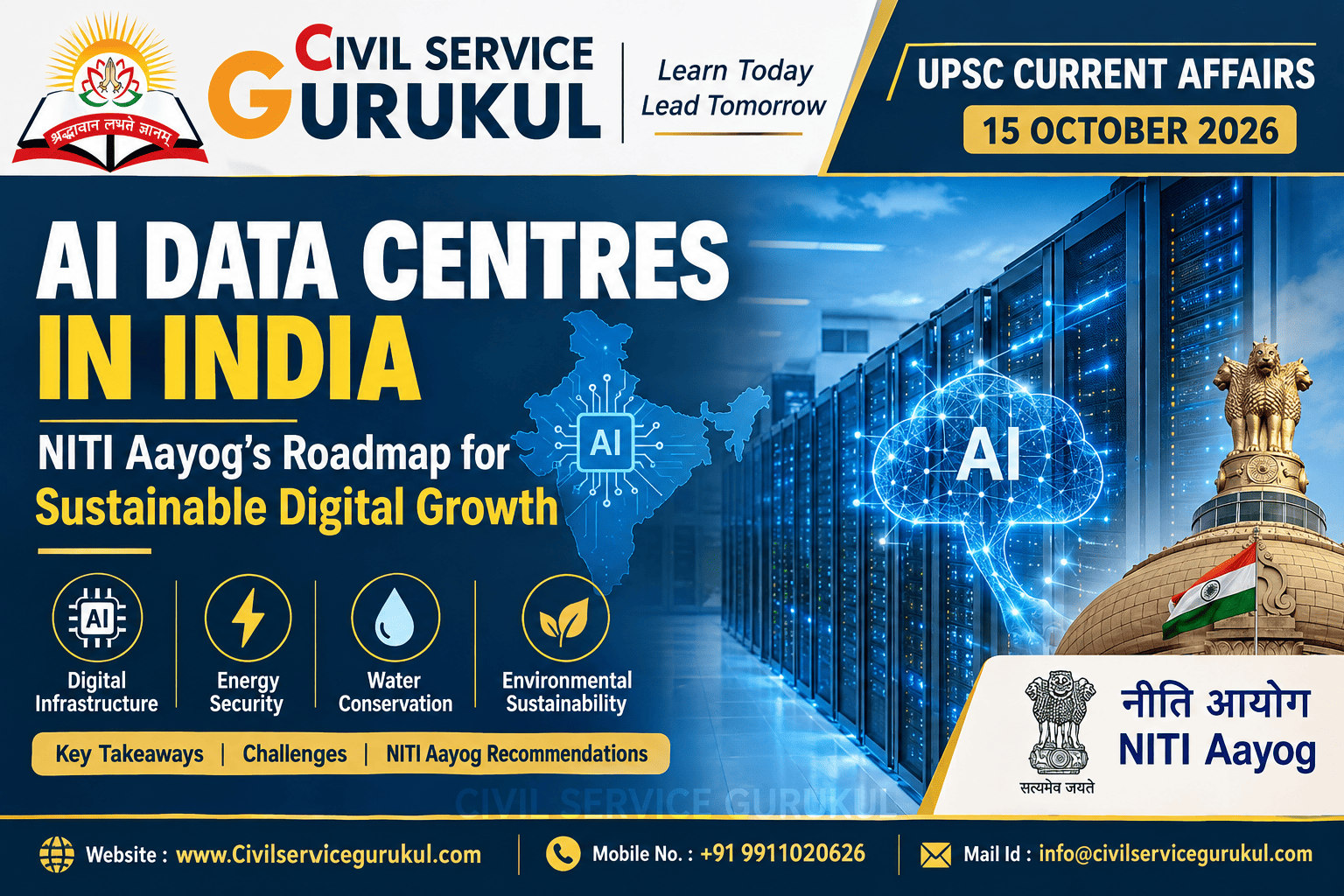
AI Data Centres in India: NITI Aayog’s Roadmap for Sustainable Digital Growth | UPSC GS 3
India’s growing AI data centre industry can strengthen digital infrastructure, innovation and technological self-reliance. However, rising electricity demand, water consumption, emissions and limited direct employment create significant policy challenges. Understand NITI Aayog’s proposed recommendations, sustainable data centre strategies and the relevance of this issue for UPSC GS Paper III.

India–Germany Agreements 2026: 19 Major MoUs, Strategic Partnership and UPSC Analysis
India and Germany strengthened their strategic partnership during German Chancellor Friedrich Merz's official visit to India on 12–13 January 2026. The two countries concluded 19 agreements and MoUs and announced eight additional initiatives covering defence cooperation, critical minerals, semiconductors, green hydrogen, education, skilled migration, and Indo-Pacific security. This UPSC-focused analysis explains the agreements, their strategic significance, implementation challenges, and relevance for India's foreign policy.
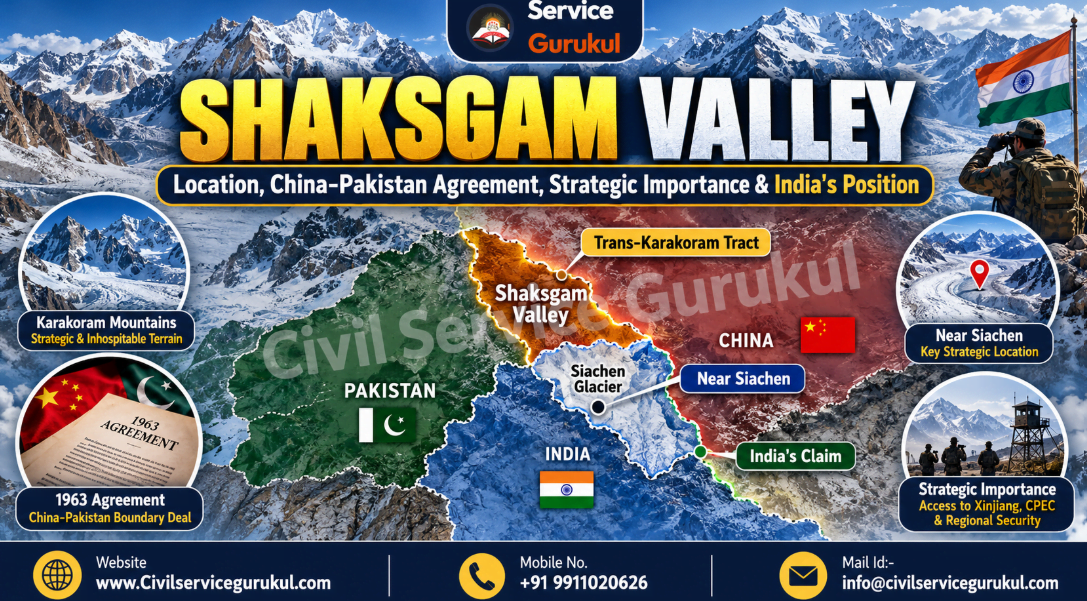
Shaksgam Valley Dispute 2026: Location, China–Pakistan Agreement & UPSC Analysis
Shaksgam Valley, also known as the Trans-Karakoram Tract, is a strategically important region of approximately 5,180 sq. km under Chinese administration but claimed by India. Explore its geography, the disputed 1963 China–Pakistan Boundary Agreement, its proximity to Siachen Glacier, infrastructure concerns and the implications for India's territorial sovereignty.

Diego Garcia 2026: Chagos Islands Dispute, UK–Mauritius Treaty & UPSC Analysis
The UK and Mauritius signed their Chagos Archipelago treaty on 22 May 2025. However, as of 16 October 2026, the treaty has not entered into force. The UK Parliament's House of Commons Library reported on 8 October 2026 that UK ratification had been paused pending discussions with the United States over the future of the military base. Mauritius reiterated its sovereignty claim on 14 October 2026.

Weimar Triangle 2026: France, Germany & Poland, European Security and UPSC Analysis
Established in 1991, the Weimar Triangle connects France, Germany and Poland through an informal diplomatic framework that promotes reconciliation and European integration. Its 35th anniversary in 2026 highlighted renewed cooperation on Ukraine, defence preparedness, economic resilience and European strategic autonomy.

UPI Transaction Fee Rollout Postponed Beyond Deepavali: Why Traders Opposed the 0.4% Merchant Charge
The National Payments Corporation of India (NPCI) has postponed the proposed 0.4% Merchant Discount Rate (MDR) on eligible UPI merchant transactions exceeding ₹2,000 until after Deepavali 2026. Explore the reasons behind the postponement, the role of traders' associations, proposed exemptions, implications for India's digital payment ecosystem and UPSC examination relevance.

PFAS in India: Why Water Treatment Plants Fail | UPSC 2026
Research from IIT Madras has raised concerns about the ability of conventional Indian water treatment systems to remove persistent PFAS, commonly known as forever chemicals. Discover why these pollutants survive treatment, the findings from Chennai and Visakhapatnam, potential health risks, gaps in India's drinking-water standards, and advanced technologies for safer water.
UPSC Current Affairs 16 October 2026: Food Security, India’s UNSC Bid & Prelims Notes
Explore UPSC Current Affairs for 16 October 2026 with concise, exam-oriented notes on India’s food and nutrition security, the 2028–29 UN Security Council bid, Ayurveda research, Ramsar sites, the Kigali Amendment, OCI and Panama mapping. Includes GS paper connections, Prelims revision points and a Mains practice question.